TagStART(508)
-
 2019-04-01
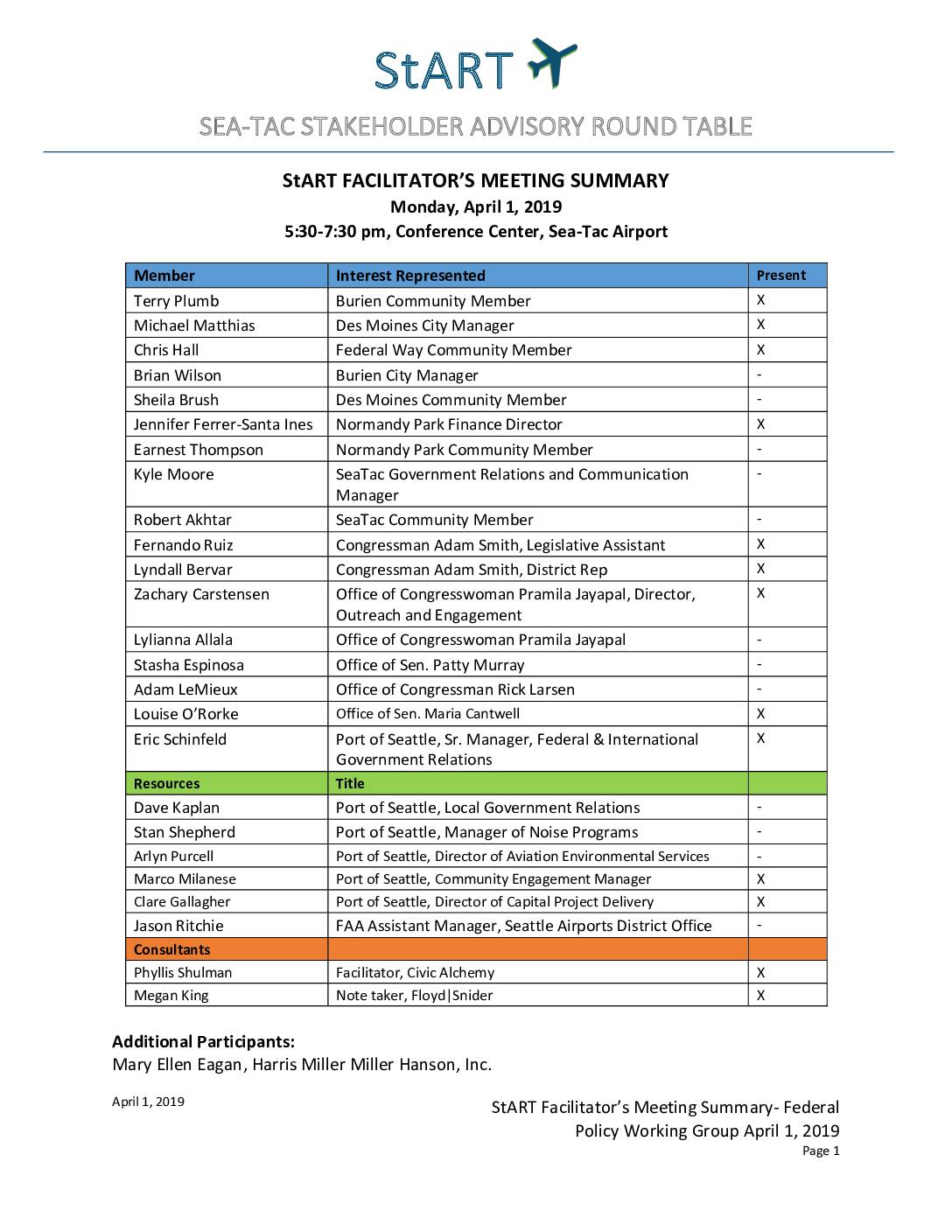
StART facilitator’s meeting summary: Federal Policy Working Group, April 1, 2019
A April 1, 2019 meeting of the Sea-Tac Stakeholder Advisory Round Table (StART) Federal Policy Working Group brought together community members, congressional staff, and Port of Seattle representatives to review noise-related provisions of the FAA Reauthorization Bill, which funds the FAA through 2023. Consultant Mary Ellen Eagan provided an overview of key noise provisions, including updates to noise exposure maps, community noise concerns, and a new grant program for environmental mitigation, while noting that the FAA is unlikely to meet many of the bill's implementation deadlines. Attendees discussed how communities and congressional offices could engage with the FAA to influence its prioritization of noise-related studies and regulatory changes affecting Sea-Tac Airport. -
 2019-03-27
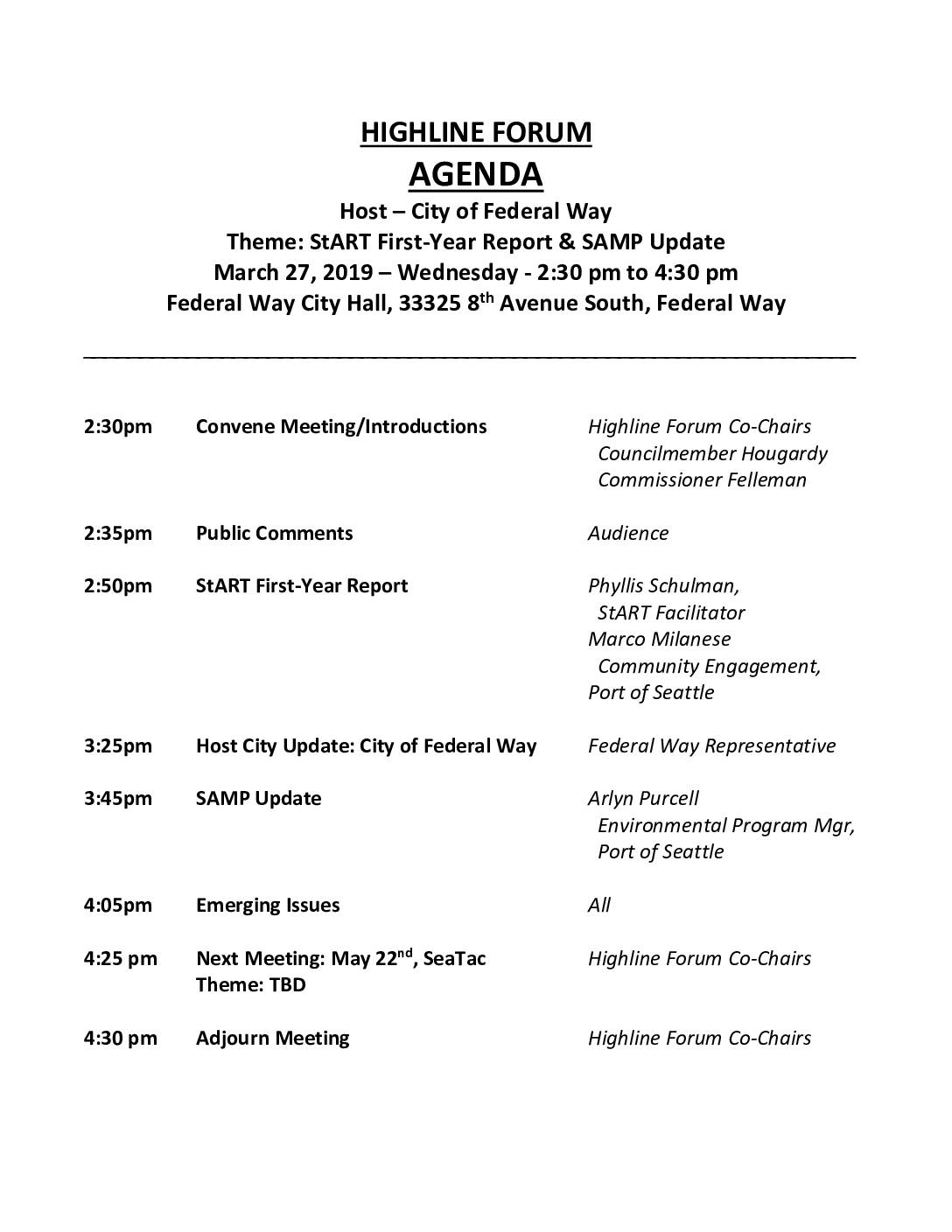
Highline Forum agenda: StART first-year report & SAMP update
The Highline Forum held a meeting on March 27, 2019, at Federal Way City Hall, focused on the StART (Sea-Tac Airport Roundtable) First-Year Report and a SAMP (Sustainable Airport Master Plan) Update, with presentations from Port of Seattle representatives and local officials. The forum serves as a regional body addressing airport-related concerns for communities near Seattle-Tacoma International Airport, including Federal Way, SeaTac, Tukwila, and Des Moines. Additional 2019 meetings were scheduled bimonthly through November at rotating locations across the Highline area. -
 2019-03-25
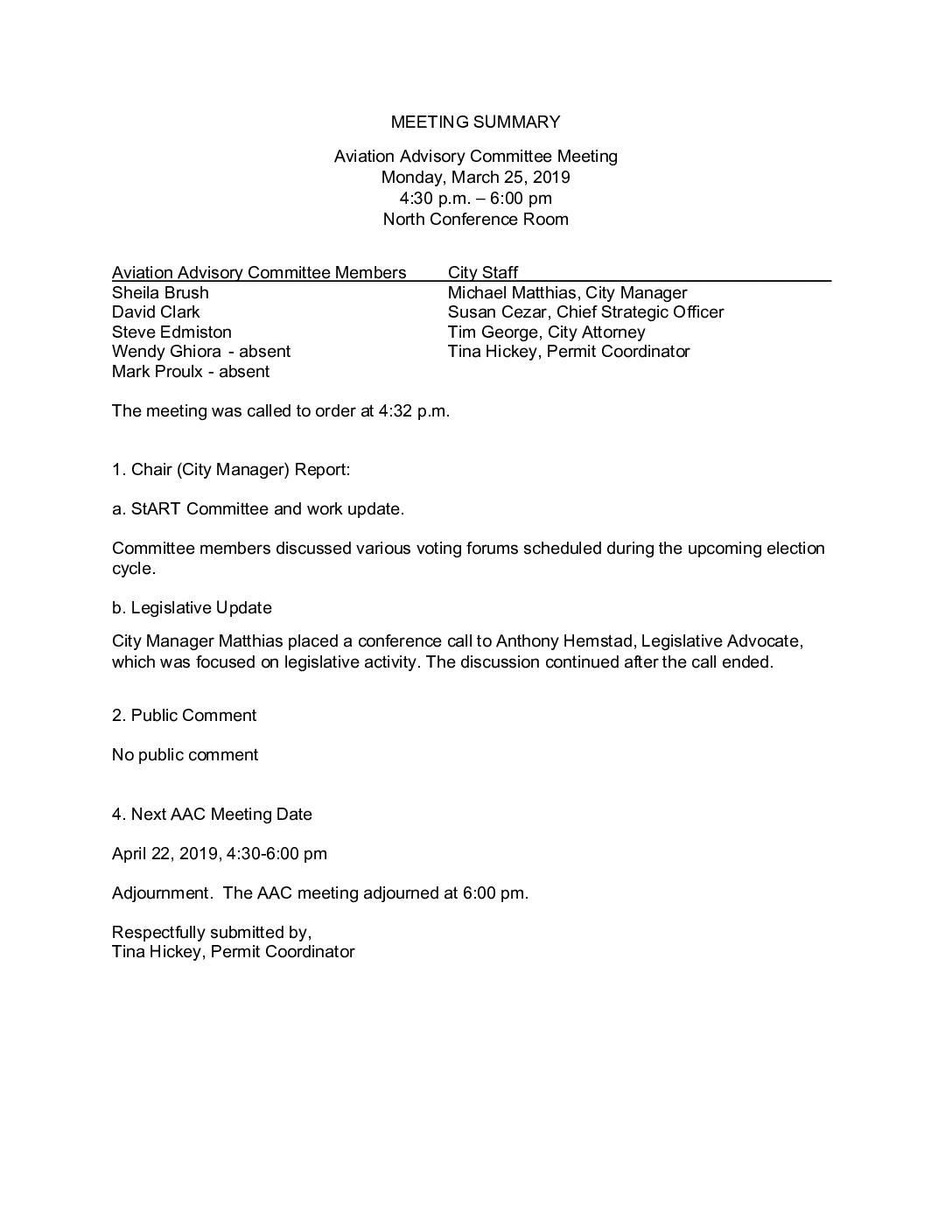
Aviation Advisory Committee Meeting Minutes — March 25, 2019
The Aviation Advisory Committee (AAC) held a meeting on March 25, 2019, where members discussed upcoming election-cycle voting forums related to the StART Committee and received a legislative update via a conference call with Legislative Advocate Anthony Hemstad. The meeting, attended by three committee members and four city staff, including City Manager Michael Matthias, lasted from 4:32 p.m. to 6:00 p.m. with no public comment. The next scheduled AAC meeting was set for April 22, 2019. -
 2019-03-19
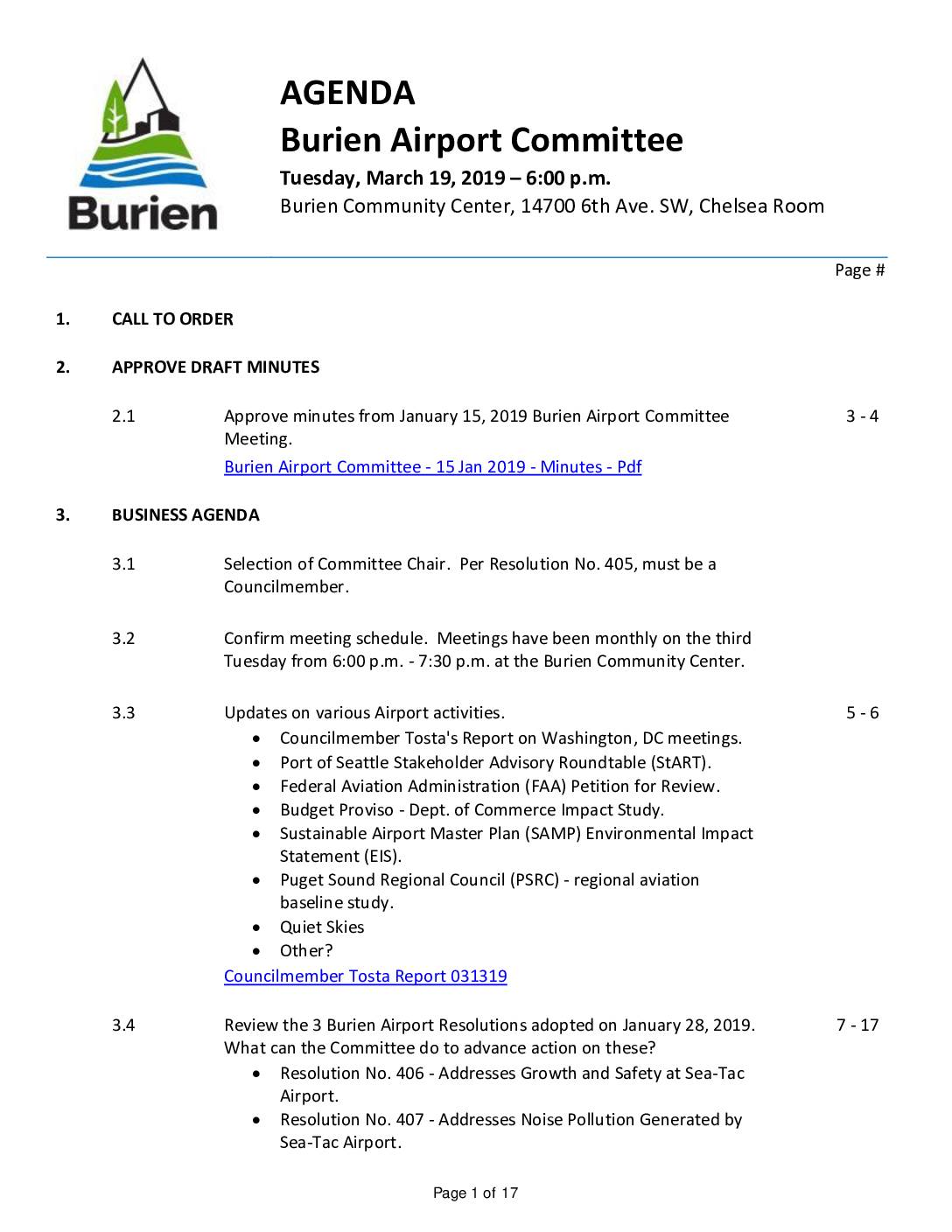
Burien Airport Committee meeting agenda, March 19, 2019
The Burien Airport Committee met on March 19, 2019 to discuss concerns about Sea-Tac Airport's impact on the surrounding community, including noise pollution, safety, and health effects. The agenda included updates on federal and regional aviation policy efforts, and a review of three resolutions adopted by the Burien City Council on January 28, 2019, addressing airport growth, noise pollution, and requests for health impact monitoring. The committee also discussed priorities for 2019 and how to advance action on these resolutions at the local, state, and federal levels. -
 2019-03-11
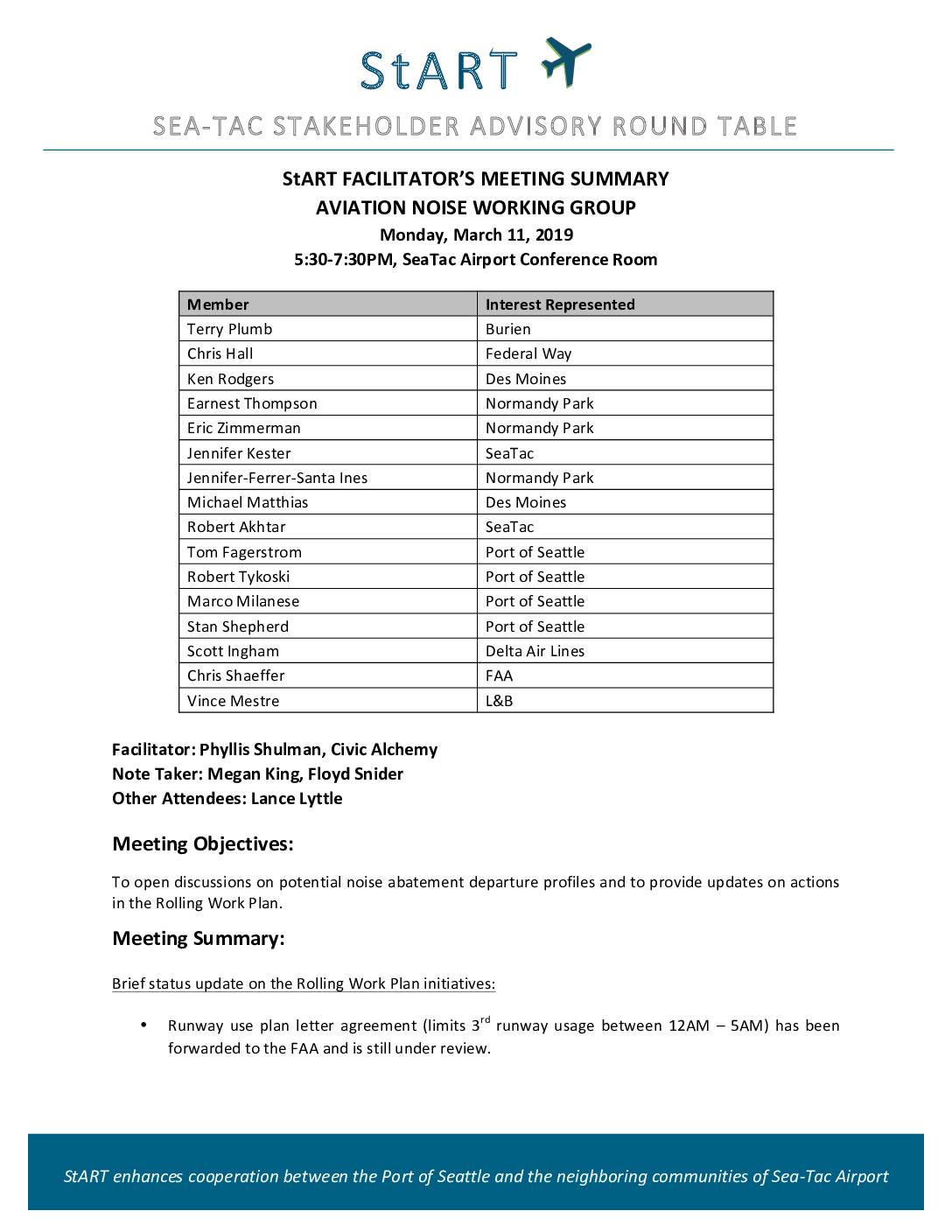
StART facilitator’s meeting summary: Aviation Noise Working Group, March 11, 2019
This document summarizes a March 11, 2019 meeting of the StART Aviation Noise Working Group, which brought together representatives from Sea-Tac Airport neighboring communities, the Port of Seattle, the FAA, and Delta Air Lines. Key topics included an update on the Late-Night Noise Limitation Program, which monitors and reports on the noisiest flights between midnight and 5 AM, and a presentation on Noise Abatement Departure Procedures (NADP), which offer two approaches to reducing aircraft noise either close to or farther from the airport. The group also discussed the limits of enforcement, noting that neither the FAA nor the Port can formally fine airlines for not following noise abatement procedures, as safety always takes priority. -
 2019-03-04
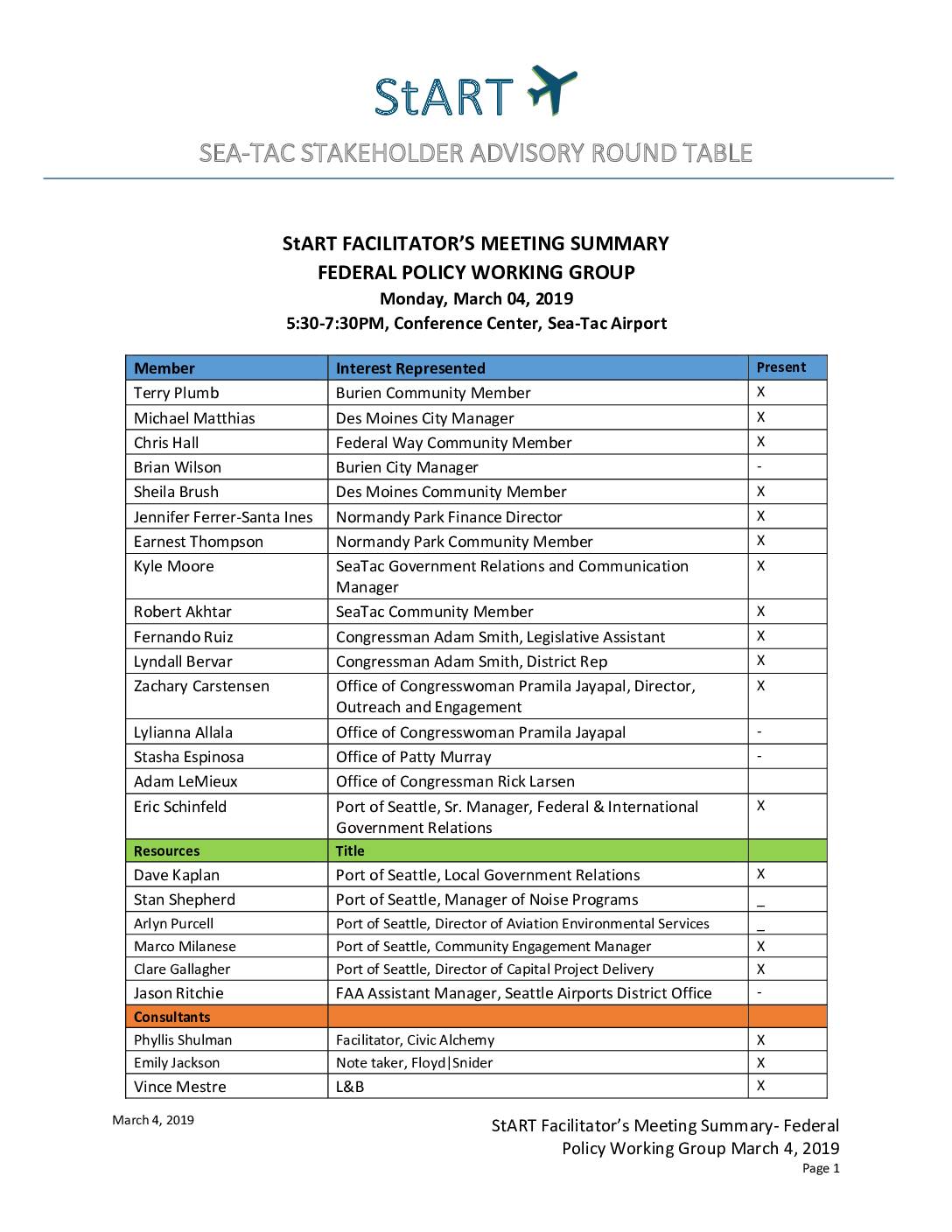
StART facilitator’s meeting summary: Federal Policy Working Group, March 4, 2019
This document summarizes a March 4, 2019 meeting of the StART (Sea-Tac Stakeholder Advisory Round Table) Federal Policy Working Group, which brought together community members, city officials, congressional representatives, and Port of Seattle staff to discuss aviation noise policy. The group reviewed the history of federal noise regulations, including the 1990 Airport Noise and Capacity Act, and debated priorities such as improving noise measurement metrics, expanding funding for noise insulation, and increasing local communities' regulatory control. Key discussions centered on how to influence the FAA Reauthorization Act and support new legislation proposed by Congressman Adam Smith to better address the noise impacts on neighborhoods surrounding Sea-Tac Airport. -
2019-03-01
Priorities
I attended my first StART meeting in a while last night. The first thing I noticed was how ‘official’ it has become. By that I mean, it was sparsely attended, quiet and the attendees were engaged in some very fine-grained the work, mostly on the whole Glide Slope thing. The second half of the meeting -
 2019-03-01
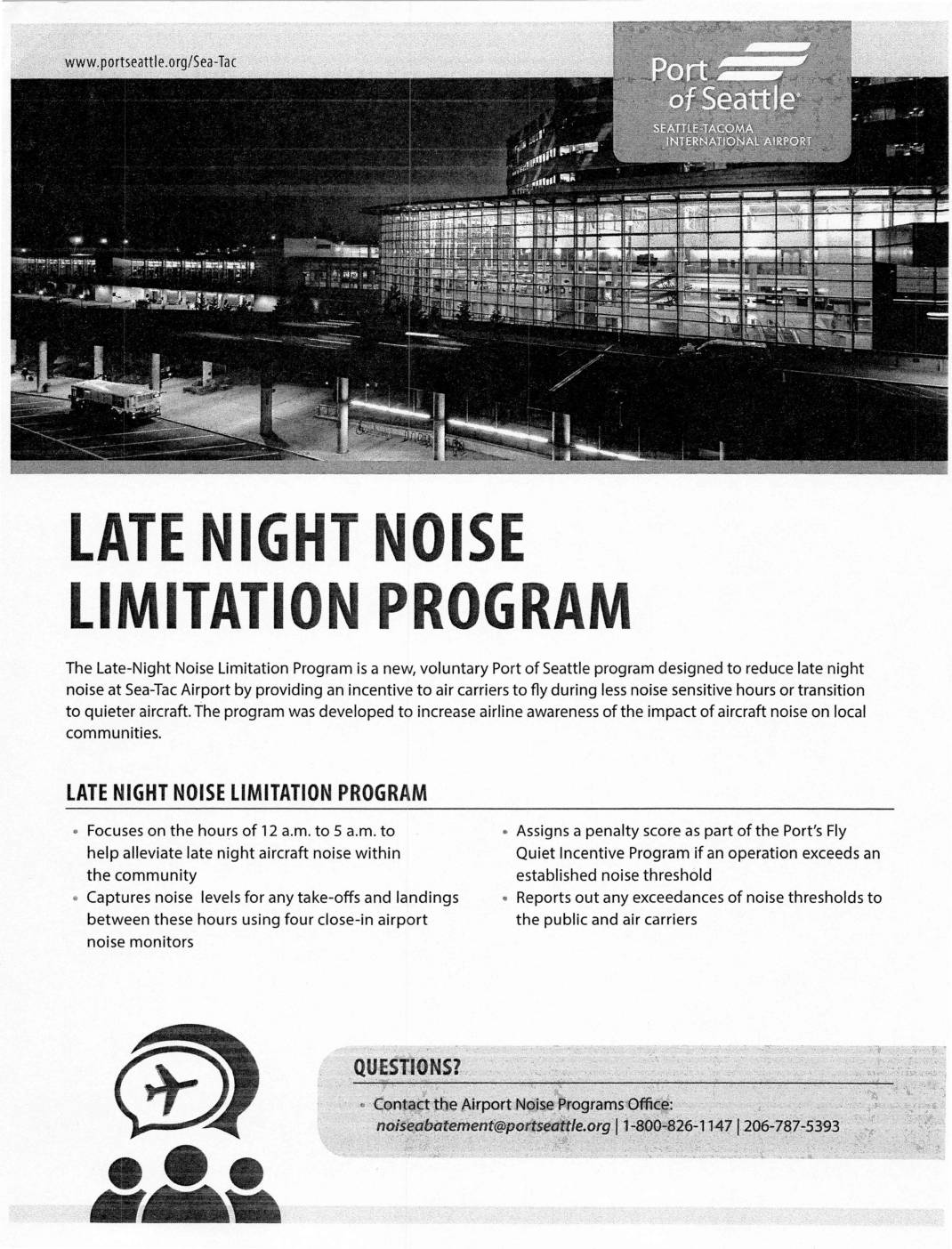
Late Night Noise Limitation Program
The Late-Night Noise Limitation Program is a voluntary Port of Seattle initiative that monitors aircraft noise at Sea-Tac Airport between 12 a.m. and 5 a.m., using four close-in noise monitors to track takeoffs and landings that exceed established thresholds. Airlines that violate these thresholds receive penalty scores under the Port's Fly Quiet Incentive Program, which has evaluated airline noise compliance since 2005. The program, developed in 2019 as an outcome of the Sea-Tac Stakeholder Advisory Round Table (StART), aims to encourage air carriers to schedule flights during less noise-sensitive hours or switch to quieter aircraft. -
 2019-02-27
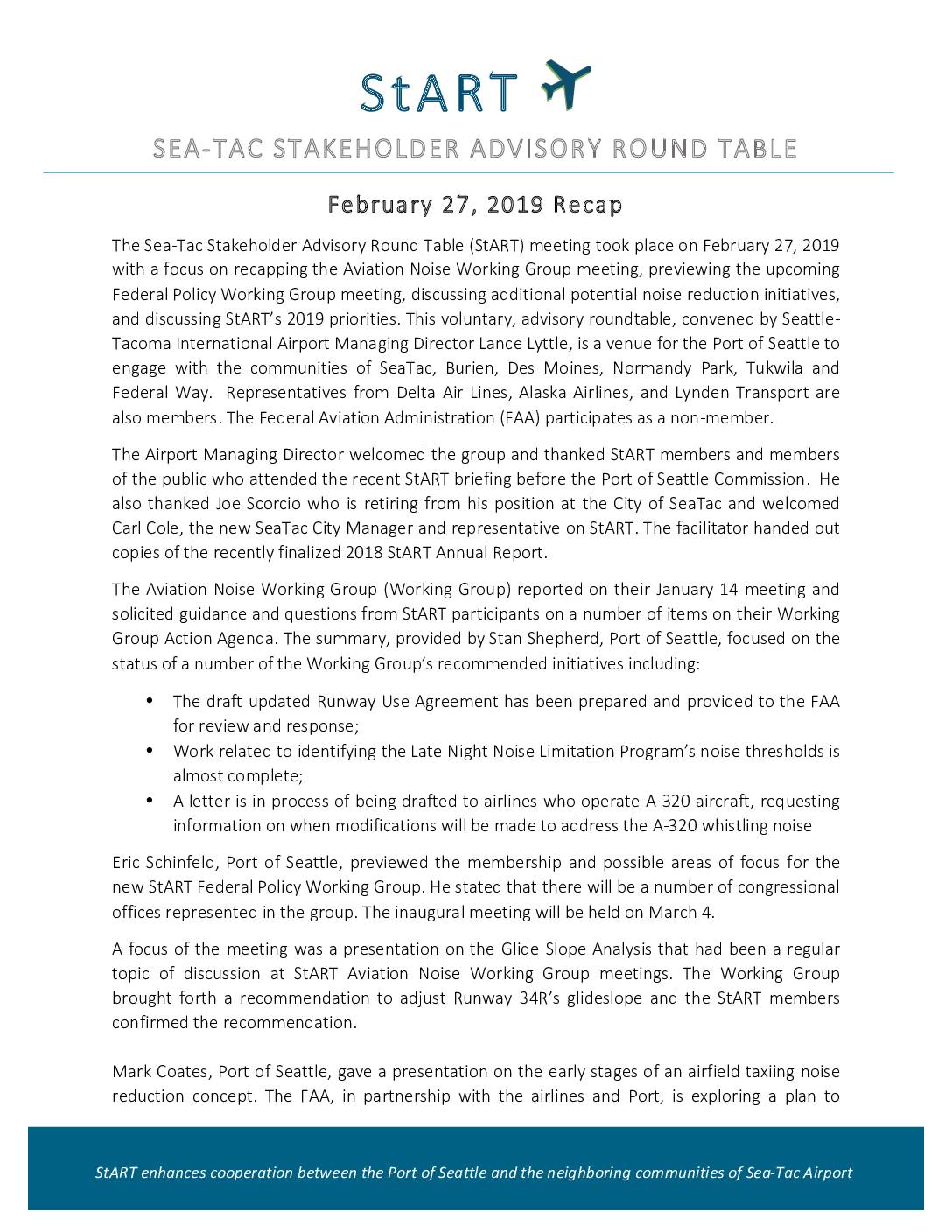
StART Meeting Recap: February 27, 2019
The Sea-Tac Stakeholder Advisory Round Table (StART) met on February 27, 2019 to discuss ongoing efforts to reduce aircraft noise around Seattle-Tacoma International Airport, including a recommended adjustment to Runway 34R's glideslope and a proposed new taxiing approach to minimize engine noise from arriving aircraft. The group also reviewed the status of the Late Night Noise Limitation Program, a draft updated Runway Use Agreement, and efforts to address the A-320 whistling noise issue. Members held small group discussions to identify StART's priorities for 2019, with the next public meeting scheduled for April 24 at the airport's Conference Center. -
 2019-02-27
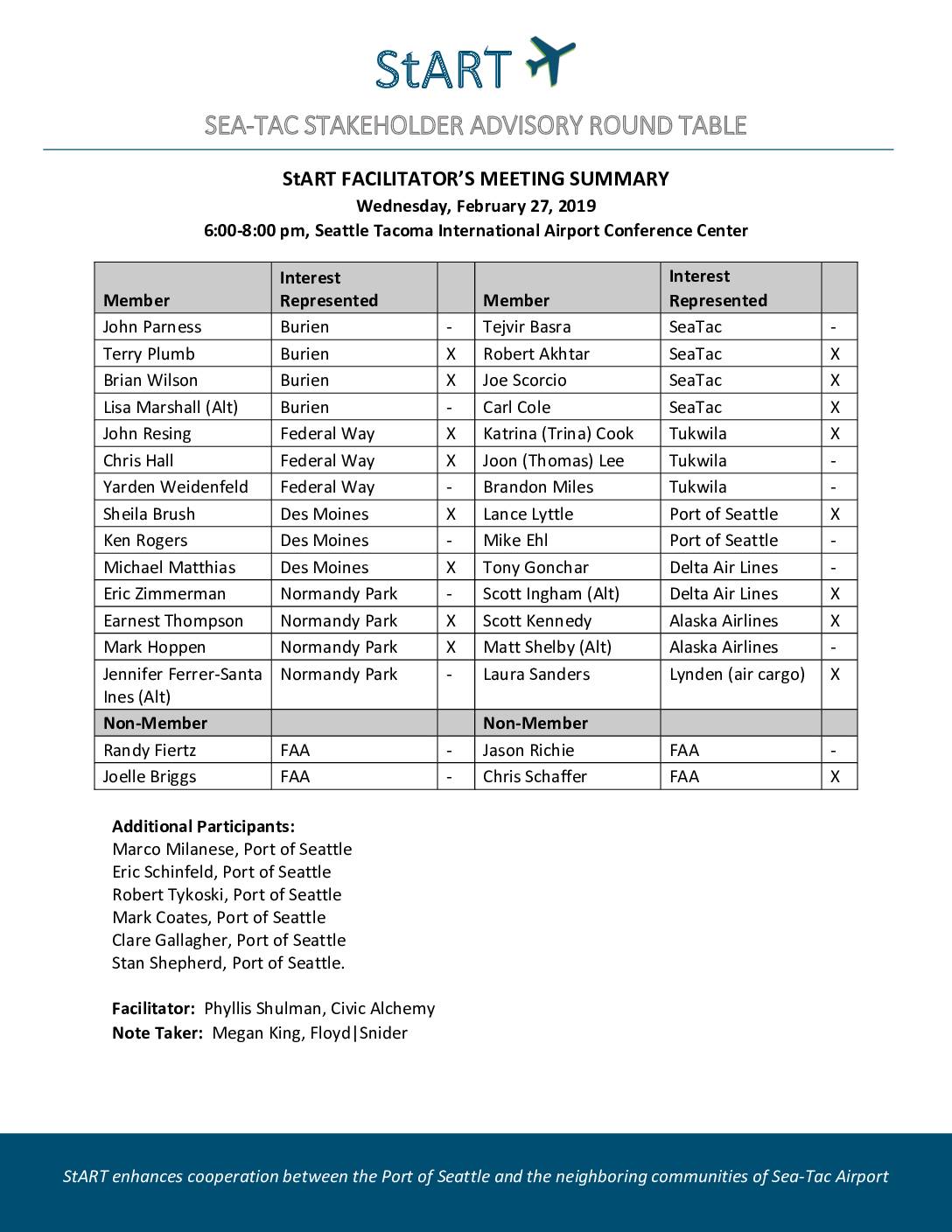
StART facilitator’s meeting summary, February 27, 2019
This document is a facilitator's meeting summary from the Sea-Tac Stakeholder Advisory Round Table (StART) held on February 27, 2019, covering discussions between the Port of Seattle and neighboring communities on airport noise reduction and federal policy. Key topics included updates on a revised Runway Use Agreement, nighttime noise thresholds, the A320 aircraft whistling noise issue, and the formation of a Federal Policy Working Group involving congressional offices. The meeting also featured a presentation on glide slope analysis as a potential noise reduction measure and a discussion of StART's priorities for 2019.