TagFAA(238)
-

FAA Northwest Mountain Regional Office
2200 216th St. Des Moines, WA 98198 FSDO -
FAA Hotline Information System – Unavailable Notice, Aug 2022
Screenshot of FAA Hotline Information System (HNIS) at fhwis.force.com showing system unavailable message, August 25, 2022. Captured as documentation that the FAA noise complaint hotline was offline. -

EPA GHG 1990 2015 2017 Complete Report
Front cover photo credit for cow and digester: Vanguard Renewables. -
EPA GHG 1990 2015 2017 All Annexes
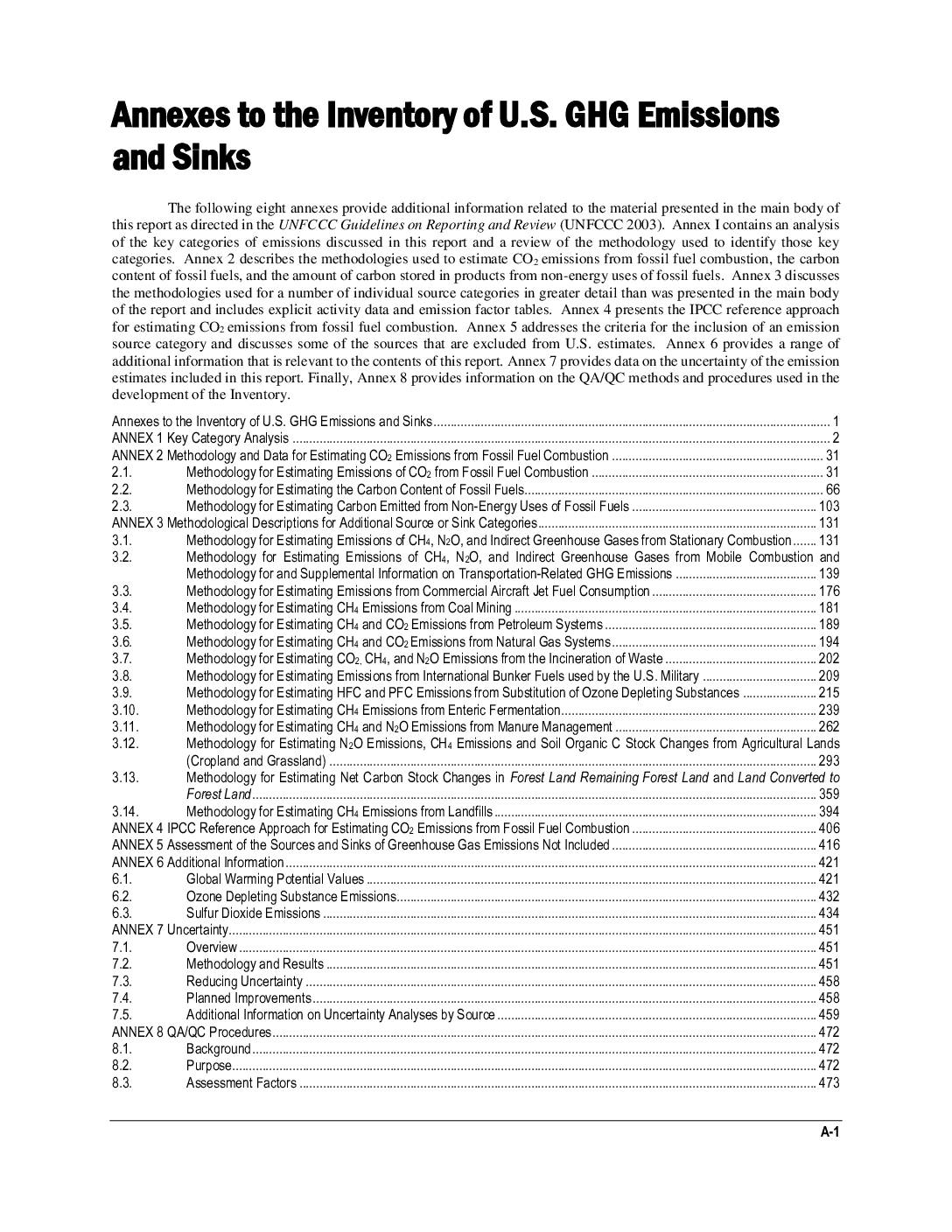
Annexes to the Inventory of U.S. GHG Emissions and Sinks The following eight annexes provide additional information related to the material presented in the main body of this report as directed in the UNFCCC Guidelines on Reporting and Review (UNFCCC 2003). Annex I contains an analysis of the key categories of emissions discussed in this report and a review of the methodology used to identify those key categories. Annex 2 describes the methodologies used to estimate CO2 emissions from fossil fuel combustion, the carbon content of fossil fuels, and the amount of carbon stored in products from non-energy uses of fossil fuels. Annex 3 discusses the methodologies used for a number of individual source categories in greater detail than was presented in the main body of the report and includes explicit activity data and emission factor tables. Annex 4 presents the IPCC reference approach for estimating CO2 emissions from fossil fuel combustion. Annex 5 addresses the criteria for the inclusion of an emission source category and discusses some of the sources that are excluded from U.S. estimates. Annex 6 provides a range of additional information that is relevant to the contents of this report. Annex 7 provides data on the uncertainty of the emission estimates included in this report. Finally, Annex 8 provides information on the QA/QC methods and procedures used in the development of the Inventory. Annexes to the Inventory of U.S. GHG Emissions and Sinks ...................................................................................................................... 1 ANNEX 1 Key Category Analysis ................................................................................................................................................................ 2 ANNEX 2 Methodology and… -
EPA GHG 1990 2015 2017 Fastfacts 2017-08-17 508 0
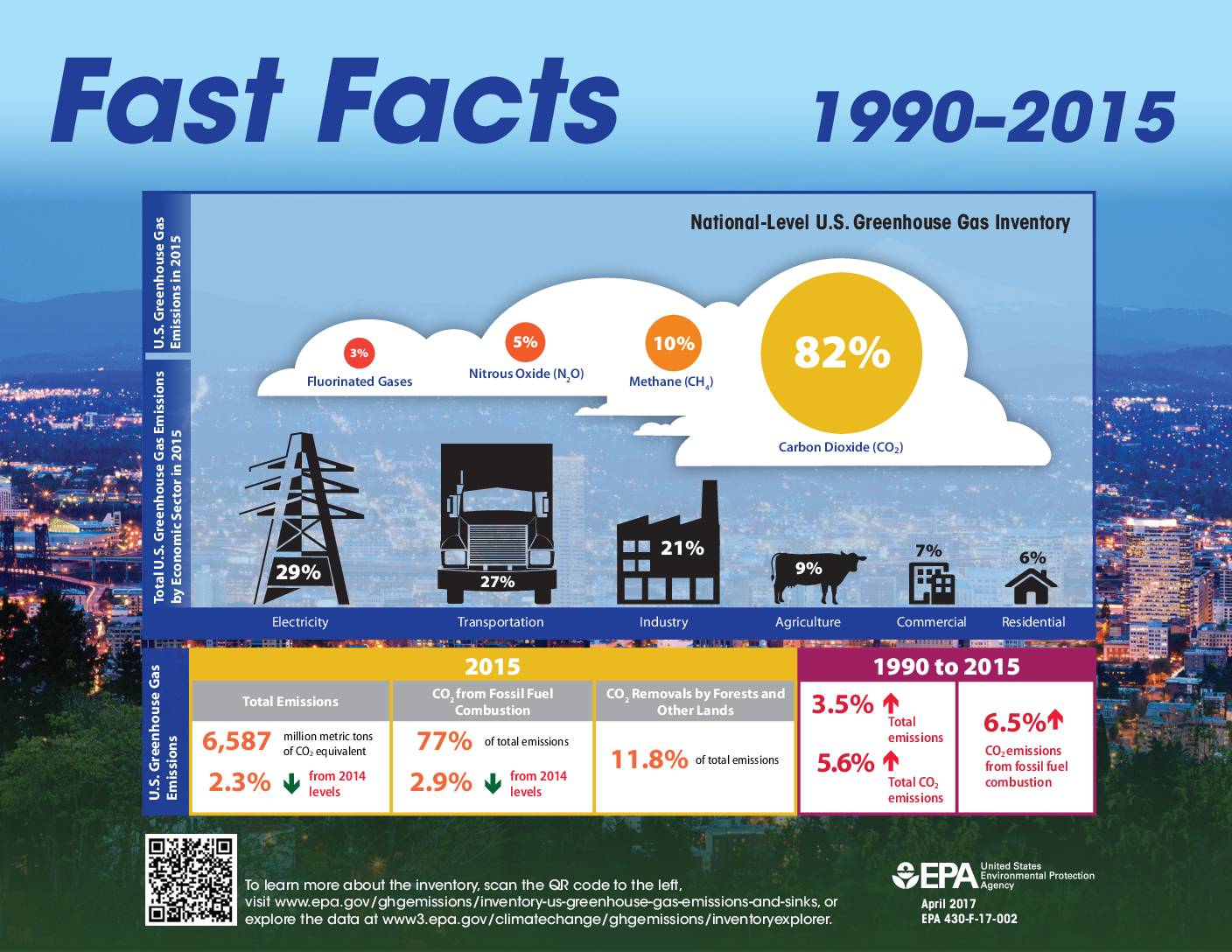
To learn more about the inventory, scan the QR code to the left, visit www.epa.gov/ghgemissions/inventory-us-greenhouse-gas-emissions-and-sinks, or explore the data at www3.epa.gov/climatechange/ghgemissions/inventoryexplorer. 2015 6,587 2.3% million metric tons of CO2 equivalent from 2014 levels 2.9% 77% of total emissions U .S . G re en h u se G as Em is si n s 1990 to 2015 6.5% CO2 emissions from fossil fuel combustion 3.5% Total emissions 5.6% Total CO2 emissions Total Emissions CO2 from Fossil Fuel Combustion CO2 Removals by Forests and Other Lands from 2014 levels 11.8% of total emissions https://www.epa.gov/ghgemissions/inventory-us-greenhouse-gas-emissions-and-sinks https://www3.epa.gov/climatechange/ghgemissions/inventoryexplorer https://www.epa.gov/ghgemissions/inventory-us-greenhouse-gas-emissions-and-sinks Gas/Source 1990 2005 2011 2012 2013 2014 2015 CO2 5,123.0 6,131.8 5,569.5 5,362.1 5,514.0 5,565.5 5,411.4 Fossil Fuel Combustion 4740.3 5746.9 5227.1 5024.6 5156.5 5202.3 5049.8 Electricity Generation 1820.8 2400.9 2157.7 2022.2 2038.1 2038.0 1900.7 Transportationa 1493.8 1887.0 1707.6 1696.8 1713.0 1742.8 1736.4 Industriala 842.5 828.0 775.0 782.9 812.2 806.1 805.5 Residential 338.3 357.8 325.5 282.5 329.7 345.4 319.6 Commerciala 217.4 223.5 220.4 196.7 221.0 228.7 246.2 U.S. Territories 27.6 49.7 40.9 43.5 42.5 41.4 41.4 Non-Energy Use of Fuels 117.6 138.9 109.8 106.7 123.6 119.0 125.5 Iron and Steel Production and Metallurgical Coke Production 101.5 68.0 61.1 55.4 53.3 58.6 48.9 Natural Gas Systems 37.7 30.1 35.7 35.2 38.5 42.4 42.4 Cement Production 33.5 46.2 32.2 35.3 36.4 39.4 39.9 Petrochemical Production 21.3 27.0 26.3 26.5 26.4 26.5 28.1 Lime Production 11.7 14.6 14.0 13.8 14.0 14.2 13.3 Other Process Uses of Carbonates 4.9 6.3 9.3 8.0 10.4 11.8 11.2 Ammonia Production 13.0 9.2… -
FAA Order JO 7110.65Z – Air Traffic Control
This order prescribes air traffic control procedures and phraseology for use by personnel providing air traffic control services. Controllers are required to be familiar with the provisions of this order that pertain to their operational responsibilities and to exercise their best judgment if they encounter situations not covered by it. Effective: May 19, 2022 Change: -
West Virginia v. EPA – Supreme Court Decision, 20-1530
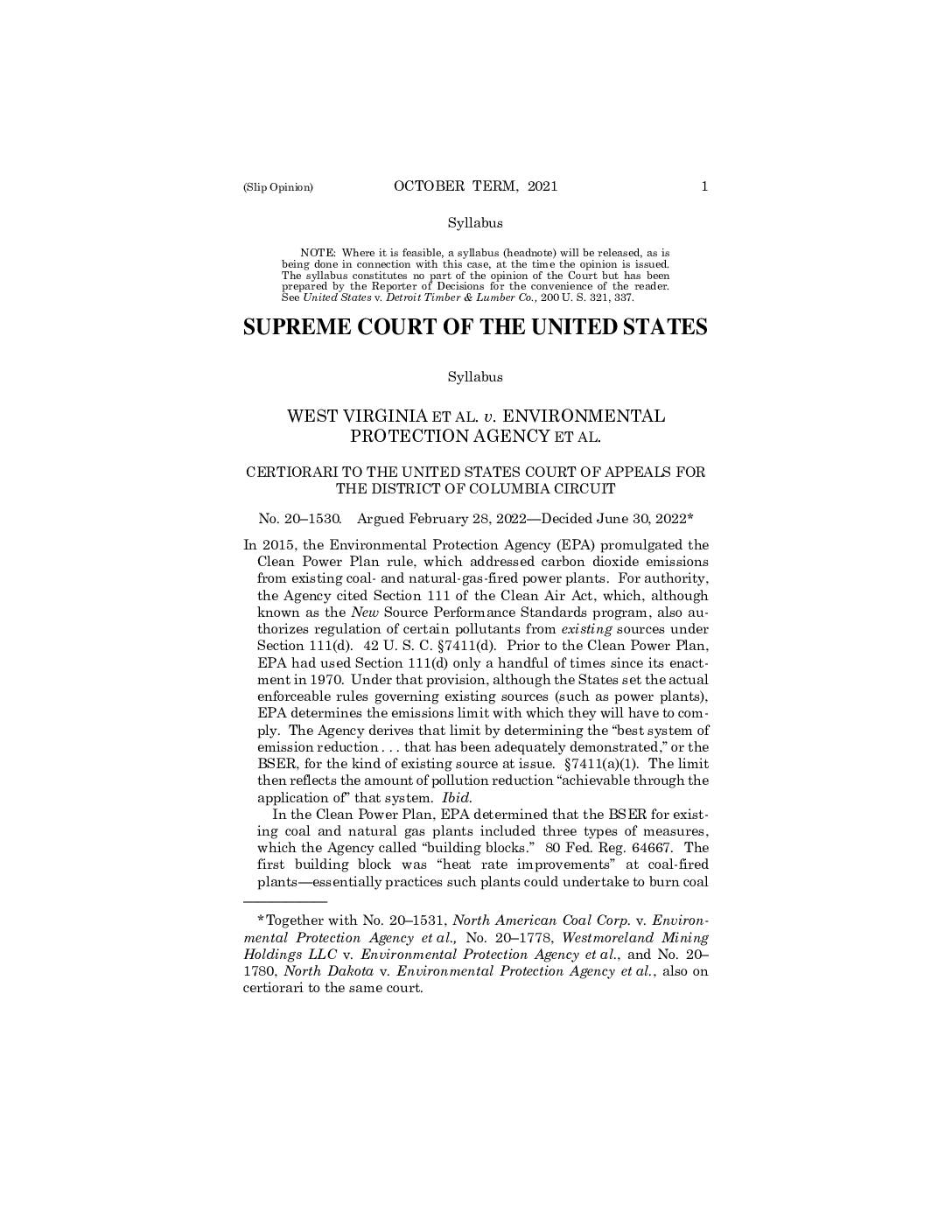
NOTE: Where it is feasible, a syllabus (headnote) will be released, as is being done in connection with this case, at the time the opinion is issued. The syllabus constitutes no part of the opinion of the Court but has been prepared by the Reporter of Decisions for the convenience of the reader. See United States v. Detroit Timber & Lumber Co., 200 U. S. 321, 337. SUPREME COURT OF THE UNITED STATES Syllabus WEST VIRGINIA ET AL. v. ENVIRONMENTAL PROTECTION AGENCY ET AL. CERTIORARI TO THE UNITED STATES COURT OF APPEALS FOR THE DISTRICT OF COLUMBIA CIRCUIT No. 20–1530. Argued February 28, 2022—Decided June 30, 2022* In 2015, the Environmental Protection Agency (EPA) promulgated the Clean Power Plan rule, which addressed carbon dioxide emissions from existing coal- and natural-gas-fired power plants. For authority, the Agency cited Section 111 of the Clean Air Act, which, although known as the New Source Performance Standards program, also au- thorizes regulation of certain pollutants from existing sources under Section 111(d). 42 U. S. C. §7411(d). Prior to the Clean Power Plan, EPA had used Section 111(d) only a handful of times since its enact- ment in 1970. Under that provision, although the States set the actual enforceable rules governing existing sources (such as power plants), EPA determines the emissions limit with which they will have to com- ply. The Agency derives that limit by determining the “best system of emission reduction . . . that has been adequately demonstrated,” or the BSER, for… -
6 Questions about Section 163 (Including ‘Is this Really Good for Airports?’)
FAA is obligated to document whether or not it has regulatory authority over use of airport property. A Section 163 determination involves looking at airport layout plan authority and how land was acquired. Rebecca Kanable Whether it’s a proposed Airport Layout Plan (ALP) change, a change in land use from aeronautical to non-aeronautical, or a -

Lawmakers examine FAA response to aviation noise, say more public outreach is needed
The number of people affected by loud aircraft has declined significantly over the past several decades Lori Aratani March 17, 2022 at 7:08 p.m. EDT A Southwest Airlines jet takes off from BWI Marshall Airport. (Katherine Frey/The Washington Post) Federal Aviation Administration officials told lawmakers Thursday that they have improved efforts to work with communities -
 2021-06-29 19:28
Cutting Through All the Noise
How the FAA is Working to Reduce the Impact of Aircraft Noise FAA Safety Briefing By Tom Hoffmann, FAA Safety Briefing Managing Editor Growing up in a neighborhood just over a mile north of JFK Airport’s Runway 22R/L, I know a thing or two about aircraft noise. We’re talking about the mid-1970s too, when 707s,