TagThird Runway(157)
-
 1994-10-27 00:00
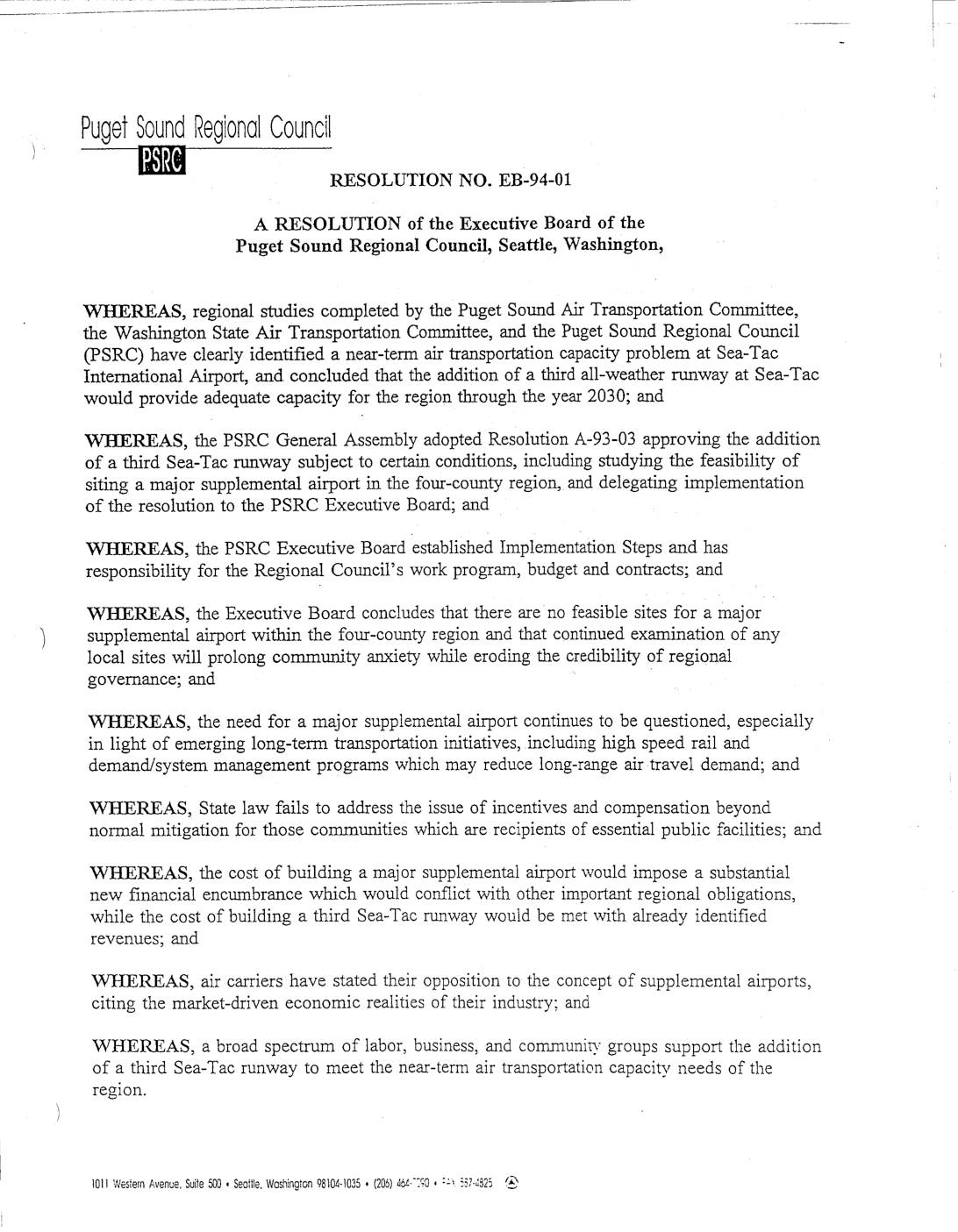
PSRC Resolution EB-94-01
A RESOLUTION of the Executive Board of the Puget Sound Regional Council, Seattle, Washington, WHEREAS, regional studies completed by the Puget Sound Air Transportation Committee, the Washington State Air Transportation Cormnittee, and the Puget Sound Regional Council (PSRC) have clearly identified a near-term air transportation capacity problem at Sea-Tac International Airport, and concluded that the addition of a third all-weather runway at Sea-Tac would provide adequate capacity for the region through the year 2030; and WHEREAS, the PSRC General Assembly adopted Resolution A-93-03 approving the addition of a third Sea-Tac runway subject to certain conditions, including studying the feasibility of siting a major supplemental airport in the four-county region, and delegating implementation of the resolution to the PSRC Executive Board; and WHEREAS, the PSRC Executive Board established Implementation Steps and has responsibility for the Regional Council's work program, budget and contracts; and WHEREAS, the Executive Board concludes that there are no feasible sites for a major ) supplemental airport within the four-county region and that continued examination of any local sites will prolong community anxiety while eroding the credibility of regional governance; and WHEREAS, the need for a major supplemental airport continues to be questioned, especially in light of emerging long-term transportation initiatives, including high speed rail and demand/system management programs which may reduce long-range air travel demand; and WHEREAS, State law fails to address the issue of incentives and compensation beyond norrnal mitigation for those cornunities which are recipients of essential public facilities; and WHEREAS, the cost of building… -
 1993-12-22 00:00
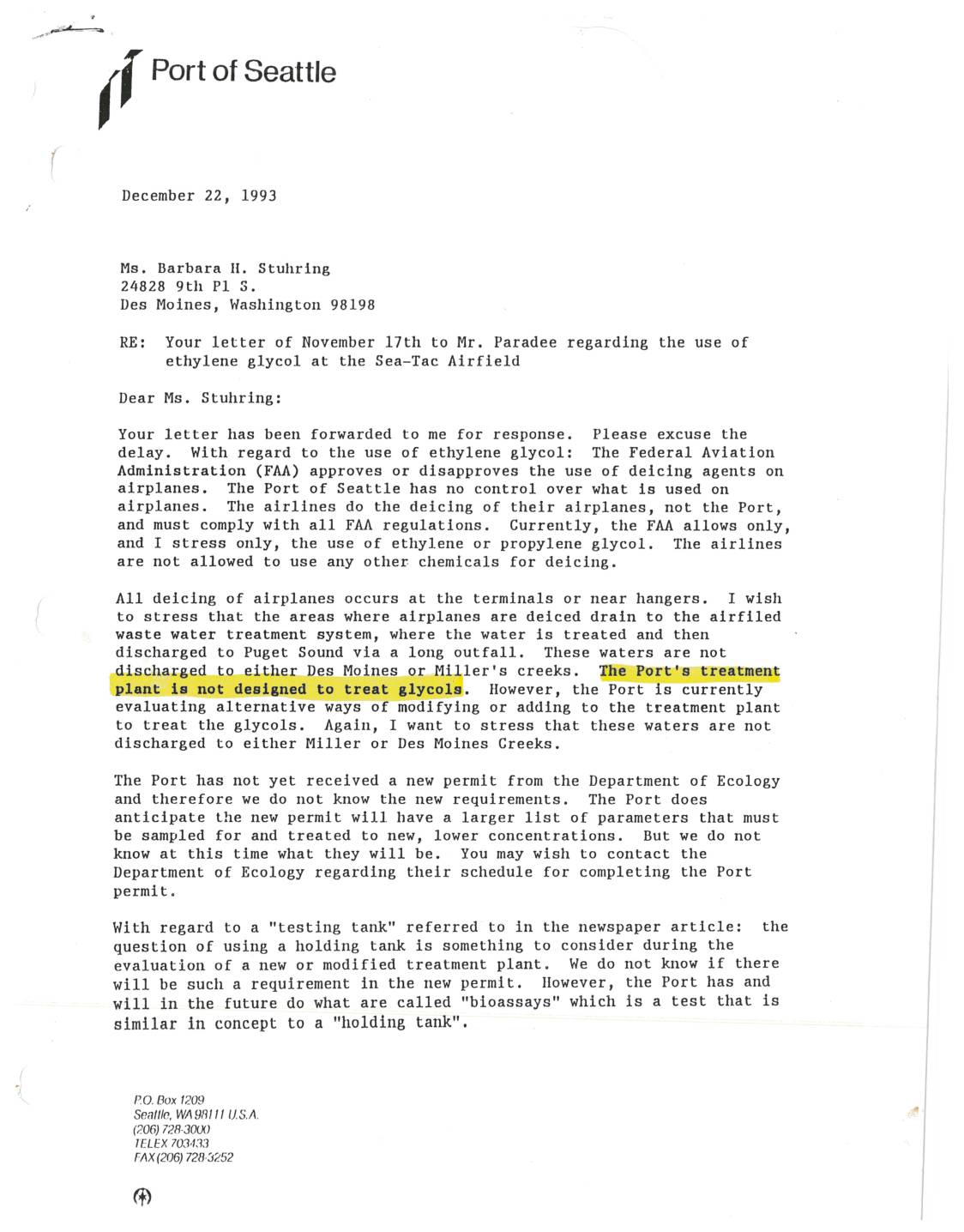
Letter to Barbara Stuhring re Deicing Ethylene Glycol water treatment
RE: Your letter of November 17th to Mr. Paradee regarding the use of ethylene glycol at the Sea-Tac Airfield Dear Ms. Stuhring: Your letter has been forwarded to me for response. Please excuse the delay. With regard to the use of ethylene glycol: The Federal Aviation Administration (FAA) approves or disapproves the use of deicing agents on airplanes. The Port of Seattle has no control over what is used on airplanes. The airlines do the deicing of their airplanes, not the Port, and must comply with all FAA regulations. Currently, the FAA allows only, and I stress only, the use of ethylene or propylene glycol. The airlines are not allowed to use any other chemicals for deicing. All deicing of airplanes occurs at the terminals or near hangers. I wish to stress that the areas where airplanes are deiced drain to the airfiled waste water treatment system, where the water is treated and then discharged to Puget Sound via a long outfall. These waters are not discharged to either Des Moines or Miller's creeks. The Port's rea~ment plant is not designed to treat glycols. However, the Port is currently evaluating alternative ways of modifying or adding to the treatment plant to treat the glycols. Again, I want to stress that these waters are not discharged to either Miller or Des Moines Greeks. The Port has not yet received a new permit from the Department of Ecology and therefore we do not know the new requirements. The Port does anticipate the… -
1993-04-05 15:14
Airport Communities Coalition (ACC)
The cities of Burien, Tukwila, Des Moines, and Normandy Park formed the Airport Communities Coalition in 1993 to stopped the proposed construction of the third runway. The coalition was eventually expanded to include the Highline School District and the City of Federal Way. The group used lawsuits and appeals to contest studies and permits. The -
 1993-04-01 00:00
Cutler & Stanfield Report on Legal Issues to ACC April 1993
TRODUcrioN . . . . . . . . . . . . . . . . . . . . . . . . . . . . . . . . . . . . . . . . . .N ACKGROUND . . . . . . . . . . . . . . . . . . . . . . . . . . . . . . . . . . . . . . . . . . .B . Ownership and Control of Seattle-Tacoma International Airport . . . . . Airport Facilities and Setting . . . . . . . . . . . . . . . . . . . . . . . . A B 1. Existing Facilities . . . . . . . . . . . . . . . . . . . . . • • • • @ • • • e • • 2. Planned Improvements to Land-Side Facilities . • • • • • • e • • • • • • • • • • • • • • • • • e + 3. Use Restrictions and Noise Abatement Procedures . • • • • @ • • • 5. Part 150 Noise Compatibility Program . . . . . . . . . . . . . . . . . Identification of Need for Additional Airport Capacity . . . . . .… -
 1992-10-08 02:11
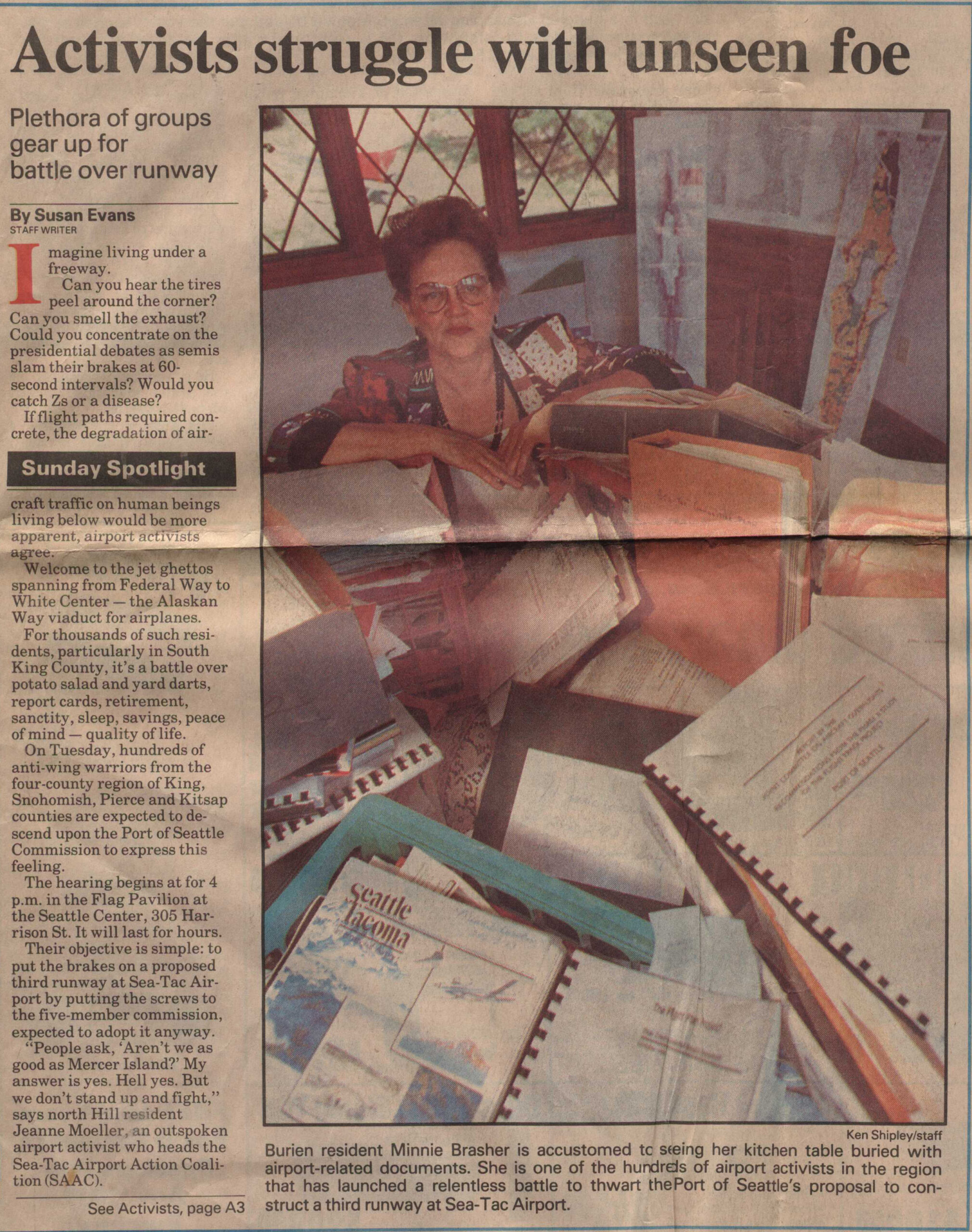
Activists struggle with unseen foe
-
 1992-10-05 00:00
Hansen & Sanders – Adverse Health Impacts of Airport Expansion (Sea-Tac), October 5, 1992
From the Health Subcommittee of the Environmental Impact Committee of the Regional Coalition on Airport Affairs Prepared by : D. Dennis Hansen, M. D. Lee A. Sanders M. D. , Ph. D. With assistance from Mark Bened llm ( Associate Administrator Highline Hospital) Rose Clark (Concerned local citizen) 10/5/92 - P SUWARY OF ADVERSE HEALTH EFFECTS OF AIRPORTS Fiction : Airport noise is a minor annoyance and people living near the airport should be 'lgood sports" and learn to ignore it Fact : Airport noise results in a significant increase in community use of tranquil i z ers and sleeping pills . Airport communities have an increased rate of alcoholism , and admissions to psychiatric hospitals . Airport-related noise can literally drive people mad. II li I1 I1 I1 I1 I1 I1 I1 I1 I1 I1 I1 I1 I1 I1 I1 I1 I1 1 Fiction : Communities near the airport offer affordable housing and would be suitable for young families. Fact : Infants born to mothers living under the flight path have lower birth weights and higher likelihood of prematurity. There is some experimental evidence to suggest that serious birth defects are more likely when the mother is exposed to high noise levels during pregnancy. Airport communities are unsafe for pregnant women and their children II II II II II tIll I II II II II II II II II II II II II Fiction : Although it is annoying, airport noise will not affect your physical health . Fact… -
 1992-04-24 00:00
HB 2609-S.SL 1992 Air Transportation System–Runway Construction Moratorium and Studies
Passed by the House March 10, 1992 Yeas 97 Nays 0 JOE KING Speaker of the House of Representatives Passed by the Senate March 10, 1992 Yeas 42 Nays 5 CERTIFICATE I, Alan Thompson, Chief Clerk of the House of Representatives of the State of Washington, do hereby certify that the attached is ENGROSSED SUBSTITUTE HOUSE BILL 2609 as passed by the House of Representatives and the Senate on the dates hereon set forth. JOEL PRITCHARD President of the Senate ALAN THOMPSON Chief Clerk Approved April 2, 1992 FILED April 2, 1992 - 11:19 a.m. BOOTH GARDNER Governor of the State of Washington Secretary of State State of Washington _______________________________________________ ENGROSSED SUBSTITUTE HOUSE BILL 2609 _______________________________________________ AS AMENDED BY THE SENATE Passed Legislature - 1992 Regular Session State of Washington 52nd Legislature 1992 Regular Session By House Committee on Transportation (originally sponsored by Representatives Hine, G. Fisher, R. Fisher, Brough, Heavey, Locke, Chandler, Leonard, Valle, Wood, Prentice, Hochstatter, Mitchell, Horn, Rasmussen, Paris, R. King, Beck, Spanel, Nelson, Appelwick, Wilson, Franklin, Wang, Jacobsen and Belcher) Read first time 02/11/92. AN ACT Relating to air transportation; amending RCW 47.86.030;1 adding a new section to chapter 53.08 RCW; creating a new section; and2 declaring an emergency.3 BE IT ENACTED BY THE LEGISLATURE OF THE STATE OF WASHINGTON:4 NEW SECTION. Sec. 1. The legislature finds that an integrated5 air transportation system with efficient intermodal linkages is vital6 to the economic and social vitality of the state. Coordination and7 cooperation among public agencies and between…