Skip to content
  • STNI
  • Statistics
    • Ops and Passengers
      • King County International Airport (Boeing Field) Annual Operations
    • Financials
    • Aviation fuel uplift in the State of Washington 2018 – 2025
      • Aviation Fuel Tax Revenue in the State of Washington 1983-2025
      • Aviation Fuel Uplift at Sea-Tac Airport
    • Air Quality Monitoring
    • Flight Tracking
      • Flow and Flight Tracks
      • Five Year Comparison
      • Busiest Hours and Days
    • SEL Noise Reports & Graphs
      • About The Permanent Noise Monitors
      • Minutes of Quiet by Noise Monitor
      • Noise Events mapped
      • Noise Events (SEL)
    • Runways
    • Employees
    • Real Estate
      • Port Properties and Trees mapped
    • Parking
  • Events
  • Protest
    • Regular Events
    • Legislation 2026
    • Complain about a particular flight
    • Advocacy Organizations
    • Media Outlets
    • People
    • The Port of Seattle
      • Commission Meetings
      • Public Records Requests
      • StART
      • Highline Forum
    • Contact Your Electeds
  • Resources
    • FAQs
      • FAA Occurrences/Accidents/Indents
    • The SAMP
      • SAMP Public Comment Template
        • Two versions of Appendix K: NEPA/SEPA 2018 vs 2023
      • SAMP NTP: 31 projects by the numbers
      • SEPA Draft EIS (2026)
      • SAMP Record of Decision/FONSI (2025)
      • SAMP Draft EA (October 2024)
      • 2018 Scoping
    • Port Packages
      • Port Package Property Costs
      • Port Packages mapped
      • The Port Package Explainer
      • So you want a (first-time) Port Package? Start here
      • Port Package Looker Upper
      • How do I determine if I have a Port Package or Avigation Easement?
      • Progress on Port Package Update legislation
      • Having a Port Package Problem?
      • Port Package Site Visit Follow-Up
    • Document Library
    • Explainers
      • The Airport Law Cheat Sheet
      • The Grant Explainer
    • External Articles
    • History
      • Timeline
      • The Sea-Tac Communities Plan
        • Sea-Tac Communities Plan – Planning Maps
      • PSRC Third Runway Decision Process
    • Studies
    • Videos
  • Stories
  • Mission
  • Subscribe
  • Contact
Scroll down to content

Get InformedStay Informedx

I understand that you will never share my information with anyone, you will only use it to keep me updated on relevant events and that I may unsubscribe at any time.

STNI

STNISea-Tac Noise.Info

  • Solve for Sea-Tac. Solve for every airport.
  • Since 2016, working to obtain justice for everyone living under the flight path.
  • Less Noise. Cleaner Air. Better Public Health. Compensation.
  • Everything you think you know about the airport is wrong.

TagRegional Transportation Plan(40)

Advanced Search Options

  • Dates
  • Media
    • External Articles
    • Images
    • PDFs
    • Video
    • Audio
  • Order By
  • 2022-09-01

    Destination 2030: Chapter 6 – Finance

    Destination 2030 is a regional transportation financial plan for the Puget Sound area that outlines funding principles and strategies for meeting local, state, and regional transportation needs through 2030. The plan acknowledges that rising infrastructure costs, insufficient public revenues, and a growing maintenance backlog require new and enhanced funding sources beyond traditional tax bases such as motor fuel and vehicle sales. It recommends use-based financing, multi-modal investment support, and the creation of a regionally managed transportation fund to better coordinate planning, prioritization, and implementation of transportation improvements.
    Tagslocal government funding, non-aviation transportation, PSRC, Puget Sound Regional Council, Regional Transportation PlanFolderDestination 2030 CD
  • 2022-09-01

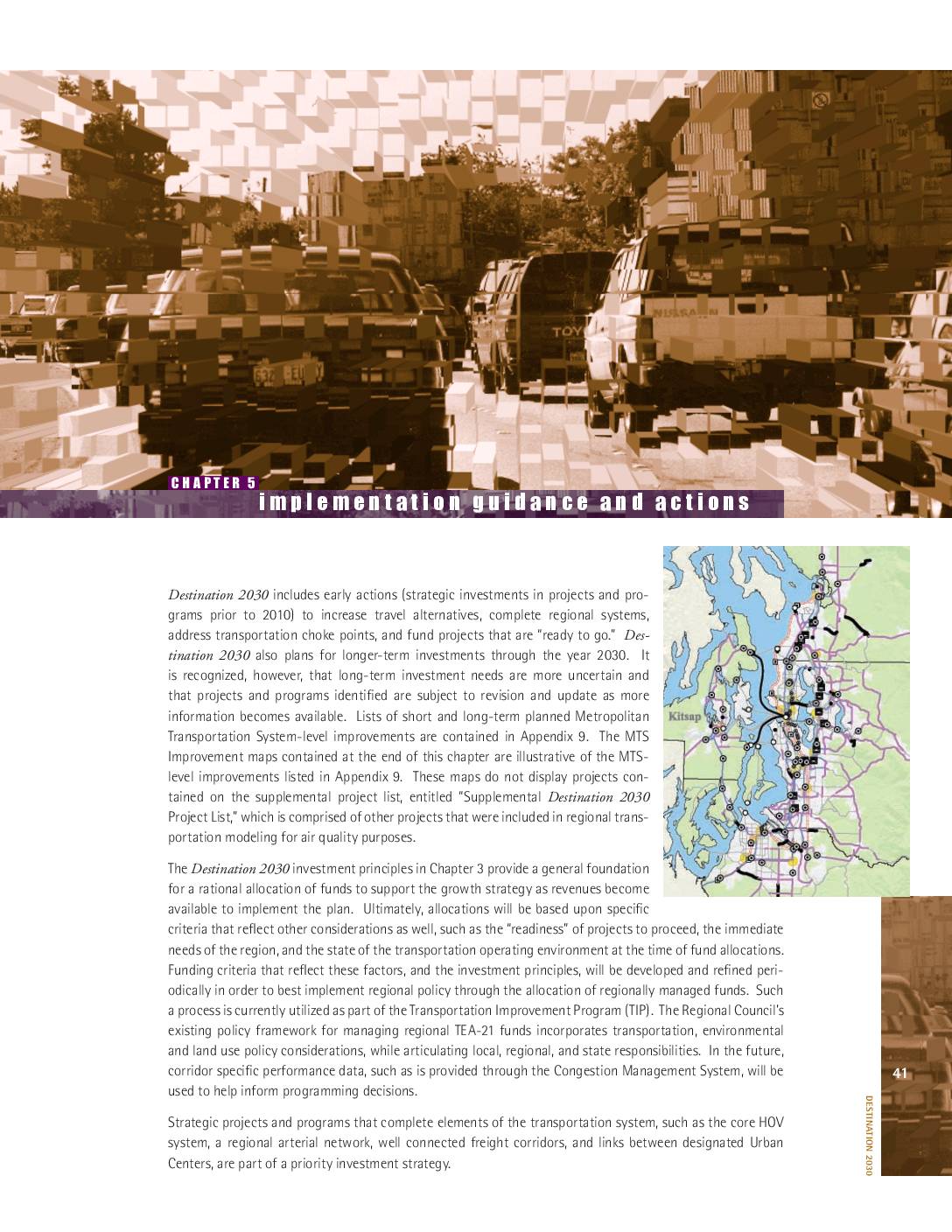
    Destination 2030: Implementation guidance and actions

    Destination 2030 is a long-term regional transportation plan for the greater Seattle area that outlines both short-term investments (prior to 2010) and longer-term improvements through 2030, focusing on roadway expansions, HOV lane completions, freight network connections, and reduced traffic congestion. The plan prioritizes safety, maintenance, and optimization of existing roads before pursuing new capacity projects, while also emphasizing travel alternatives and pedestrian and bicycle improvements. Fund allocations are guided by project readiness, regional need, and consistency with local growth management policies.
    Tagsnon-aviation transportation, PSRC, Puget Sound Regional Council, Regional Transportation Plan, WSDOTFolderDestination 2030 CD
  • 2022-09-01

    Destination 2030: Linking land use and transportation

    Destination 2030 is a regional growth and transportation plan for the Seattle metropolitan area that focuses on linking land use decisions with transportation investments. It outlines strategies for directing housing and employment growth into compact urban centers where walking, biking, and transit use are more practical, while also providing physical design guidelines and development tools to support that vision. The plan emphasizes coordinating infrastructure spending with growth management goals to build more connected, pedestrian-friendly communities across the region.
    TagsLand Use, PSRC, Puget Sound Regional Council, Regional Transportation Plan, transportationFolderDestination 2030 CD
  • 2022-09-01

    Destination 2030: Investment strategy

    The Destination 2030 plan outlines a long-range transportation investment strategy for the central Puget Sound region, prioritizing maintenance and preservation of existing infrastructure while expanding multimodal travel options. Key investment principles include completing gaps in regional transportation systems, linking spending to measurable outcomes, and supporting compact urban development connected by efficient transit.
    Tagsnon-aviation transportation, PSRC, Puget Sound Regional Council, Regional Transportation Plan, transportationFolderDestination 2030 CD
  • 2022-09-01

    Destination 2030: Metropolitan Transportation Plan background

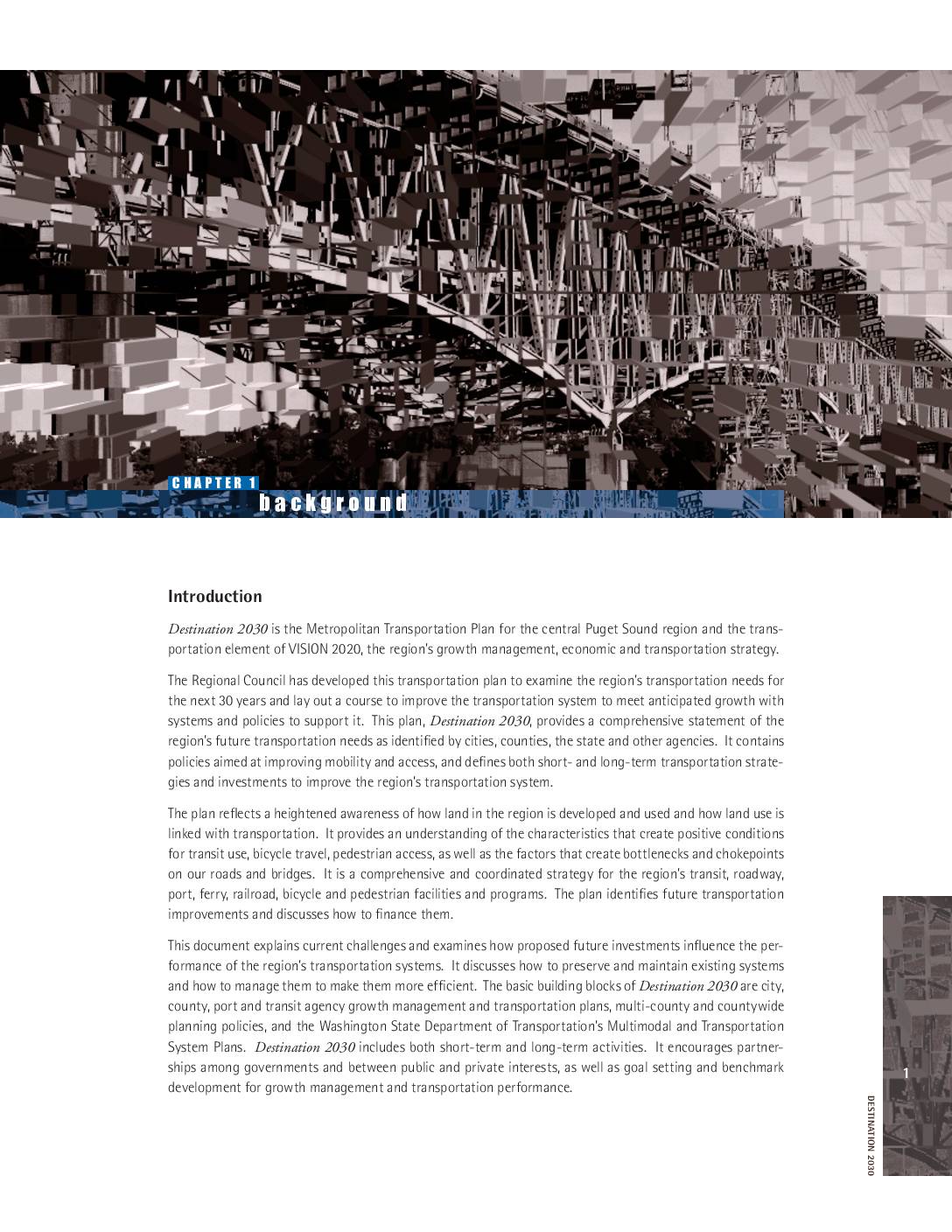
    Destination 2030 is the long-range Metropolitan Transportation Plan for the central Puget Sound region, developed by the Puget Sound Regional Council to address transportation needs over a 30-year horizon as the region's population is expected to grow by over 1.5 million people. The plan covers all modes of transportation—including transit, roads, ferries, rail, bicycle, and pedestrian facilities—and links land use planning with transportation investment strategies. It builds upon the 1995 Metropolitan Transportation Plan by providing improved guidance on funding, system management, and multimodal improvements across King, Kitsap, Pierce, and Snohomish counties.
    TagsMetroplitan Transportation Plan, PSRC, Puget Sound Regional Council, Regional Transportation Plan, transportationFolderDestination 2030 CD
  • 2022-09-01

    Destination 2030: Executive summary

    Destination 2030 is a long-range regional transportation action plan for King, Pierce, Snohomish, and Kitsap counties in the central Puget Sound area of Washington state, designed to address growing traffic congestion as the region prepares for an additional 1.5 million residents and 800,000 new jobs. The plan outlines over 2,200 specific projects—including more than 2,000 miles of new and improved roadways, expanded transit services, and new walkways and bikeways—to improve mobility across the region by 2030. It also emphasizes coordinating land use and transportation planning to support sustainable growth while preserving environmental quality.
    TagsPSRC, Puget Sound, Puget Sound Regional Council, Regional Transportation Plan, transportationFolderDestination 2030 CD
  • 2022-05-01

    Puget Sound Regional Council Annual Report 2022

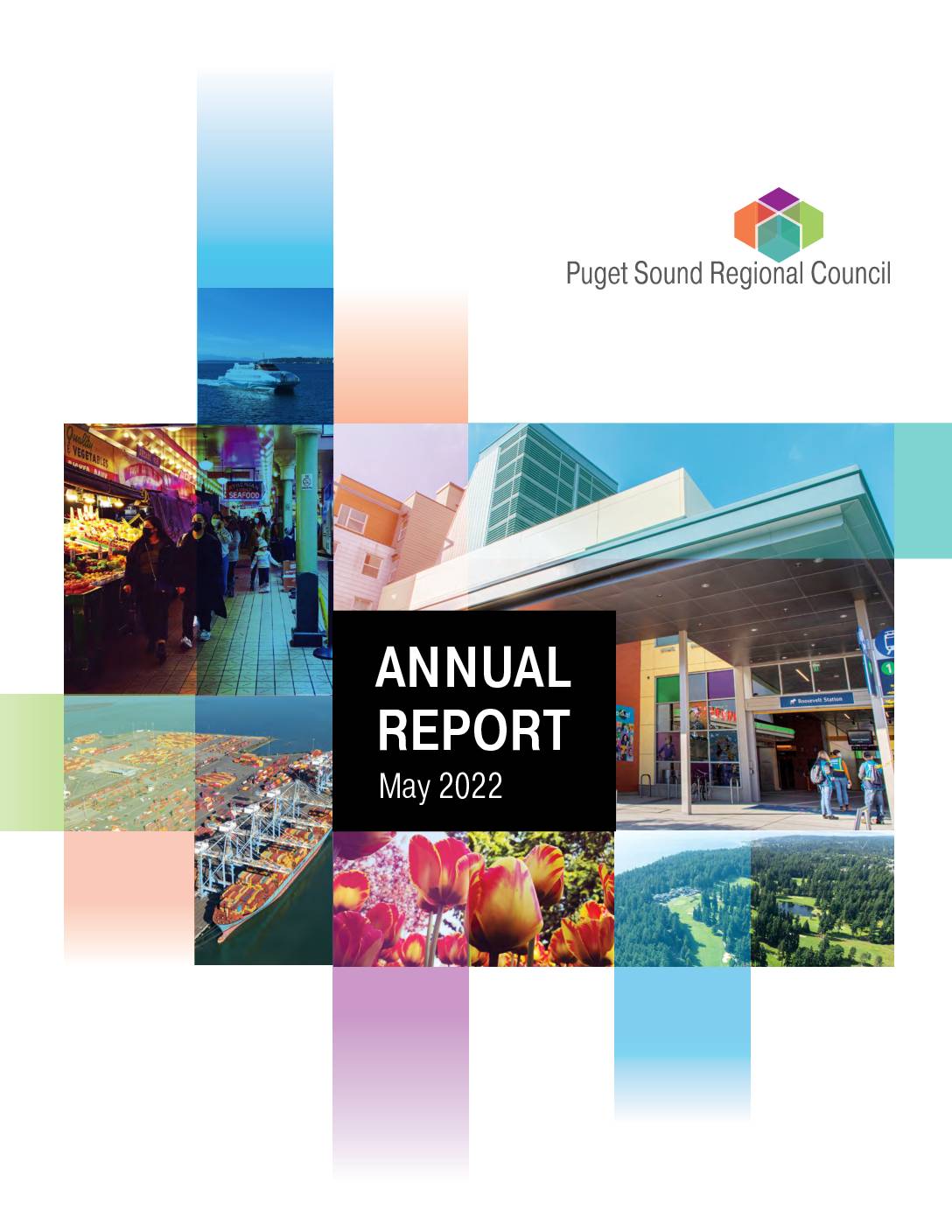
    The Puget Sound Regional Council (PSRC) 2022 Annual Report highlights key regional planning achievements, including the opening of the Northgate Link Light Rail Extension, the adoption of the region's first Regional Housing Strategy, and updates to the Regional Transportation Plan. The report also notes the passage of the federal Bipartisan Infrastructure Law and Washington State's Move Ahead transportation package, which together provide historic funding for transit, roads, bridges, and ferries. While focused broadly on regional growth and transportation planning for the central Puget Sound area, this document does not address Sea-Tac Airport noise policy specifically.
    Tagsnon-aviation transportation, PSRC, Puget Sound, Puget Sound Regional Council, Regional Transportation PlanFolderAnnual Reports
  • 2022-05-01

    PSRC annual report 2022

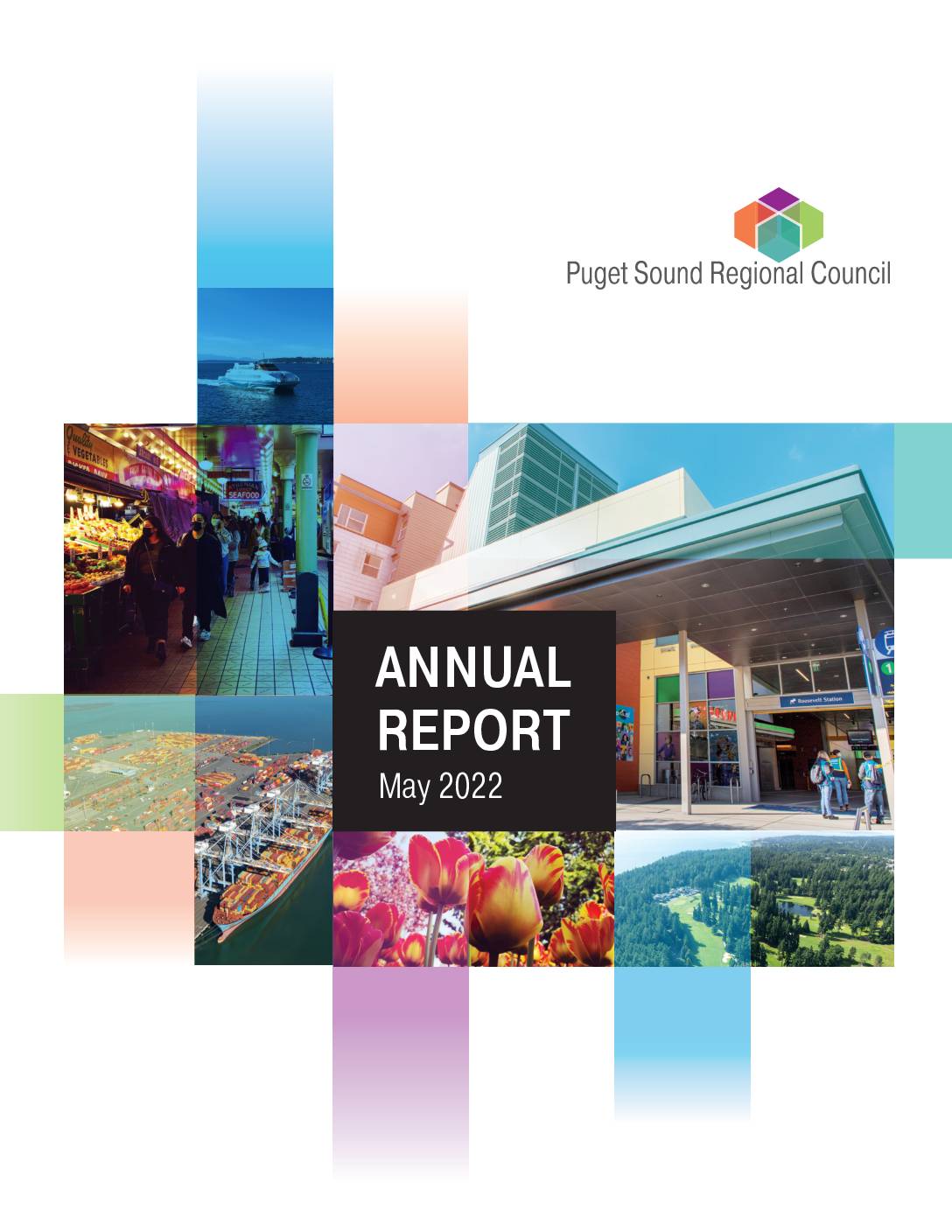
    The Puget Sound Regional Council (PSRC) 2022 Annual Report highlights the organization's key regional planning achievements, including the adoption of the first-ever Regional Housing Strategy, an update to the Regional Transportation Plan, and $102 million in funding for the Northgate Extension of Link Light Rail. The report also notes the passage of the federal Bipartisan Infrastructure Law and Washington State's Move Ahead transportation package as significant funding milestones for transit, bridges, and roads in the central Puget Sound region. Note: this document does not contain information specifically related to Sea-Tac Airport noise policy.
    TagsHousing, PSRC, Puget Sound Regional Council, Regional Transportation Plan, transportationFolderPuget Sound Regional Council
  • 2021-04-01

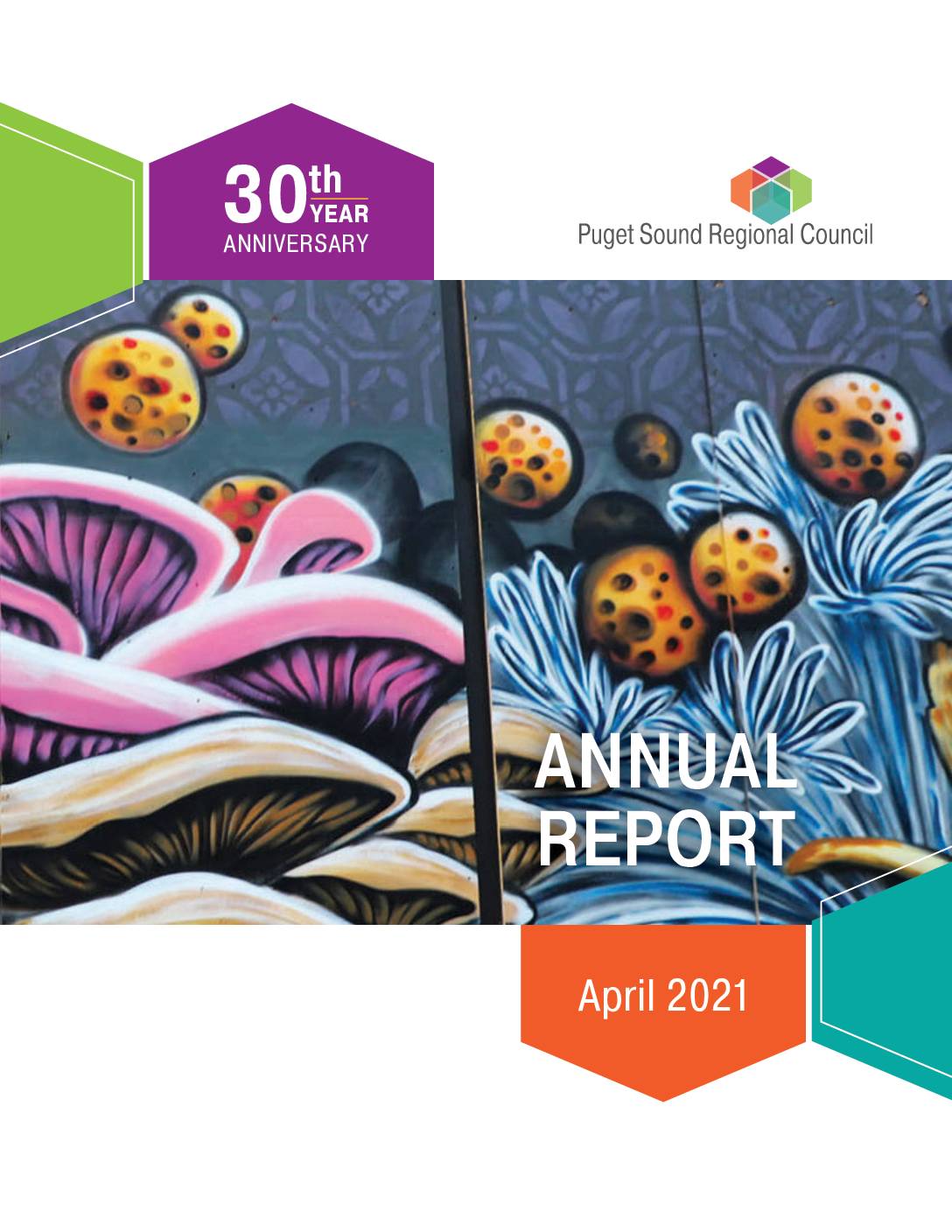
    Puget Sound Regional Council Annual Report 2021

    The Puget Sound Regional Council (PSRC) 2021 Annual Report highlights the organization's 30th anniversary and its key accomplishments during the COVID-19 pandemic, including directing $549 million in federal funding to 128 regional transportation projects and adopting the VISION 2050 long-range growth plan. The report also covers efforts to advance housing and equity initiatives, conduct passenger-only ferry studies, and lead a Regional Aviation Baseline Study examining current conditions and future aviation demand across the central Puget Sound area.
    TagsPSRC, Puget Sound Regional Council, Regional Aviation Baseline Study, Regional Transportation PlanFolderAnnual Reports
  • 2019-09-17

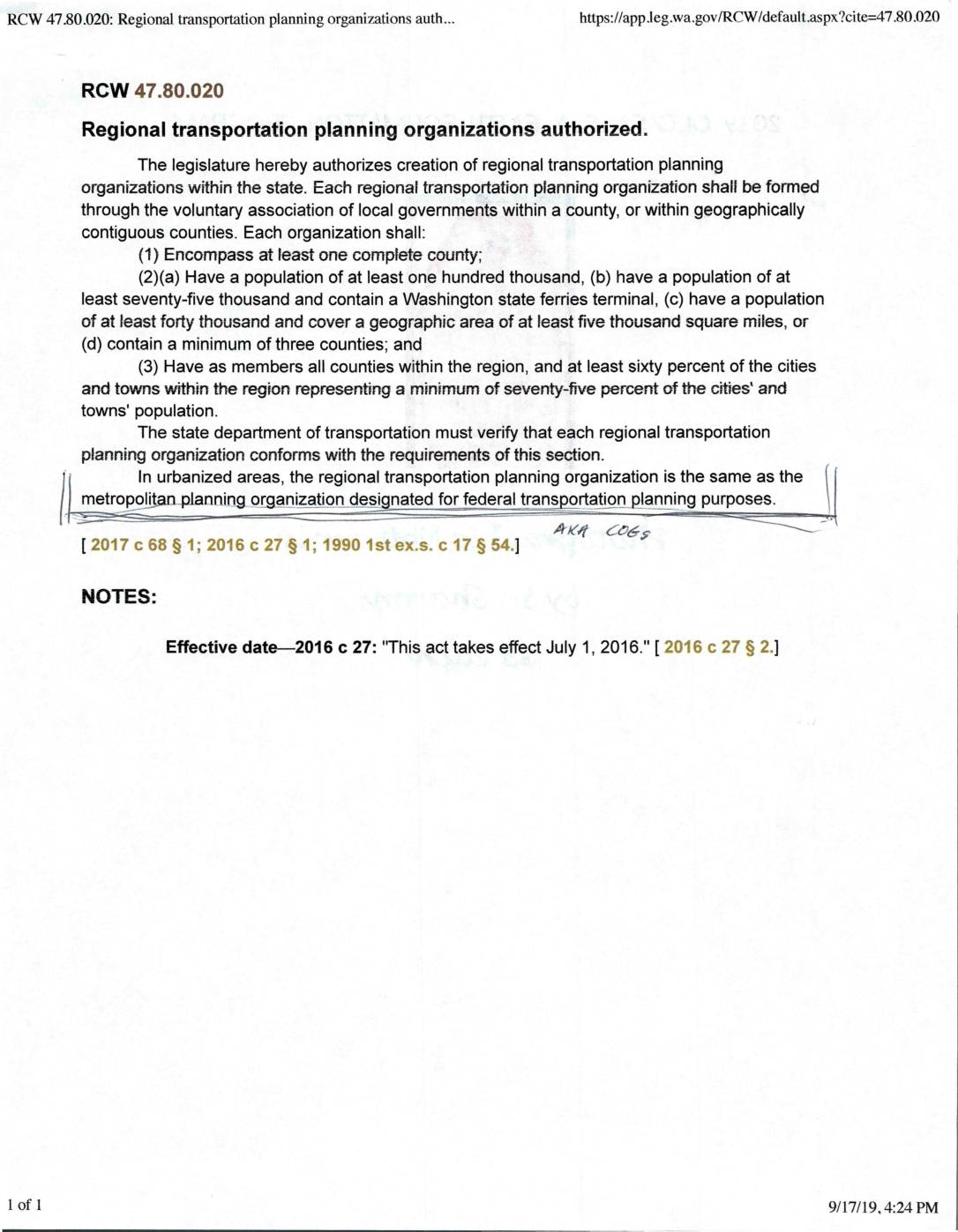
    RCW 47.80.020: Regional transportation planning organizations authorized

    Washington State law (RCW 47.80.020) authorizes the creation of Regional Transportation Planning Organizations (RTPOs), formed through voluntary associations of local governments within contiguous counties. Each RTPO must meet minimum population and geographic requirements, include all counties in the region, and have at least 60% of cities and towns representing 75% of the regional city/town population as members. In urbanized areas, the RTPO is the same body as the federally designated Metropolitan Planning Organization (MPO), also known as a COG.
    Tagsnon-aviation transportation, PSRC, RCW, Regional Transportation Plan, Washington State LegislatureFolderSP #2

Posts pagination

Page 1 Page 2 Page 3 Page 4
Sidebar On/Off

Upcoming Events

  • Stay Grounded Event: Night trains, not night planes!
    Add to CalendarMSunday Sep 13: 12:00am
    Ntnnp social media3

    For the past two years, more than 220 initiatives from 15 countries have declared September 13th as the International day for the ban of night flights at airports. In parallel, activists across Europe have been gathering for pyjama parties for night trains – coordinated in 2024 and 2025 by Back on Track and Stay Grounded.

    [...]
  • Burien Airport Committee Meeting September 15, 2026
    Add to CalendarMTuesday Sep 15: 6:00pm
    400 SW 152nd St, Burien, WA 98166
    Burien airport committee 15 sep 2026 agenda pdf pdf

    a) Part 150 Noise Study (Emily Inlow-Hood) — 15 minutes
    b) SAMP Update and Next Steps (Brian Davis and Sarah Moore) — 15 minutes
    c) Legislative Updates — 10 minutes
       • SCA (Sarah Moore)
       • Work with Sen. Orwall (Brian Davis)
    d) StART Reorganization (Jeff Harbaugh and Karen Veloria) — 10 minutes

    [...]

[See all...]


Help study childhood asthma. Get free HEPA filter!

read more...

Issues

Sea-Tac Airport is currently undergoing the largest and longest expansion in its history, collectively known as the Sustainable Airport Master Plan (SAMP). Some of it you can already hear, but you’re probably not aware of what it all means. Here’s what you need to know.
read more...

Read This!

As the source for federal transportation grants, the Puget Sound Regional Council was charged with developing a system to meet the growing need for commercial aviation. When the search for a second airport failed, they authorized the Port of Seattle to build the Third Runway, with a mandate to develop a noise abatement and mitigation program. In their effort to stop the Third Runway, the ACC argued over every detail of the Port's efforts--including property buyouts and sound insulation. The dispute was meant to be settled by a three member Expert Arbitration Panel. This is their final report. It finds 2-1, that the Port's program was insufficient in several respects. Despite that, funding for the Third Runway was approved by the PSRC, and the 'Port Package' program, proceeded largely unchanged. Expert Arbitration Panel's final decision finding that the Port of Seattle had not shown sufficient reduction in real on-the-ground noise impacts to satisfy noise reduction conditions required for approval of a third runway at Sea-Tac International Airport. The majority decision concluded the Port's noise abatement programs were insufficient despite being impressive in scope.
continue...

The Podcast!

Subscribe to the only podcast devoted to policies, politics, history, impacts for people living under the flight path everywhere. It’s definitely not just about noise!
  • Sea-Tac Noise.Info
  • Connect with STNI

    • Subscribe
    • Port Package Problem?
    • Donate
    • Podcast
    • Socials
      • Facebook
      • X (Twitter)
      • Bluesky
      • Instagram

    "Alaska Airlines Aircraft at Sea-Tac Airport Gates" — , 2025

  • Learn

    • Frequently Asked Questions
    • Explainers
    • Youtube
    • Research Requests
    • Make a complaint
  • Goals

    Fulfill the promises of 1976:
    • Compensation
    • Reduced noise
    • Improved air quality
    • Environmental remediation
Login/Register
©2026•Data Privacy

Message

We use cookies to provide basic functionality. We also provide access to search engines in order to provide site analytics. We do not sell or share your data.
V V