TagReauthorization Act Of 2018(7)
-
 2023-04-24 15:13
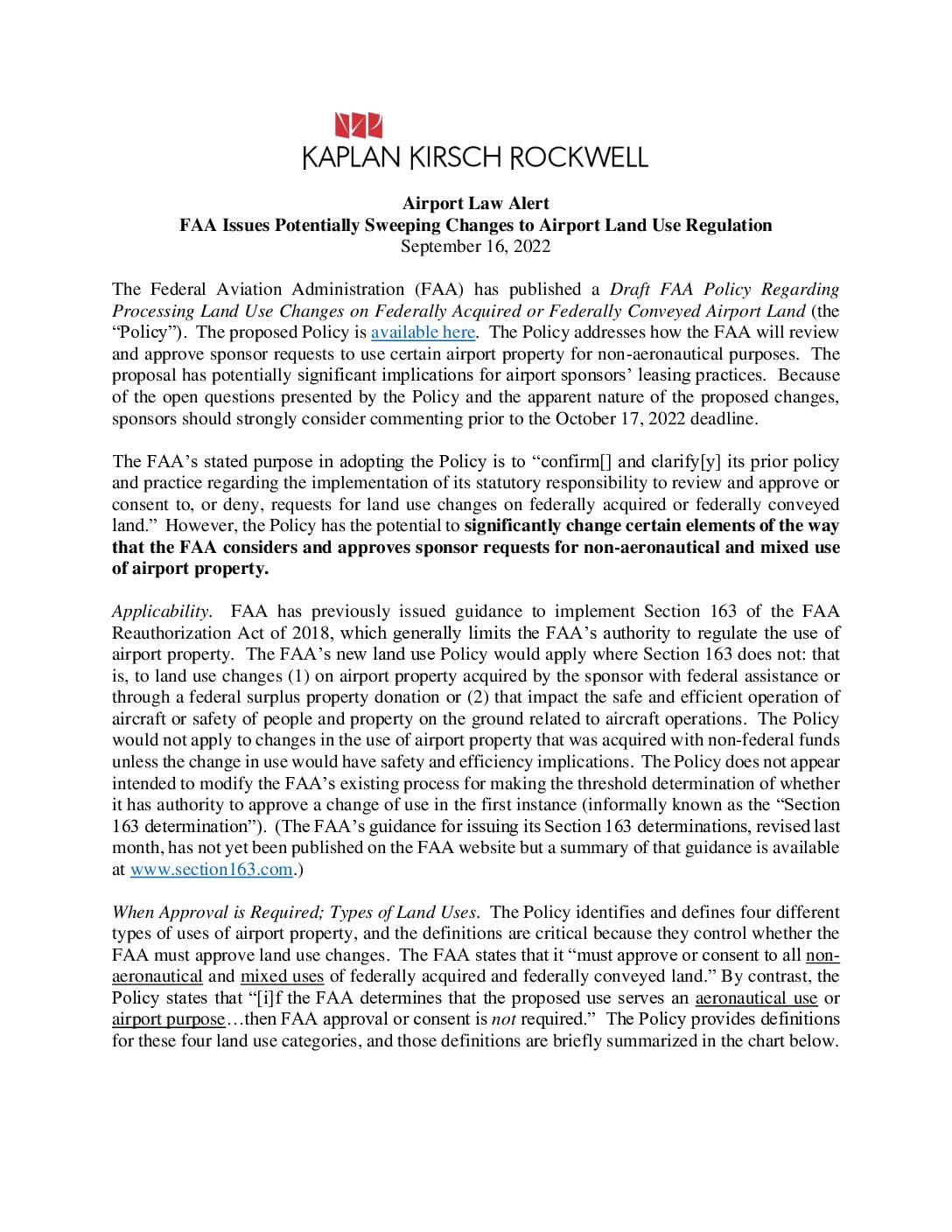
KKR – Airport Law Alert, FAA Section 163 Land Use Policy, September 2022
FAA Issues Potentially Sweeping Changes to Airport Land Use Regulation September 16, 2022 The Federal Aviation Administration (FAA) has published a Draft FAA Policy Regarding Processing Land Use Changes on Federally Acquired or Federally Conveyed Airport Land (the “Policy”). The proposed Policy is available here. The Policy addresses how the FAA will review and approve sponsor requests to use certain airport property for non-aeronautical purposes. The proposal has potentially significant implications for airport sponsors’ leasing practices. Because of the open questions presented by the Policy and the apparent nature of the proposed changes, sponsors should strongly consider commenting prior to the October 17, 2022 deadline. The FAA’s stated purpose in adopting the Policy is to “confirm[] and clarify[y] its prior policy and practice regarding the implementation of its statutory responsibility to review and approve or consent to, or deny, requests for land use changes on federally acquired or federally conveyed land.” However, the Policy has the potential to significantly change certain elements of the way that the FAA considers and approves sponsor requests for non-aeronautical and mixed use of airport property. Applicability. FAA has previously issued guidance to implement Section 163 of the FAA Reauthorization Act of 2018, which generally limits the FAA’s authority to regulate the use of airport property. The FAA’s new land use Policy would apply where Section 163 does not: that is, to land use changes (1) on airport property acquired by the sponsor with federal assistance or through a federal surplus property donation or (2)… -
2022-10-09 01:02
Section 163
Section 163 of the FAA Reauthorization Act of 2018 regulates the uses of properties acquired by airport sponsors using FAA funds. These include property buyouts for noise mitigation and other non-aeronautical uses. SEC. 163. LIMITED REGULATION OF NON-FEDERALLY SPONSORED PROPERTY. (a) <> In General.--Except as provided in subsection (b), the Secretary of Transportation may not -
 2020-12-23 00:00
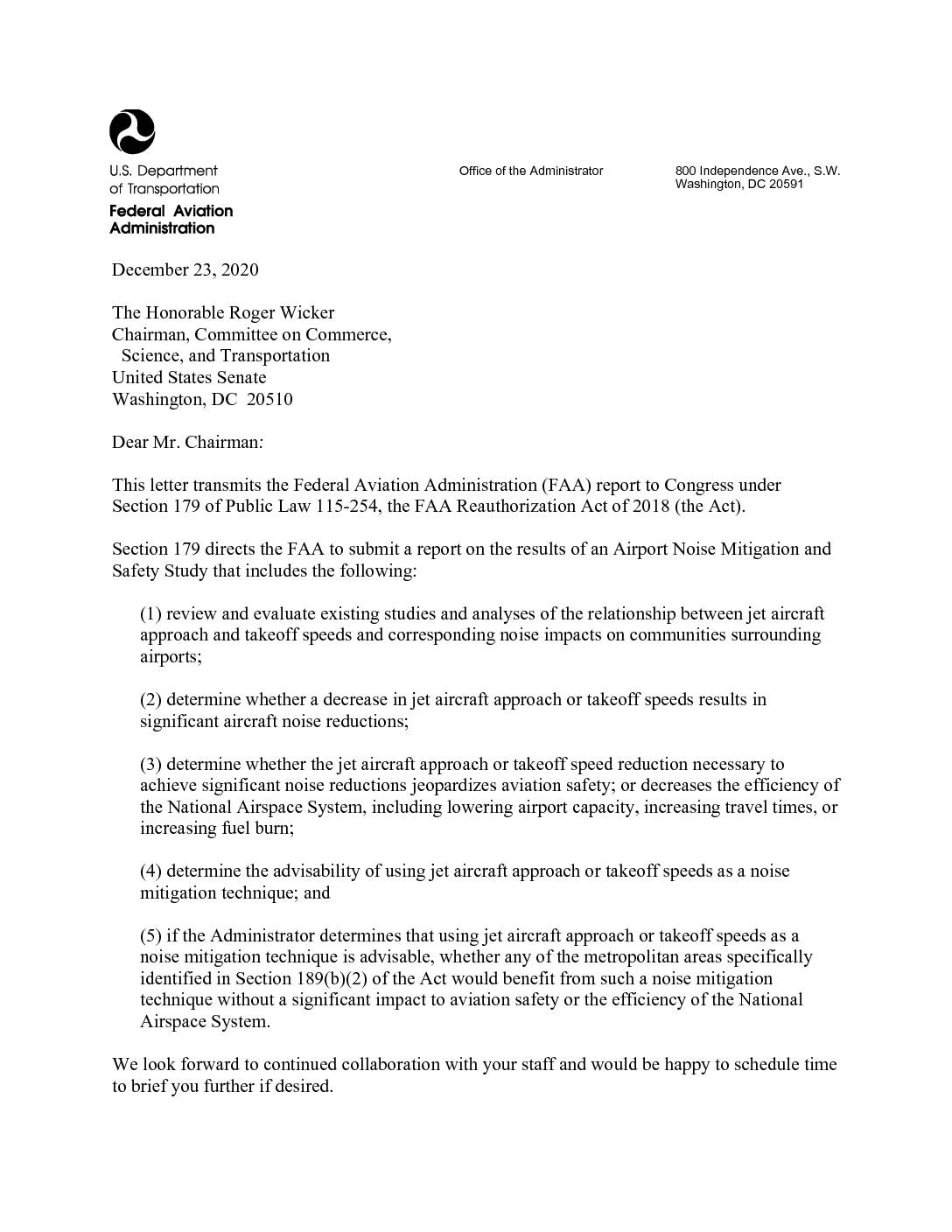
Report to Congress on Airport Noise Mitigation and Safety Study Section 179
Office of the Administrator 800 Independence Ave., S.W. Washington, DC 20591 December 23, 2020 The Honorable Roger Wicker Chairman, Committee on Commerce, Science, and Transportation United States Senate Washington, DC 20510 Dear Mr. Chairman: This letter transmits the Federal Aviation Administration (FAA) report to Congress under Section 179 of Public Law 115-254, the FAA Reauthorization Act of 2018 (the Act). Section 179 directs the FAA to submit a report on the results of an Airport Noise Mitigation and Safety Study that includes the following: (1) review and evaluate existing studies and analyses of the relationship between jet aircraft approach and takeoff speeds and corresponding noise impacts on communities surrounding airports; (2) determine whether a decrease in jet aircraft approach or takeoff speeds results in significant aircraft noise reductions; (3) determine whether the jet aircraft approach or takeoff speed reduction necessary to achieve significant noise reductions jeopardizes aviation safety; or decreases the efficiency of the National Airspace System, including lowering airport capacity, increasing travel times, or increasing fuel burn; (4) determine the advisability of using jet aircraft approach or takeoff speeds as a noise mitigation technique; and (5) if the Administrator determines that using jet aircraft approach or takeoff speeds as a noise mitigation technique is advisable, whether any of the metropolitan areas specifically identified in Section 189(b)(2) of the Act would benefit from such a noise mitigation technique without a significant impact to aviation safety or the efficiency of the National Airspace System. We look forward to continued collaboration with… -
 2020-10-27 00:00
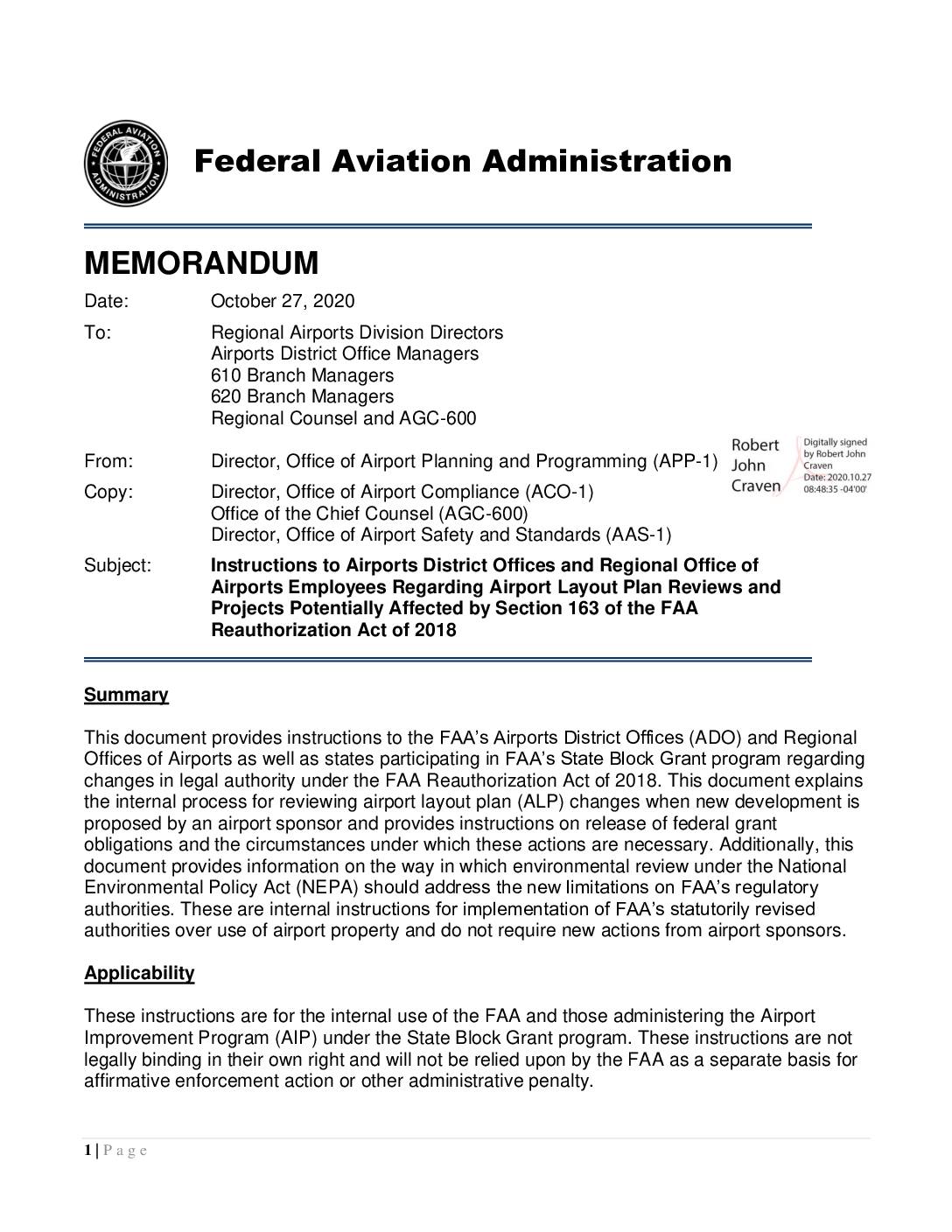
FAA – Section 163 Final Instructions, October 2020
From: Director, Office of Airport Planning and Programming (APP-1) Copy: Director, Office of Airport Compliance (ACO-1) Office of the Chief Counsel (AGC-600) Director, Office of Airport Safety and Standards (AAS-1) Subject: Instructions to Airports District Offices and Regional Office of Airports Employees Regarding Airport Layout Plan Reviews and Projects Potentially Affected by Section 163 of the FAA Reauthorization Act of 2018 Summary This document provides instructions to the FAA’s Airports District Offices (ADO) and Regional Offices of Airports as well as states participating in FAA’s State Block Grant program regarding changes in legal authority under the FAA Reauthorization Act of 2018. This document explains the internal process for reviewing airport layout plan (ALP) changes when new development is proposed by an airport sponsor and provides instructions on release of federal grant obligations and the circumstances under which these actions are necessary. Additionally, this document provides information on the way in which environmental review under the National Environmental Policy Act (NEPA) should address the new limitations on FAA’s regulatory authorities. These are internal instructions for implementation of FAA’s statutorily revised authorities over use of airport property and do not require new actions from airport sponsors. Applicability These instructions are for the internal use of the FAA and those administering the Airport Improvement Program (AIP) under the State Block Grant program. These instructions are not legally binding in their own right and will not be relied upon by the FAA as a separate basis for affirmative enforcement action or other administrative penalty.… -
 2020-09-23 00:00
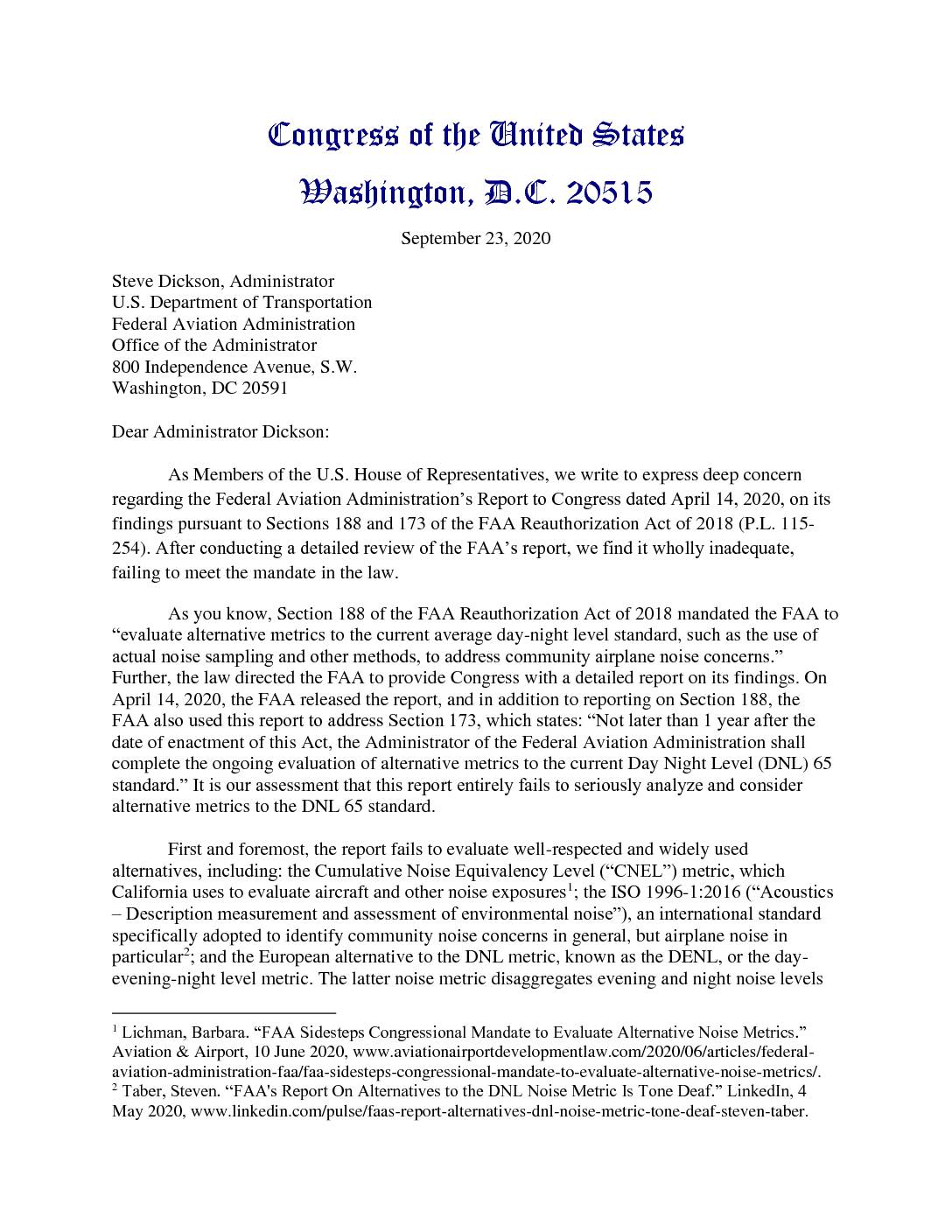
Congressional Quiet Skies Caucus Letter To FAA Administrator Steve Dickson re DNL65
Currently, FAA law has extremely complicated rules for establishing a noise boundary around airports. (A noise boundary is a geographic area inside which there is a certain acceptable noise level.) This is referred to as the DNL65. and it has several major flaws. The FAA Reauthorization Act Of 2018 attempted to address these flaws in several ways. This letter, from a caucus of Congressmen engaged on airport community issues complains to the Administrator that the spirit of the law is not being adhered to and demands that he make attempts to put his agency into compliance. The language is fairly technical, however there are a couple of basic points they raise: First, that the noise boundary be determined by actual noise measurements (currently the noise boundaries are 'modeled' and those calculations often do not reflect in any way the lived experience for residents.) Second, that the 'acceptable' noise level of sixty five decibels (hence DNL65) has been determined to be far too high to conform with current understandings of healthy living. -
 2020-09-17 16:53
White Paper: FAA Re-authorization Act 2018
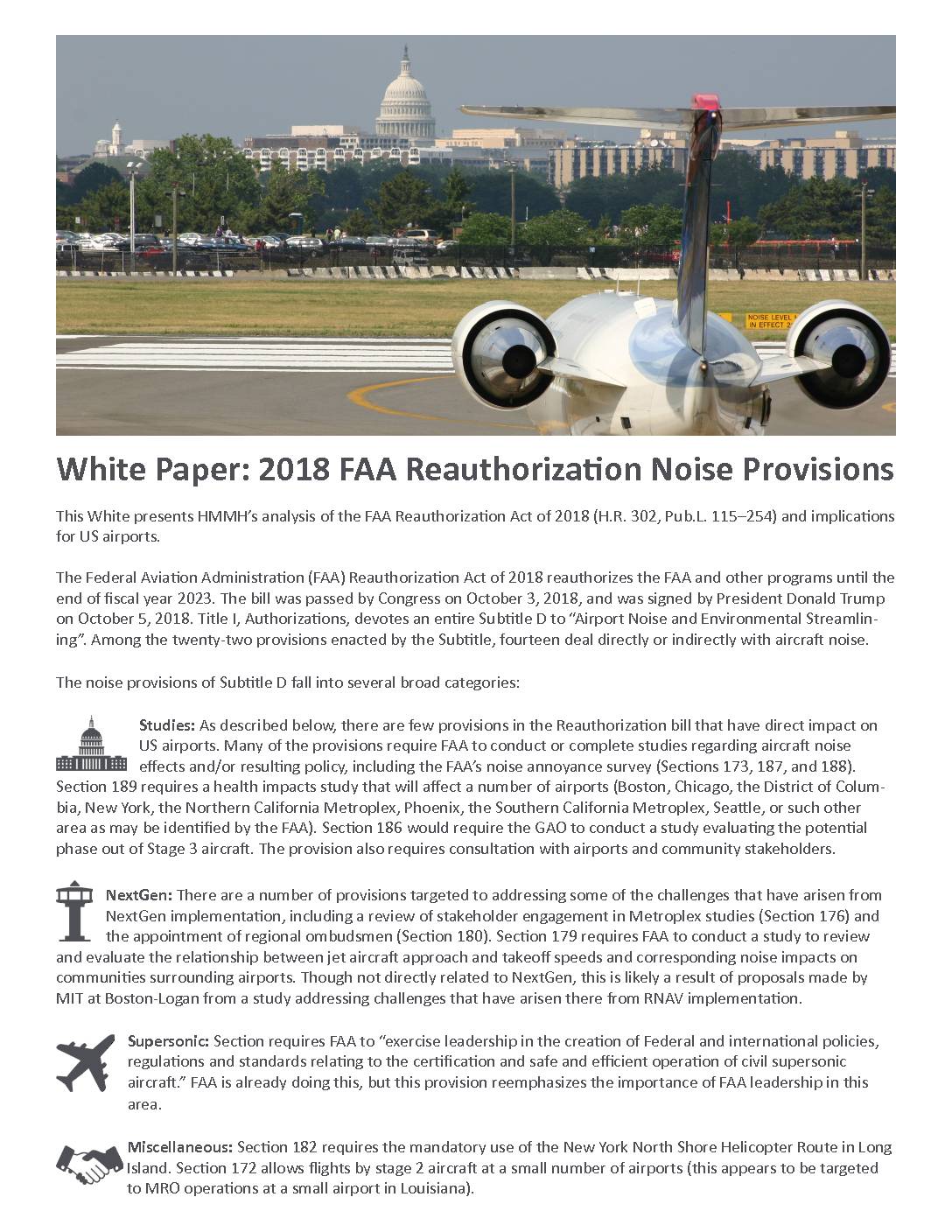
White Paper: 2018 FAA Reauthorization Noise Provisions This White presents HMMH’s analysis of the FAA Reauthorization Act of 2018 (H.R. 302, Pub.L. 115–254) and implications for US airports. The Federal Aviation Administration (FAA) Reauthorization Act of 2018 reauthorizes the FAA and other programs until the end of fiscal year 2023. The bill was passed by Congress on October 3, 2018, and was signed by President Donald Trump on October 5, 2018. Title I, Authorizations, devotes an entire Subtitle D to “Airport Noise and Environmental Streamlin- ing”. Among the twenty-two provisions enacted by the Subtitle, fourteen deal directly or indirectly with aircraft noise. The noise provisions of Subtitle D fall into several broad categories: Studies: As described below, there are few provisions in the Reauthorization bill that have direct impact on US airports. Many of the provisions require FAA to conduct or complete studies regarding aircraft noise effects and/or resulting policy, including the FAA’s noise annoyance survey (Sections 173, 187, and 188). Section 189 requires a health impacts study that will affect a number of airports (Boston, Chicago, the District of Colum- bia, New York, the Northern California Metroplex, Phoenix, the Southern California Metroplex, Seattle, or such other area as may be identified by the FAA). Section 186 would require the GAO to conduct a study evaluating the potential phase out of Stage 3 aircraft. The provision also requires consultation with airports and community stakeholders. NextGen: There are a number of provisions targeted to addressing some of the challenges that have… -
 2020-01-22 00:00
FAA 2018 Reauthorization Section 190 Pilot-Programs
To: Office of Airports Regional Directors, AXX‐600s Regional Airport Planning & Programming, AXX‐610s Airports District Office Managers, XXX‐ADOs From: Robert J. Craven, Director, Office of Airport Planning and Programming, APP‐1 Subject: Reauthorization Program Guidance Letter (R‐PGL) 19‐04: Pilot Program Eligibility This Reauthorization Program Guidance Letter (R‐PGL) 19‐04 explains and implements provisions in the FAA Reauthorization Act of 2018 (the 2018 Act) (P.L. 115‐254) that establish or sunset pilot programs under 49 U.S.C., Chapter 471 (the primary statutory provision governing the Airport Improvement Program (AIP)). This R‐PGL also references pilot programs under the authority of the Transportation Security Administration (TSA) for clarity purposes. This R‐PGL is directed to Office of Airports’ staff for the purpose of helping them implement statutory changes. This R‐PGL is not legally binding in its own right and will not be relied upon by the FAA as a separate basis for affirmative enforcement action or other administrative penalty. This PGL includes analyses and implementation strategies for the following topics and bill Sections: Bill Section(s) Topic 49 USC Section(s) impacted 140 Non‐movement area surveillance pilot program 47143 161(c) Remote Tower Pilot Program for rural and small communities 47124, 47102 166 Pilot Program Sunsets 47136, 47136a, 47140, 47140a 184 Eligibility of Pilot Program Airports 47115, 47134, 47110 190 Environmental Mitigation Pilot Program 47117(e)(1)(A) 383(a)(e) Airport Safety and Airspace Hazard Mitigation and Enforcement 44810; FY19‐23 only JAN 2 2 2020