TagEIS(25)
-
 2024-10-25 22:44
SAMP Draft EA: How to provide a great public comment
1How to provide effective public comment by December 13, 2024 Because new ways for you to participate will likely become available, this article may be subject to updates. Introduction This is the second of a two-part article concerning the Sustainable Airport Master Plan Draft Environmental Assessment (SAMP Draft EA). If you’re looking for the short -
 2024-09-30 00:55
The SAMP Comment Period Explainer (Intro)
Preparing for the October 21st Comment Period This is the first of a two-part article concerning the SAMP comment period. We’re including a few paragraphs of background because the process has been so lengthy–with many years of delay. The feedback we’ve received thus far has been confusion, partly because the information on the Port’s official -
 2023-07-30 01:34
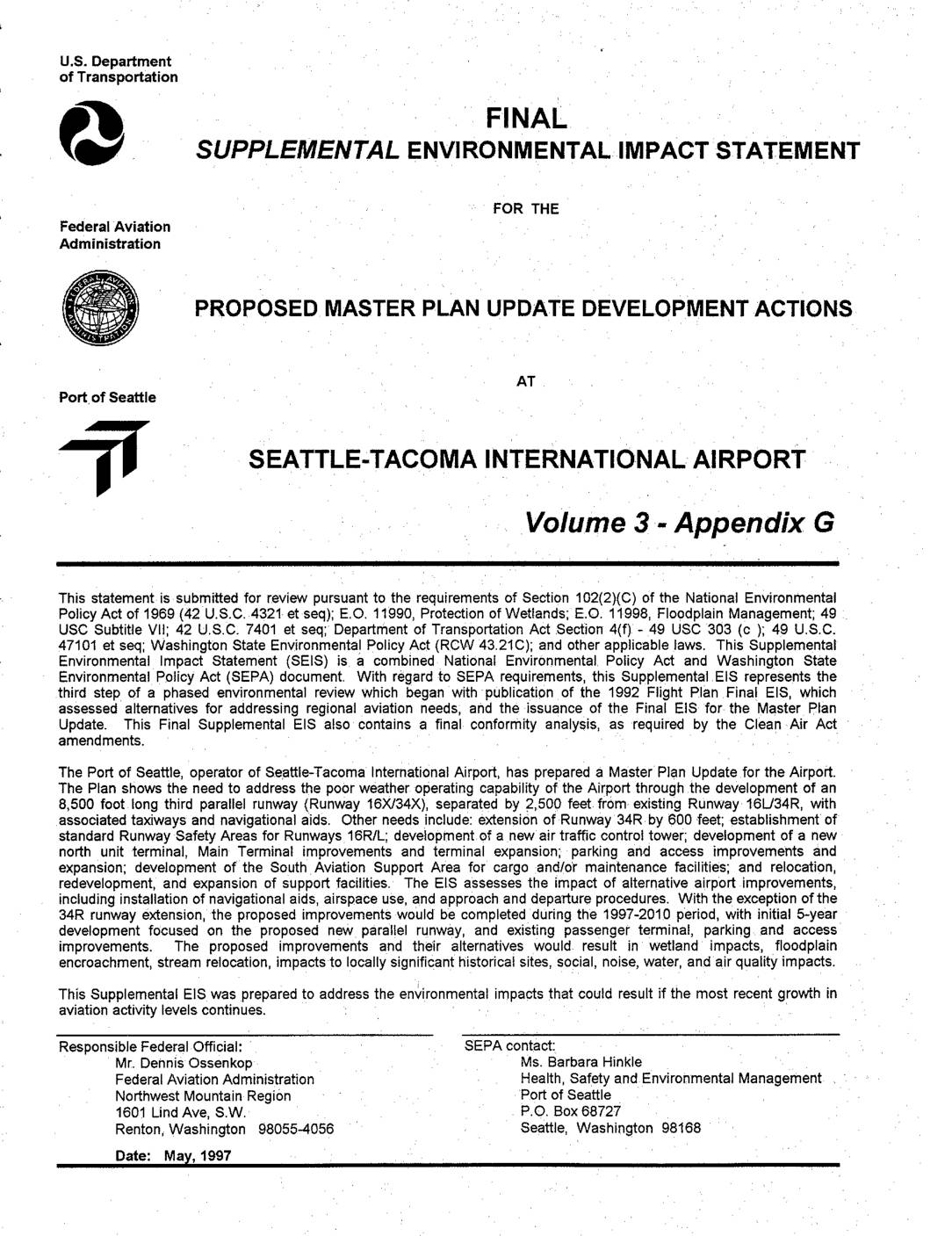
STIA MPU Final Supplemental EIS May 1997 Vol. 3 Of 3 1 Appendix G
This statement is submitted for review pursuant to the requirements of Section 102(2)(C) of the National Environmental Policy Act of 1969 (42 U.S.C. 4321 et seq); E.O. 11990, Protection of Wetlands; E.O. 11998, Floodplain Management; 49 USC Subtitle VII; 42 U.S.C. 7401 et seq; Department of Transportation Act Section 4(f) - 49 USC 303 (c ); 49 U.S.C. 47101 et seq; Washington State Environmental Policy Act (RCW 43.210); and other applicable laws. This Supplemental Environmental Impact Statement (SEIS) is a combined National Environmental Policy Act and Washington State Environmental Policy Act (SEPA) document. With regard to SEPA requirements, this Supplemental EIS represents the third step of a phased environmental review which began with publication of the 1992 Flight Plan Final EIS, which assessed alternatives for addressing regional aviation needs, and the issuance of the Final EIS for the Master Plan Update. This Final Supplemental EIS also contains a final conformity analysis, as required by the Clean,Air Act amendments. The Port of Seattle, operator of Seattle-Tacoma International Airport, has prepared a Master Plan Update for the Airport. The Plan shows the need to address the poor weather operating capability of the Airport through the development of an 8,500 foot long third parallel runway (Runway 16X/34X), separated by 2,500 feet from. existing Runway 16U34R, with associated taxiways and navigational aids. Other needs include: extension of Runway 34R by 600 feet; establishment of standard Runway Safety Areas for Runways 16RIL; development of a new air traffic control tower; development of a new north… -
 2023-07-30 01:33
STIA Master Plan Update Final Supplemental EIS May,1997 Vol. 1 of 3 Main Appendix A-C1
Volume 1 - Main TextandAppendices A through C-1 - This statement is submitted for review pursuant to the requirements of Section 102(2)(C) of the National Environmental Policy Act of 1969 (42 U.S.C. 4321 et seq); E.O. 11990, Protection of Wetlands ; E.O. 11998, Floodplain Management; 49 USC Subtitle VII ; 42 U.S.C. 7401 et seq; Department of Transportation Act Section 4(f) 49 USC 303 (c ); 49 U.S.C. 47101 et seq; Washington State Environmental Policy Act (RCW 43.21C); and other applicable laws. This Supplemental Environmental Impact Statement (SEIS) is a combined National Environmental Policy Act and Washington State Environmental Policy Act (SEPA) document. With regard to SEPA requirements, this Supplemental EIS represents the third step of a phased environmental review which began with publication of the 1992 Flight Plan Final EIS, which assessed alternatives for addressing regional aviation needs , and the issuance of the Final EIS for the Master Plan Update. This Final Supplemental EIS also contains a final conformity analysis, as required by the Clean Air Act amendments. The Port of Seattle, operator of Seattle-Tacoma International Airport, has prepared a Master Plan Update for the Airport. The Plan shows the need to address the poor weather operating capability of the Airport through the development of an 8,500 foot long third parallel runway (Runway 16X/34X), separated by 2,500 feet from existing Runway 16L/34R, with associated taxiways and navigational aids. Other needs include: extension of Runway 34R by 600 feet; establishment of standard Runway Safety Areas for Runways 16R/L; development… -
 2023-07-30 01:32
STIA Final Supplemental Environmental Impact Statement EIS MPU Vol 2 of 3 Appendices C2-F
This statement is submitted for review pursuant to the requirements of Section 102(2)(C) of the National Environmental Policy Act of 1969 (42 U.S.C. 4321 et seq); E.O. 11990, Protection of Wetlands; E.O. 11998, Floodplain Management; 49 USC Subtitle VII ; 42 U.S.C. 7401 et seq; Department of Transportation Act Section 4(f) - 49 USC 303 (c ); 49 U.S.C. 47101 et seq; Washington State Environmental Policy Act (RCW 43.21C); and other applicable laws. This Supplemental Environmental Impact Statement (SEIS) is a combined National Environmental Policy Act and Washington State Environmental Policy Act (SEPA) document. With regard to SEPA requirements, this Supplemental EIS represents the third step of a phased environmental review which began with publication of the 1992 Flight Plan Final EIS, which assessed alternatives for addressing regional aviation needs , and the issuance of the Final EIS for the Master Plan Update . This Final Supplemental EIS also contains a final conformity analysis, as required by the Clean Air Act amendments. The Port of Seattle, operator of Seattle-Tacoma International Airport, has prepared a Master Plan Update for the Airport. The Plan shows the need to address the poor weather operating capability of the Airport through the development of an 8,500 foot long third parallel runway (Runway 16X/34X), separated by 2,500 feet from existing Runway 16L/34R, with associated taxiways and navigational aids . Other needs include: extension of Runway 34R by 600 feet; establishment of standard Runway Safety Areas for Runways 16R/L; development of a new air traffic control tower;… -
 2023-07-30 00:01
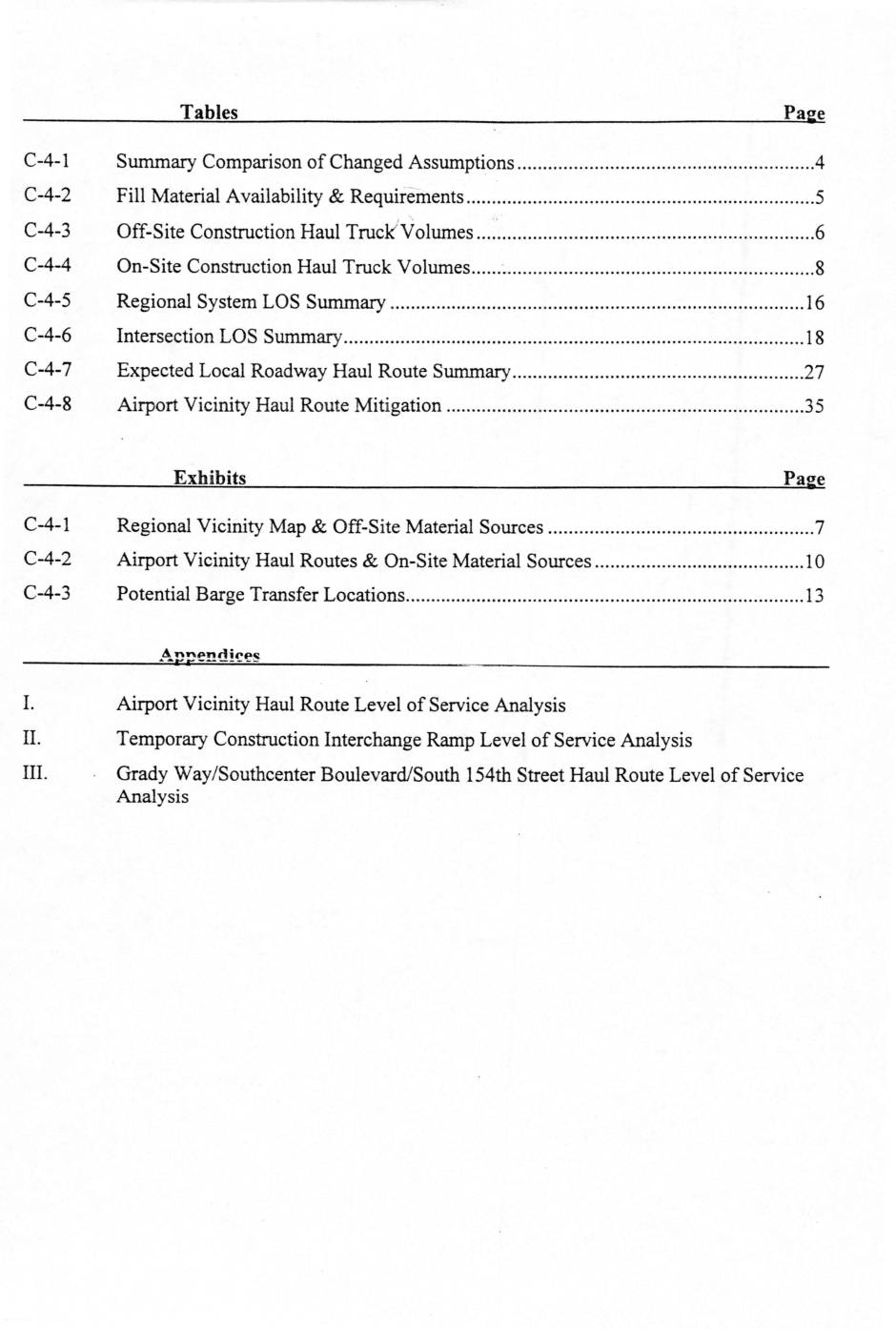
Stmpu 1997 05 Fseis Appendix C
Summary Comparison of Changed Assumptions e eeeeee8eee+eeee+ee©© +eee8e•ee•••• ••••eeee••e•••ee+••• ee ee = Fill Material Availability & Requirements ..5•••••+• e e•••••••••e•••••••e•••••••••••• •• •e•e• Off.Site Construction Haul TruckVol1 les •• •••+••••• • •••••+•••••••e•••••e•••• e• ee •••••• •••• e•• On-Site Construction Haul Truck Vol1 .es . . ••• + • •• e••••e•• • •• •••••e•• LOS S1 16e •e• •••••••+ee••• •••e•e•• 8 •••••e••••+•©•• ©•••+•••••••e•••••• •e•e• •• 18••••• •••ee•e••••••••••••ee•e• B•e•e•••• e •e• IP •+•• e •••• •e••e••e•• •••• Expected Local Roadway Haul Route 51 .27••••e•e •O•••• •••••••• 80•••OO••e••+•••• •• e• ©••• Regional System Intersection LOS Airport Vicinity Haul Route Mitigation ••••• ee •4••e•••eeeeoee•+• +©•ee©e©••• o•o•o••••• ••e•e••••9©eeeoeeee© ee ee JJ Exhibits Bl••ll•H• Page Cd- 1 C-4-2 C.4-3 Regional Vicinity Map & OfFSite Material Sources •e•e+•••••• e•e••••••••••+e•••e• ee ee Be ee ee see ee see e + e / )oR Vicinity Haul Routes & On-'Site Material Sources 10•••••• e •+••• e •+•••••e• • e•••+•+••••• Potential Barge Transfer Locations.... 13••+••••••••••••••8• e•e•••e•••ee• ••O•• •••+•e••••••••••e••• e •O•• •••• + + 4AAppe=dices 1. 11. 111 Airport Vicinity Haul Route Level of Service Analysis Temporary Construction Interchange Ramp Level of Service Analysis Grady Way/Southcenter Boulevard/South 154th Street Haul Route Level of Service Analysis Seattle-Tacoma International Airport Final Supplemental Environmental Impact Statement APPENDIX C-4 CONSTRUCTION IMPACTS REPORT ,/ 1. EXECUTIVE SUMMARY This Technical Report documents the additional analysis performed to supplement the Final EIS review of potential construction activities associated with the Master Plan Update improvements. These include dle construction of a Third Runway and associated projects, improvements to the Runway Safety… -
 2023-07-30 00:00
Stmpu 1997 05 Feis Appendix E
Port of Seattle Response to Highlin8 Water District letter in Draft E.I.S. for Master Plan Upiate at Seatac International Re: PI F-L LA) Dear Mr. Ossenkop and Ms. Hinkle: The response to our July 27. 1995 letter with regard to specific issues effecting the Highline Water District's existIng and future groundwater Issues were not adequately addressed. The District now has water rights to 17.5 million gallons per daY (MGD) of ground water within the Highline area What steps will be taken by the Port of Seattle to mitigate the contamination of the ground watel? VWlat steps will be taken by the Port of Seattle to mitigate the Ioss of ground wateF lecharge to the aquifers now being used and those that will be used in the future? These two simple questions were not addressed by the Draft Environmental Impact Statement for the Master Plan Update at Seatac InternatIonal Airport. We are expecting a response to our questions which would be acceptable to ou1 District. Sincerely , }h:/ /L &b,,A Keith A. Harris Manager. Planning/Construction KAH mat m 98032 . 824-0375 / FAX: 824-0806 JLN a6 '96 IQ: ISRM POS AV/CbC March 18, Ma. Barbara Hlnkle Port of BeattIe R> Box 68727 8©attle WA 98168 Dear MB e Hlnkl e : Thank you for the oppottunlty to aonnent on the FIn al Bnvironnantal Inpaot 8tateaant (FB18) for the Ha8t8r Plan Update laprovene IIta for Seattle-Taeona InternatIonal Altport+ We revIewed the rE:IB and hav© the £ollovlng coanent8. IIIL a 2+ If you… -
 2023-07-30 00:00
Stmpu 1997 05 Fseis Appendix F
response to comments concerning noise issues, aircraft fleet mix has a notable effect on the resulting environmental impacts. Thus, evaluation of impacts associated with a demand level would require the evaluation of the fleet mix associated with that demand. While current regulations mandate the phase..out of Stage 2 aircraft, little is precisely known about which specific aircraft will be flying in years beyond 2010. Estimates of fleet are possible, but their impact on the resulting environmental condition description are significant, and a slight change aom one aircraft type to another could have significant ramifications on noise and air pollution conditions. Because of this variability, the resulting impact analysis would have little meaning. As a result, Appendix D achieves an objective of anaying the possible impacts that might occur in time frames beyond year 2010. See response to comment 2.-Q and 2-J. One commentor indicated that an EIS is required to use worst.-case data, and thus should have used the FAA TAF. NEP A and SEPA do not require the use of worst-case conditions. However, in certain conditions, agencies encourage the use of worst case conditions, such as the air quality analysis. As a result, certain worst-case conditions were used in assessing the impacts of the Port’s new forecast. The Draft Supplemental EIS acknowledges that Master Plans are typically undertaken every 7-.10 years, or for airports experiencing unforeseen growth, plans are undertaken every 3-5 years. Thus, it is anticipated that the Port would likely undertake a new Master Plan Update after… -
 2022-11-04 22:59
MOA – Air Quality Monitoring at Sea-Tac Vicinity, October 15, 1996
. €. c s '-J €. 0 MEMORANDUM OF AGREEJ.IIENT R . oCI ~ d~~r;Eti MONITORING PROGRAM ACTIVITIES RELATING TO THE . . · oL p..Gt~ATTLE-TACOMA INTERNATIONAL AIRPORT VICINITY ~0~-- cotf ~ Introduction For a number ·of years, residents in the vicinity of Seattle-Tacoma International Airport (Sea-Tac) have expressed concerns over air pollution . . Several studies and small-scale air pollutant sampling programs have been conducted by the Port of Seattle (Port), the State Department of Ecology (Ecology) and the Puget Sound Air Pollution Control Agency (PSAPCA). Because of ongoing concerns about air quality in the vicinity of Sea-Tac, the undersigned agencies have agreed to work together to gather additional air quality baseline data. In April 1995, the Federal Aviation Administration (FAA) and the Port issued a joint Draft Environmental Impact Statement (EIS) for the proposed Master Plan Update Improvements at Seattle-Tacoma International Airport. In February, 1996 the FAA and Port issued the Final EIS, which incorporated a draft air quality conformity determination. These environmental documents address, among other issues, potential air quality impacts associated with various Master Plan Update improvement projects (facility developments and operational changes) to be phased-in between 1996 and 2020 as part of the long-range airport vision (Exhibit A, attached to this agreement). The Final EIS considered the available Sea-Tac air quality information from previous studies, updated the baseline and projection year emission . inventories for five "criteria" pollutants of concern, performed area-wide dispersion screening modeling for volatile organic. compounds (VOC) _ and oxides of nitrogen… -