Tageducation(25)
-
 2000-08-01
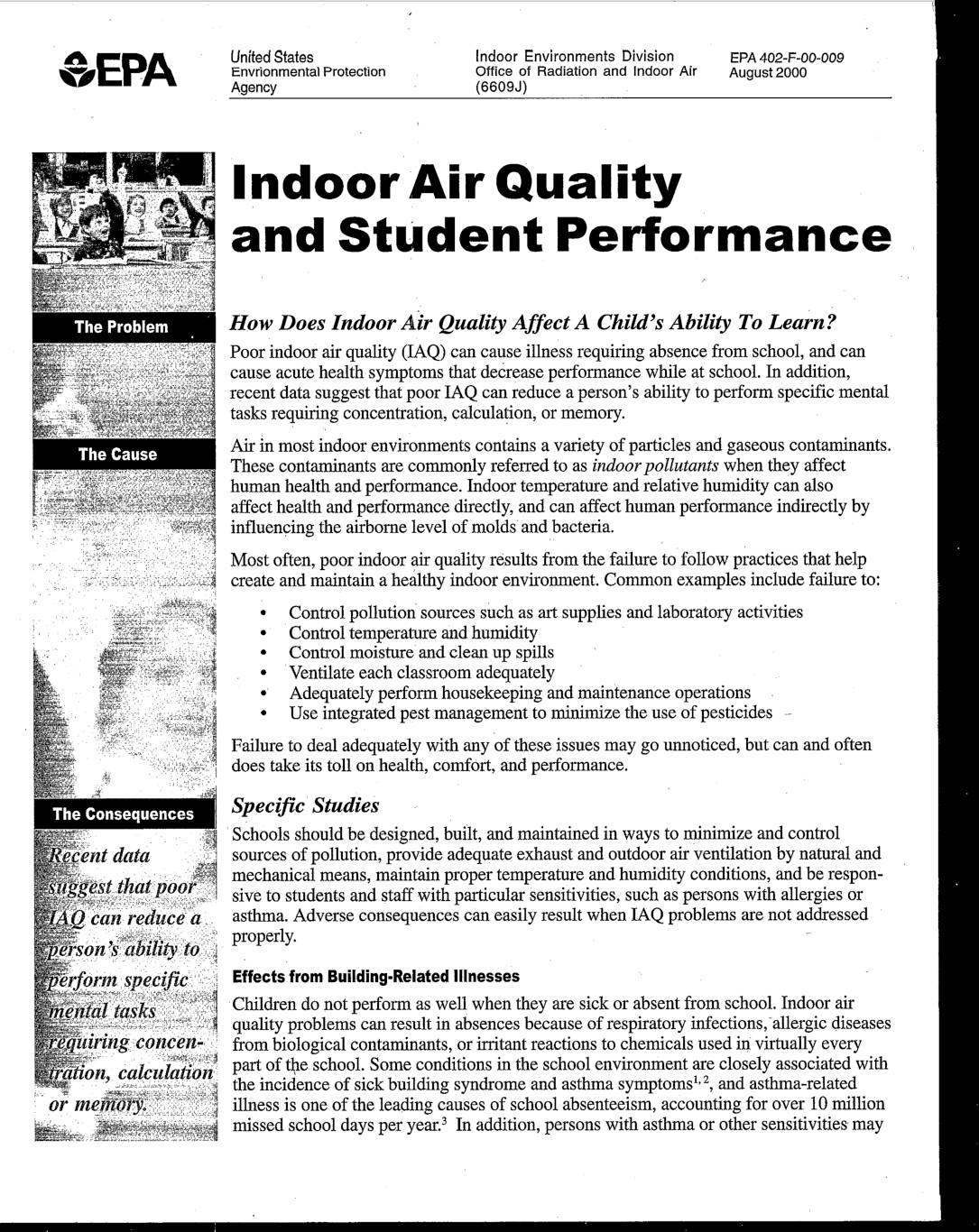
Indoor air quality and student performance
This EPA document explains how poor indoor air quality (IAQ) in schools can harm students' health and academic performance, causing absences due to respiratory illnesses and reducing the ability to concentrate, calculate, and remember. Studies show that high pollution levels, inadequate ventilation, and improper temperature and humidity control contribute to these problems. The EPA recommends schools use the IAQ Tools for Schools Kit to identify and address indoor air quality issues at little or no cost. -
 1997-09-01
Chronic noise exposure and reading deficits: The mediating effects of language acquisition
A 1997 Cornell University study found that elementary school children chronically exposed to aircraft noise showed significant reading deficits, even when tested under quiet conditions — meaning the harm stems from long-term exposure, not just momentary distraction. The researchers identified impaired language acquisition, particularly speech perception, as a key reason why noise-exposed children fall behind in reading. These findings have direct relevance for communities near busy airports, where sustained noise levels may quietly undermine children's academic development. -
1997-04-28
Kids near airports don’t read as well because they tune out speech, Cornell study finds
Children in schools bombarded by frequent aircraft noise don’t learn to read as well as children in quiet schools, Cornell University researchers have confirmed. And they have discovered one major reason: kids tune out speech in the racket. “We’ve known for a long time that chronic noise is having a devastating effect on the academic -
 1996-12-04
Neighborhood impact matrices
This document outlines a Neighborhood Impact Matrices framework used to assess environmental, transportation, and socio-economic effects of a proposed airport-related project on communities surrounding Seattle-Tacoma International Airport, including cities such as Burien, Des Moines, Federal Way, Normandy Park, and Tukwila. Each matrix evaluates impacts across four columns — Measure, Impact, Mitigation, and Cost — covering issues such as aircraft noise (DNL and SEL contours), air quality, surface and groundwater quality, wetlands, and floodplains. Proposed mitigations range from neighborhood buyouts at $760,000 per acre for areas within the 65 DNL contour to easement and insulation programs, stormwater management plans, and flight track modifications. -
 1975-12-01
The effect of elevated train noise on reading ability
A 1975 study by Bronzaft and McCarthy examined how noise from passing elevated subway trains affected the reading ability of elementary school children at a New York City school located approximately 220 feet from the tracks. Researchers compared reading scores of students in classrooms on the noisy train-facing side of the building versus the quieter opposite side, finding that chronic exposure to loud, unpredictable noise was associated with measurable reading deficits. The findings built on earlier research suggesting that children in high-noise environments struggle to distinguish relevant speech cues, which can hinder their ability to learn to read.