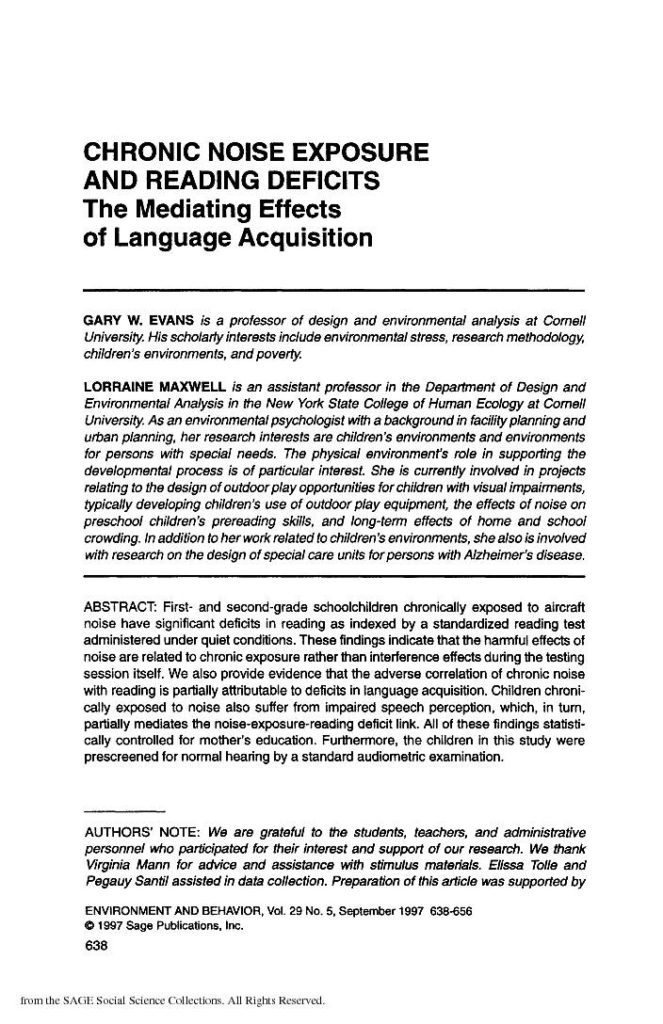
A 1997 Cornell University study found that elementary school children chronically exposed to aircraft noise showed significant reading deficits, even when tested under quiet conditions — meaning the harm stems from long-term exposure, not just momentary distraction. The researchers identified impaired language acquisition, particularly speech perception, as a key reason why noise-exposed children fall behind in reading. These findings have direct relevance for communities near busy airports, where sustained noise levels may quietly undermine children's academic development.Open full document
Notes
This study examines the relationship between chronic aircraft noise exposure and reading deficits in first- and second-grade schoolchildren. The authors investigate whether language acquisition processes — specifically speech perception and phoneme comprehension — mediate the link between noise exposure and reading deficits. Findings indicate that noise-related reading deficits stem from chronic exposure rather than acute interference during testing, and that impaired speech perception partially mediates the noise-exposure-reading deficit relationship.