TagCentury Agenda(40)
-
 2018-01-30
Tourism Marketing Support Program summary
This January 2018 Port of Seattle presentation outlines the Tourism Marketing Support Program, which aims to grow the region's visitor economy by increasing tourist numbers and spending across Washington State while expanding use of Port assets. The program supports partnerships with travel organizations and positions the Port as a leader in the visitor industry, aligning with the Port's broader Century Agenda goal of advancing the Seattle region as a leading tourism destination. -
Century Agenda: Strategic Objectives
(As amended December 19, 2017. Goals are intended to reflect attainment in 2037, unless explicitly noted otherwise.) Strategy 1: Position the Puget Sound region as a premier international logistics hub Objectives: 1. Grow seaport annual container volume to more than 3.5 million TEUs. 2. Structure the Port of Seattle’s relationship with Washington ports to optimize infrastructure -
 2017-10-24
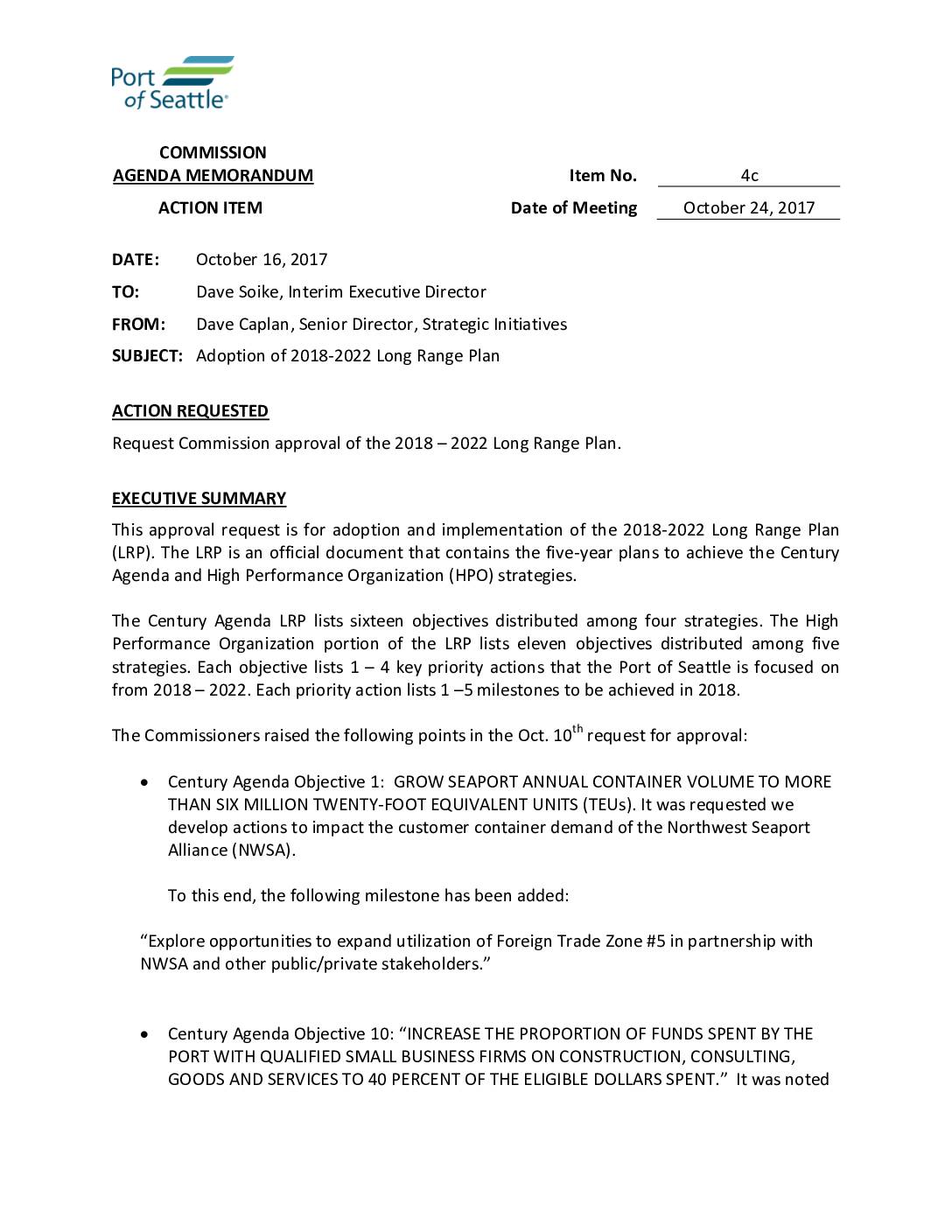
Adoption of 2018-2022 Long Range Plan
The Port of Seattle Commission considered approval of its 2018-2022 Long Range Plan (LRP) at its October 24, 2017 meeting, outlining a five-year strategy to achieve the Port's Century Agenda goals, including growing seaport container volume and increasing spending with small, women-owned, and minority-owned businesses. The plan incorporates cross-departmental efforts across aviation, maritime, environmental, and workforce development areas, and is designed to support the creation of 100,000 new jobs in the Puget Sound region. Note: this document addresses broad Port strategic planning and does not specifically cover Sea-Tac Airport noise policy. -
 2017-10-24
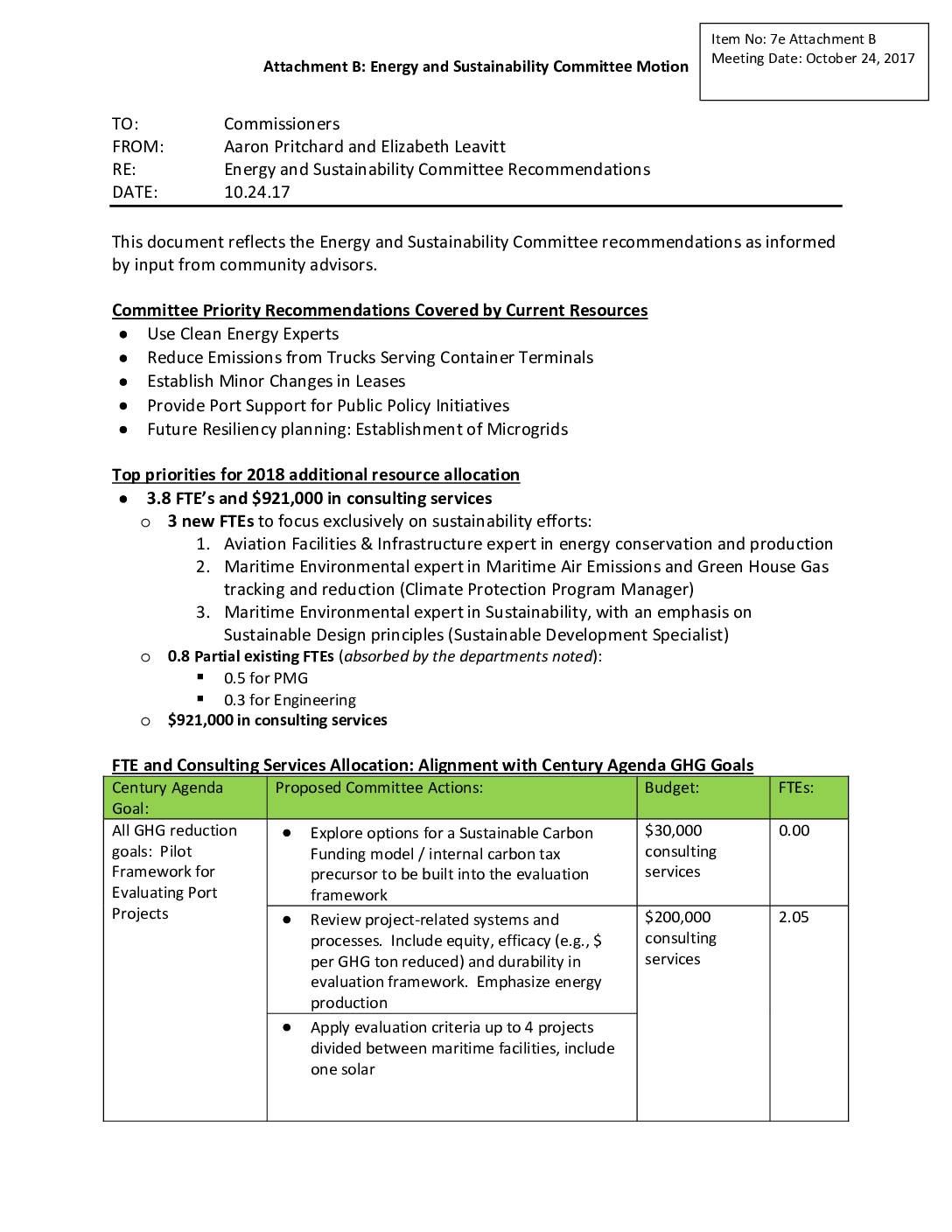
Energy and Sustainability Committee motion: recommendations for 2018 resource allocation
In October 2017, the Port of Seattle's Energy and Sustainability Committee recommended allocating 3.8 new staff positions and $921,000 in consulting services to advance greenhouse gas reduction goals for both aviation and maritime operations. Key initiatives included reducing natural gas use at airport terminals, improving energy efficiency at maritime facilities, and developing programs to cut ground transportation emissions. These efforts were designed to meet Century Agenda targets of 15% Scope 1 and 2 GHG reductions by 2020 and 50–80% Scope 3 reductions by 2030–2050. -
 2017-10-24
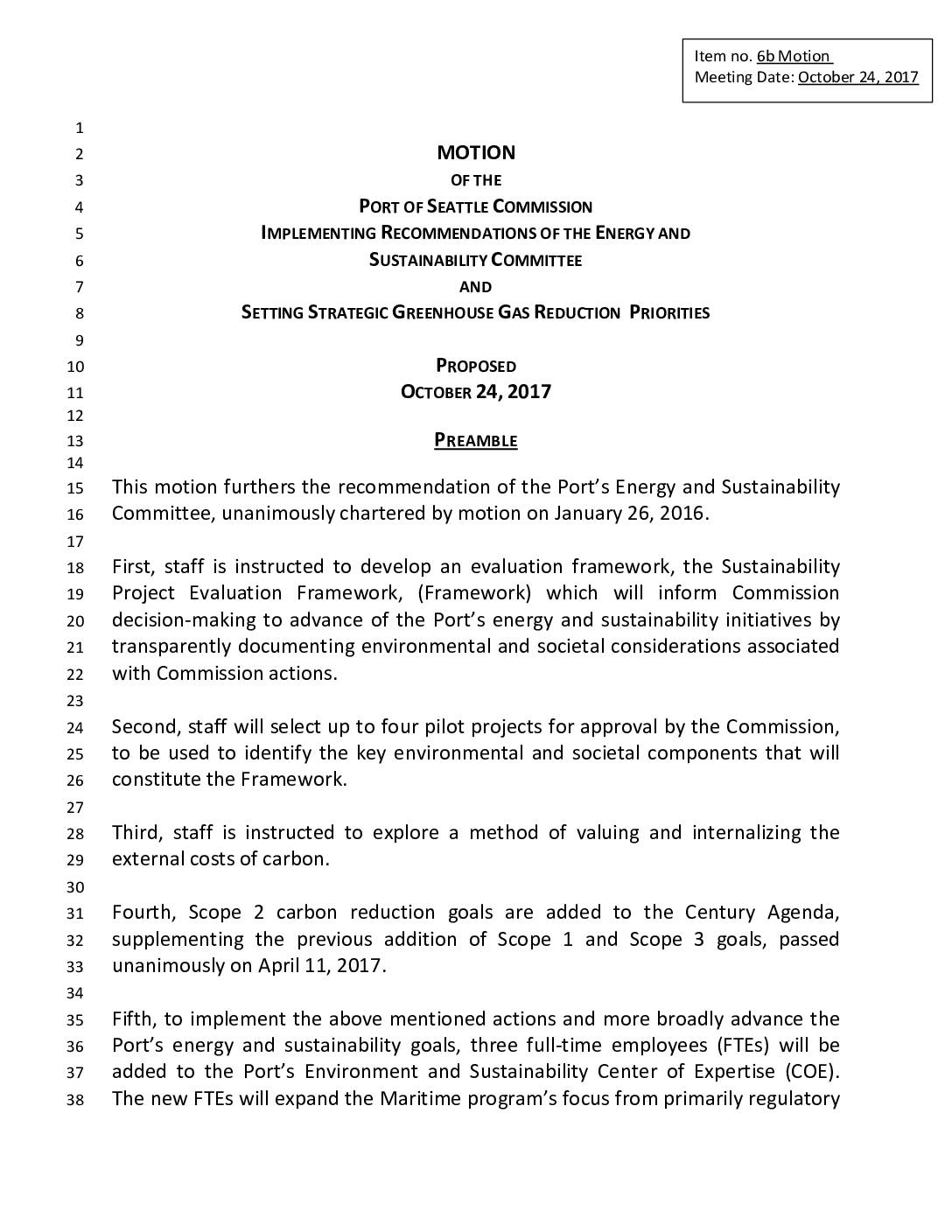
Motion of the Port Of Seattle Commission implementing recommendations of the Energy and Sustainability Committee and setting strategic greenhouse gas reduction priorities
In October 2017, the Port of Seattle Commission adopted a motion setting greenhouse gas reduction priorities and implementing recommendations from its Energy and Sustainability Committee. The motion established targets to reduce Scope 1, 2, and 3 emissions — aiming for 15% below 2005 levels by 2020, 50% below 2005 levels by 2030, and carbon neutrality by 2050. It also directed staff to develop a Sustainability Project Evaluation Framework, select pilot projects, and add three full-time employees to advance the Port's energy and sustainability goals. -
 2017-10-10
Port Of Seattle 2018-2022 long range plan: Achieving the Century Agenda
The Port of Seattle's 2018-2022 Long Range Plan outlines the agency's strategic goals for growing trade, commerce, maritime activity, and employment in the Seattle region, aiming to add 100,000 jobs while reducing its environmental footprint. The plan is guided by the Port's Century Agenda and is updated annually by the Commission to align budgets and departmental actions with economic and environmental priorities. Note: this document does not specifically address Sea-Tac Airport noise policy. -
 2017-09-26
2018 – 2022 Long Range Plan – Part Two, narratives
This 2018–2022 Long Range Plan document outlines strategic objectives for the Port of Seattle, focusing on growing seaport container volume, increasing outbound cargo value, supporting small businesses, and improving energy efficiency. It details key milestones for strengthening the Puget Sound region as an international logistics hub through the Northwest Seaport Alliance (NWSA), a partnership formed between the ports of Seattle and Tacoma in 2015. Note that this document does not directly address Sea-Tac Airport noise policy, but is part of the Port of Seattle's broader long-range planning framework. -
 2017-09-26
Long Range Plan 2018-2022 update (2 of 2) for Commission
This September 2017 Port of Seattle Commission presentation provides the second of two updates on the Long Range Plan (LRP) for 2018–2022, covering remaining Century Agenda and High Performance Organization objectives. It recaps key accomplishments from the first review held in July 2017, during which 20 of 27 LRP objectives were shared, and notes that Commission feedback from that session was incorporated into the latest draft document. The update outlines next steps for finalizing the five-year plan. -
 2017-09-26
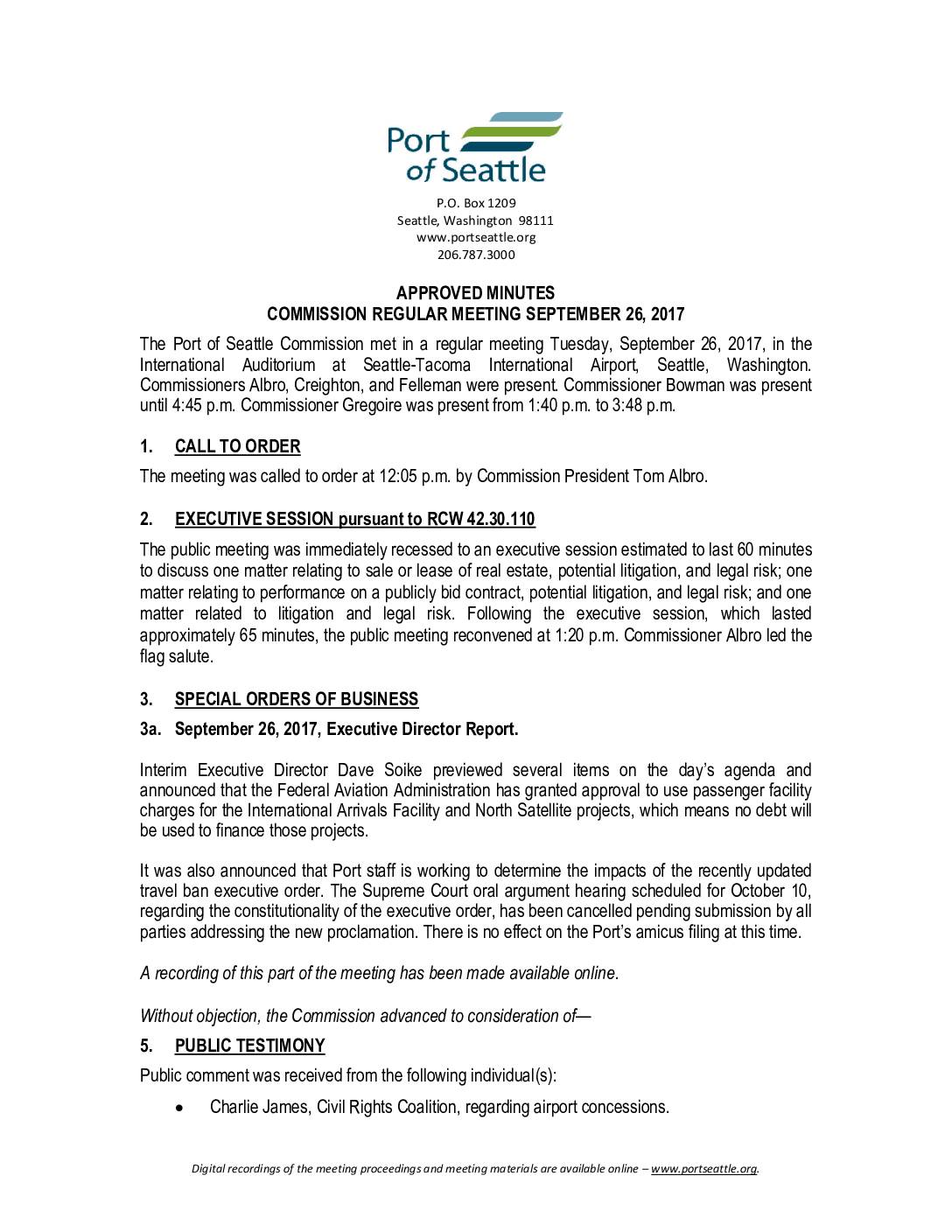
Approved minutes: Commission regular meeting September 26, 2017
The Port of Seattle Commission held a regular meeting on September 26, 2017, at Seattle-Tacoma International Airport, covering topics including FAA approval to use passenger facility charges for the International Arrivals Facility and North Satellite projects, eliminating the need for debt financing. A significant portion of the meeting involved public testimony from taxi drivers and transportation companies regarding taxi rates, as well as discussion of airport concessions. The Commission unanimously approved an amendment to the concession agreement with Eastside for Hire, lowering the per-trip fee to six dollars and introducing automatic vehicle tracking to improve fare transparency. -
 2017-09-26
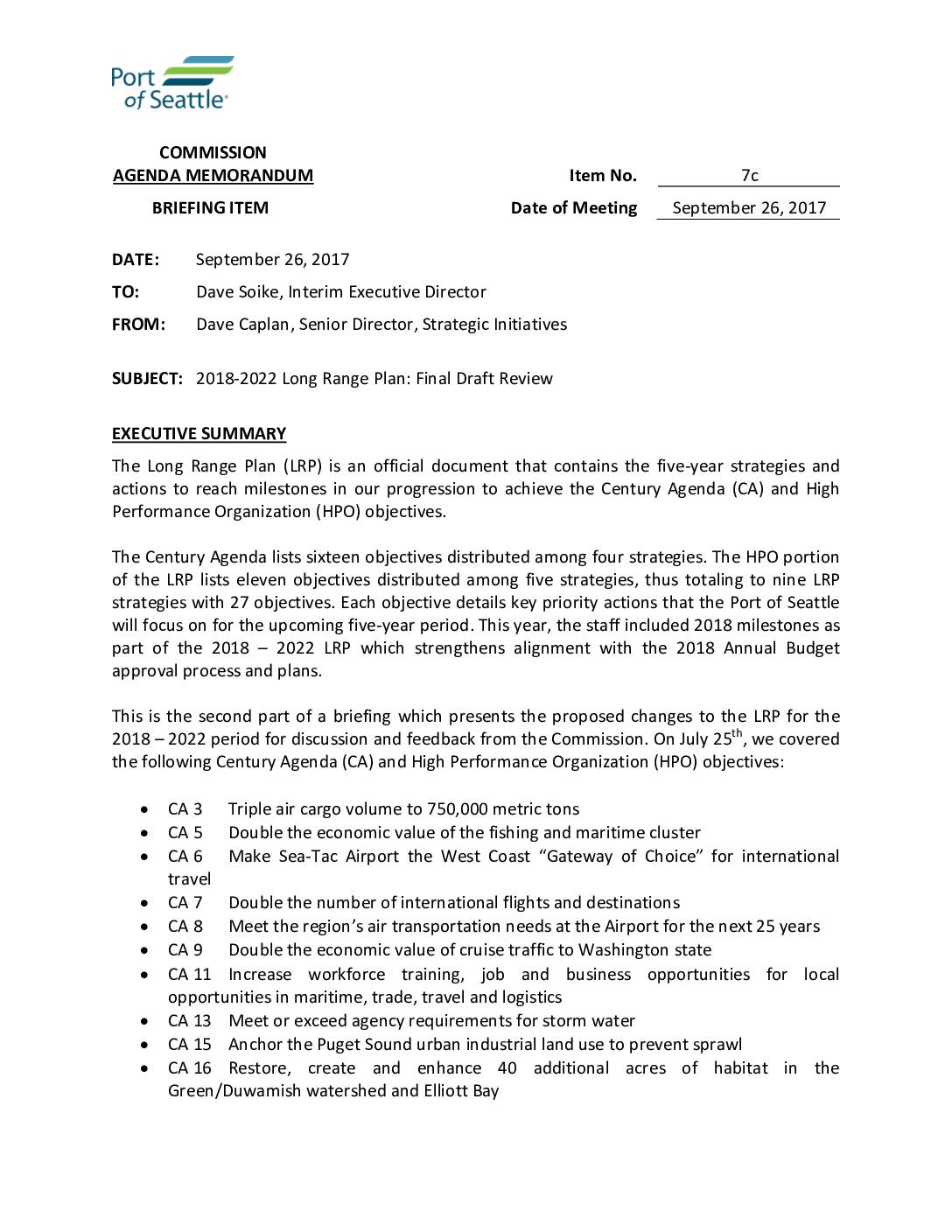
2018-2022 Long Range Plan: Final Draft Review
This September 2017 Port of Seattle Commission briefing memo presents the final draft review of the 2018–2022 Long Range Plan, which outlines five-year strategies and actions tied to the Port's Century Agenda and High Performance Organization goals. The document covers objectives across aviation, maritime, economic development, and environmental areas, including reducing air pollutants and carbon emissions at Sea-Tac Airport. It serves as a planning and budget alignment tool aimed at driving regional economic growth and creating 100,000 family-wage jobs.