TagSustainable Aviation Fuels(78)
-
Treasury issues tax-credit guidelines for sustainable aviation fuel
The IRS has issued more guidance on the new Sustainable Aviation Fuel credit. The SAF credit applies to qualified fuel mixtures containing sustainable aviation fuel for certain sales or uses in calendar years 2023 and 2024. (IR 2023-240, 12/15/2023; Notice 2024-6, 2024-2 IRB) Sustainable Aviation Fuel Credit. The Sustainable Aviation Fuel Credit (SAF) was part of -
 2023-12-09
Looking for a Greener Way to Fly
The Treasury Department is about to announce tax credits for sustainable aviation fuel, which raises the question: What fuels are actually “sustainable”? By Elizabeth Kolbert December 9, 2023 Planes account for roughly two per cent of the world’s CO2 emissions—if all the world’s aircraft got together to form a country, they’d emit more than the vast majority -
 2023-12-08
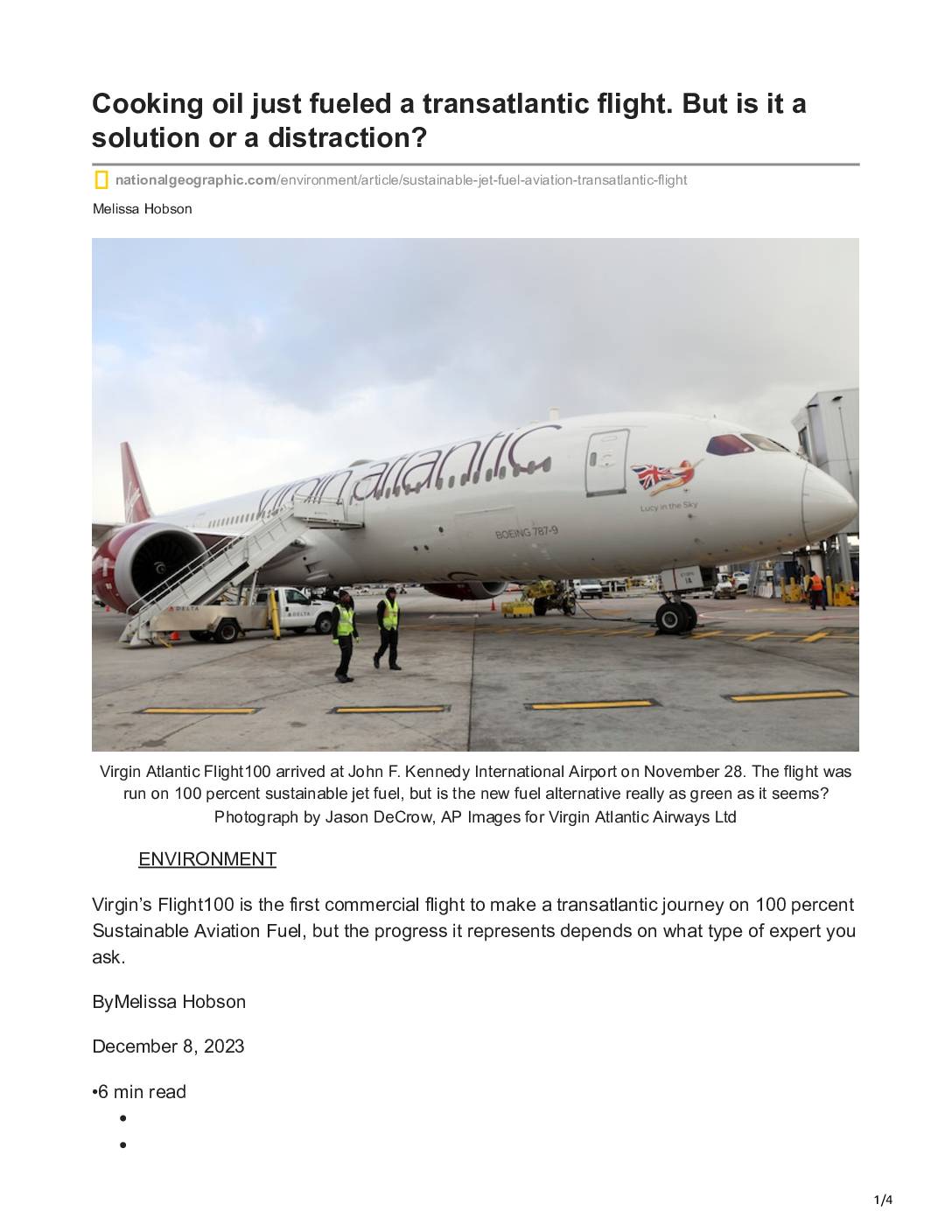
Cooking oil just fueled a transatlantic flight. But is it a solution or a distraction?
Virgin Atlantic completed the first transatlantic commercial flight powered entirely by Sustainable Aviation Fuel (SAF), made primarily from used cooking oil, flying from London Heathrow to New York JFK. While supporters say SAF can cut emissions by over 90% compared to conventional jet fuel and works with existing aircraft, critics argue it is a greenwashing effort due to limited fuel supply and potential land-use conflicts. SAF currently makes up less than 1% of global jet fuel and costs roughly three times more than conventional fuel, leaving its large-scale viability uncertain. -
2023-11-22
Why the world’s first flight powered entirely by sustainable aviation fuel is a green mirage
A Boeing 787 Dreamliner is set to take off from Heathrow on November 28 and head for JFK airport in New York, powered by so-called sustainable aviation fuel (SAF). According to its operator, Virgin Atlantic, the world’s “first 100% SAF flight” will mark “a historic moment in aviation’s roadmap to decarbonisation”. It is proof of concept, we -
 2023-11-07
Farm to Fly Act of 2023 (H.R. 6271)
The Farm to Fly Act of 2023 (H.R. 6271) is a U.S. House bill introduced in November 2023 that updates agricultural law definitions to formally include sustainable aviation fuel (SAF) within USDA bioenergy programs. The bill aims to expand the domestic supply of cleaner aviation fuel by supporting American farmers and agricultural feedstocks as key sources for SAF production. It recognizes the partnership between the agricultural and aviation sectors as a means to boost rural economic development and domestic energy security. -
Truckee Tahoe Airport Goes All-in on Sustainable Aviation Fuel
Author: Mike Schwanz Published in: November-December Truckee Tahoe Airport (TRK) in California recently made a bold environmental move by changing from standard Jet A to sustainable aviation fuel (SAF). The general aviation airport started offering SAF several years ago, with a goal of gradually increasing the percentage sold to 100% by the end of 2023. -
WA’s largest oil refinery ramps up cleaner fuels as climate laws take hold
By Isabella Breda Seattle Times staff reporter CHERRY POINT, Whatcom County — Thick steam billowed from a series of towers and pipes, intricately woven together to form a powerhouse of the region’s energy production and Washington’s largest oil refinery. BP’s Cherry Point facility, which belched more than 2 million metric tons of climate-warming gases into -
 2023-09-04
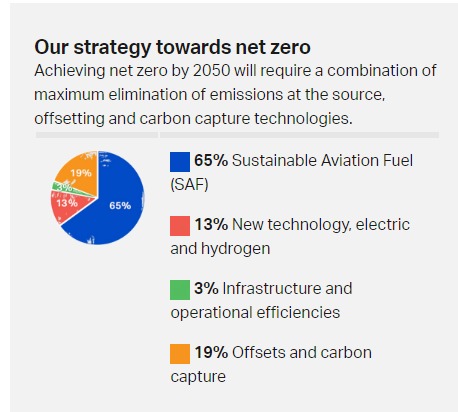
Net Zero Strategy Pie Chart — Aviation Emissions Reduction
A pie chart titled 'Our strategy towards net zero' outlines a combination of approaches to achieve net zero by 2050: 65% Sustainable Aviation Fuel (SAF), 19% Offsets and carbon capture, 13% New technology, electric and hydrogen, and 3% Infrastructure and operational efficiencies. No organizational logo or authorship is clearly visible in this cropped image. -
 2023-08-23
Sustainable aviation fuels: Roles of airports & networks
This presentation by Erin Cooke of San Francisco International Airport (SFO) outlines the roles that airports and networks can play in advancing Sustainable Aviation Fuels (SAF). It covers how airports can baseline emissions, set policy ambitions, study supply chain and financing challenges, and build awareness among future fuel buyers. The presentation also addresses how broader coalitions can streamline roadmaps, advocate for funding, and expand incentives to accelerate SAF adoption. -
Sustainable aviation fuels aren’t the answer; flying less is
By Laura Gibbons and Brandon Bowersox-Johnson Special to The Seattle Times Despite The Seattle Times’ editorial board’s enthusiasm for sustainable aviation fuels, SAF remain a dangerous fantasy. If we buy into this myth, we will continue expanding air travel instead of what we actually must do: significantly reduce flights until real solutions are in place.