TagSustainable Airport Master Plan(126)
-
-
Sustainable Airport Master Plan 2019 Scoping Documents
1The same documents can be found here. [get_filebird_folder folder_id=170] 1We often provide replicas of important documents, news stories, etc. We refer to this as ‘belt and suspenders’. Although we always recommend that researchers source from the original sites, computers often fail. It’s good to have backup. -
The SAMP Four City Consultant ILA 2018
Burien, Des Moines, Normandy Park, SeaTac environmental response Although the Sustainable Airport Master Plan (SAMP) was announced in 2012, it only moved towards public environmental review in 2017. We covered where we’re at now in the SAMP Public Comment Explainer To help them navigate the process, in 2018 four cities (Burien, Des Moines, Normandy Park, -
-
The SAMP Comment Period Explainer (Intro)
Preparing for the October 21st Comment Period This is the first of a two-part article concerning the SAMP comment period. We’re including a few paragraphs of background because the process has been so lengthy–with many years of delay. The feedback we’ve received thus far has been confusion, partly because the information on the Port’s official -
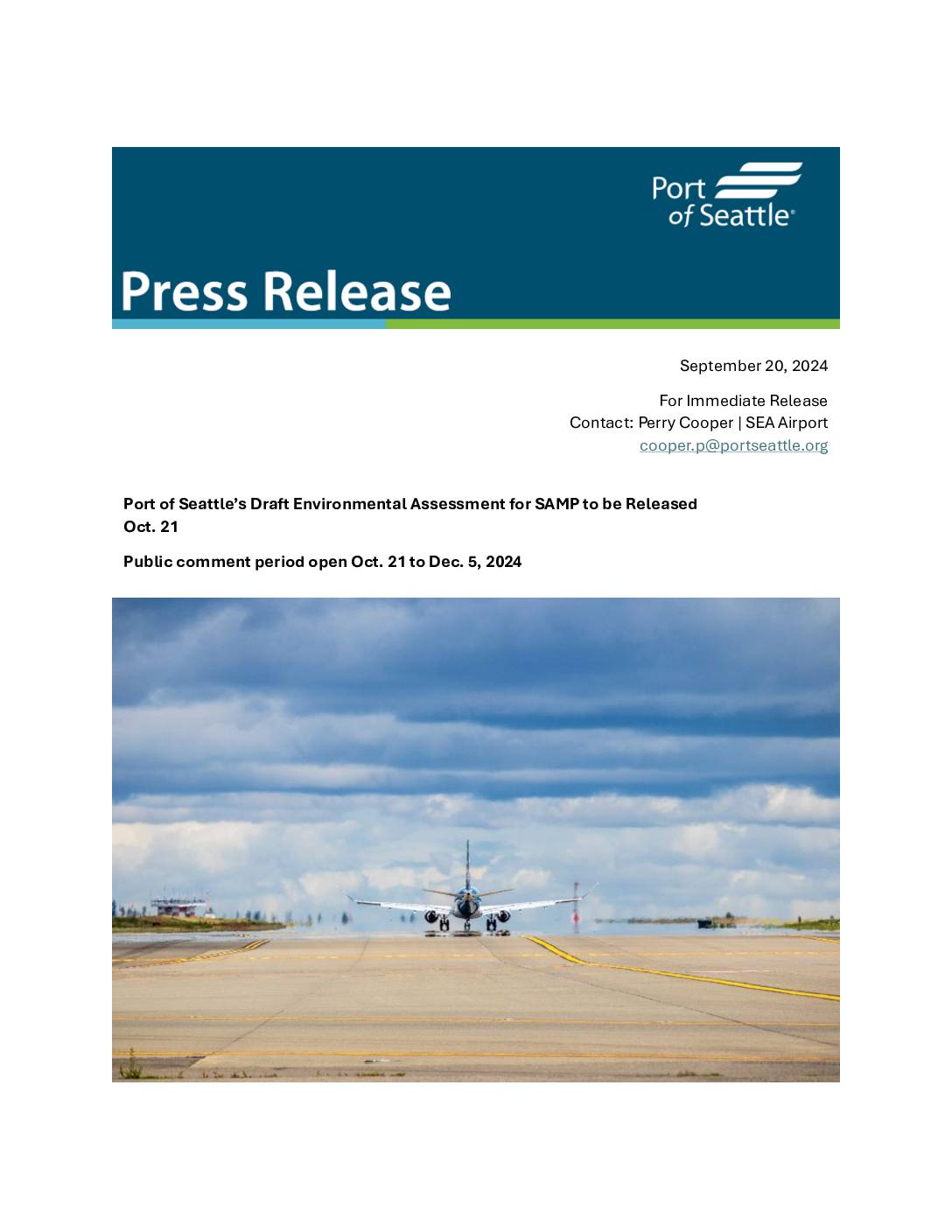
SAMP Press Release 2024-09-20
Port of Seattle’s Draft Environmental Assessment for SAMP to be Released Oct. 21 Public comment period open Oct. 21 to Dec. 5, 2024 -
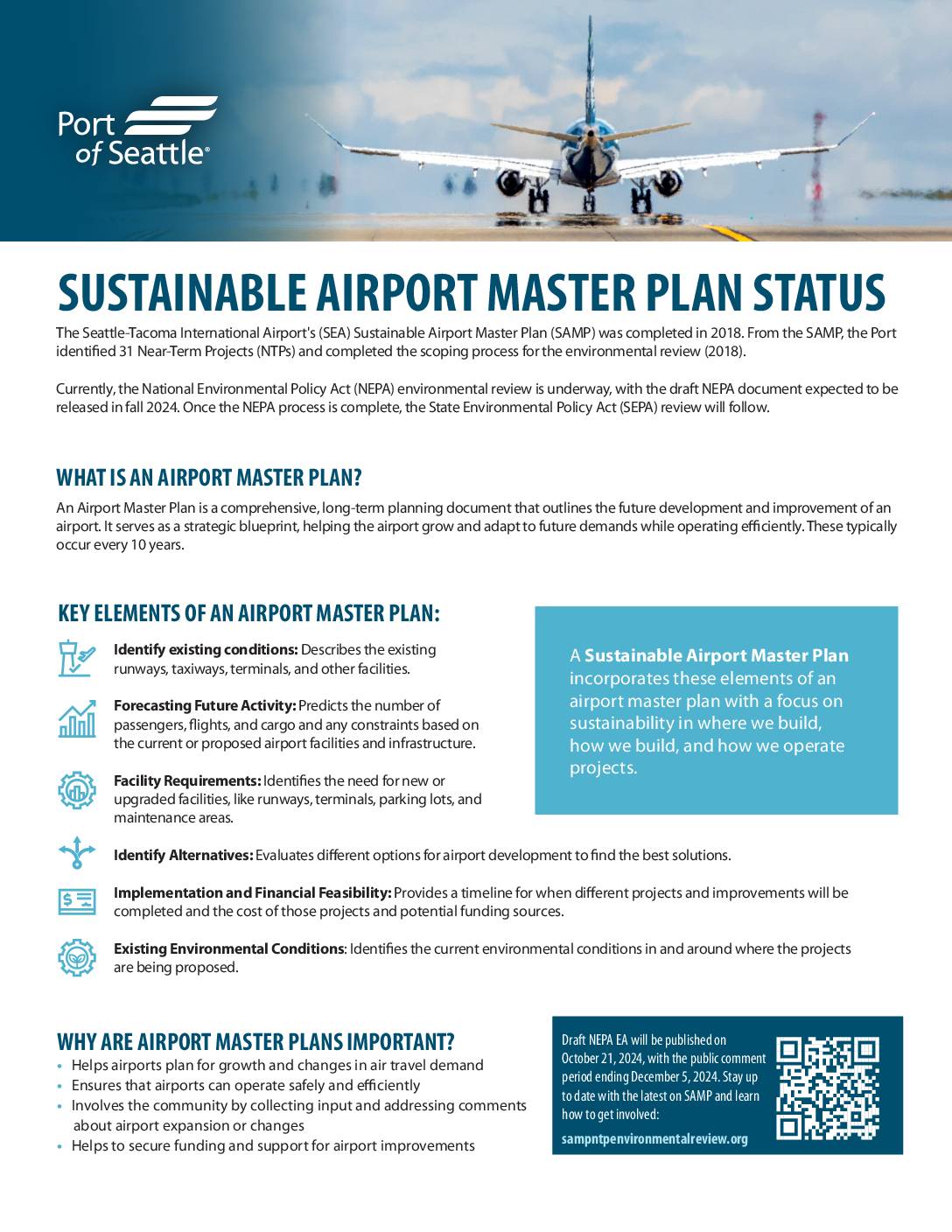
SAMP Environmental Review Factsheet September 20, 2024
The Seattle-Tacoma International Airport's (SEA) Sustainable Airport Master Plan (SAMP) was completed in 2018. From the SAMP, the Port identi�ed 31 Near-Term Projects (NTPs) and completed the scoping process for the environmental review (2018). Currently, the National Environmental Policy Act (NEPA) environmental review is underway, with the draft NEPA document expected to be released in fall 2024. Once the NEPA process is complete, the State Environmental Policy Act (SEPA) review will follow. An Airport Master Plan is a comprehensive, long-term planning document that outlines the future development and improvement of an airport. It serves as a strategic blueprint, helping the airport grow and adapt to future demands while operating e�ciently. These typically occur every 10 years. WHY ARE AIRPORT MASTER PLANS IMPORTANT? • Helps airports plan for growth and changes in air travel demand • Ensures that airports can operate safely and e�ciently • Involves the community by collecting input and addressing comments about airport expansion or changes • Helps to secure funding and support for airport improvements SUSTAINABLE AIRPORT MASTER PLAN STATUS WHAT IS AN AIRPORT MASTER PLAN? KEY ELEMENTS OF AN AIRPORT MASTER PLAN: Identify existing conditions: Describes the existing runways, taxiways, terminals, and other facilities. Forecasting Future Activity: Predicts the number of passengers, �ights, and cargo and any constraints based on the current or proposed airport facilities and infrastructure. Facility Requirements: Identi�es the need for new or upgraded facilities, like runways, terminals, parking lots, and maintenance areas. Identify Alternatives: Evaluates di�erent options for airport development to �nd… -
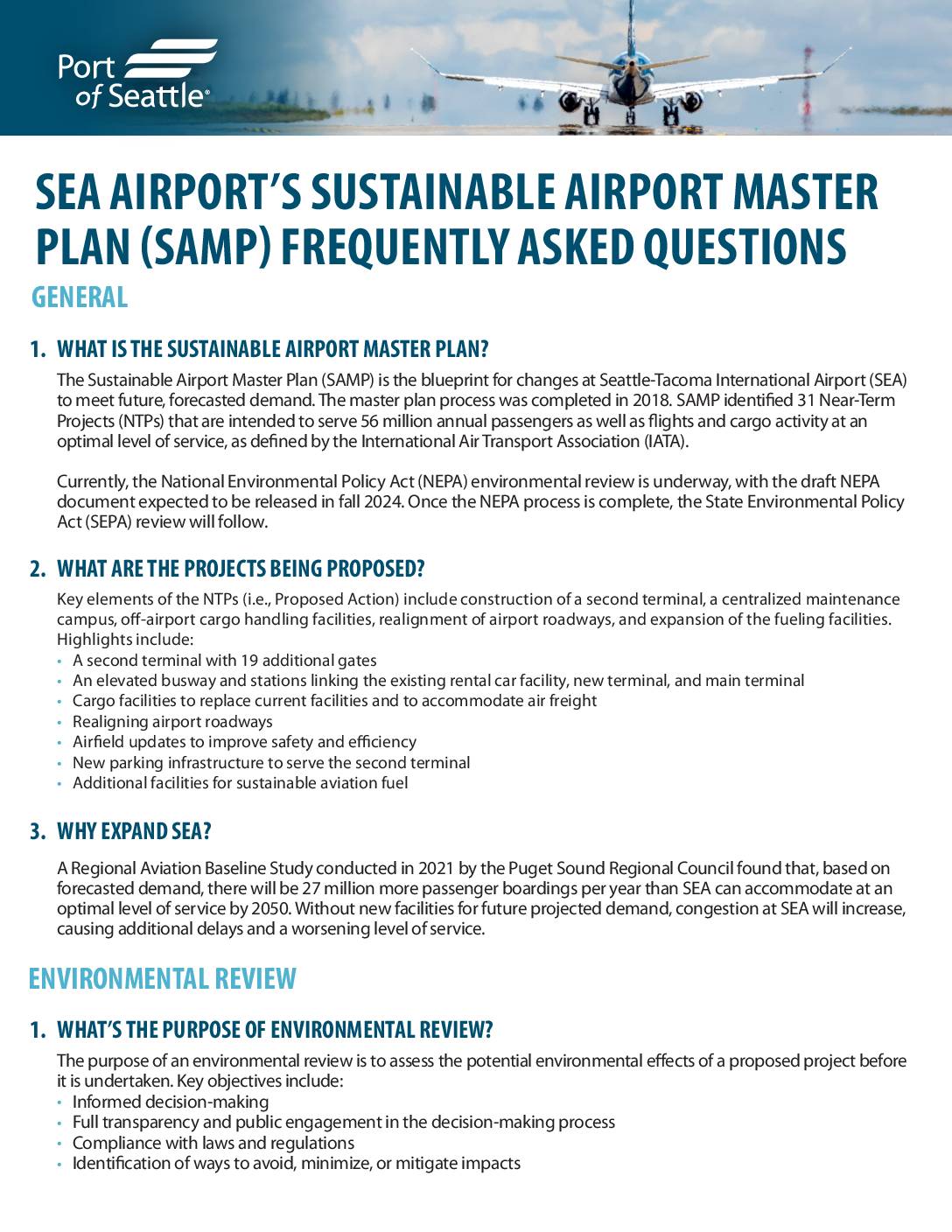
SAMP FAQs 2024-09-20
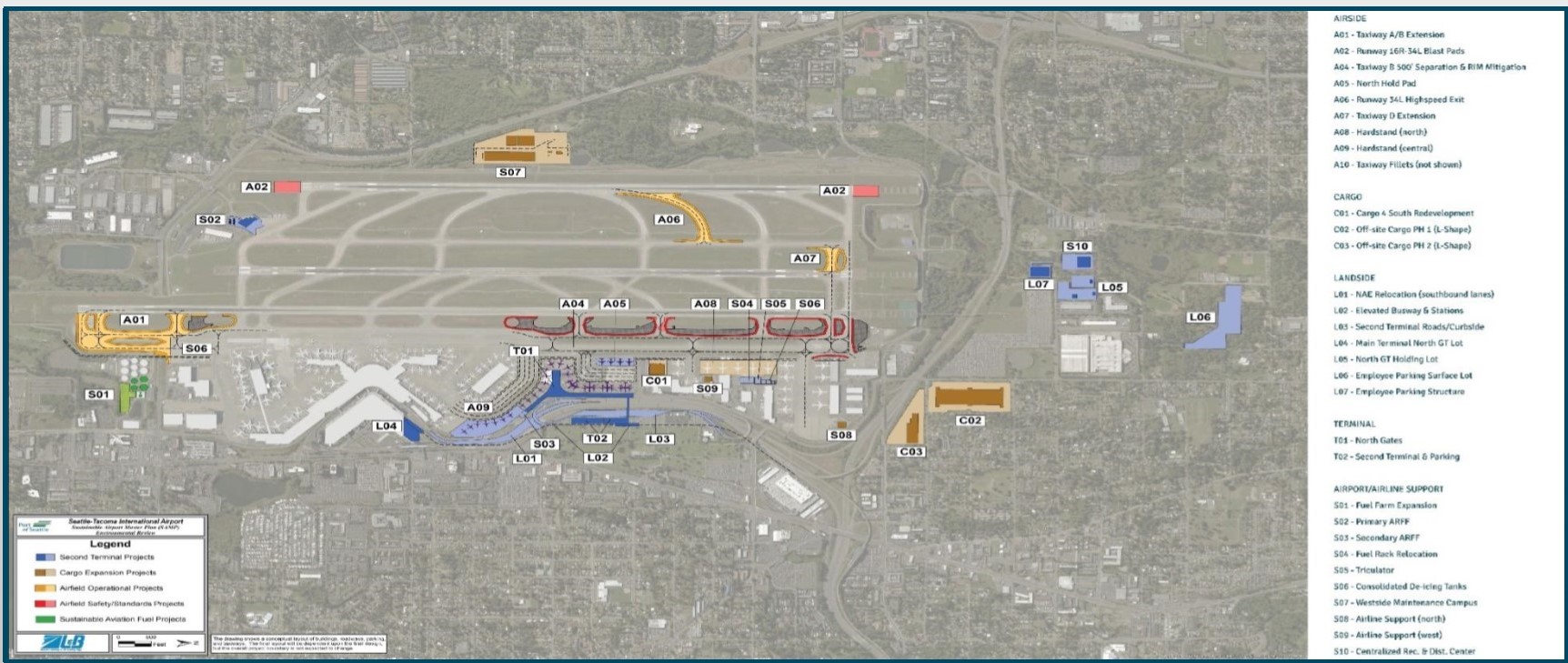
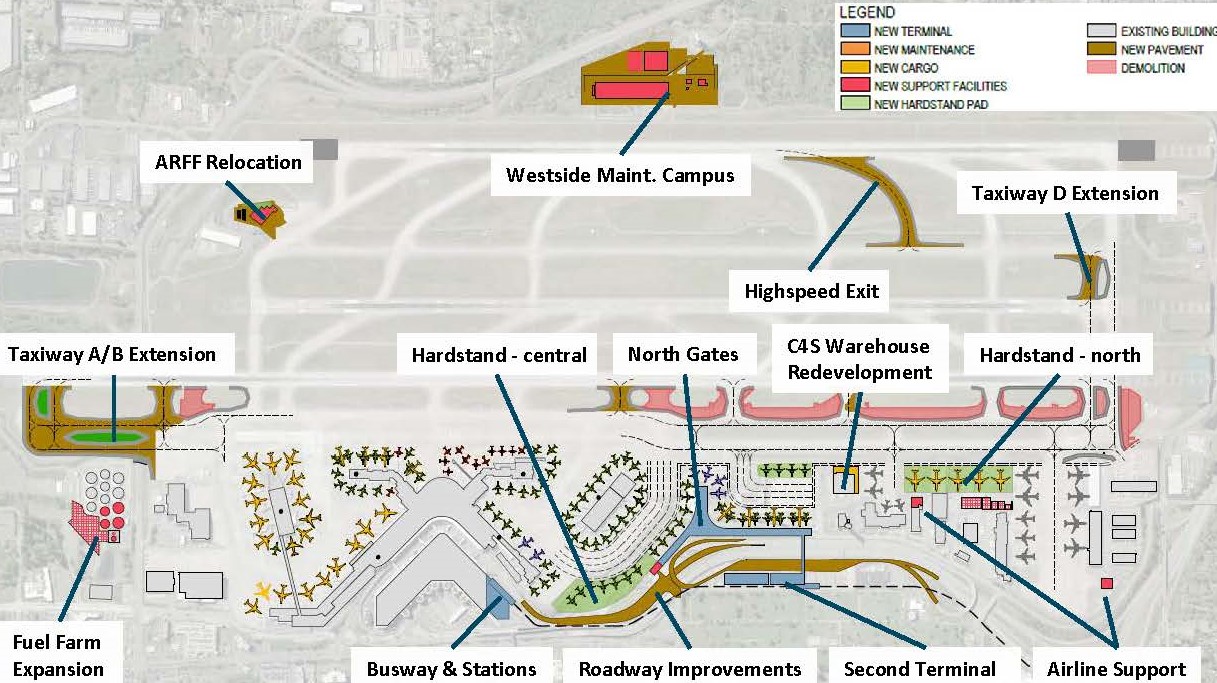
The Sustainable Airport Master Plan (SAMP) is the blueprint for changes at Seattle-Tacoma International Airport (SEA) to meet future, forecasted demand. The master plan process was completed in 2018. SAMP identi�ed 31 Near-Term Projects (NTPs) that are intended to serve 56 million annual passengers as well as �ights and cargo activity at an optimal level of service, as de�ned by the International Air Transport Association (IATA). Currently, the National Environmental Policy Act (NEPA) environmental review is underway, with the draft NEPA document expected to be released in fall 2024. Once the NEPA process is complete, the State Environmental Policy Act (SEPA) review will follow. Key elements of the NTPs (i.e., Proposed Action) include construction of a second terminal, a centralized maintenance campus, o�-airport cargo handling facilities, realignment of airport roadways, and expansion of the fueling facilities. Highlights include: • A second terminal with 19 additional gates • An elevated busway and stations linking the existing rental car facility, new terminal, and main terminal • Cargo facilities to replace current facilities and to accommodate air freight • Realigning airport roadways • Air�eld updates to improve safety and e�ciency • New parking infrastructure to serve the second terminal • Additional facilities for sustainable aviation fuel www.portseattle.org A Regional Aviation Baseline Study conducted in 2021 by the Puget Sound Regional Council found that, based on forecasted demand, there will be 27 million more passenger boardings per year than SEA can accommodate at an optimal level of service by 2050. Without new facilities for… -
2024-09-20 20:23
SAMP Update September 20, 2024
After a four year pause, Environmental Review of Near-Term Projects begins October 21 with a 45 day comment period. The end result will be 2025 rulings by the FAA (NEPA) and the State of Washington (SEPA) to determine whether or not a full EIS is required. -
The Factory
A two minute presentation on how the Sustainable Airport Master Plan (SAMP) will increase flight operations at Sea-Tac Airport as much as a new runway. Without a new runway.