TagStART(508)
-
 2019-09-12
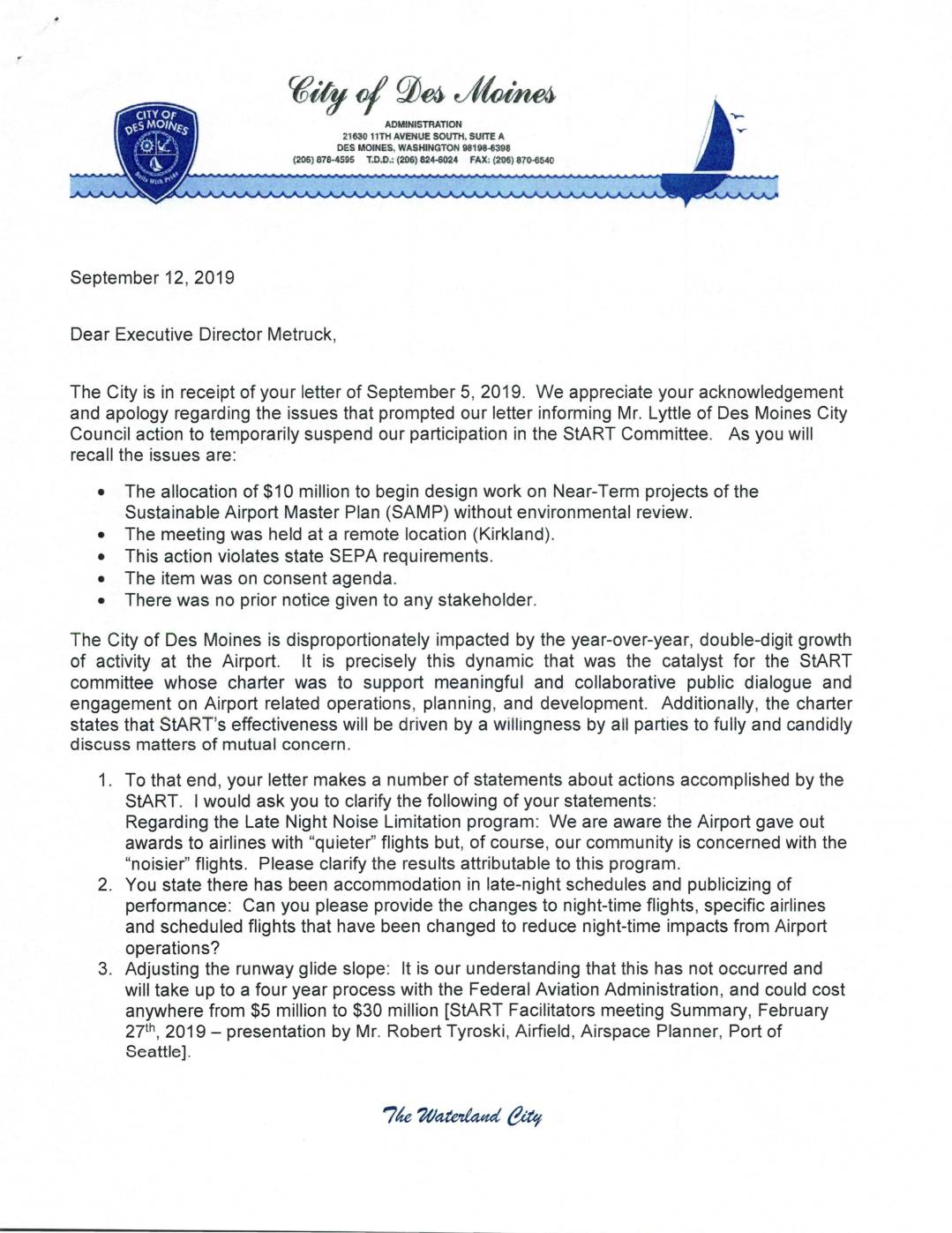
City of Des Moines response to Port Of Seattle Executive Director Metruck regarding StART Committee
In September 2019, the City of Des Moines responded to a Port of Seattle apology letter regarding the allocation of $10 million for Sustainable Airport Master Plan (SAMP) design work without prior environmental review or stakeholder notice, which had prompted Des Moines and other nearby cities to temporarily suspend participation in the Sea-Tac Stakeholder Advisory Round Table (StART). The City challenged the Port's claims of meaningful progress on noise reduction measures, requesting specific data on the Late Night Noise Limitation program, changes to nighttime flight schedules, and the status of runway glide slope adjustments. The exchange highlights ongoing tensions between Sea-Tac Airport and surrounding communities over transparency, environmental compliance, and the effectiveness of collaborative noise mitigation efforts. -
 2019-09-12
City of Des Moines Letter to Executive Director Metruck in Response to Port Of Seattle
In a September 12, 2019 letter to Port of Seattle Executive Director Steve Metruck, Des Moines Mayor Matt Pina outlines the city's concerns about Sea-Tac Airport's decision to allocate $10 million for Sustainable Airport Master Plan design work without environmental review or stakeholder notice, which prompted Des Moines to temporarily suspend its participation in the StART Committee. The letter demands specific, verifiable data on six noise-mitigation measures the Port claimed to have accomplished, including late-night flight reductions, runway glide slope adjustments, and third-runway usage limits, arguing these initiatives have been overstated as completed achievements. While expressing willingness to re-engage and noting several positive Port-city partnerships, Des Moines calls for greater transparency and accountability in the airport's community engagement process. -
 2019-09-12
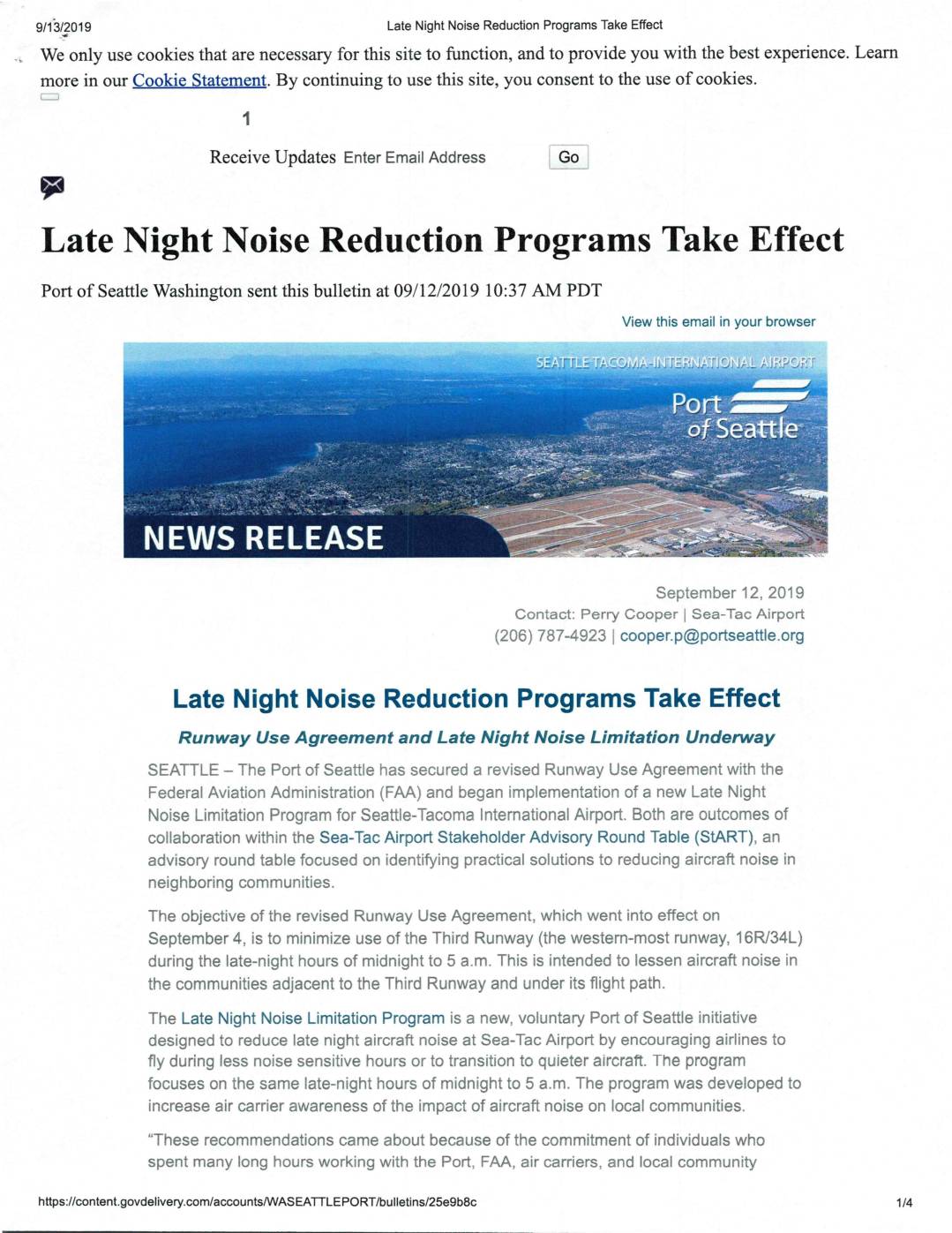
Late night noise reduction programs take effect
In September 2019, the Port of Seattle announced two new programs to reduce late-night aircraft noise at Seattle-Tacoma International Airport. A revised Runway Use Agreement with the FAA took effect on September 4, limiting use of the Third Runway (16R/34L) between midnight and 5 a.m., while a new voluntary Late Night Noise Limitation Program encourages airlines to schedule flights during less noise-sensitive hours or switch to quieter aircraft during the same period. Both initiatives stemmed from recommendations by the Sea-Tac Airport Stakeholder Advisory Round Table (StART). -
A Letter To Earnest Thompson
Mr. Thompson is a member of the StART Committee for Normandy Park and a candidate for City Council in that town. This letter is in regard to a failed Resolution #944 voted on at their City Council Meeting 09/10/2019. Hi Earnest, Again, I’m sorry that I was unable to make the Normandy Park City Council -
 2019-09-09
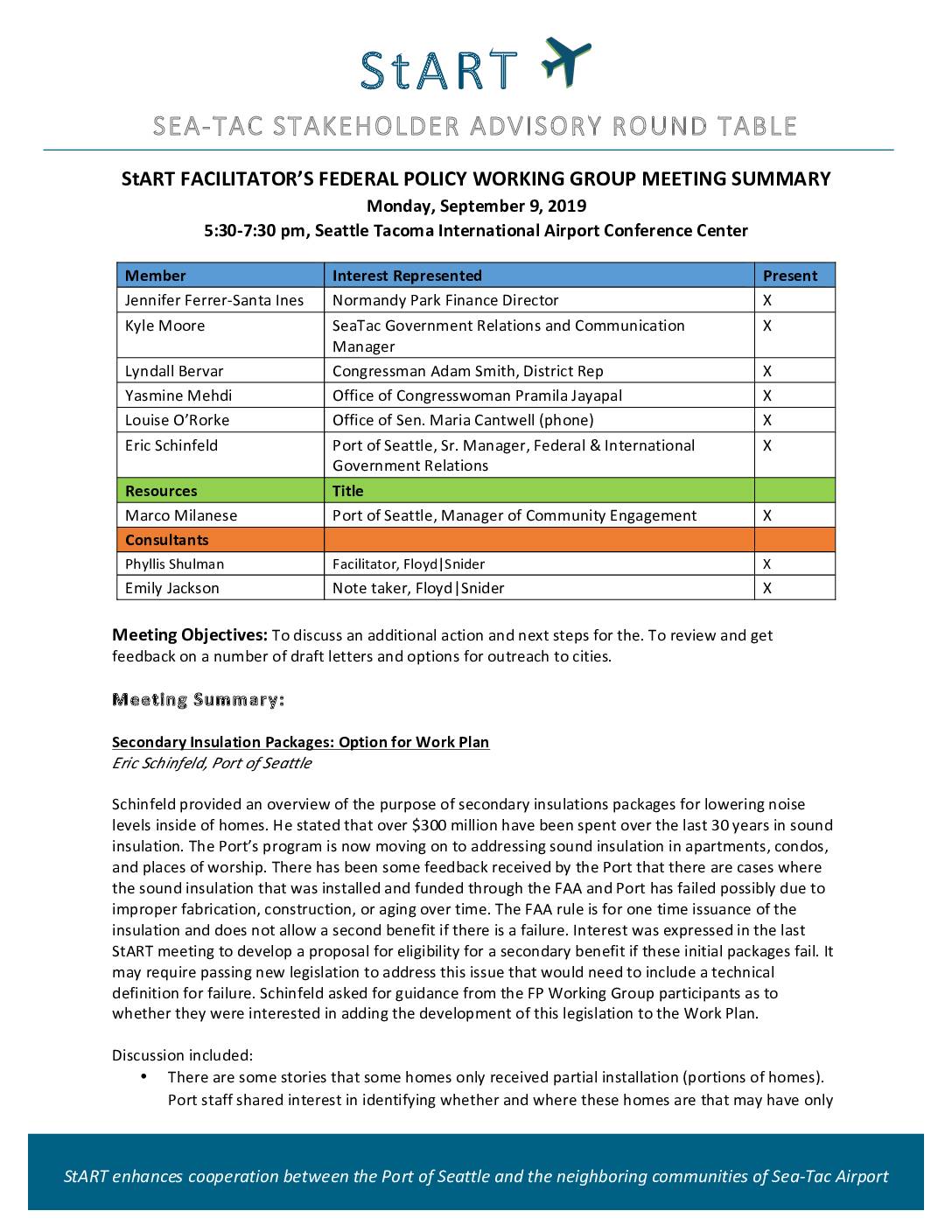
StART facilitator’s Federal Policy Working Group meeting summary
This document summarizes a September 9, 2019 meeting of the StART Federal Policy Working Group, a collaboration between the Port of Seattle and neighboring communities affected by Sea-Tac Airport noise. Key topics included a proposal to allow secondary sound insulation benefits for homes where original FAA-funded insulation has failed, and a review of draft letters to be sent to the FAA and members of Congress regarding noise studies and mitigation policies. The group also discussed strategies for outreach to six original StART member cities and a potential trip to Washington, DC to advocate for noise-related legislative priorities. -
 2019-09-05
Port Of Seattle Executive Director Letter to Burien City Council on StART Suspension
In this September 5, 2019 letter, Port of Seattle Executive Director Stephen Metruck responds to the City of Burien's decision to suspend participation in the Sea-Tac Stakeholder Advisory Round Table (StART), along with similar decisions by Des Moines and Federal Way. Metruck apologizes for failing to promptly notify cities about preliminary design funding and reaffirms the Port's commitment to open communication on airport expansion and noise issues. He highlights progress made through StART—such as late-night noise limits, runway glide slope adjustments, and requests for airlines to retire louder aircraft—and pledges to work with all cities to find a constructive path forward. -
2019-09-05
Port Of Seattle Executive Director Letter to Burien City Council on StART Suspension
In this September 5, 2019 letter, Port of Seattle Executive Director Stephen Metruck responds to the City of Burien's decision to suspend participation in the Sea-Tac Stakeholder Advisory Round Table (StART), along with similar decisions by Des Moines and Federal Way. Metruck apologizes for failing to promptly notify cities about preliminary design funding and reaffirms the Port's commitment to open communication on airport expansion and noise issues. He highlights progress made through StART—such as late-night noise limits, runway glide slope adjustments, and requests for airlines to retire louder aircraft—and pledges to work with all cities to find a constructive path forward. -
 2019-08-28
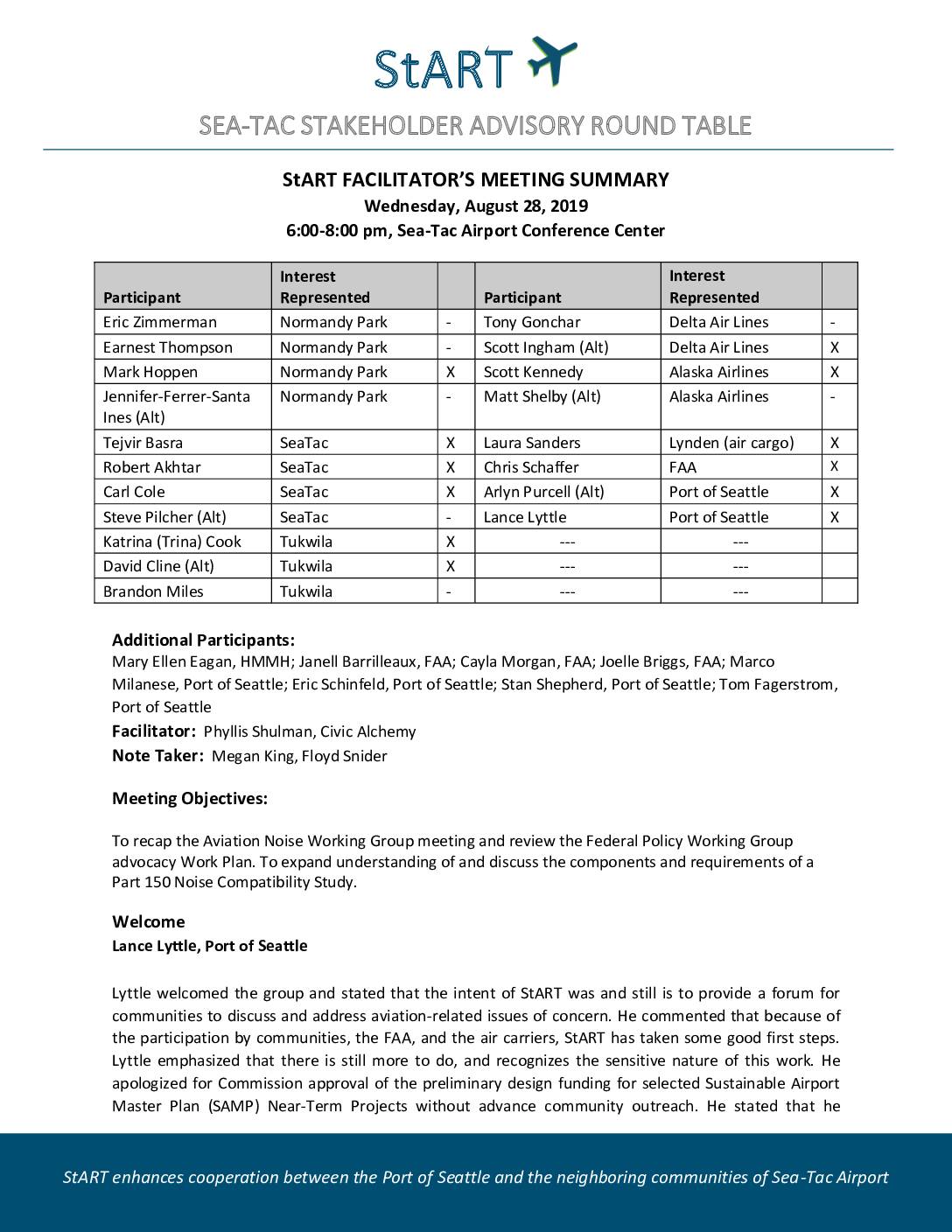
StART facilitator’s meeting summary, August 28, 2019
This document summarizes the StART (Sea-Tac Stakeholder Advisory Round Table) meeting held on August 28, 2019, where community representatives, airline officials, the FAA, and the Port of Seattle discussed ongoing efforts to address aviation noise concerns around Sea-Tac Airport. Key topics included updates on the Revised Runway Use Agreement to limit late-night use of the 3rd Runway, the Late-night Noise Limitation Program, and a Noise Abatement Departure Profile analysis aimed at reducing community noise impacts. Port of Seattle director Lance Lyttle also addressed tensions with some neighboring cities that had suspended participation in StART, urging them to rejoin the collaborative process. -
 2019-08-28
Federal aircraft noise regulations: Part 150 overview
This presentation, delivered to the Sea-Tac Stakeholder Advisory Round Table in August 2019, provides an overview of 14 CFR Part 150, the federal regulation governing airport noise compatibility planning. Created by the FAA in response to the Aviation Safety and Noise Abatement Act of 1979, Part 150 establishes standards for measuring noise, modeling cumulative noise exposure, and coordinating with local land use agencies. The study process involves four key phases—developing a study protocol, verification, creating Noise Exposure Maps (NEMs), and developing Noise Compatibility Plans (NCPs)—supported by public and technical advisory meetings throughout. -
 2019-08-28
Sound mitigation briefing
This August 2019 Port of Seattle briefing outlines the airport's sound mitigation program for neighborhoods near Sea-Tac Airport. It defines a Noise Remedy Boundary based on the 2018 forecasted DNL 65 dB contour, covering areas roughly between 240th Street, 8th Avenue, HWY 99, and 101st Street. Eligible homeowners can receive free sound insulation—including rated windows, doors, and ventilation—in exchange for granting the Port an Avigation Easement, with the goal of reducing interior noise levels to DNL 45 dB or less.