TagEIS(25)
-
 1996-02-01 00:00
Sea-Tac Airport Final EIS, Feb. 1996, Vol. 5 of 7
This statement is submitted for review pursuant to the requirements of Section 102(2)(C) of the National Environmental Policy Act of 1969 (42 U.S.C. 4321 et seq); E.O. 11990, Protection of Wetlands; E.O. 11998, Floodplain Management; the USC Subtitle VII; 42 U.S.C. 7401 et seq; 49 U.S.C. 47101 et seq; Washington State Environmental Policy Act (RCVJ 43.21C); and other applicable laws. The proposed action will impact the 100-year floodplain as indicated on the Federal Emergency Management Agency's Flood Insurance Rate Map. This Environmental Impact Statement (EIS) is a combined National Environmental Policy Act and Wa~hington State Environmental Policy Act (SEPA) document. With regard to SEPA requirements. this EIS represents the second step of a phased environmental review which began with publication of the 1992 Right Plan Final EIS, which assessed alternatives for addressing regional aviation needs. Thii Final EIS also contains the draft conformity statement, as required by the Clean Air Act amendments. The Port of Seattle, operator of Seattle-Tacoma International Airport, has prepared a Master Plan Update for the Airport. The Plan shows the need to address the poor weather operating capability of the Airport through the development of a third parallel runway (Runway 16W34X) with a length of up to 8,500 feet, separated by 2,500 feet from existing Runway 16U34R, with associated taxiways and navigational aids. Other development needs include: extension of Runway 34R by 600 feet; establishment of standard Runway Safety Areas for Runways 16W34L and 16U34R; development of a new air traffic control tower; development of a… -
 1996-02-01 00:00
Sea-Tac Airport Final EIS, Feb. 1996, Vol. 6 of 7
This statement is submitted for review pursuant to the requirements of Section 102(2)(C) of the National Environmental .-. Policy Act of 1969 (42 U.S.C. 4321 et seq); E.O. 11990, Protection of Wetlands; E.O. 11998, floodplain Management; the USC Subtitle VII; 42 U.S.C. 7401 et seq; 49 U.S.C. 47101 et seq; Washington State Environmental Policy Act (RCW 43.21C); and other applicable laws. The proposed action will impact the 100-year floodplain as indicated on the Federal Emergency Management Agency's Flood Insurance Rate Map. This Environmental lmpact Statement (EIS) is a combined National Environmental Policy Act and Washington State Environmental Policy Act (SEPA) document. With regard to SEPA requirements, this EIS represents the second step of a phased environmental review which began with publication of the 1992 Flight Plan Final EIS, which assessed alternatives for addressing regional aviation needs: This Final EIS also contains the draft conformity statement, as required by the Clean Air Act amendments. The Port of Seattle, operator of Seattle-Tacoma International Airport, has prepared a Master Plan Update for the Airport. The Plan shows the need to address the poor weather operating capability of the Airport through the development of a third parallel runway (Runway 16W34X) with a length of up to 8,500 feet, separated by 2,500 feet from existing Runway 16L/34R, with associated taxiways and navigational aids. Other development needs include: extension of Runway 34R by 600 fee!; establishiiient of standard Runway Safety Areas for Runways 16W34L and 16U34R; development of a new air traffic control tower; development of… -
 1993-12-22 00:00
Letter to Barbara Stuhring re Deicing Ethylene Glycol water treatment
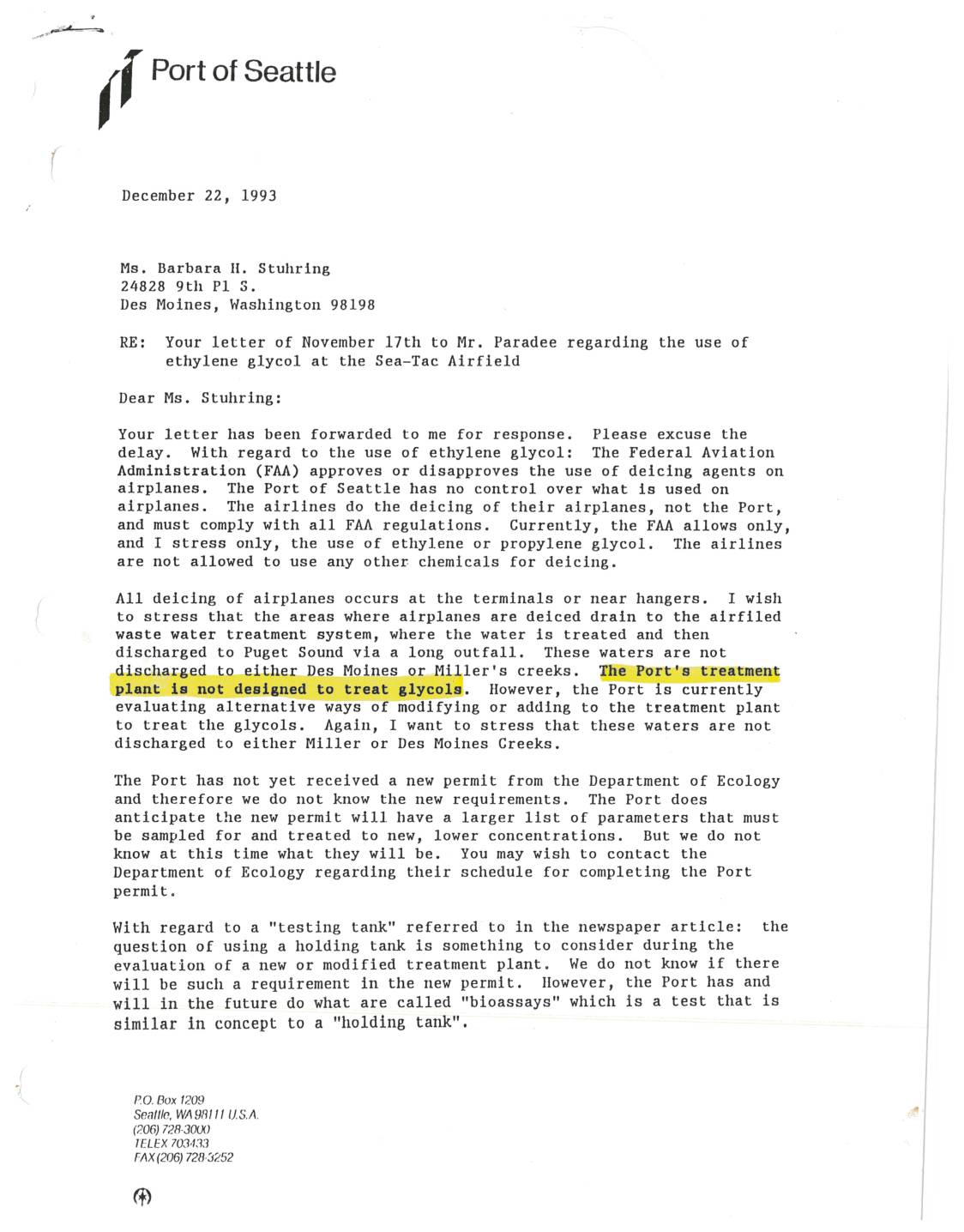
RE: Your letter of November 17th to Mr. Paradee regarding the use of ethylene glycol at the Sea-Tac Airfield Dear Ms. Stuhring: Your letter has been forwarded to me for response. Please excuse the delay. With regard to the use of ethylene glycol: The Federal Aviation Administration (FAA) approves or disapproves the use of deicing agents on airplanes. The Port of Seattle has no control over what is used on airplanes. The airlines do the deicing of their airplanes, not the Port, and must comply with all FAA regulations. Currently, the FAA allows only, and I stress only, the use of ethylene or propylene glycol. The airlines are not allowed to use any other chemicals for deicing. All deicing of airplanes occurs at the terminals or near hangers. I wish to stress that the areas where airplanes are deiced drain to the airfiled waste water treatment system, where the water is treated and then discharged to Puget Sound via a long outfall. These waters are not discharged to either Des Moines or Miller's creeks. The Port's rea~ment plant is not designed to treat glycols. However, the Port is currently evaluating alternative ways of modifying or adding to the treatment plant to treat the glycols. Again, I want to stress that these waters are not discharged to either Miller or Des Moines Greeks. The Port has not yet received a new permit from the Department of Ecology and therefore we do not know the new requirements. The Port does anticipate the… -
-
 1978-03-20 00:00
Proposed Boeing HQ West Side Final EIS