The Federal regulations concerning community noise around Sea-Tac Airport
Part 150 (Airport Noise Compatibility Planning) is a section of the Code of Federal Regulations governing the FAA and airports. The code describes a ‘voluntary’ study airports can do to determine the impacts of noise on surrounding communities.
A 1Part 150 Study is very expensive and has many detailed requirements including significant amounts of community outreach–such as Noise Workshops and FAQs. But again, Part 150 studies are voluntary. Technically, an airport is not required to do them. And yet, the Port of Seattle has already completed four.
Why?
Why would an airport want to do a very lengthy and expensive study like this if they do not have to?
Airports obtain a major portion of their funding from the FAA. No airport can stay in business without 9ongoing grants to build things like runways. And whenever an airport builds, they are required to do environmental reviews. And those environmental reviews require a noise study.
So… calling a Part 150 Study ‘voluntary’ might sound like some great public service. Not really. It is more like all the ‘voluntary’ activities teenagers do in order to get into a competitive college. You don’t have to do them. But you probably won’t be successful unless you do.
There is also something else called the DNL65.
The DNL65 and you
The first part of a Part 150 Study is to establish 3geographic boundaries around the airport, which are called ‘noise contours, or ‘noise exposure maps’ (NEM). They are all the same thing. These maps represent a series of noise levels around the airport based on both current and forecasted conditions. Every time a new Part 150 Study is done, those boundaries change–as you would expect. The number of flights change. The types of airplanes change. The flight paths change.
Here are the maps from the 61991 and 2013 Noise Boundaries.
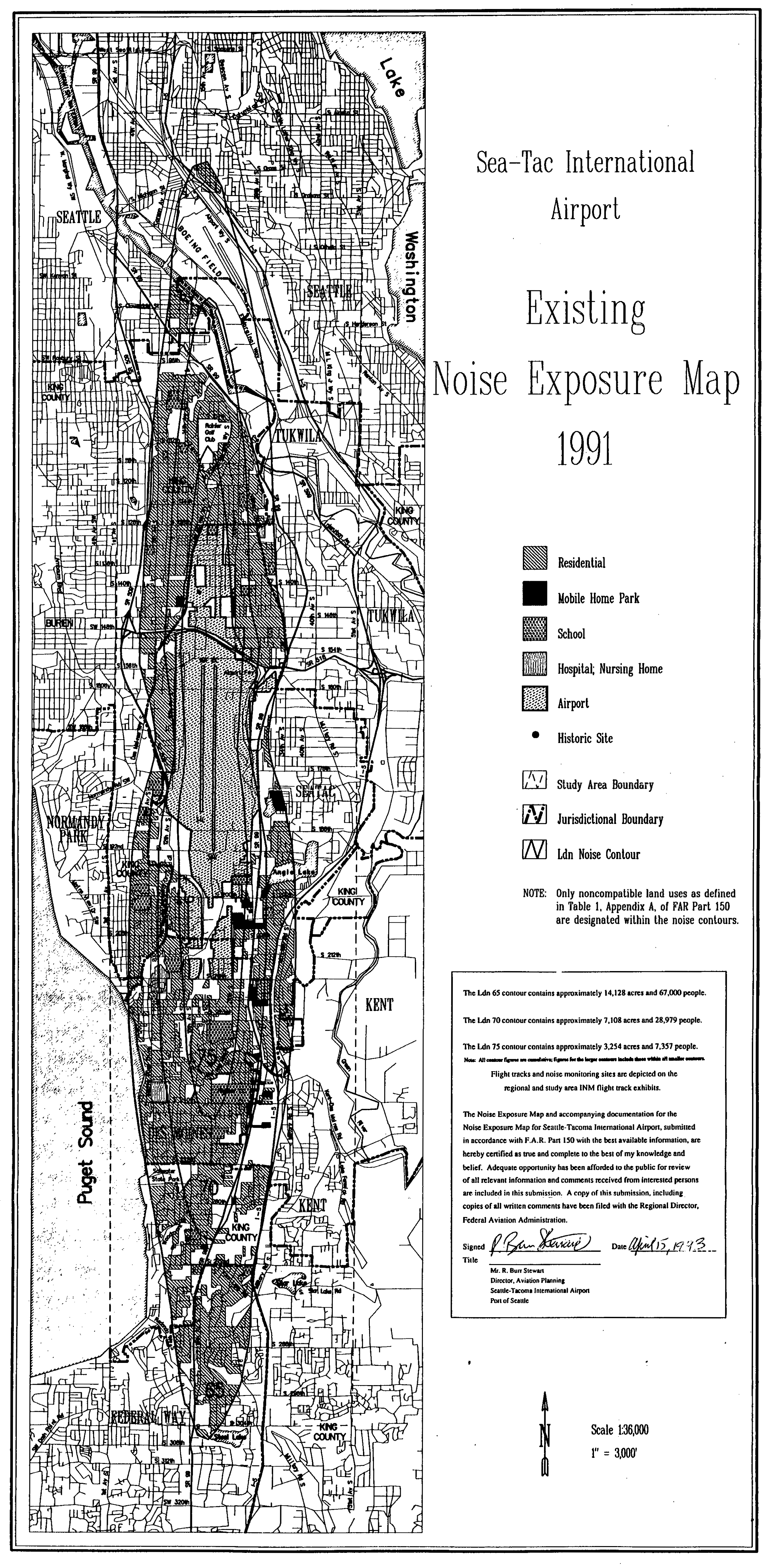

The ‘noise’ unit of measure for each of those boundaries is based on an unbelievably complex formula called Ldn or DNL. Same difference. So the area nearest the runways might be designated as ‘DNL80’ while each area further away might be designated DNL75, DNL70, DNL65, and so on.
The one boundary that residents should care about is called DNL65. The area inside DNL65 determines whether or not a home or apartment is eligible for another FAA grant program to the airport, which the airport can then use to provide you with sound insulation. That’s important. The grant is to the airport, not you.
The Incredible Shrinking Boundary
Many people contact us saying “I was told that my home is ineligible for sound insulation. Will this new Part 150 study make my home eligible?” At the risk of sounding snippy, “that’s the point of doing the study!”
However, the trend has been for the DNL65 boundary to shrink dramatically over time. To illustrate this, here are the 61991, 2018 and proposed 2032 Noise Boundaries.
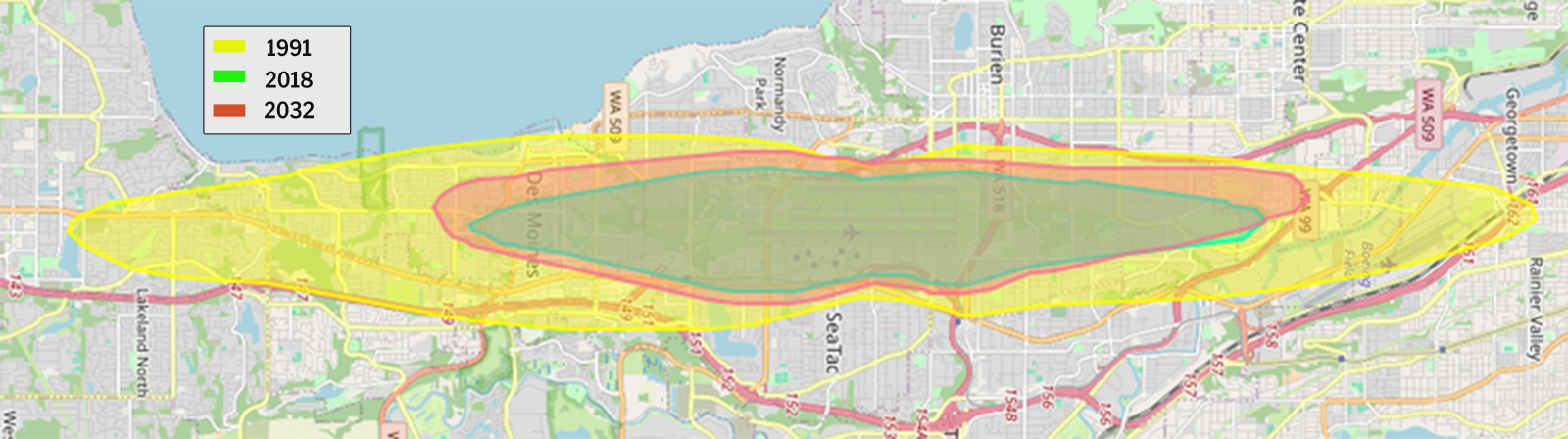
As to “why” they are shrinking, there are two reasons.
- Because “the airplanes are getting quieter.” Yes, that makes no sense, but a partial explanation is here.
- Because residents and electeds have usually not understood the implications of the Part 150 process (unless there was a Third Runway involved) and 7have not pushed back nearly as effectively as they might have.
It’s also about people…
Those maps are about people, not just geography. They also include an estimate of people living within the DNL65.

- In 1991 there were over 67,000 living within the DNL65. That number would be over 80,000 today.
- By 2013 it’s down to 9,712.
Or to put it another way:
Over 85% of the people living in homes that previously received Port Packages would not be eligible for sound insulation today.
This shrinking boundary has created some very confusing (and unfair) situations for homeowners.
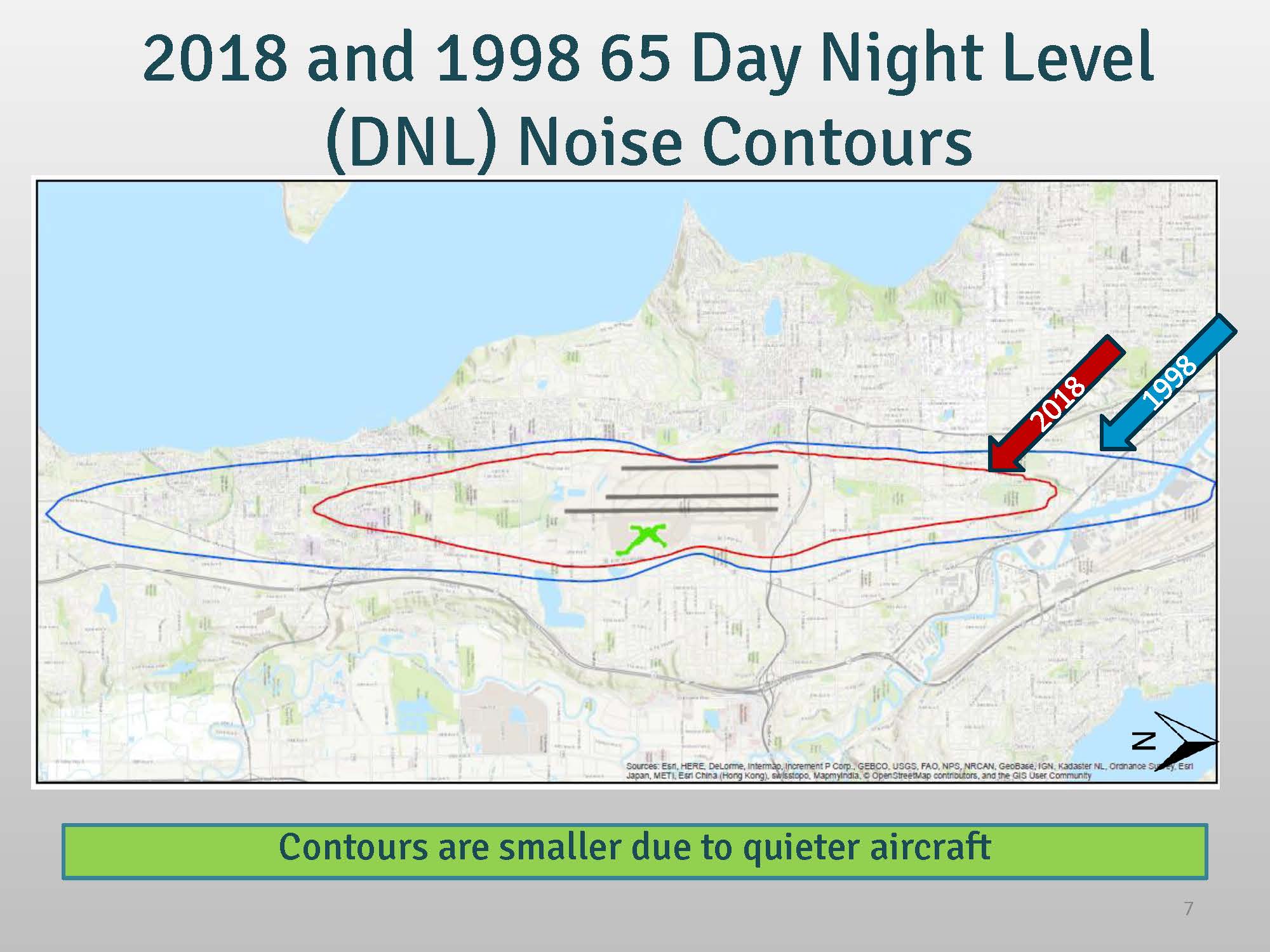 All homes on a particular street were offered sound insulation in 1999. They were inside the DNL65 of that Part 150 Study and the Port had applied for and received grant money to pay for it. All accepted, except for two homeowners who, for various reasons, decided not to.
In 2009, one of those two holdouts sold their home. The buyer called the Port of Seattle to obtain sound insulation and got it because that home was still within the same DNL65 as in 1999.
In 2013, the airport conducts a new Part 150 Study. As you can see from the graphic, the DNL65 shrank dramatically.
In 2019 the lone remaining homeowner without sound insulation sells. The new owner also calls the Port of Seattle to obtain sound insulation, but finds out that they are no longer eligible. Why? Because although the home was inside the DNL65 in 1999, it is now outside the new DNL65 created in 2013!
Because they are not noise mitigation experts, and because providing best-in-class sound reduction is much more expensive, the new owners purchase a low-cost set of windows, which do not provide the same level of noise reduction as a Port Package. And by doing so, they permanently remove the home from eligibility for any FAA sound insulation program for future owners.
The FAA and money…
In theory, an airport can provide sound insulation (or any other mitigation it likes) to people living anywhere around the airport, and at any time it wants. But as we said, in order to get Federal money to reimburse them for those costs, the airport needs to do a Part 150 Study–and even then will only get reimbursed for homes that are within the DNL65 established by the current Part 150 Study.
Sound insulation is expensive. For example, the Port of Seattle needed over $300,000,000 in Federal money just to provide sound insulation for 9,400 homes and apartments. So, in practical terms, the DNL65 (and other Federal regulations) have ended up determining most of the people who get sound insulation. Because only the Federal government has the money to pay for all of it.
However, we feel the need to say this again, because many people (including the Port of Seattle) like to use the Federal government as an excuse for every failure to provide various mitigations. Airports are free to use their own money to provide all kinds of mitigation on their own–including sound insulation outside the DNL65 or updates to existing systems. They don’t even need a Part 150 Study to do it. A Part 150 Study is simply the path to get someone else (the FAA) to pay for it.
The Port of Seattle and money…
And the Part 150 Study isn’t the only thing about the FAA sound insulation program that’s voluntary. Even after a Part 150 Study is complete and the DNL65 is established, the airport then has to apply to the FAA for grant money. And they are under absolutely no requirement to do so.
Every year, airports like Sea-Tac make a list of projects they want Federal money for. These include everything from a new runway to sound insulation. It’s all one big grant application. Each airport has a cap of how much it can apply for every year. And all airports are competing for the same big pot of money. Also, there is no separate ‘Federal Sound Insulation Fund’. In any given year, Sea-Tac may get everything they request, or just some of it. But every year Sea-Tac Airport decides how much to ask for, and what to ask for; from runways to restrooms to sound insulation.
 For example, as a result of this new Part 150, let’s say that a lot of people near the airport 4suddenly become eligible for sound insulation. Hooray! But at the same time, the airport really needs a new layer of cement on one of the runways. So in that year, the airport can simply decide to apply for $100,000,000 to buy cement, and $0 for sound insulation. And it can make that same choice every year, regardless of how long eligible homeowners have to wait.
Again, what to ask for, and when to ask for it is at the airport’s discretion. There is no requirement for an airport to ask the FAA for money for sound insulation. Ever.
Like most Federal programs, sound insulation grants, meaning the entire program, were supposed to be 8overseen by the FAA. A lot of the problems people have with existing Port Packages come down to the fact that the initial program was not well run. Theoretically, one could have filed a complaint with the FAA, and attempted to sue the Port of Seattle, not for the Port Package problems per sé, but for failing to comply with the oversight portion of the FAA grant.
Finally, Federal sound insulation grants are one-time only. There was never any provision for ‘updates’ or ‘second chances’. For many homes, where the sound insulation was installed properly, this may not be problematic. But if your home has problems? It is up to the airport (ie. the Port of Seattle) to pay for it.
Quick Review:
- Airports are free to provide most any kind of mitigation programs they want–including sound insulation. But they traditionally only do so when they think they can get FAA reimbursement for all or most of their costs.
- Several times since 1985, Sea-Tac Airport has done a ‘voluntary’ Part 150 Study–almost always before a major construction project where environmental review will be necessary.
- The Part 150 process determines DNL65. If your home is inside, you may be eligible for FAA reimbursement for sound insulation. If you’re outside? You’re not.
- Airports apply for annual grants from the FAA. They may use some of that money for sound insulation. Or not, if they feel like they have more urgent needs. What they apply for and when is also totally ‘voluntary’.
- The FAA requires that its grants (including sound insulation) be subject to auditing and inspection. But that has been almost impossible to get done.
- 2Currently, the FAA will not reimburse the airport for any ‘second chance’ program.
Summary: The Voluntary Two-Edged Sword
As you can see, the Part 150 Study process is complicated. It can be used by the Port of Seattle to obtain currently available noise mitigation funds for first-timers. Great. But, it has also been used by the Port to deflect responsibility, to incorrectly blame other agencies such as the FAA, to confuse residents and electeds, and to avoid doing many things that it could always have done on its own. It is the confusing, and apparently ‘voluntary’ nature of the process that has made it subject to so much manipulation.
The Port of Seattle will (correctly) say that we all need to work together to get help from the Federal government. Absolutely. There is simply no way that any airport can afford to provide fair mitigation without a lot more help from Congress, including changing 5the insane way the DNL65 is calculated.
However… the Port of Seattle also has a lot to answer for. It can and should do a lot more on its own–especially given how profitable the airport has become and how much the Port has encouraged airport expansion. To protect residents, some of those FAA regulations need to be updated in ways the Port will likely never agree with.
Key Points
- The original sound insulation programs were terribly managed, creating hundreds and hundreds of very poor installs that the Federal government is (rightly) reluctant to pay to fix.
- The Port has used the voluntary nature of sound insulation grant applications to slow-walk sound insulation to thousands more. It chose not to apply for those grants. Sea-Tac Airport should be required to allocate money every year for sound insulation!
- Every year the Port waits to provide repairs, the DNL65 shrinks. People move, pass away. And thus homes are unknowingly altered in ways that remove them from eligibility for any future FAA reimbursement. Every year the Port waits, saves them money and makes life more difficult for people currently living under the flight path.
- Sea-Tac Airport likes to promote itself as The Greenest Airport in America. Ironically, the voluntary nature of the Part 150 program also gives them the ability to do more on their own. So despite what you may hear, remember: there is nothing stopping the Port from doing better on any number of issues–except the amount of money they choose to spend. No, it will never be able to spend the sums of money the FAA can. But given their record number of flight operations and revenues, it can always do more for our communities.
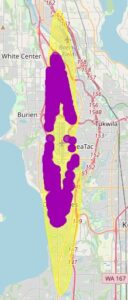 Although the current Part 150 Study is not ‘complete’ (remember, we told you they take several years), the first part, meaning the new noise map, is complete. That is what you will be seeing at upcoming Part 150 Workshops. The new map looks slightly larger in size. But in terms of eligible homes it is much larger. Hooray!
Not really.
As you can see by looking at our Port Packages mapped, almost all homes inside the ‘new’ area (purple) already received sound insulation long ago. So, unless the Port of Seattle changes their policy on funding updates, the new map will only affect 50 homes. Those are homes which never received first time Port Packages. So, if you were hoping that a new Part 150 might provide relief for your existing sound insulation system? No. Keep reading.
What you can do?
You’re reading this article and that’s a great start! We know it’s a lot.
Next, subscribe to STNI! We’ll let you know the simple steps you can can take, and when to take them. We provide the information many of you want. But we won’t waste your time on things that lead nowhere.
By subscribing you’ll help with our work on three main tracks:
- We insist that the Port of Seattle do more of the things it always could do on its own, using its own money. That means fixing existing bad Port Packages. In 2024 they began an update program called the SIRRPP, and it is terrible. But they can fix that now!
- At the same time, we continue to work with the Port to change policies at the State and Federal levels–including the DNL65–to provide new sound insulation opportunities. We completely agree with the Port that they will also need more money and changes in Federal law to address the impacts of airport expansion.
- Advocate with local and State electeds to change policies at the Port of Seattle that they choose not to address voluntarily.
It is not one or the other.
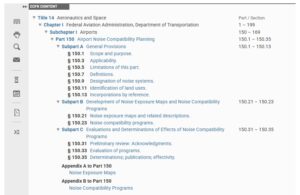 1‘Part’ is a subdivision of the 200,000 page full Code of Federal Regulations. So, Part 150 is short hand for the 150th sub-sub chapter of Chapter 1 (FAA) of Title 14 (Aerospace).
1To add to the confusion, each Part 150 Study provides a future-cast of where the expected boundary will be. That’s why it says ‘2018’ in a 2013 Study.)
2One part of getting the Port of Seattle to provide a pilot update program is to demonstrate to the FAA that such a program can be run well–thus encouraging Congress to allocate Federal funding.
3The FAA has a whole set of Noise Density Guidelines–those activities considered ‘appropriate’ for various distances from the runways. By ‘density’ they mean the number of people per acre. For example, right next to the airport, a city might zone for a parking lot or a commercial building or even something like North Sea-Tac Park. But houses or apartments would need to be zoned further away.
4This is not hypothetical. During the 1990’s, the Port of Seattle prioritized sound insulation for single family homes, but put off working on over a thousand apartments until their Accelerated Sound Insulation Program of 2020. Those units are not scheduled to be completed until 2026–literally thirty years after they became eligible!
5In fact, the FAA needs no encouragement. At the policy level, their staff really do understand. Again, it is a question of money–and Congress determines that every five years in the FAA Reauthorization bill. Spoiler alert: there will likely be no new money for community mitigation until the next bill in 2028.
6Everything to do with airports is confusing. Noise Exposure Maps are required to provide various forecasts (usually five years out.) That’s why the 1991 map says ‘1996’ and the 2013 map says ‘2018’.
7Attendance at the 2013 Part 150 Study Workshops was lower than expected. There were less than a hundred unique public commenters. This was likely because there was no apparent construction project (like a Third Runway) immanent. However, the 2013 Part 150 Study caused the largest reduction in size and population of the DNL65 of any previous study.
8The C6 portion of FAA grant compliance is beyond the scope of this article. We mention it only to because there are no ‘second chance’ grants for sound insulation. Read this letter from Karen Keiser to Seattle Times based on the work of local activist Minnie O. Brasher who first raised the alarm on Port Packages in 1998. For the full story, read The Port Package Explainer.
9As one example, the Port of Seattle has collected over $3,000,000,000 in passenger facilities charges since 2001.