TagPart 161(16)
-
2009-10-30
FAA Decision Letter: Disapproval of Burbank-Glendale-Pasadena Airport Authority Application for Full Nighttime Curfew at Bob Hope Airport
The FAA denied the Burbank-Glendale-Pasadena Airport Authority's 2009 application to impose a full nighttime flight curfew (10:00 p.m. to 6:59 a.m.) at Bob Hope Airport in Burbank, California. Under the Airport Noise and Capacity Act of 1990, all six statutory conditions must be supported by substantial evidence for such a restriction to be approved, but the Authority's application only satisfied two of the six required conditions. The Authority was informed it could revise and resubmit its application, subject to the same review requirements. -
2009-10-30
FAA Decision Letter: Disapproval of Burbank-Glendale-Pasadena Airport Authority Application for Full Nighttime Curfew at Bob Hope Airport
FAA Acting Associate Administrator for Airports Catherine M. Lang transmits the FAA’s disapproval of the Burbank-Glendale-Pasadena Airport Authority application for a full mandatory nighttime curfew (10:00 p.m. to 6:59 a.m.) on Stage 3 aircraft operations at Bob Hope Airport, Burbank, CA (BUR). The application, submitted February 2, 2009 and found complete May 29, 2009, was -
2005-08-18
Part 161 Summit agenda
This document is an agenda and discussion outline from the Part 161 Summit held on August 18, 2005, in Denver, Colorado, focused on airport noise use restrictions. It covers topics including the Naples Municipal Airport's experience with a noise ban, the legal and factual requirements needed to justify aircraft use restrictions, and alternative paths to noise relief such as grandfathering, Part 150 programs, and federal legislation. Key criteria for imposing Stage 3 noise restrictions under the Noise Act and FAR Part 161 are outlined, including ensuring restrictions are reasonable, non-discriminatory, and do not unduly burden interstate commerce or the national aviation system. -
2004-06-01
Guide to Airport Noise Rules and Use Restrictions
This guide, produced by law firm Kaplan Kirsch & Rockwell and noise consulting firm Harris Miller Miller & Hanson, explains the rules and regulations governing airport noise and aircraft use restrictions at publicly owned airports. It covers who is responsible for regulating airports and aircraft, what tools airports have to manage noise, and the requirements of the Airport Noise and Capacity Act of 1990. The guide is designed for airport managers, elected officials, consultants, and community groups seeking to understand how noise disputes are handled and resolved. -
2002-01-01
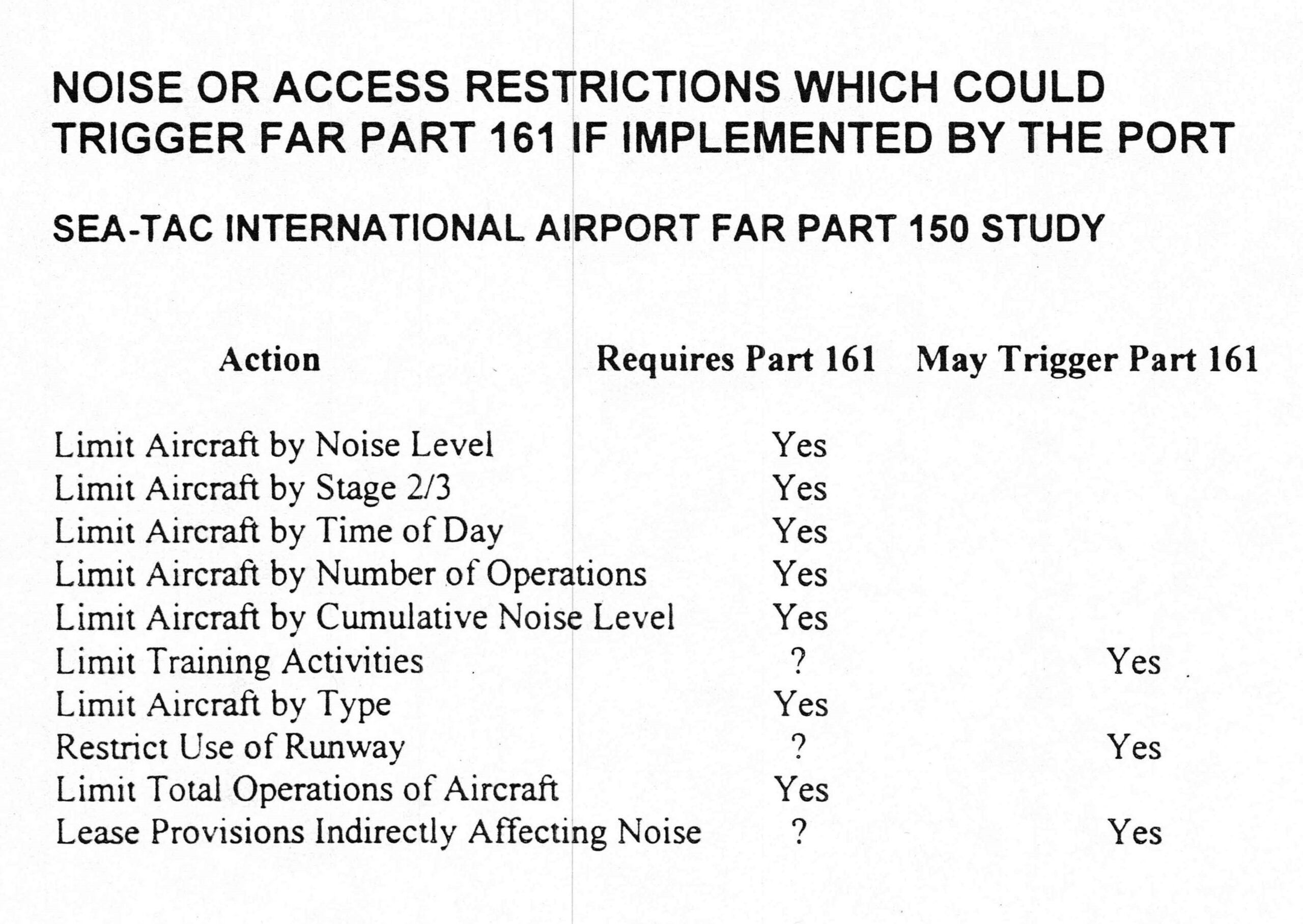
FAR Part 150 Study Table: Airport Noise Restrictions and FAR Part 161 Compliance Requirements
A table from the Sea-Tac International Airport FAR Part 150 Study listing airport actions (such as limiting aircraft by noise level, time of day, type, and runway use) and indicating whether each action definitively requires FAR Part 161 compliance or may potentially trigger it. Actions including limiting training activities, restricting runway use, and lease provisions indirectly affecting noise are marked with '?' under 'Requires Part 161' but 'Yes' under 'May Trigger Part 161.' -
1998-02-04
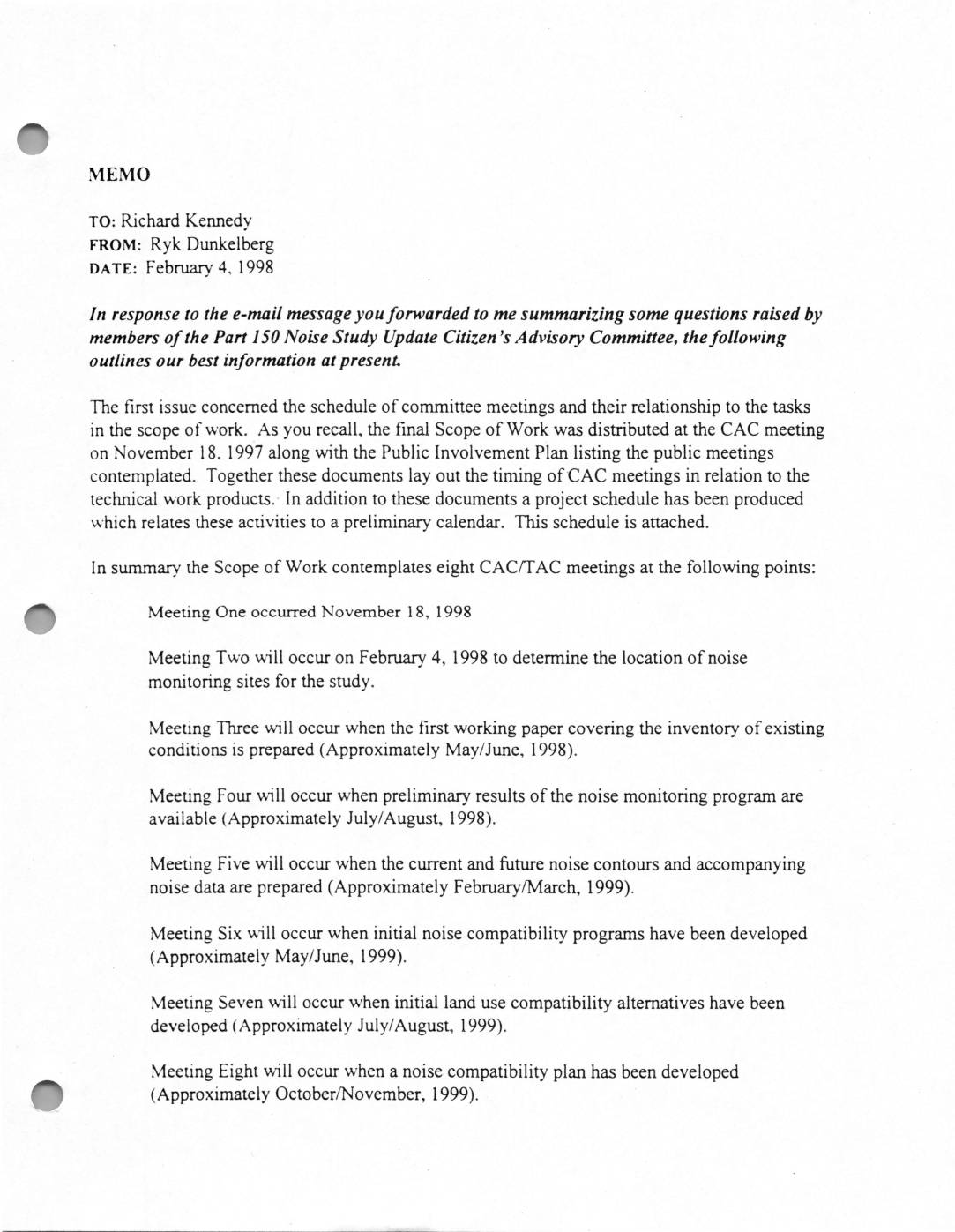
Memo: Ryk Dunkelberg to Richard Kennedy on Part 150 CAC Meeting Schedule and Part 161 FAQs
A 1998 internal memo from Ryk Dunkelberg to Richard Kennedy outlines the schedule of eight public CAC/TAC meetings planned through 1999 for the Part 150 Noise Study Update at Sea-Tac Airport, along with broader public engagement activities such as workshops, newsletters, and a project website. The memo also explains the Port of Seattle's cautious policy toward FAR Part 161 aircraft noise regulations, noting that no such studies have ever been successfully approved by the FAA and that pursuing one could jeopardize existing noise abatement programs. Additionally, it addresses the potential acquisition of residential properties in the Approach Transition Areas, stating that no decision has been made and that further study and federal funding would be required.