TagConformity(39)
-
 1996-06-07
EPA Region X letter on conformity, mitigation measures, and cumulative impacts for Sea-Tac Airport EIS
This 1996 EPA letter addresses environmental conformity requirements for the Sea-Tac Airport expansion project, noting that projected increases in carbon monoxide pollution require mitigation measures or a phased development approach to meet federal air quality standards. It also calls on the FAA's Record of Decision to address cumulative environmental impacts from related regional projects, including the Sea-Tac expansion, the SR 509 proposal, and the South Aviation Support Area. -
 1996-06-05
Revised traffic analysis for air quality conformity review of Sea-Tac Master Plan Update
A 1996 traffic analysis prepared for the Airport Communities Coalition by SMITH Engineering & Management identifies several critical flaws in the Sea-Tac Airport Master Plan Final EIS, arguing that the traffic modeling unfairly favored the proposed North Unit Terminal Alternative over the Do Nothing Alternative. Key concerns include inconsistent use of the Traffix simulation model, the omission of a south access road from the Do Nothing scenario, and failure to account for increased staffing and peak-hour passenger traffic that a new terminal would generate. The report presents revised traffic forecasts intended to provide a more balanced comparison of the two alternatives for air quality conformity purposes. -
 1996-04-06
Attachment to the Environmental Protection Agency air quality comments on the proposed Master Plan Update development actions at Seattle-Tacoma International Airport
This 1996 EPA document provides air quality comments on the proposed Master Plan Update Development Actions at Seattle-Tacoma International Airport, focusing on Clean Air Act conformity requirements. It explains that federal agencies must determine that proposed projects will not cause or worsen air quality violations in non-attainment or maintenance areas, and outlines enforceable mitigation measures required when pollution increases are modeled. The document also flags inconsistencies in projected CO emissions across multiple related EIS studies for nearby projects, recommending better data sharing and coordination among agencies. -
 1996-02-29
Comments on Draft General Conformity Determination for the Sea-Tac Airport Runway and Associated Development Projects
A 1996 public comment letter raises serious concerns about air quality violations related to the proposed third runway expansion at Seattle-Tacoma International Airport, arguing that the environmental review failed to adequately account for nitrogen dioxide and carbon monoxide pollution affecting nearby neighborhoods. The author contends that the General Conformity Determination is flawed because it ignores existing NAAQS violations, underestimates future NOx emissions from larger aircraft and increased flight operations, and treats the airport as a regional rather than a concentrated point source of pollution. The letter calls for more rigorous modeling and mitigation measures before any finding of conformity is approved. -
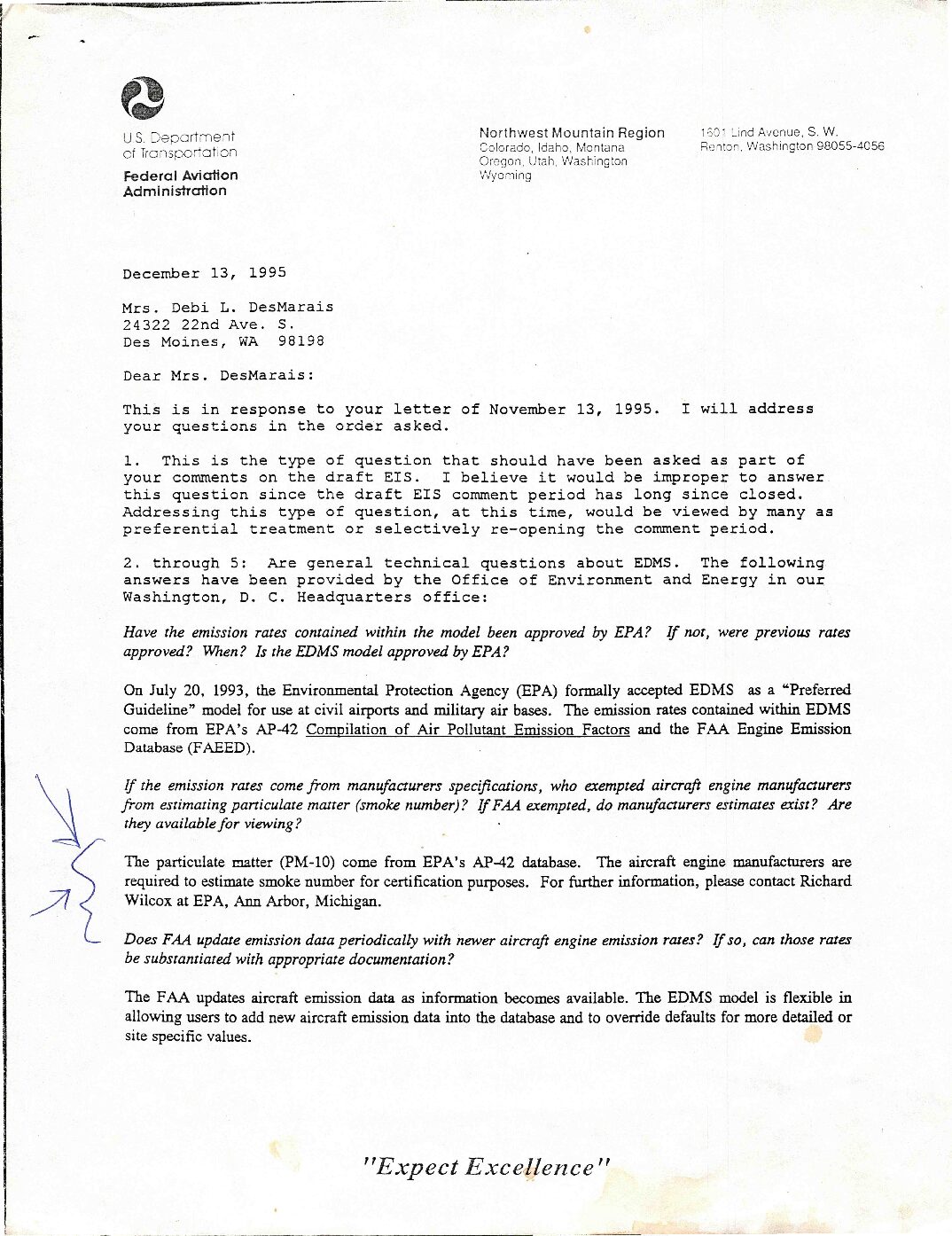 1995-12-13
FAA response to Mrs. DesMarais regarding EDMS emission rates and EIS questions
This collection of 1995 correspondence addresses community concerns about air quality and emissions near Seattle-Tacoma International Airport. A December 1995 FAA letter responds to technical questions about the EDMS emissions model, confirming it was accepted by the EPA in 1993 and that emission rates are sourced from EPA's AP-42 database and the FAA Engine Emission Database. A separate Port of Seattle letter acknowledges a resident's complaint about jet fuel odor, noting that high aircraft traffic and weather conditions can intensify odors, and directing the resident to the Puget Sound Air Pollution Control Agency for further assistance. -
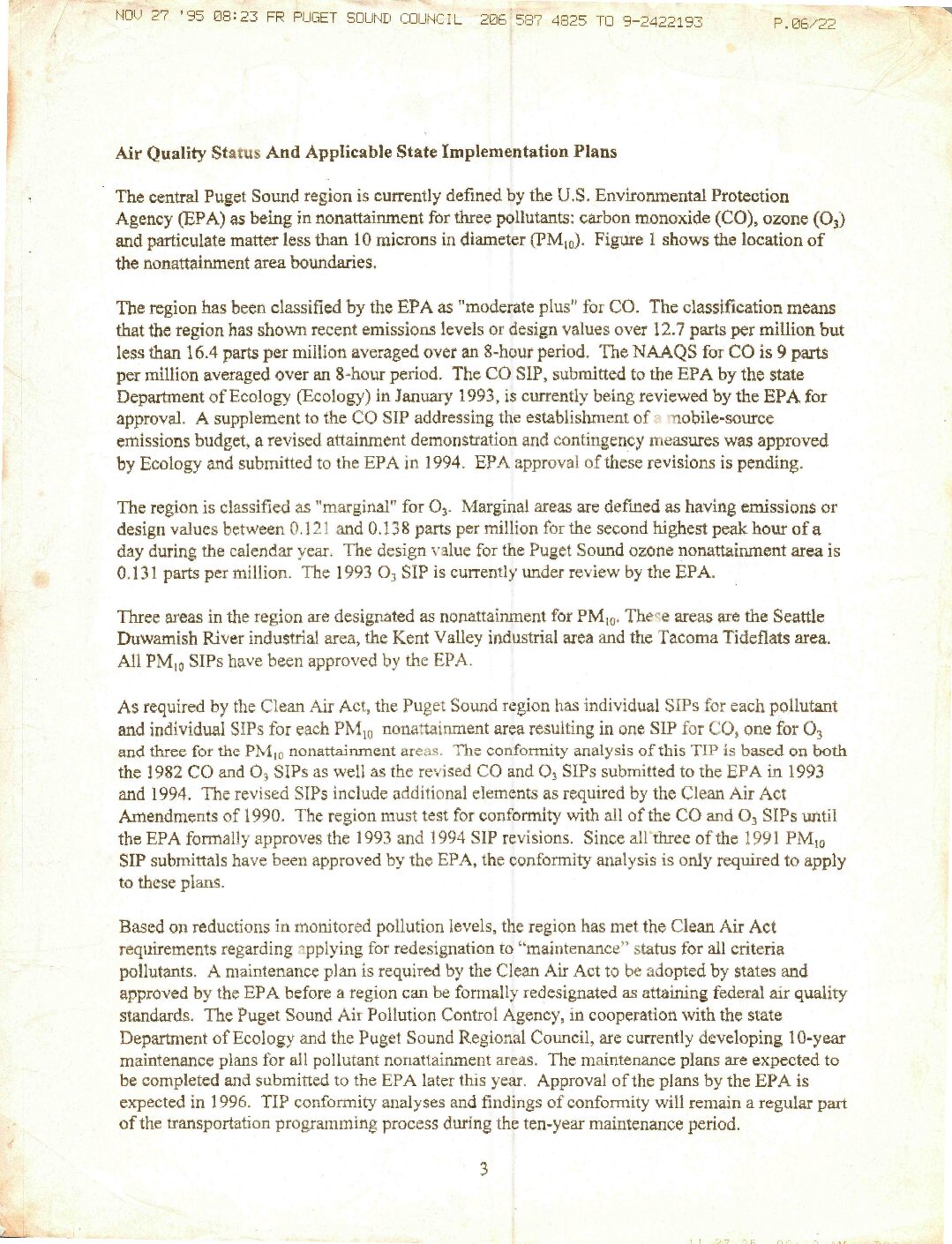 1995-11-27
Air quality status and applicable state implementation plans
As of 1995, the central Puget Sound region was designated by the EPA as failing to meet federal air quality standards for three pollutants: carbon monoxide, ozone, and particulate matter. The region held 'moderate plus' status for carbon monoxide and 'marginal' status for ozone, with State Implementation Plans (SIPs) submitted to the EPA awaiting approval. Based on improving pollution levels, the region was working toward 'maintenance' status redesignation, with 10-year maintenance plans expected to be submitted to the EPA and approved by 1996. -
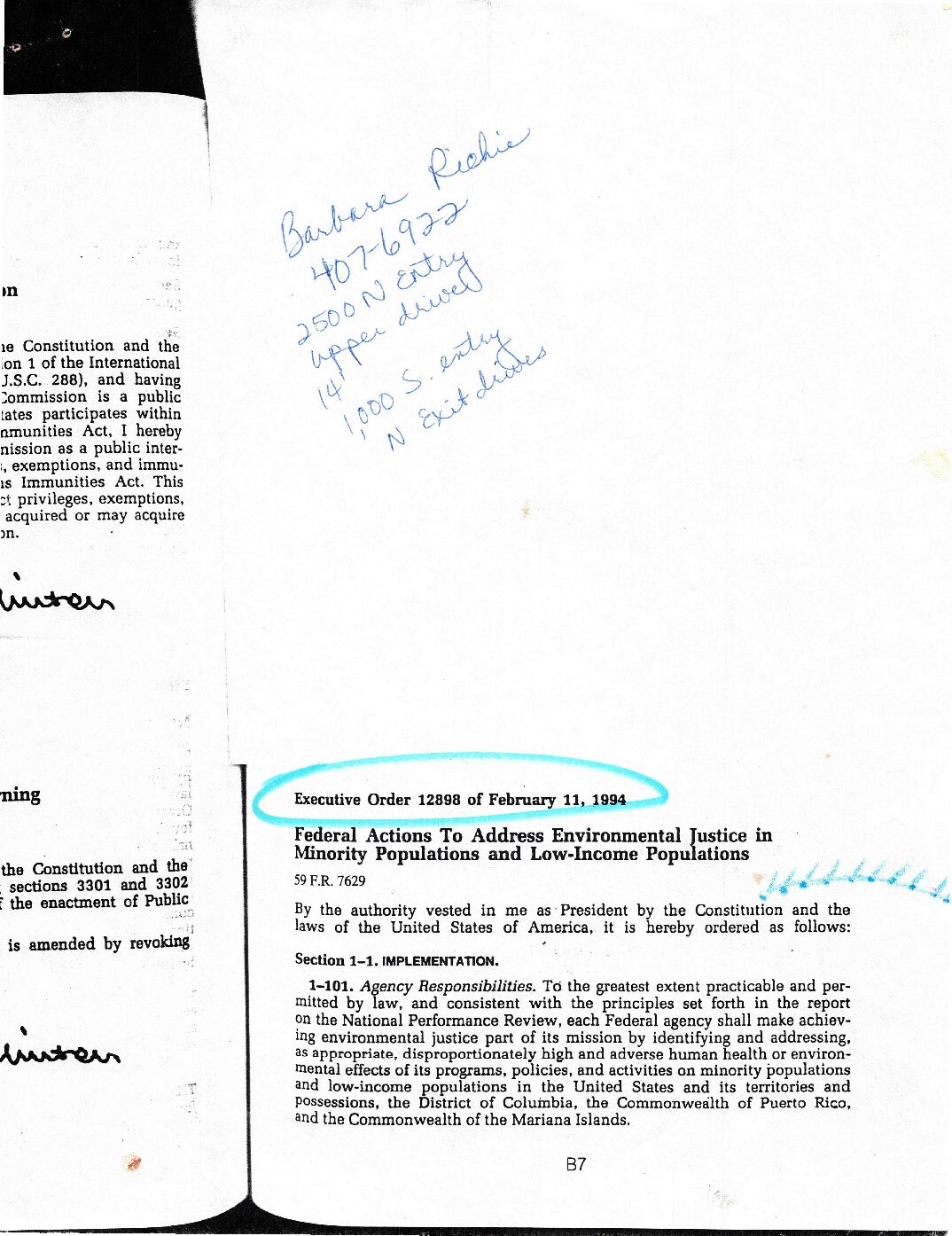 1994-02-11
Executive Order 12898: Federal actions to address environmental justice in minority populations and low-income populations
Executive Order 12898, signed by President Clinton on February 11, 1994, directs all federal agencies to identify and address disproportionately high and adverse health or environmental impacts on minority and low-income populations as part of their core mission. The order establishes an Interagency Working Group on Environmental Justice, led by the EPA Administrator, to coordinate agency strategies, research, and data collection. Each federal agency is required to develop and finalize an environmental justice strategy within 12 months, ensuring that federal programs do not discriminate based on race, color, or national origin. -
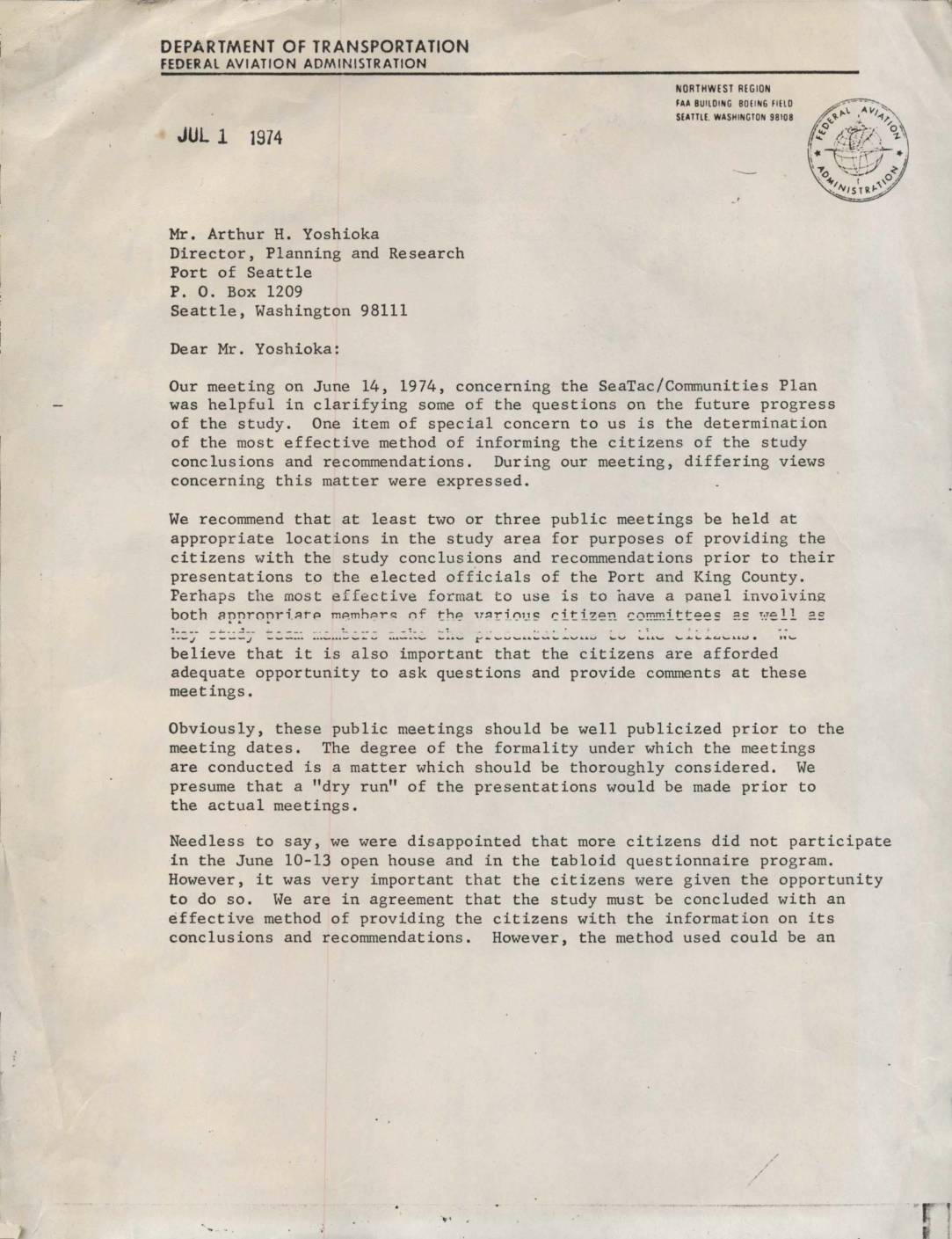 1974-07-01
Letter to Arthur H. Yoshioka regarding SeaTac/Communities Plan public meetings
In this July 1974 letter, George L. Buley of the FAA's Airports Planning Branch writes to Arthur H. Yoshioka of the Port of Seattle regarding the SeaTac/Communities Plan study. Buley recommends holding two or three public meetings in the study area to present the study's conclusions and recommendations to citizens before they are brought before elected officials of the Port and King County. He emphasizes the importance of well-publicized meetings that allow citizens adequate opportunity to ask questions, and urges that the topic be discussed at the upcoming July PAC and TAC meetings. -
 1972-01-01
Average aircraft emissions, O’Hare International Airport, 1972
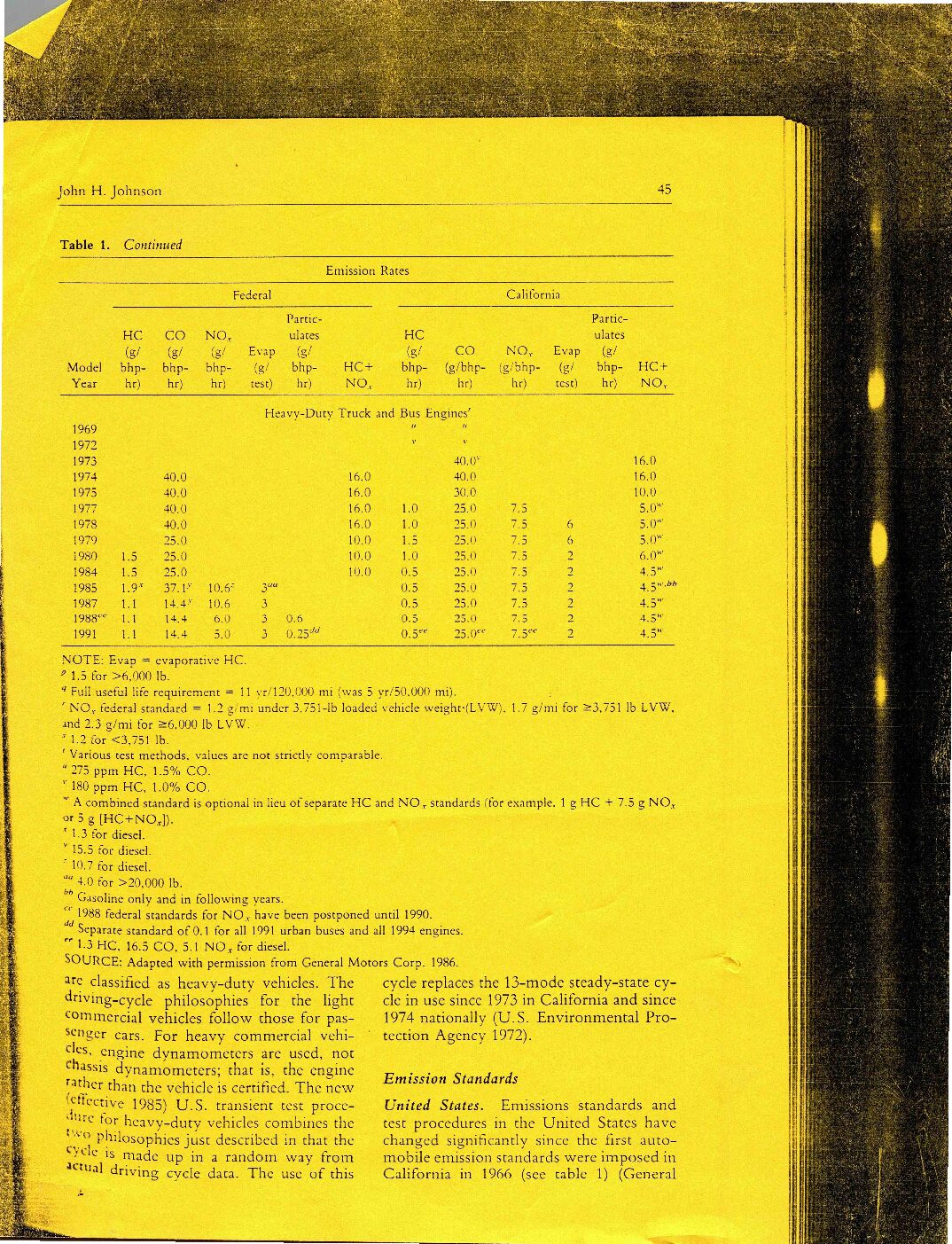
This document presents average aircraft emission data recorded at O'Hare International Airport in 1972, listing pollutant levels per aircraft landing and takeoff cycle and per enplaned passenger for carbon monoxide, hydrocarbons, nitrogen oxides, and particulates. It also includes a comparison table of federal and California emission standards for heavy-duty truck and bus engines spanning model years 1969 through 1991, showing how regulations tightened over time. The data reflects early efforts to quantify and regulate air quality impacts from both aviation and ground transportation sources.