TagConformity(39)
-
 1997-06-23
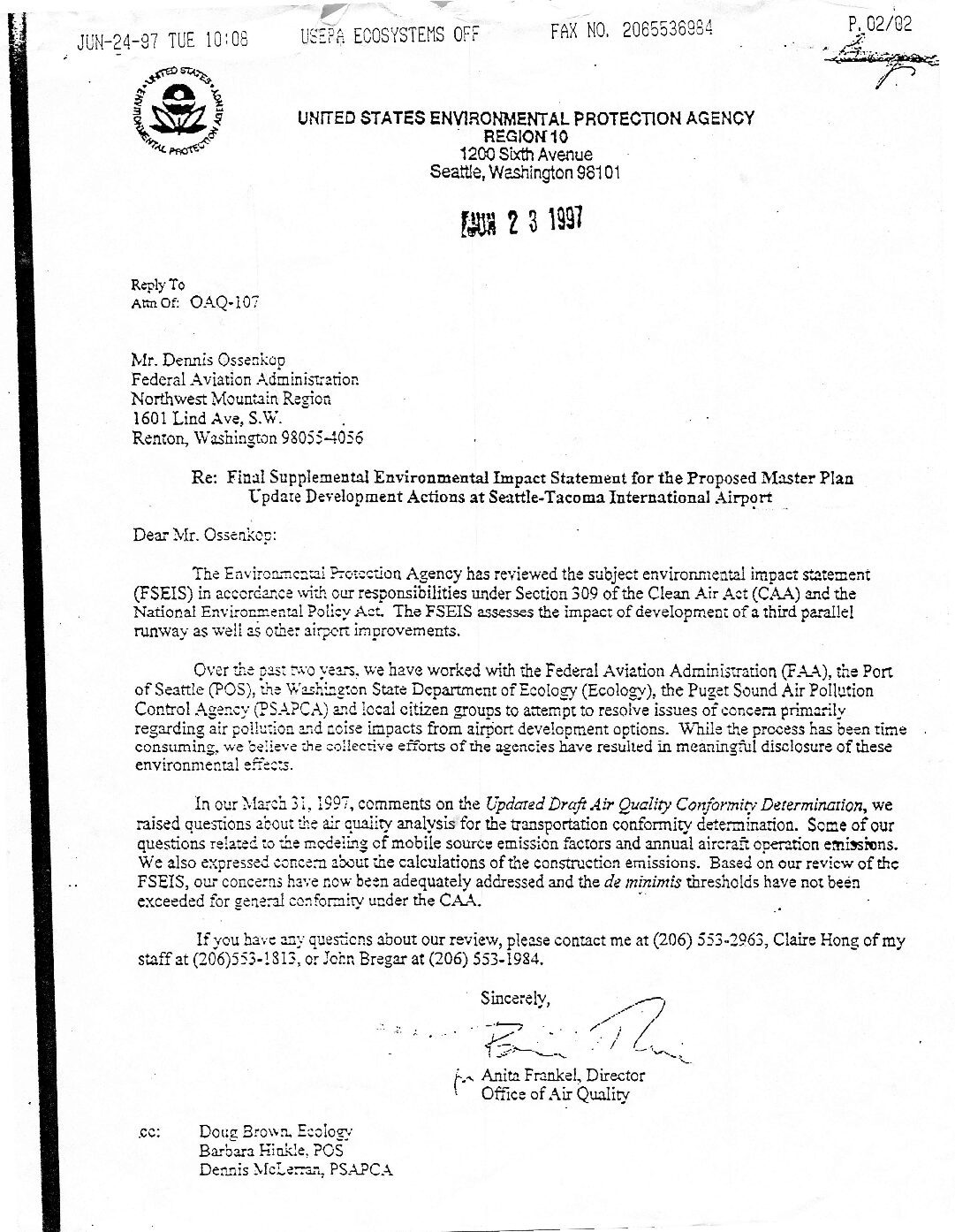
Final Supplemental Environmental Impact Statement for the Proposed Master Plan Update Development Actions at Seattle-Tacoma International Airport
These letters from the U.S. Environmental Protection Agency (EPA) Region 10 document the agency's review of air quality analyses related to the proposed third parallel runway and Master Plan Update at Seattle-Tacoma International Airport. In a 1997 letter, EPA confirmed that concerns about mobile source emission factors, aircraft operation emissions, and construction emissions had been adequately addressed in the Final Supplemental Environmental Impact Statement, with de minimis thresholds not exceeded under the Clean Air Act. An earlier letter from the mid-1990s outlined EPA's technical recommendations on the air quality modeling protocol, including guidance on screening versus refined analyses, receptor selection, and the need to account for other Port of Seattle projects in the environmental review. -
 1997-03-31
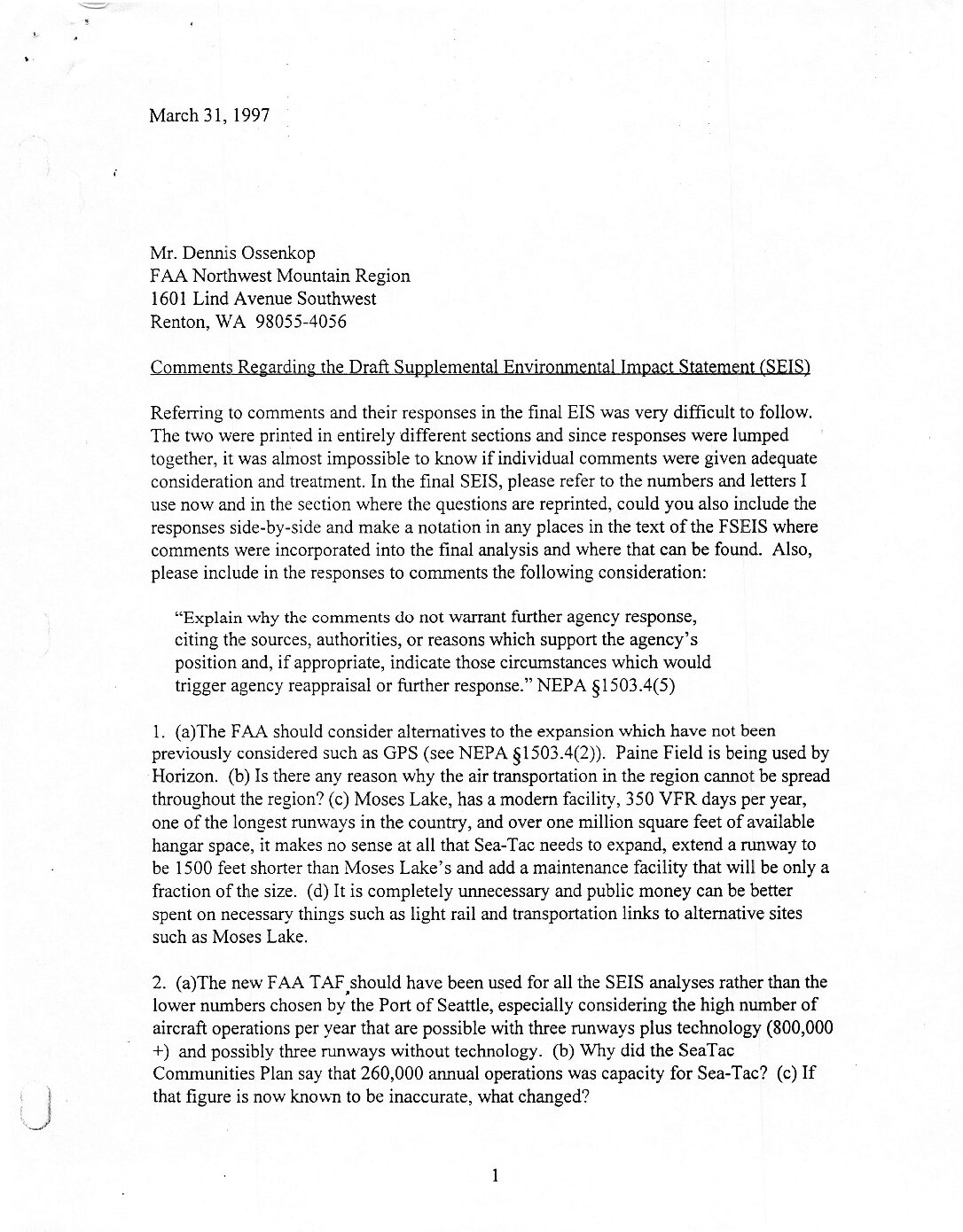
Comments regarding the Draft Supplemental Environmental Impact Statement (SEIS)
A March 1997 public comment letter submitted to the FAA raises detailed concerns about the Draft Supplemental Environmental Impact Statement (SEIS) for Sea-Tac Airport's proposed third runway expansion, questioning the adequacy of alternatives considered, the accuracy of capacity and traffic forecasts, and the handling of noise impacts on surrounding communities. The writer challenges the FAA on issues ranging from air quality violations and wellhead protection to construction logistics and the lack of a noise insulation plan for new flight corridors created by the third runway. The letter demands side-by-side presentation of comments and responses in the final SEIS, along with fuller justifications as required under NEPA. -
 1997-03-31
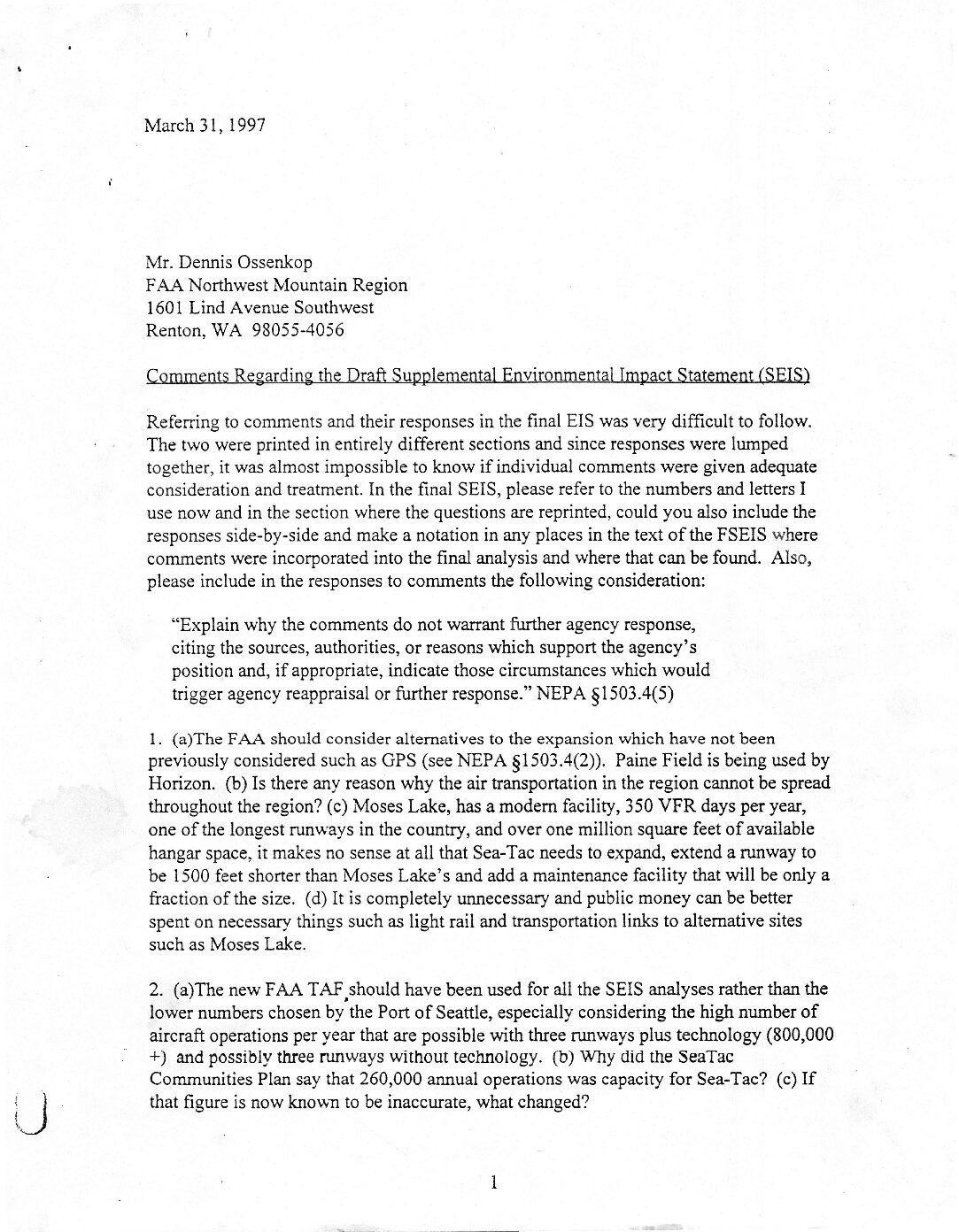
Comments regarding the Draft Supplemental Environmental Impact Statement (SEIS)
A March 1997 public comment letter submitted to the FAA raises detailed concerns about the Draft Supplemental Environmental Impact Statement (SEIS) for Sea-Tac Airport's proposed third runway expansion, questioning the adequacy of noise mitigation planning, air quality analysis, and traffic projections. The author challenges the FAA's consideration of regional alternatives such as Moses Lake and Paine Field, disputes the accuracy of capacity and operations forecasts, and demands side-by-side presentation of comments and agency responses. Key issues include new flight corridor noise impacts on western neighborhoods, potential Clean Air Act violations, and construction concerns related to borrow areas in Des Moines. -
 1997-03-31
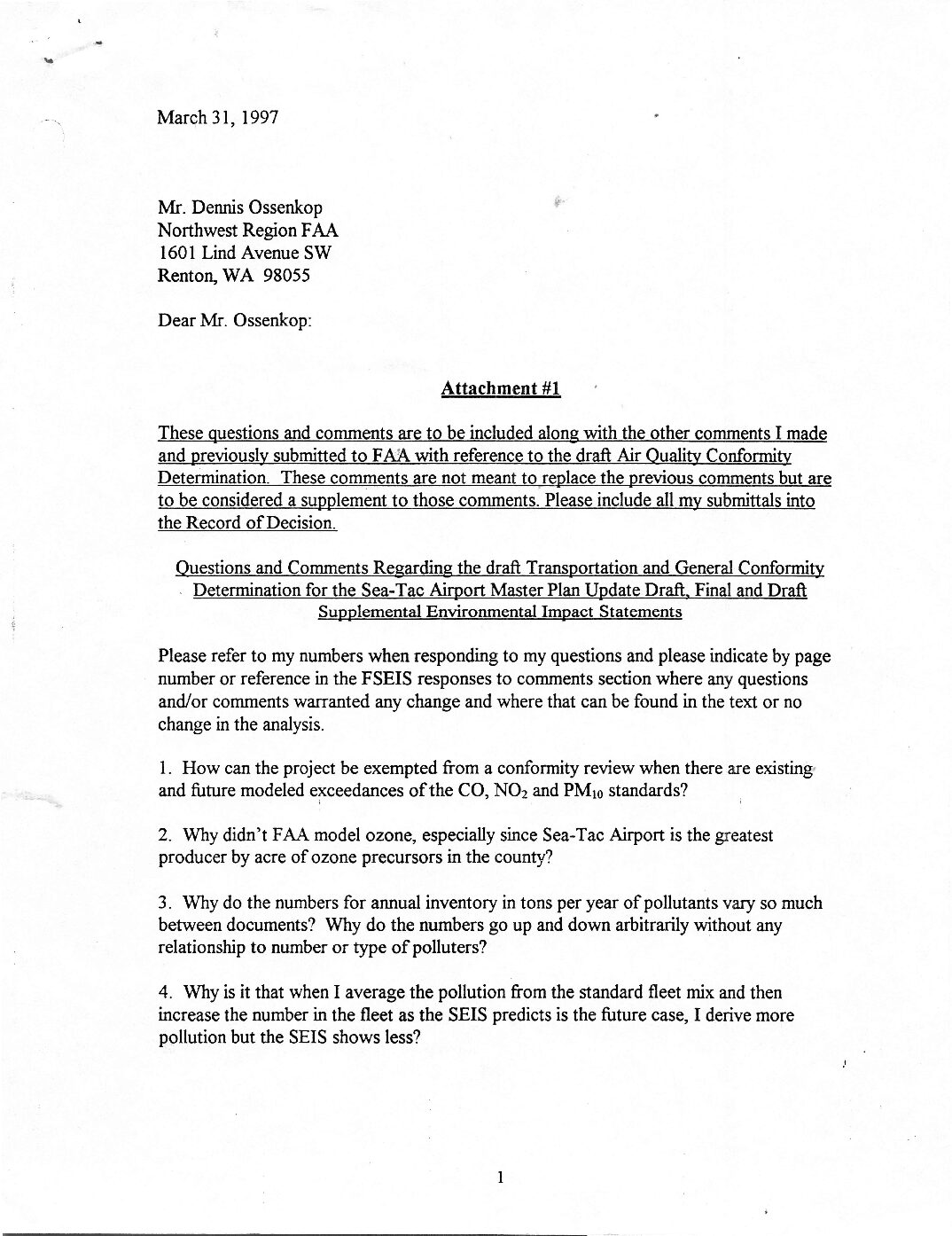
Questions and comments regarding the draft Transportation and General Conformity Determination for the Sea-Tac Airport Master Plan Update Draft, Final and Draft Supplemental Environmental Impact Statements
A 1997 public comment letter submitted to the FAA's Northwest Region raises detailed technical questions about the air quality conformity determination for the Sea-Tac Airport Master Plan Update. The author challenges the accuracy of pollution emission estimates, questions why the project may be exempt from conformity review despite existing exceedances of CO, NO₂, and PM₁₀ standards, and calls for a more thorough cumulative analysis of health impacts on nearby residents. The letter requests that the FAA address discrepancies in nitrogen oxide modeling, ozone precursor emissions, and particulate data before finalizing the Supplemental Environmental Impact Statement. -
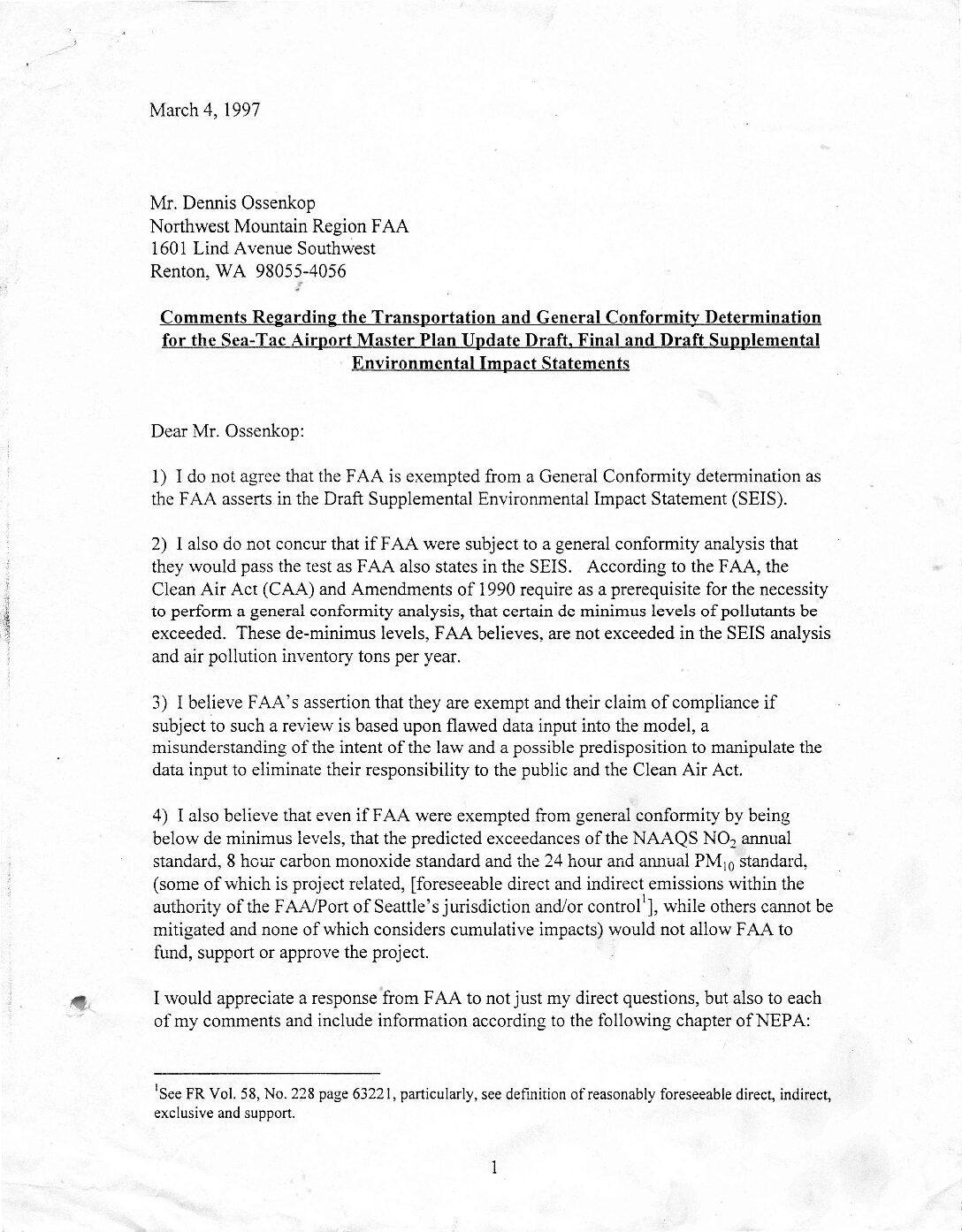 1997-03-04
Comments regarding the transportation and general conformity determination for the Sea-Tac Airport Master Plan Update Draft, Final and Draft Supplemental Environmental Impact Statements
A 1997 public comment letter to the FAA challenges the environmental review of the Sea-Tac Airport Master Plan Update, arguing that the agency improperly claimed exemption from Clean Air Act General Conformity requirements and used manipulated air pollution data to avoid regulatory thresholds. The author contends that nitrogen oxide (NOx) emission figures in successive environmental impact statements were inconsistently reported—sometimes decreasing even as projected aircraft operations increased significantly—suggesting the modeling inputs were skewed to produce predetermined results. The letter calls on the FAA to justify its findings under NEPA and warns that predicted exceedances of federal air quality standards for NO2, carbon monoxide, and particulate matter should prevent the agency from funding or approving the expansion project. -
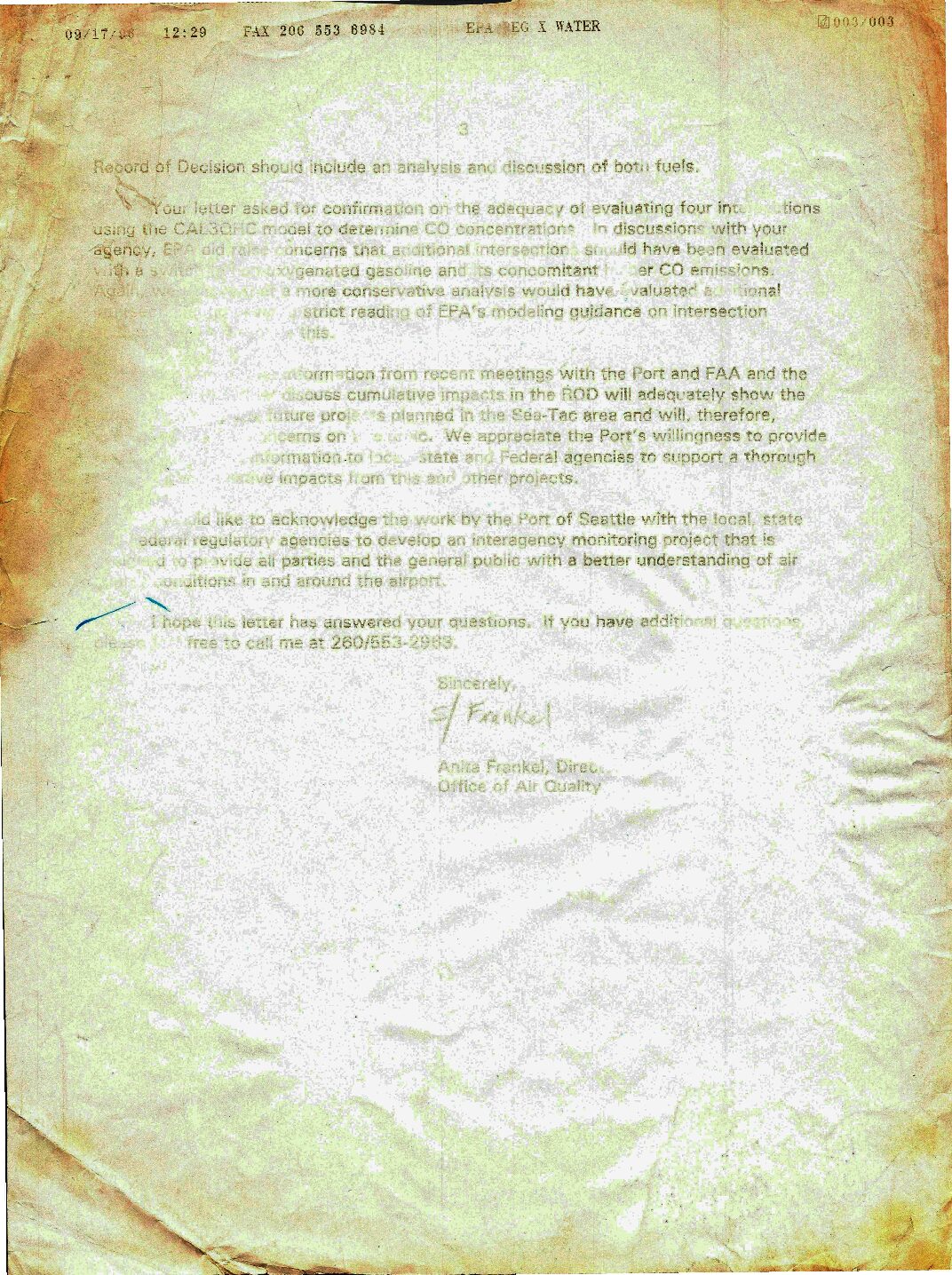 1996-09-17
Letter from EPA Region X Office of Air Quality regarding CO concentration analysis at Sea-Tac Airport
A letter from Anita Frankel, Director of the EPA Region X Office of Air Quality, addresses concerns about air quality evaluations near Seattle-Tacoma International Airport. The letter confirms that EPA raised concerns about the adequacy of using the CAL3QHC model to evaluate CO concentrations at intersections, noting that a more conservative analysis should have included additional intersections when switching to oxygenated gasoline. It also acknowledges the Port of Seattle's collaborative work with local, state, and federal agencies to develop an interagency air quality monitoring project around the airport. -
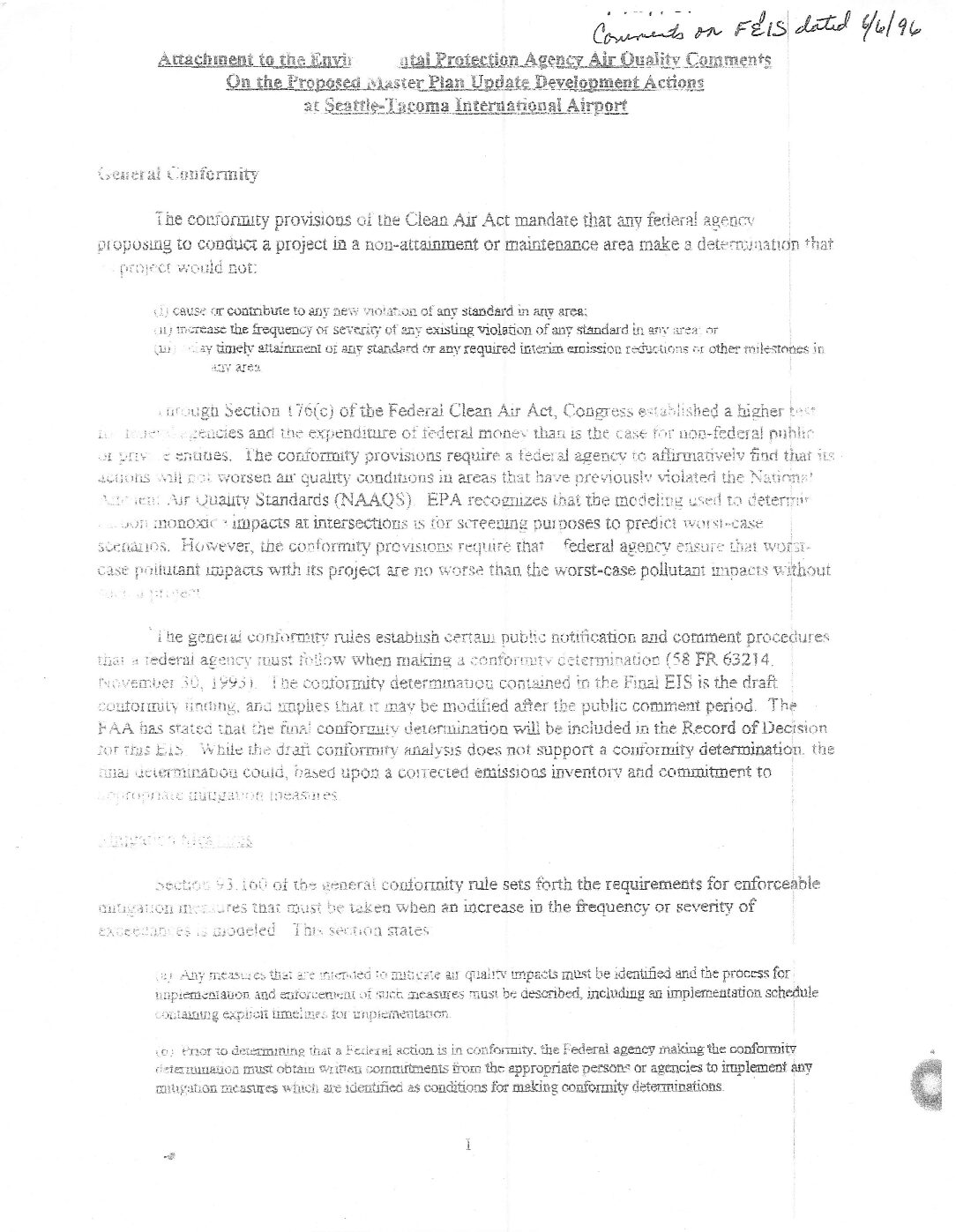 1996-09-06
Attachment to the Environmental Protection Agency Air Quality Comments on the Proposed Master Plan Update Development Actions at Seattle-Tacoma International Airport
This 1996 EPA Region X document provides air quality comments on the proposed Master Plan Update Development Actions at Seattle-Tacoma International Airport, outlining Clean Air Act conformity requirements that federal agencies must meet when conducting projects in non-attainment or maintenance areas. It highlights inconsistencies found across multiple environmental impact statements for nearby projects, including conflicting carbon monoxide modeling results at key intersections near the airport. The EPA calls for better coordination and data sharing among project leads to ensure consistent and comprehensive cumulative air quality impact analyses. -
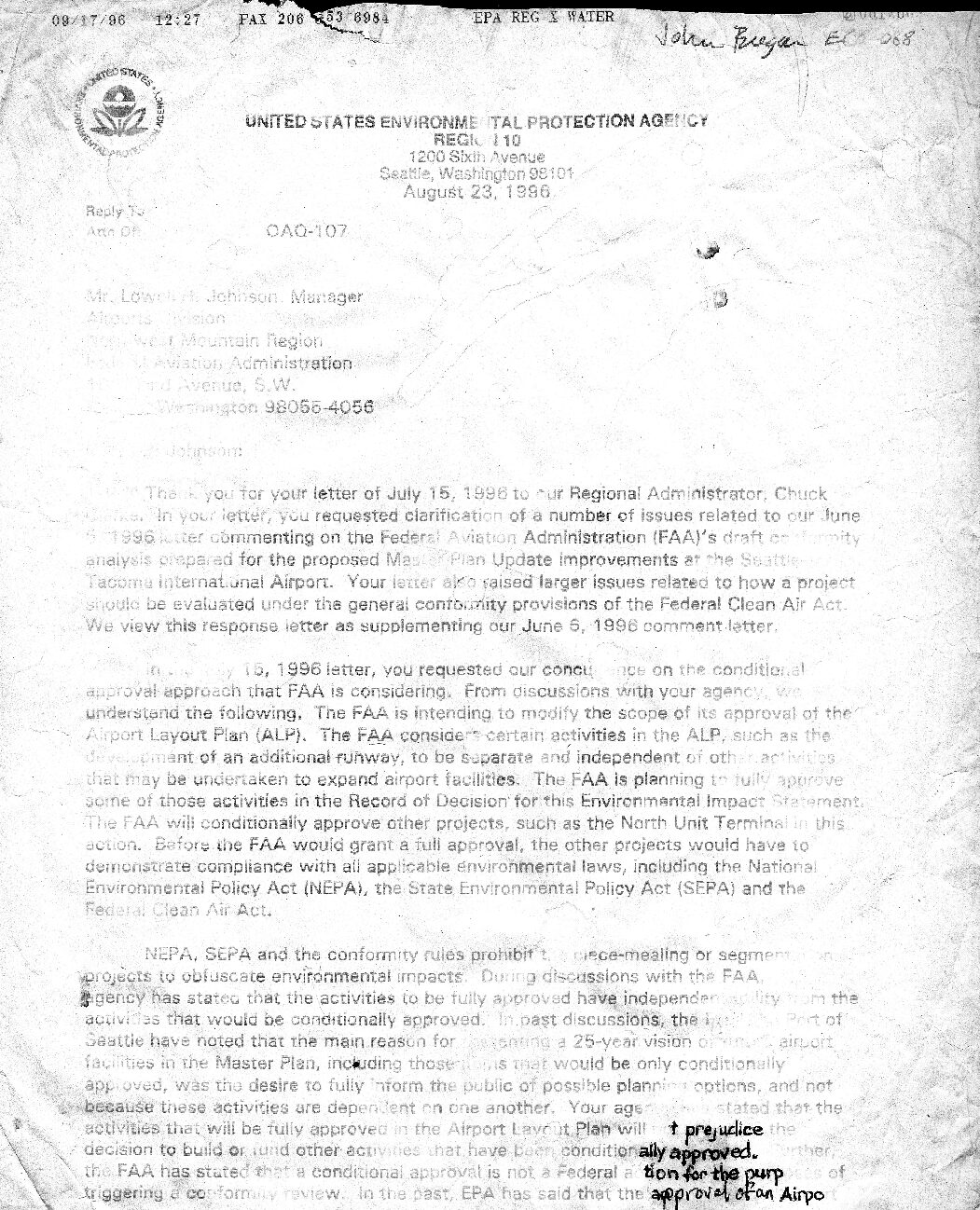 1996-08-23
EPA Region 10 letter to FAA Northwest Mountain Region regarding Sea-Tac Airport Master Plan conformity analysis
In this August 23, 1996 letter, the U.S. EPA Region 10 responds to the FAA's request for clarification on the conditional approval approach for the Seattle-Tacoma International Airport Master Plan Update. The EPA explains that NEPA, SEPA, and federal Clean Air Act conformity rules prohibit piece-mealing or segmenting projects to obscure environmental impacts, and that any conditionally approved projects — such as the North Unit Terminal — must eventually demonstrate full compliance with all applicable environmental laws before receiving final approval. -
 1996-07-15
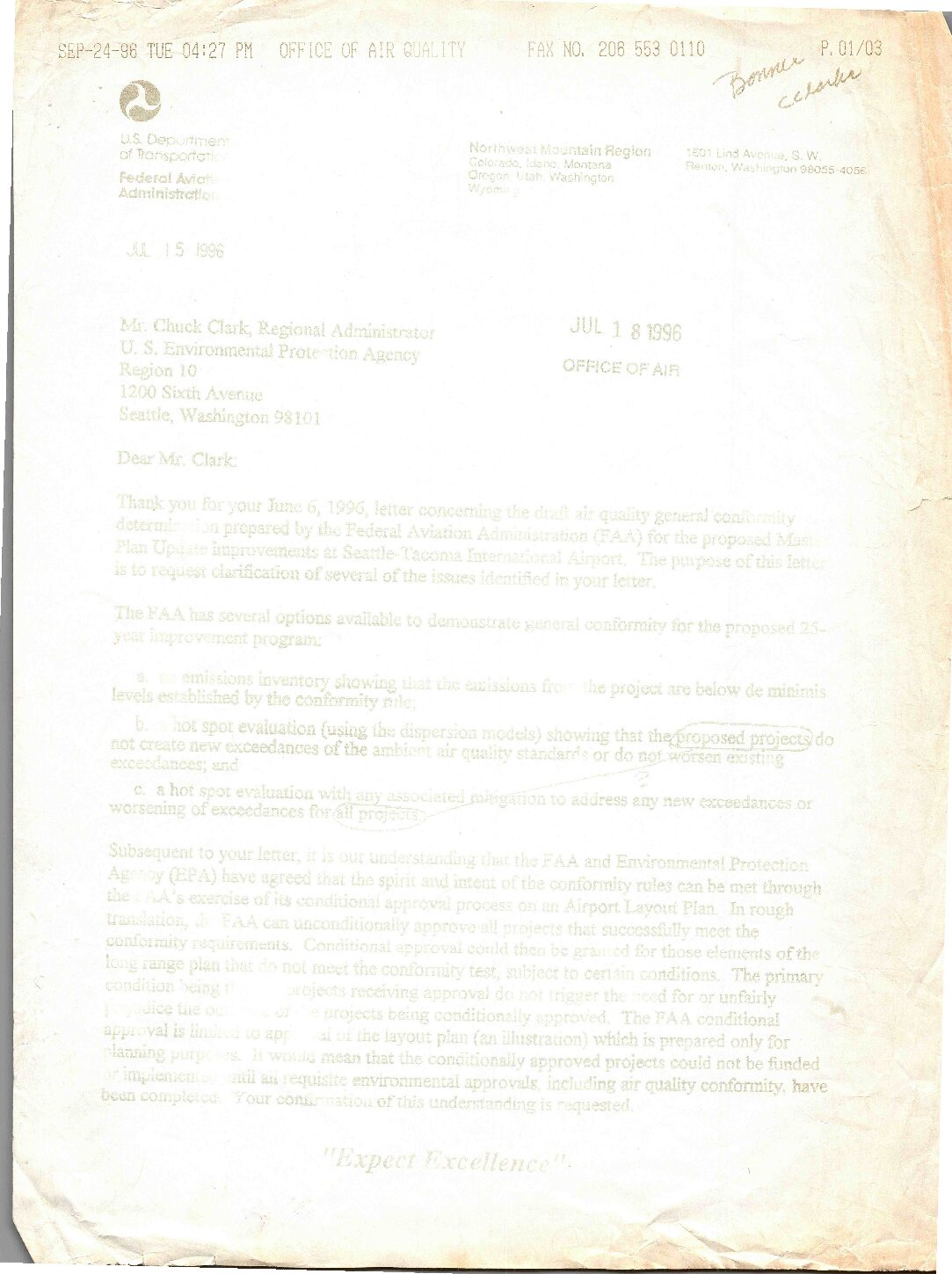
Letter from FAA Northwest Mountain Region to EPA Region 10 regarding air quality conformity for Sea-Tac Airport Master Plan Update
A July 1996 letter from the FAA's Northwest Mountain Region to EPA Region 10 Administrator Chuck Clark addresses air quality general conformity issues related to proposed Master Plan improvements at Seattle-Tacoma International Airport. The FAA outlines three options for demonstrating conformity, including emissions inventories and hot spot evaluations, and responds to EPA questions about construction emissions, fuel type assumptions, and cumulative traffic impacts at nearby intersections. The letter concludes that the proposed improvements would not create new exceedances of national ambient air quality standards, and requests EPA confirmation before proceeding with a final conformity determination. -
 1996-06-07
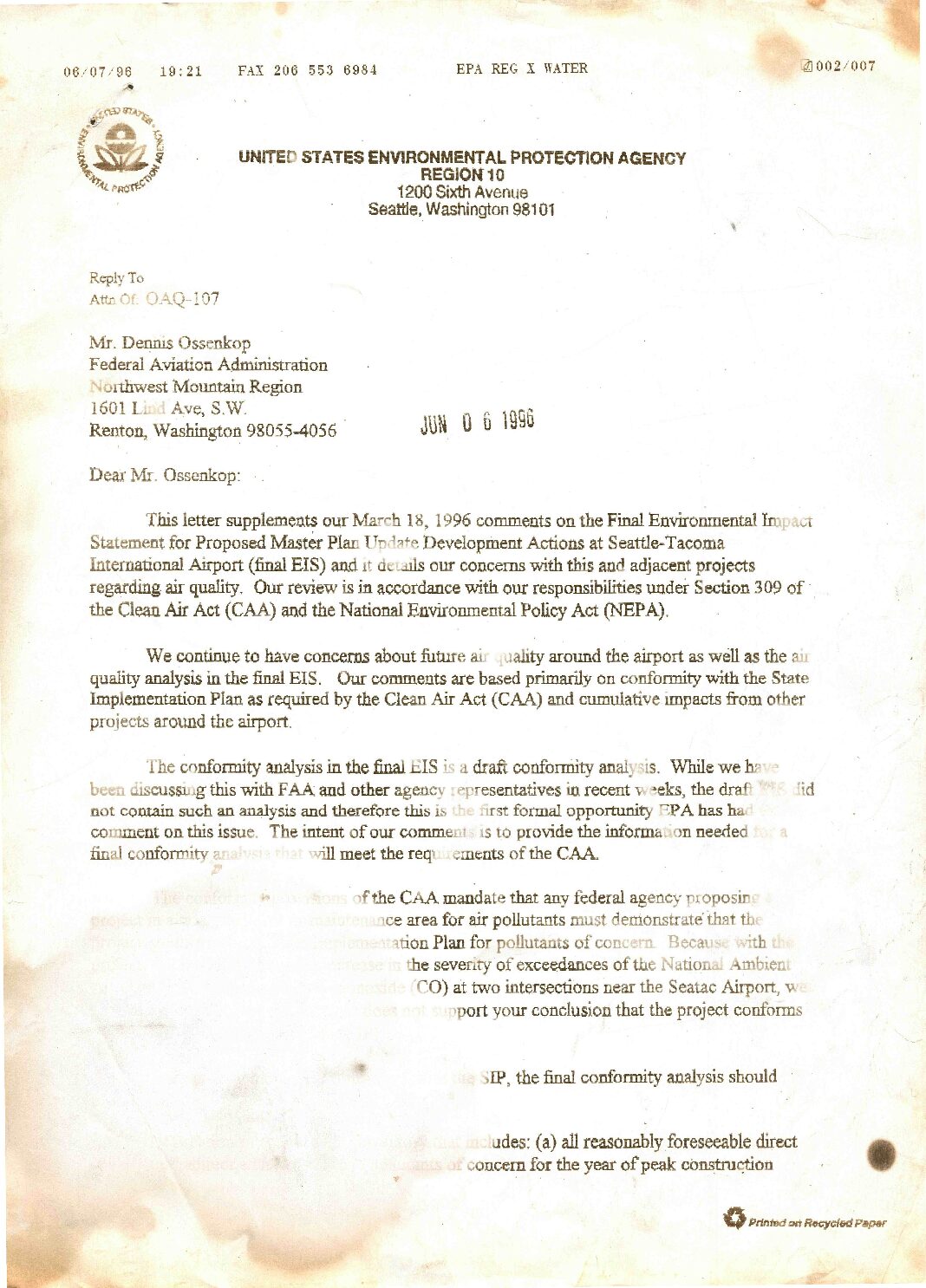
EPA Region 10 letter to FAA on air quality concerns for Sea-Tac Airport master plan EIS
In a June 1996 letter, the EPA's Region 10 office raised concerns about air quality impacts from the proposed Master Plan development at Seattle-Tacoma International Airport, noting that the Final Environmental Impact Statement contained only a draft conformity analysis that did not fully meet Clean Air Act requirements. The agency called for a comprehensive conformity analysis covering emissions forecasts through 2020, comparisons of 'no project' versus 'with project' air quality scenarios, and enforceable mitigation measures to prevent exceedances of National Ambient Air Quality Standards. EPA also urged that the Record of Decision include a cumulative impacts analysis and a long-term air quality monitoring program, coordinated with the Washington Department of Ecology and the Puget Sound Air Pollution Control Agency.