TagAirport Development Fund(18)
-
2025-08-12
Sea-Tac Airport Development Fund Balance — Financial Presentation (Page 214)
A bar chart from a Sea-Tac Airport financial presentation (page 214 of 292) showing the Airport Development Fund Balance with a beginning balance of $739,774 thousand, an ending balance forecast of $830,000 thousand, and a budget of $829,833 thousand. The slide notes the ending balance forecast of $830M meets the target of 18 months of O&M in 2025. -
2025-08-12
Sea-Tac Airport ADF Sources and Uses Summary — 2025 Forecast vs. Budget (Page 251)
This slide (page 251 of 292) presents the Airport Development Fund (ADF) Sources and Uses summary for Seattle-Tacoma International Airport, comparing 2025 forecast against 2025 budget. Key figures include a 1/1/2025 ADF balance of $739,774K (forecast) vs. $703,614K (budget), total sources of $957,838K, total uses of $(867,612)K, and a projected 12/31/2025 ADF balance of $830,000K, meeting the 18-month operating expense target. -
2025-01-01
Port Of Seattle 2025 Aviation Budget Briefing Adf
A budget summary slide presenting Sea-Tac Airport's financial data from 2021 actuals through the 2025 proposed budget, showing Total Operating Revenues projected at $933,942K and Net Operating Income at $371,370K for 2025. Key indicators include ADF (Airport Development Fund) Cash Balance at 18 months of O&M and Capital Expenditures of $920,089K for 2025, representing a 28.2% increase from 2024. -
2024-06-25
SR 509, I-5 to 24th Avenue S. (Stage 1b)
Aerial rendering showing the planned SR 509 Expressway extension (Stage 1b) connecting I-5 to 24th Avenue S. in the SeaTac/Kent area of Washington State. The image labels key project elements including the new SR 509 Expressway alignment, a toll point near S. 208th St, southbound and northbound SR 509 ramps, a southbound I-5 off-ramp, 24th Ave S. interchange ramps, a future light rail corridor, and the S. 216th St overpass. -
2024-06-25
SR 509, I-5 to 24th Avenue S. (Stage 1b)
A planning rendering for SR 509, Stage 1b, showing proposed highway improvements between I-5 and 24th Avenue S. in the Kent/Des Moines area. Labeled features include new northbound and southbound I-5/SR 509 ramp connections, a new Veterans Drive I-5 undercrossing and SR 516 interchange improvements, wider sidewalks and shared use paths, and the future SoundTransit Kent/Des Moines Station along SR 99. -
2020-03-24
Resolution No. 3771: Flight Corridor Safety Program 2019 property interests
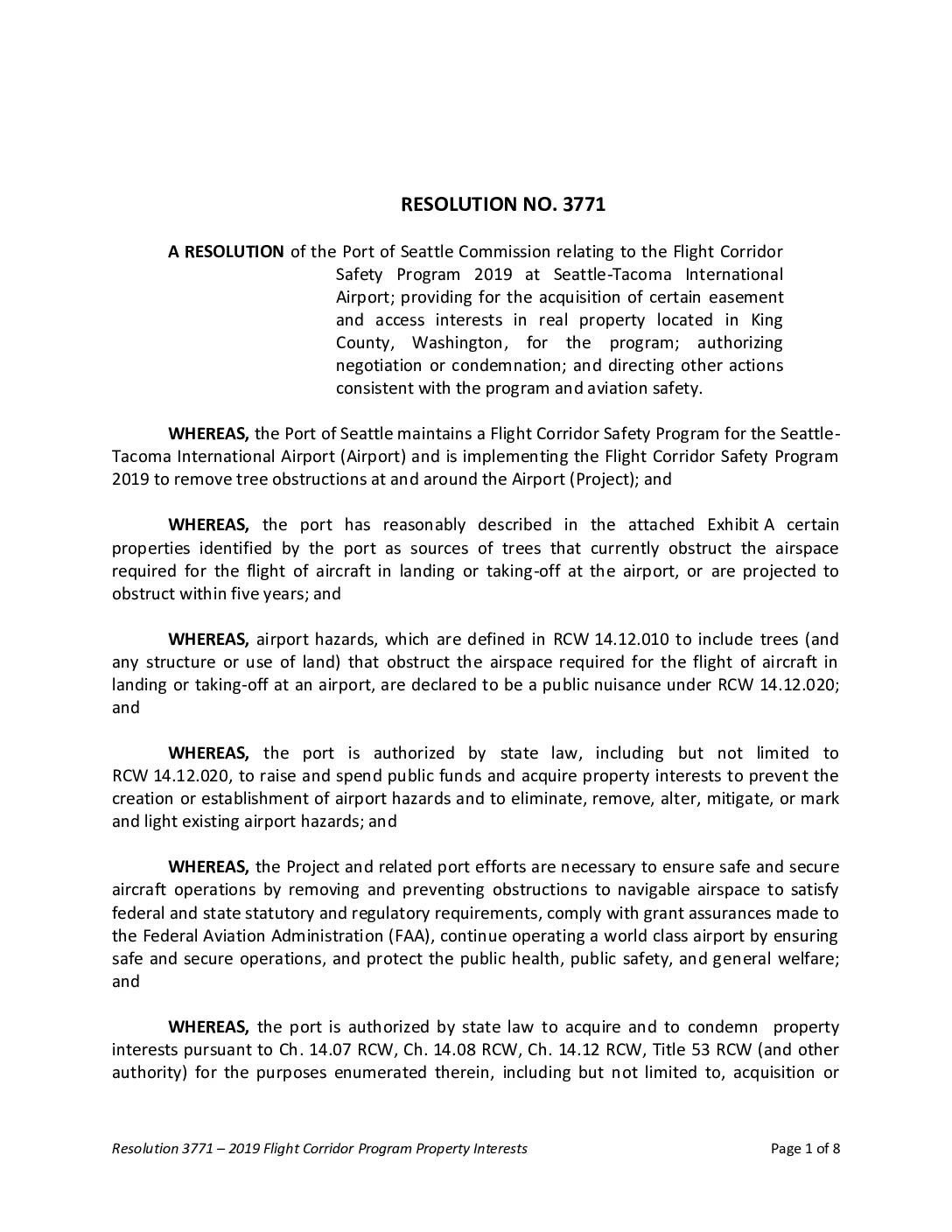
The Port of Seattle Commission adopted Resolution No. 3771 in March 2020 to authorize the acquisition of property easements and access rights around Seattle-Tacoma International Airport as part of the 2019 Flight Corridor Safety Program. The program aims to remove trees and other obstructions that interfere with aircraft landing and takeoff corridors, in compliance with FAA requirements and state law. The Port is directed to first pursue voluntary negotiations with affected property owners, but is authorized to use eminent domain condemnation proceedings if those negotiations fail. -
2020-03-24
Resolution No. 3771: Flight Corridor Safety Program 2019 property interests
The Port of Seattle Commission adopted Resolution No. 3771 in March 2020 to authorize the acquisition of property easements and access rights around Seattle-Tacoma International Airport as part of the 2019 Flight Corridor Safety Program. The program aims to remove trees and other obstructions that interfere with aircraft landing and takeoff corridors, in compliance with FAA requirements and state law. The Port is directed to first pursue voluntary negotiations with affected property owners, but is authorized to use eminent domain condemnation proceedings if those negotiations fail. -
2017-10-24
Transfer of airport property to EDD
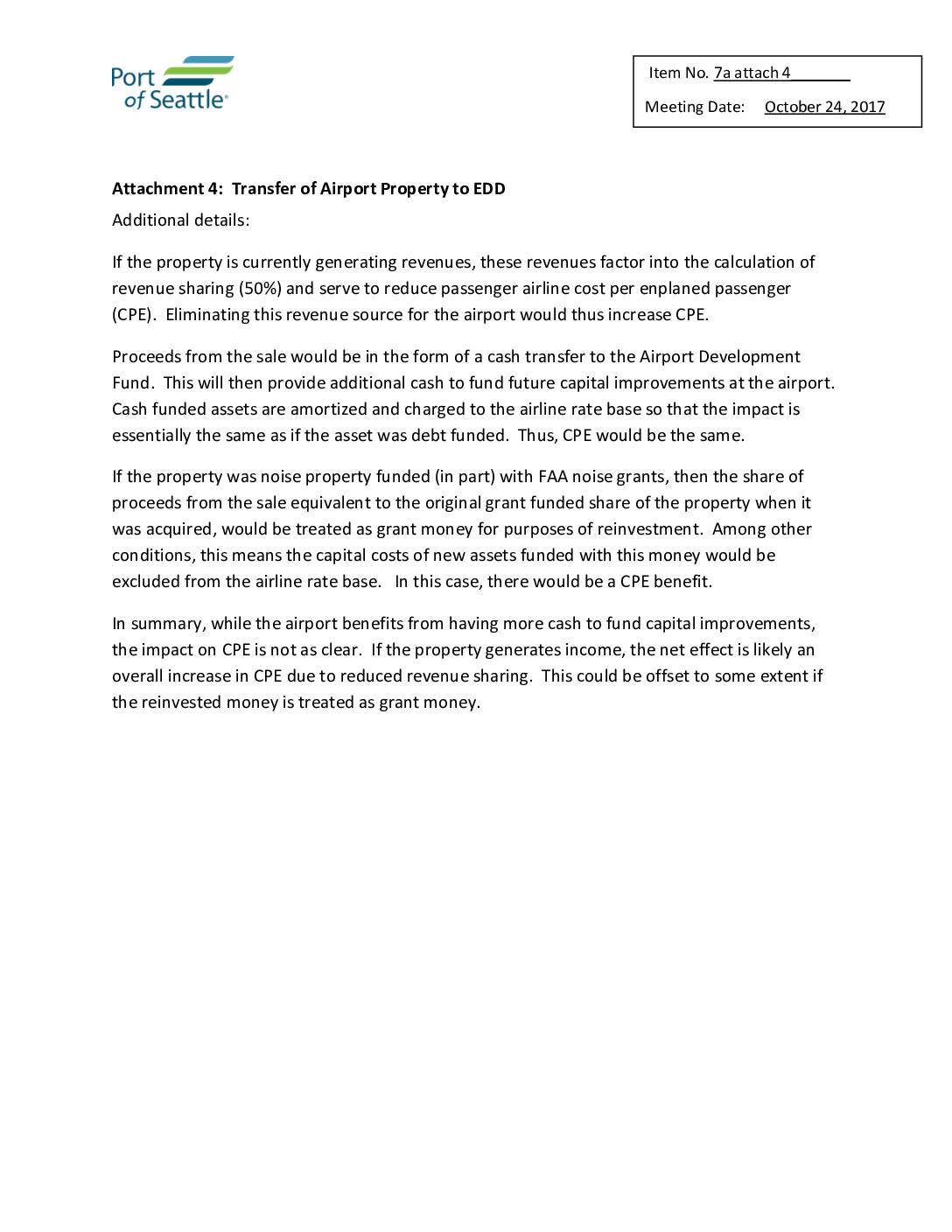
This Port of Seattle document examines the financial implications of transferring airport property to the Economic Development Division (EDD). It explains that if the transferred property currently generates revenue, losing that income would likely raise the cost per passenger (CPE) for airlines, since those revenues normally offset airline fees. However, if the property was originally purchased using FAA noise grants, a portion of the sale proceeds could be reinvested as grant money, potentially reducing costs and partially offsetting the CPE increase.