Notes
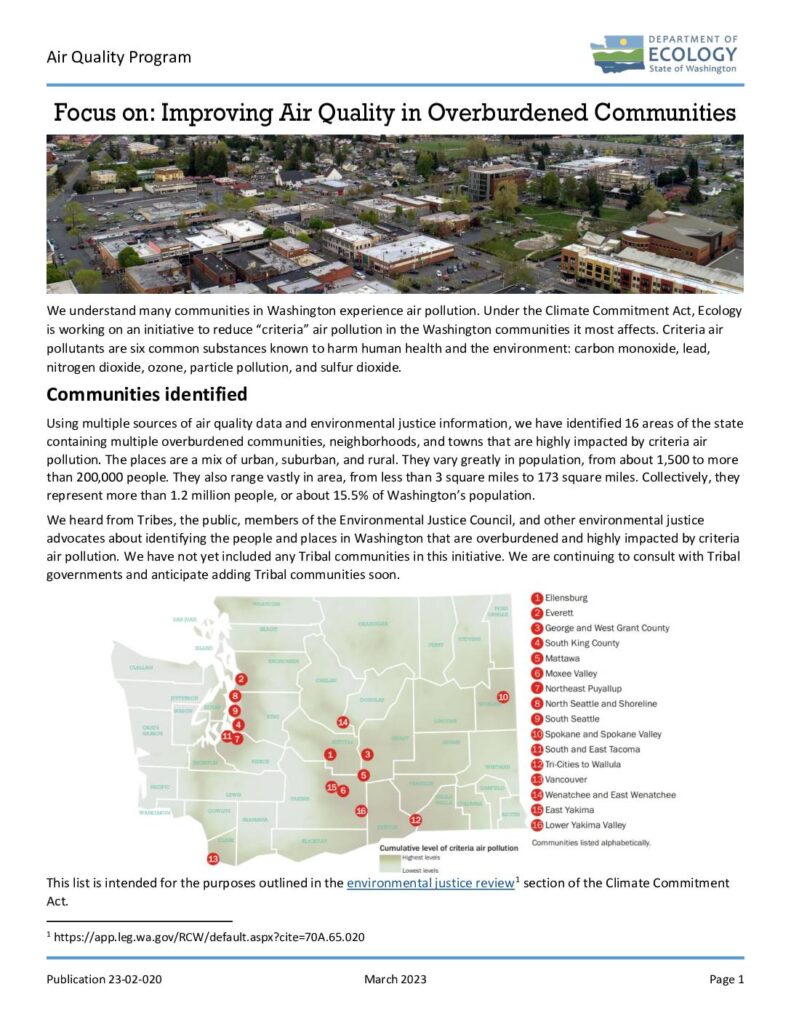
Washington State Department of Ecology Air Quality Program publication (Publication 23-02-020, March 2023) identifying 16 overburdened communities highly impacted by criteria air pollutants under the Climate Commitment Act (RCW 70A.65.020). Criteria pollutants include PM2.5, PM10, ozone, carbon monoxide, lead, nitrogen dioxide, and sulfur dioxide. The 16 identified communities are: Ellensburg, Everett, George and West Grant County, South King County, Mattawa, Moxee Valley, Northeast Puyallup, North Seattle and Shoreline, South Seattle, Spokane and Spokane Valley, South and East Tacoma, Tri-Cities to Wallula, Vancouver, Wenatchee and East Wenatchee, East Yakima, and Lower Yakima Valley. Communities were identified using the Washington Environmental Health Disparities map and EPA EJScreen, with consideration of historic redlining, health disparities, and environmental justice factors. Collectively representing over 1.2 million people (15.5% of Washington’s population). Contact: Susan Woodward, susan.woodward@ecy.wa.gov.