Skip to content
  • STNI
  • Statistics
    • Ops and Passengers
      • King County International Airport (Boeing Field) Annual Operations
    • Financials
    • Aviation fuel uplift in the State of Washington 2018 – 2025
      • Aviation Fuel Uplift at Sea-Tac Airport
    • Air Quality Monitoring
    • Flight Tracking
      • Flow and Flight Tracks
      • Five Year Comparison
      • Busiest Hours and Days
    • SEL Noise Reports & Graphs
      • About The Permanent Noise Monitors
      • Minutes of Quiet by Noise Monitor
      • Noise Events mapped
      • Noise Events (SEL)
    • Runways
    • Employees
    • Real Estate
      • Port Properties and Trees mapped
    • Parking
  • Events
  • Protest
    • Regular Events
    • Legislation 2026
    • Complain about a particular flight
    • Advocacy Organizations
    • Media Outlets
    • People
    • The Port of Seattle
      • Commission Meetings
      • Public Records Requests
      • StART
      • Highline Forum
    • Contact Your Electeds
  • Resources
    • FAQs
      • FAA Occurrences/Accidents/Indents
    • The unSustainable Airport Master Plan
      • SAMP NTP: 31 projects by the numbers
      • SEPA Draft EIS (2026)
      • SAMP Record of Decision/FONSI (2025)
      • SAMP Draft EA (October 2024)
      • 2018 Scoping
    • Port Packages
      • Port Package Property Costs
      • Port Packages mapped
      • The Port Package Explainer
      • So you want a (first-time) Port Package? Start here
      • Port Package Looker Upper
      • How do I determine if I have a Port Package or Avigation Easement?
      • Progress on Port Package Update legislation
      • Having a Port Package Problem?
      • Port Package Site Visit Follow-Up
    • Document Library
    • Explainers
      • The Airport Law Cheat Sheet
      • The Grant Explainer
    • External Articles
    • History
      • Timeline
      • The Sea-Tac Communities Plan
        • Sea-Tac Communities Plan – Planning Maps
      • PSRC Third Runway Decision Process
    • Studies
    • Videos
  • Stories
  • Mission
  • Subscribe
  • Contact
Scroll down to content

Get InformedStay Informedx

I understand that you will never share my information with anyone, you will only use it to keep me updated on relevant events and that I may unsubscribe at any time.

STNI

STNISea-Tac Noise.Info

  • Solve for Sea-Tac. Solve for every airport.
  • Since 2016, working to obtain justice for everyone living under the flight path.
  • Less Noise. Cleaner Air. Better Public Health. Compensation.
  • Everything you think you know about the airport is wrong.

TagNorth Sea-Tac Park(77)

Advanced Search Options

  • Dates
  • Media
    • External Articles
    • Images
    • PDFs
    • Video
    • Audio
  • Order By
  • 1981-01-14

    Port of Seattle Response to Community Concerns about Sea-Tac Airport

    Letter from Sea-Tac Airport Manager Oris W. Dunham Jr. to William C. Holstine addressing community concerns about airport operations, including land acquisition programs, noise mitigation, flight operations, and the North Sea-Tac Park development. The letter responds to a November 14 meeting and community questionnaire about Port of Seattle relationships with surrounding neighborhoods.
    CategoriesHistory Tagscommunity engagement, Land Use, letter, Noise Complaints, North Sea-Tac Park, Port Of Seattle
  • 1980-01-03

    North Sea-Tac Park recreation master plan

    This 1980 recreation master plan for North Sea-Tac Park was prepared by Jongejan/Gerrard/McNeal, Inc. as a joint planning effort between the Port of Seattle and King County. The plan identifies community recreational needs, assesses natural and manmade site constraints including airport noise impacts, and proposes development guidelines for the park adjacent to Seattle-Tacoma International Airport. It was described at the time as a pioneering example of airport-adjacent land use planning at the national level.
    TagsKing County, Land Use, North Sea-Tac Park, NSTP, Port Of Seattle
  • 1979-12-02

    North Sea-Tac Park plan coverage: Recreation council endorsement, records center proposal, and Sunset Park editorial

    In late 1979, community discussions around Sea-Tac International Airport's north clear zone focused on repurposing approximately 240 acres of noise-impacted land into a multi-use recreational park, featuring soccer fields, tennis courts, nature trails, a golf course, and a motorcycle training area. The Highline Recreation Council unanimously endorsed the North Sea-Tac Park Plan (Sunset Plan), while a separate initiative proposed converting the closed Sunset Junior High School into a regional government records and archives center. Both plans reflect broader efforts to find productive uses for land rendered uninhabitable by airport noise, with funding and community engagement identified as key challenges.
    TagsHighline Times, Historic Preservation, North Sea-Tac Park, NSTP, Port Of Seattle, Seattle Times
  • 1979-11-14

    Letter to Arthur H. Yoshioka re: North Sea-Tac Park planning

    A November 1979 FAA letter to the Port of Seattle expresses support for a 'Modified Passive 2' conceptual plan for the proposed North Sea-Tac Park, while urging that any final park plan carefully weigh adverse impacts on adjacent residential neighborhoods and airport operations. The letter emphasizes that residents in the immediate study area should have meaningful input into the final park plan, and calls for close collaboration among the Port, King County, consultants, and citizens to minimize conflicts between park uses and the unique challenges posed by proximity to a major airport.
    TagsFAA, North Sea-Tac Park, Port Of Seattle, Robert O. Brown, STCP
  • Highline Community Plan initial proposal for NSTP VD notes

    TagsNorth Sea-Tac Park, NSTP, Virginia Dana
  • 1979-08-06

    FAA letter to Jongejan Gerrard Associates regarding North Sea-Tac Recreation Planning guidelines

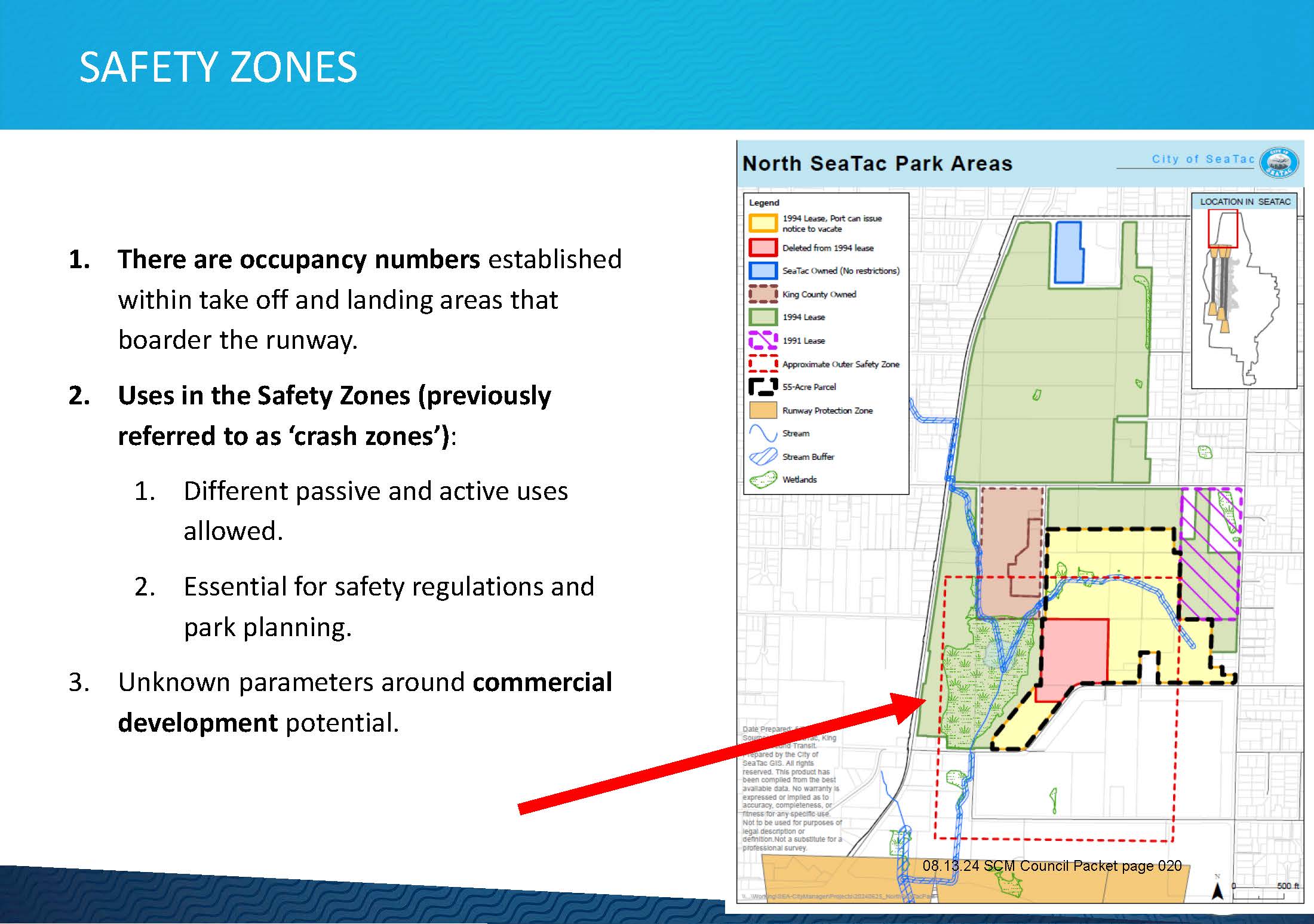
    In this August 6, 1979 letter from the FAA's Northwest Region to Jongejan Gerrard Associates, the agency provides guidelines on acceptable crowd density levels for recreation planning near Sea-Tac Airport. The FAA outlines four zones around the runway, each with specific limits on peak-time people per acre, ranging from no intensive use in the clear zone closest to the runway to no more than 40 people per acre in outlying areas. The letter also discourages any recreation development that could create bird hazards, incompatible lighting, or electronic interference with airport operations.
    TagsAirport Citizen Participation Program, FAA, Jongejan, letter, North Sea-Tac Park, NSTP
  • 1979-07-30

    North Clear Zone Recreation Plan Study – Sea-Tac International Airport

    A July 1979 FAA memo summarizes the first advisory committee meeting on a proposed recreation plan for the North Clear Zone near Sea-Tac International Airport. The meeting, attended by about 40 community members, consultants, and Port of Seattle representatives, centered on what types of recreational uses—such as soccer fields, golf courses, and bike trails—would be compatible with airport safety guidelines, with the FAA cautioning against intensive uses and large fixed spectator facilities in the clear zone. The group requested more specific, quantitative FAA guidelines on acceptable land use, and a follow-up meeting was scheduled for August 8, with the full study expected to take six months and potentially set precedents for recreational land use near major airports.
    Tagscommunity engagement, FAA, Land Use, North Sea-Tac Park, Sea-Tac Airport
  • 1979-07-27

    Letter to FAA North Sea-Tac site development plans and carrying capacity analysis

    A July 1979 letter from planner Janis Snoey to FAA Airport Planning Branch representative George Sato transmits five pre-schematic site plans for the North Sea-Tac Park, showing projected peak-time visitor numbers under various development scenarios. The plans, prepared following an FAA meeting on July 17, 1979, are accompanied by a 'Carrying Capacity' map that classifies park areas by development suitability—from very high intensity (sports fields, motorcycle trails) to low intensity (foot paths only)—based on analysis of soils, hydrology, vegetation, and noise. The documents were intended solely to provoke discussion during the early master planning phase for the North Sea-Tac site.
    CategoriesCorrespondence, History TagsFAA, Gerrard Associates, Jongejan, Land Use, North Sea-Tac Park, NSTP
  • 1979-07-22

    North Sea-Tac Park planning maps: Passive, Modified Passive, and Modified Passive 2 concepts

    These three hand-drawn planning maps present alternative development scenarios for North Sea-Tac Park, labeled 'Passive,' 'Modified Passive,' and 'Modified Passive 2.' Each concept proposes different mixes of recreational facilities—such as soccer fields, baseball fields, tennis courts, a golf course, and archery targets—alongside preserved natural areas, nature trails, and passive open space. The maps were intended solely for discussion purposes and show peak-time visitor capacity estimates for each proposed facility zone.
    CategoriesHistory TagsLand Use, North Sea-Tac Park, NSTP
  • GHCPB Flyer North Sea-Tac Park 1979

    CategoriesHistory TagsFlyer, GHCPB, Greater Highline Community Parks Board, North Sea-Tac Park, NSTP

Posts pagination

Page 1 … Page 5 Page 6 Page 7 Page 8
Sidebar On/Off

Help study childhood asthma. Get free HEPA filter!

read more...

Issues

Sea-Tac Airport is currently undergoing the largest and longest expansion in its history, collectively known as the Sustainable Airport Master Plan (SAMP). Some of it you can already hear, but you’re probably not aware of what it all means. Here’s what you need to know.
read more...

Read This!

As the source for federal transportation grants, the Puget Sound Regional Council was charged with developing a system to meet the growing need for commercial aviation. When the search for a second airport failed, they authorized the Port of Seattle to build the Third Runway, with a mandate to develop a noise abatement and mitigation program. In their effort to stop the Third Runway, the ACC argued over every detail of the Port's efforts--including property buyouts and sound insulation. The dispute was meant to be settled by a three member Expert Arbitration Panel. This is their final report. It finds 2-1, that the Port's program was insufficient in several respects. Despite that, funding for the Third Runway was approved by the PSRC, and the 'Port Package' program, proceeded largely unchanged. Expert Arbitration Panel's final decision finding that the Port of Seattle had not shown sufficient reduction in real on-the-ground noise impacts to satisfy noise reduction conditions required for approval of a third runway at Sea-Tac International Airport. The majority decision concluded the Port's noise abatement programs were insufficient despite being impressive in scope.
continue...

The Podcast!

Subscribe to the only podcast devoted to policies, politics, history, impacts for people living under the flight path everywhere. It’s definitely not just about noise!
  • Sea-Tac Noise.Info
  • Connect with STNI

    • Subscribe
    • Port Package Problem?
    • Donate
    • Podcast
    • Socials
      • Facebook
      • X (Twitter)
      • Bluesky
      • Instagram

    "Port Sound Insulation Repair and Replace Pilot Program postcard 20240516_0001_Page_2" — , 2024

  • Learn

    • Frequently Asked Questions
    • Explainers
    • Youtube
    • Research Requests
    • Make a complaint
  • Goals

    Fulfill the promises of 1976:
    • Compensation
    • Reduced noise
    • Improved air quality
    • Environmental remediation
Login/Register
©2026•Data Privacy

Message

We use cookies to provide basic functionality. We also provide access to search engines in order to provide site analytics. We do not sell or share your data.
V V