Notes
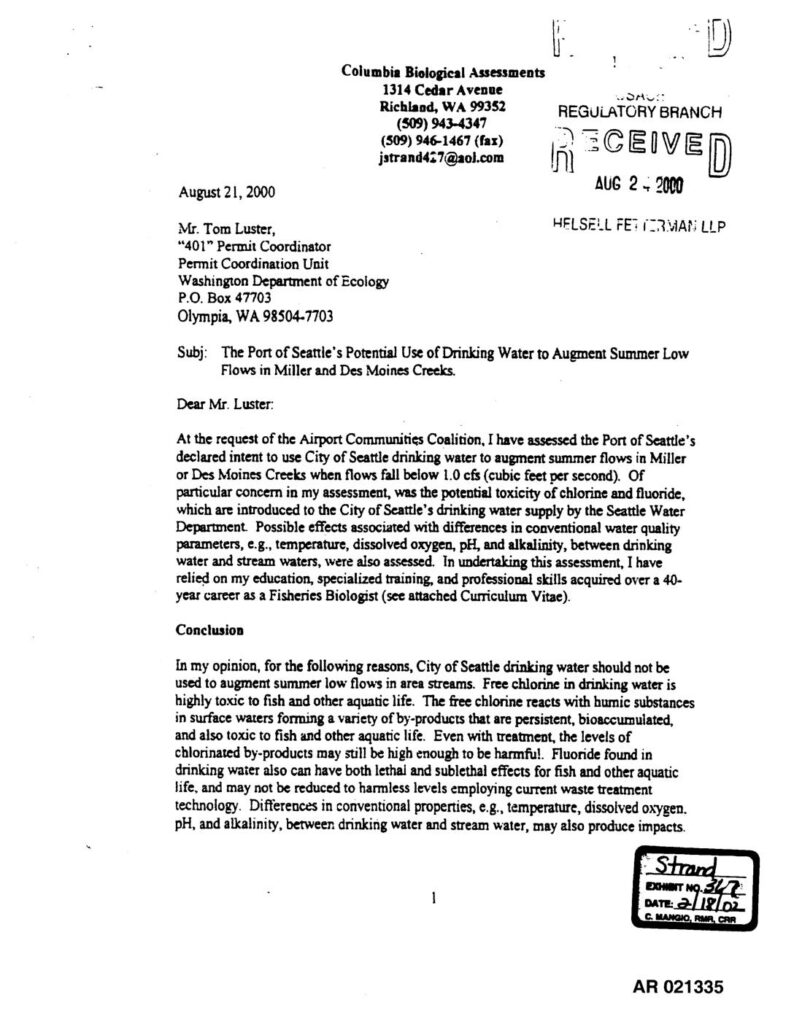
Exhibit AR021335. Letter dated August 21, 2000 from Columbia Biological Assessments (fisheries biologist J. Strand, Richland WA) to Tom Luster, ‘401’ Permit Coordinator, Washington Department of Ecology, submitted on behalf of the Airport Communities Coalition (ACC). Assesses Port Of Seattle’s declared intent to use City of Seattle drinking water to augment summer low flows in Miller Creek and Des Moines Creek when flows fall below 1.0 cfs. Concludes that free chlorine (residuals 0.5–1.5 mg/L at tap) is highly toxic to fish and aquatic life at concentrations far exceeding WAC 173-201A-030 acute criterion (19 ug/L) and chronic criterion (11 ug/L). Documents LC50 values for daphnia (27.6 ug/L), rainbow trout (61.92 ug/L), and cutthroat trout (85.46 ug/L). Addresses chlorination by-products including trihalomethane (chloroform), bromoform, and chloramines; cites USEPA 1994 Water Quality Standards. Also addresses fluoride toxicity and conventional water quality parameters (temperature, dissolved oxygen, pH, alkalinity). References WAC 173-201A-030, USEPA 1994, Parkhurst et al. 1996, Holland et al. 1960, Merkens 1958, Arthur and Eaton 1971, Hidaka and Tatsukawa 1985. Filed in PCHB Third Runway EIS administrative record.