Notes
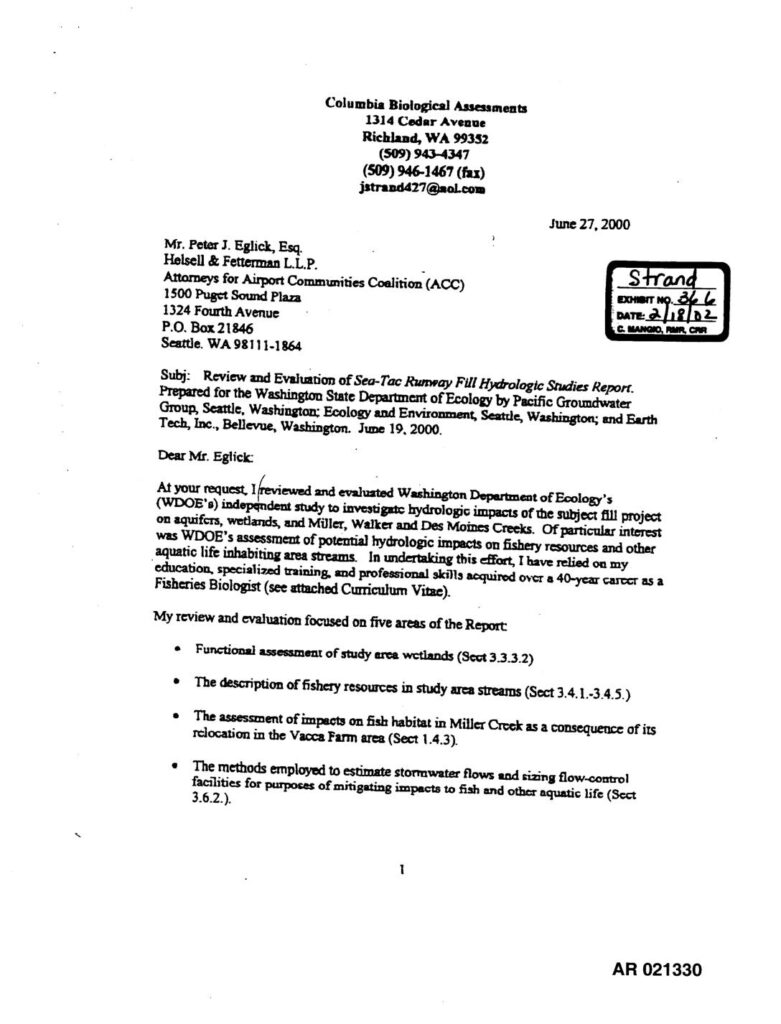
Expert review letter dated June 27, 2000, authored by a Fisheries Biologist at Columbia Biological Assessments (Richland, WA), addressed to Peter J. Eglick, Esq. of Helsell & Fetterman L.L.P., attorneys for the Airport Communities Coalition (ACC). Reviews and critiques the Washington State Department of Ecology (WDOE) Sea-Tac Runway Fill Hydrologic Studies Report prepared by Pacific Groundwater Group, Ecology and Environment (E&E), and Earth Tech, Inc. Focuses on five areas: functional assessment of wetlands (Sect 3.3.3.2), fishery resources in Miller Creek, Walker Creek, and Des Moines Creek (Sect 3.4.1–3.4.5), construction impacts on Miller Creek fish habitat due to relocation in Vacca Farm area (Sect 1.4.3), stormwater flow estimation methods (Sect 3.6.2), and warm water runoff impacts from runways and taxiways (Sect 3.6.10). Criticizes E&E for understating ecological importance of Wetland 43 (Walker Creek headwaters), incomplete fish surveys missing cutthroat trout, coho salmon, prickly sculpin, yellow perch, and black crappie, premature conclusions on chum salmon spawning viability, and failure to address full impacts of 980-foot Miller Creek relocation fill. References Hillman et al. 1998/1999 spawning surveys and Parametrix 2000 reports. AR 021330–021332.