Notes
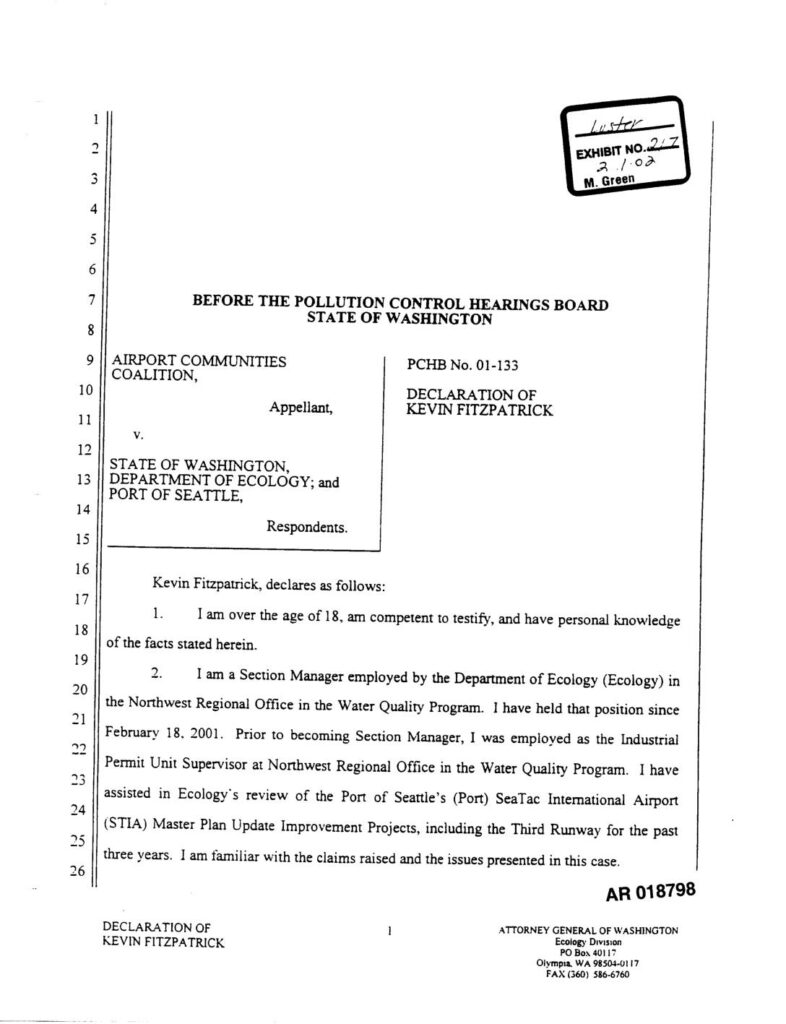
Declaration of Kevin Fitzpatrick, Section Manager at Washington Department of Ecology (Ecology) Northwest Regional Office, Water Quality Program, filed in PCHB No. 01-133, Airport Communities Coalition (ACC) v. Ecology and Port Of Seattle. Fitzpatrick addresses ACC’s claims that Port Of Seattle stormwater discharges from Seattle-Tacoma International Airport (STIA) violate state water quality standards for copper, lead, and zinc. Declaration explains that instantaneous exceedences of numeric criteria do not constitute violations under WAC 173-201A; discusses NPDES permit requirements, best management practices (BMPs), source control studies including zinc from metal roofs and de-icing agent fate-and-transport study, re-routing of de-icing runoff to the Port’s Industrial Wastewater System, and the Stormwater Management Plan (SMP) retrofit. Also addresses Clean Water Act Section 401 Certification condition requiring a Water Effects Ratio Study (WERS) before discharge from new pollution-generating impervious surfaces, and refutes ACC’s claim that the 401 Certification authorizes a mixing zone in violation of WAC 173-201A-100 and WAC 173-201A-110(3). AR 018798–018800.