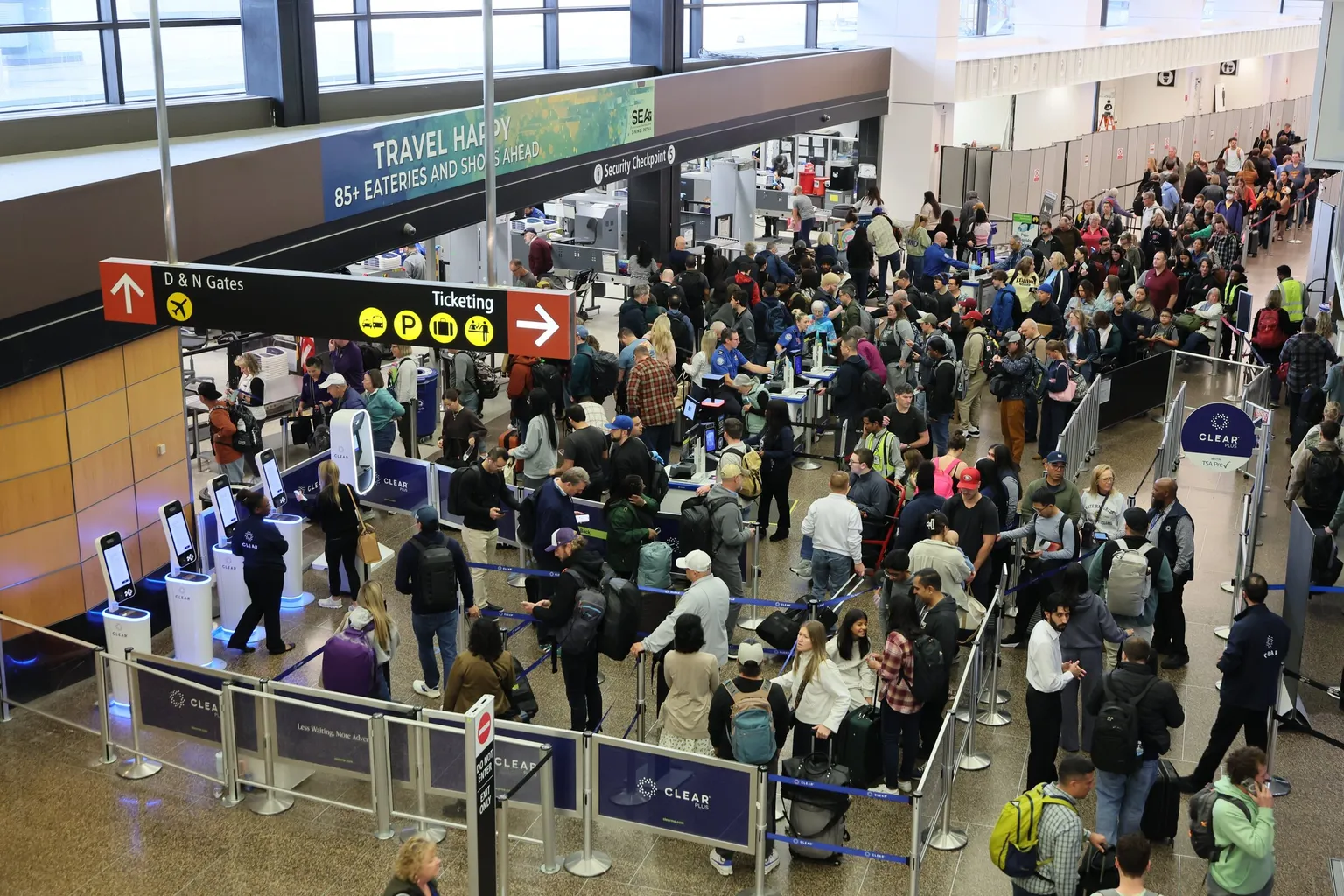
General screening passengers flying out of Seattle-Tacoma International Airport will see one fewer way to skip the lines at security checkpoints beginning this fall.
The airport announced Thursday that its SEA Spot Saver program — which allowed travelers to book a TSA security appointment in advance for free, skipping the line at the airport — will be discontinued on Nov. 30. Travelers can still book a time slot at the airport’s Checkpoint 4 between now and Nov. 29, according to airport representatives.
The Spot Saver program was launched in 2021 with a goal of reducing security wait times at Sea-Tac, which has since grown into the 11th busiest airport in the United States, said Perry Cooper, senior manager of media relations for the Port of Seattle and Sea-Tac.
The airport is also “the most space-constrained major airport” in the country, according to Thursday’s news release.
“We’re thrilled it was there when we had some challenges before,” Cooper said Thursday. “We’re going to say goodbye to it because it also … provides us an opportunity to be a little bit more flexible in the way that we have our lines queued up in front of those checkpoints.”
While popular, the program’s usage has declined in recent years as the airport rolled out broader upgrades to its security checkpoints. And while bookings peaked in 2025, at 1.58 million reservations, security checkpoints only recorded 826,333 Spot Saver scans last year, according to airport data.
At 52%, that rate of scans versus reservations was the lowest since 2023 — and so far in 2026, the rate has dropped further, to 42%. Through July of this year, 422,000 passengers out of 987,000 reservations used their scheduled appointments instead of waiting in general security lines upon arrival.
“What’s been happening is that we’ve seen the (SEA Spot Saver) program not needed as much as it has in the past,” Cooper said.
SEA Spot Saver gives travelers a 15-minute appointment window during which they can go through security; appointments can be scheduled between 4 a.m. and 10 p.m. daily, up to five days before a flight.
And while Sea-Tac is booming yet again this year, following a record 2025 in which 52.7 million passengers traveled through the airport — an average of about 144,000 per day — Cooper said infrastructure improvements have helped the airport outgrow Spot Saver.
The airport debuted a new Checkpoint 1 and a redesigned Checkpoint 6 last year, which Cooper says have helped lines move more quickly. More than 94% of travelers have gotten through security in 20 minutes or less this year, according to Sea-Tac data.
That includes the partial government shutdown in March, which left hundreds of Transportation Security Administration workers without pay and other airports around the country with hourslong waits. At that time, Cooper said, Sea-Tac was able to manage wait times typically between 10 and 15 minutes.
Since the Spot Saver program’s inception at Sea-Tac, airports across the country, including Phoenix Sky Harbor International Airport and Minneapolis-St. Paul International Airport, have created similar TSA reservation programs.
With airport security wait times staying stable currently, Cooper said Sea-Tac does not have plans to replace the program. Outside of timesaving security programs like TSA PreCheck and CLEAR, Sea-Tac passengers can monitor live wait times online at portseattle.org and on digital signage inside the airport.
“We’ve got more lanes open in the checkpoints overall,” Cooper said. “And the lower wait times we’ve seen have really made a difference.”