Federal Way Mirror: JCH Letter to the Editor
Introduction
The events of the past few years have demonstrated something clearly: if you cannot explain a threat in plain language, you cannot get the public to respond appropriately. If a substance like asbestos or lead is already regulated, that is less important. In that case, health specialists in government are (usually) able to take action. But if not, you have to get the public and electeds to become engaged.
It is our belief that policy experts, politicians, health, science are not messaging the issue properly. We must find a way to do better. Above all things, scientists do not like to be seen as alarmist, but sometimes, that works to the public disadvantage. The public, decision makers mistake ‘calm’ for a lack of urgency. Therefore, unlike other articles in this Explainers series, we’re leaving comments open. The goals are: Create an an article with maximum impact, that is accurate, and 1,500 words. It’s a tough challenge and we need your input. This is not an article for experts. How do we know we’ve succeed?
“Would this make an average person care enough to write their elected?”
Size matters: Part I
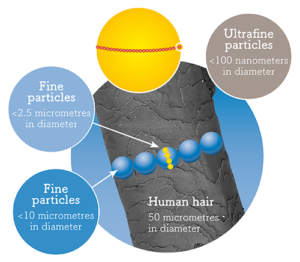 As the name implies, ultrafine particles (UFPs) are a way of talking about pollution based on size, not components.
Right off the bat that may be new. Most of us are used to thinking about hazardous materials based on what they are. Currently we don’t know the components of UFPs in exhaust emissions.
But set aside what are in those UFPs; just counting such tiny particles has been challenging. And in this article, you’ll hear about the need for research, but there is so much more that we don’t know than do.
Size matters: Part II
One thing we do know is that such tiny particles can infiltrate various parts of the body more easily, And no matter what they’re made of, that may be bad for health.
Now, your body was designed to filter out larger particles. (the things commonly found in nature) really well. Your nose? Fantastic invention. Coughing? Amazing for keeping bad things out of your body.
But as we became more industrialized about 150 years ago, we started creating not only new chemicals, but also emissions from engines which have much smaller particle sizes than evolution prepared us to deal with.
When particles get that small, no matter what they’re made of, they can the slip past all our built-in filters.
Surface Area
Consider a typical backyard (OK, my backyard.) There are four objects of interest:
- There’s the soccer ball that my neighbor’s kids kicked into my yard.
- But there’s also about 40 golf balls in his backyard which I sent there (I’m working on my short game. 😀 )
- There’s a big drain pipe left from some gardening project I never finished.
- And we each have one of those motion-activated lights everybody has.
As it flew into my yard, the soccer ball was so big it set off my motion detector. But it’s also way too large to send back through the pipe.
Now if you measured all 40 golf balls, together they have the same surface area as the one soccer ball. But since they’re so tiny, I can practice chip shots all night and they don’t set of the motion detector. And I can send them back to my neighbor because they easily fit through the pipe.
Now, instead of soccer balls and golf balls, think of the particles emitted by any engine. Some engine exhaust (diesel trucks) takes the form of large particles; like soccer balls. But other types of engines (jet airplanes) emit much larger quantities of tiny, tiny particles. They’re more like the golf balls.
One last step: Instead of a drain pipe, think of the blood vessels in your lungs and in your brain. The soccer balls are too big to squeeze through all those smaller tubes. But the golf balls? They zip right on through.
Health
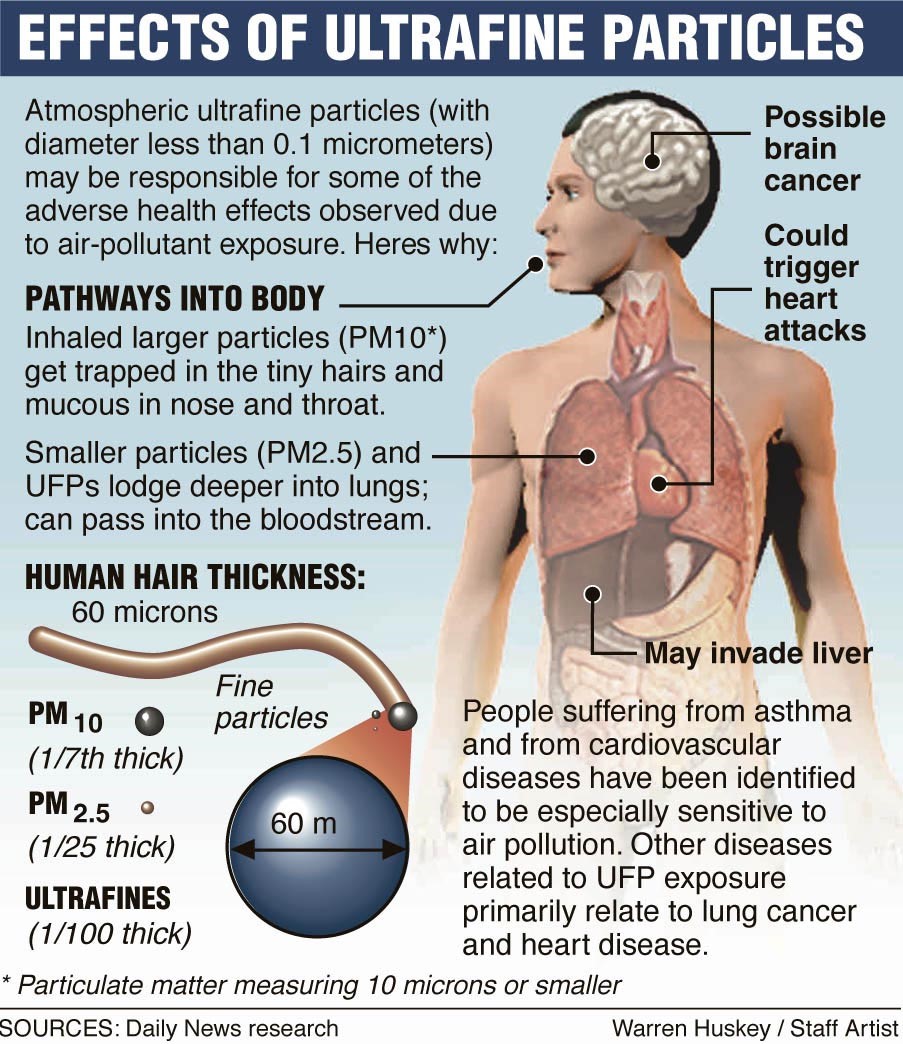
And the thing about any kind of particles small enough to into your blood or brain or any kind of deep tissues, they tend to get stuck. They’re not like a germ that your body knows how to kill and dispose of. They just sit there, blocking traffic.
But what seems to be especially worrying about UFPs is all that surface area. All those tiny particles actually create far more surfaces areas which glom onto your cells and cause trouble.
Catch-22
Because UFPs were so tiny, they weren’t known until recently. And since they weren’t known, they were never monitored. And since they were never regularly monitored, they were never regulated.
But today, we definitely know they exist and every day we’re obtaining more evidence that they may present some serious health risks. But the detectors are still very, very expensive. Which makes it very, very hard to get funding to buy more of them, which means they’ll continue to be very expensive.
Again, think of that backyard motion light. At one time those detectors were also very expensive. But after companies started manufacturing thousands of them, the cost went down to almost nothing.
Auto, Aviation, What’s the Diff?
Currently, most scientific work on UFPs has focused on auto emissions. It has been very difficult to tease out Aviation-based UFPs from roadway UFPs.
Here’s the thing: the auto industry is used to doing things to reduce pollution. But the aviation industry has no environmental regulations to speak of. They are not used to having to make their aircraft more environmentally responsible.
To demonstrate this, how many roadway emissions detectors are there in Puget Sound? About this many:
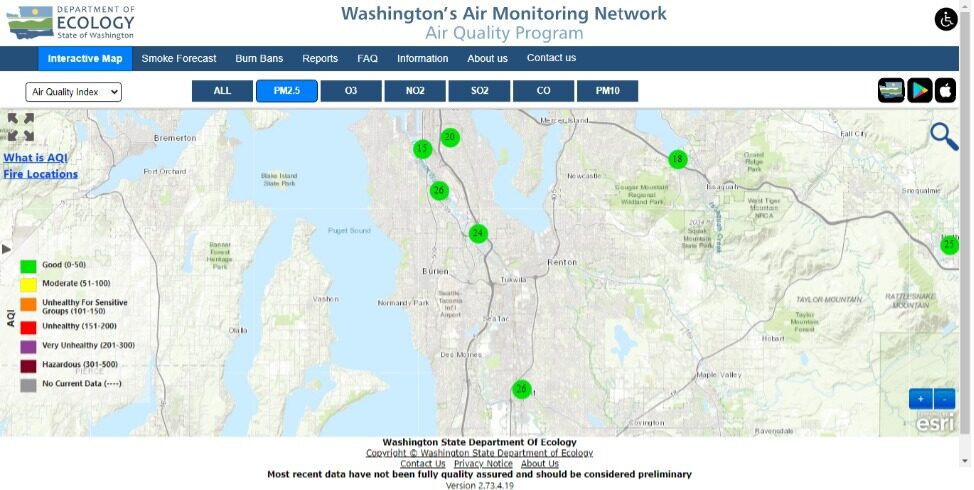
Now, how many aviation emission detectors are there in Puget Sound?
Zero,
Get it? They’re not regulated. So… they’re not measured. And since they’re not measured, they can’t be regulated. Catch-22. It’s the best catch there is.
Quality, not quantity
If we’re not looking at the contents of UFPs, how do we know which are from airplanes and which are from cars and trucks? And why does it matter?
Expense
All particles tend to have certain patterns of motion and ‘clumping’ which can be used for identification. This is not as precise as being able to say definitively that the particles consist of ‘asbestos’ or ‘lead’, etc., but it’s useful as far as it goes. These indirect techniques are being used for a very simple reason: if you think creating a cheap particle counter will be hard? Wait until you see the price tag for UFP detectors that can tell us what those particles are made of.
Source
But regardless of cost, if you can’t determine the source, you can simply blame all of it on roadway emissions, since those are already regulated.
And that matters because…
There are lots of other things that fly off of a jet airplane in microscopic quantities as it zooms overhead. For example, various parts of a turbine engine are coated with all kinds of exotic ceramics (think ‘teflon’). These are absolutely necessary to tolerate high heat, maximise ‘slipperiness’ and prevent corrosion among other things. But unfortunately, some of those coatings are among the most toxic materials ever invented.
Again, because UFPs are so tiny and their components have not been studied, we simply do not know. But we should be measuring them. Now.
Look out below!
 One other thing that would be good to know about UFPs. Remember from science class where Galileo dropped a feather and a bowling ball off the top of the 2Leaning Tower Of Pisa to prove that they both fall at the same rate? Yeah, nobody believes that physics crap, right? 😀
But when people measure UFPs, remember: they’re measuring what hits the ground at a particular point, not what exits the engine. We currently have no proof as to how such tiny particles disperse. Do they dance around up there in the wind and spread out evenly for miles and miles? If so, you could place one UFP monitor to cover the entire area. But Galileo showed, falling objects obey the laws of physics, not ‘common sense’. So perhaps certain neighbourhoods are more at risk of UFP exposure depending on geography, season, weather, etc. And if so, you’d want monitors 5all over the place–as Ecology now does with air quality monitors for cars and trucks.
If there are no air quality monitors near Sea-Tac Airport how do they know how much emissions from airplanes? They look in a chemistry book, silly. When King County does its greenhouse gas inventories or other estimates of aviation emissions, they call the Port of Seattle, find out how much aviation fuel was pumped last year, multiply that number by the amount of C02 generated by burning a gallon of Jet-A and… et voila! 3That right there should tell you how unserious we are about aviation emissions.
And one other detail: The aviation industry is happy to tell you that aviation contributes only 3-7% to C02 emissions across the nation. Maybe, maybe not. But if one lives under the flight path we would suggest that the quantity is actually much higher and for that reason alone, we’d sure like to know what precisely is in those emissions.
Some credit where credit is due
Another balancing act is acknowledging that some work is being done, while saying in the strongest possible terms that it is simply not enough.
The University of Washington Department of Environmental & Occupational Health Sciences (DEOHS) has done a study of the area MOV-UP, but it uses a method that is not recognised by regulatory agencies.
It is now doing an empirical study which may have benefit but again is not the same thing as measurement. But it is worth mentioning.
Natural Experiment
Previously, there have been several natural experiments, including a very famous one in Southern California involving school children and air pollution. A 2015 gas leak in Aliso Canyon, CA ncaused the facility to shut down for a year. Students at the nearby school scored almost a grade level higher that year on standardised tests. Even more importantly: the benefits persist. Put bluntly: certain types of pollution permanently affect the intellectual outcomes of children. That is the case with lead and there is evidence to suggest that such is the case with UFPs.
What UWDEOHS is doing is placing HEPA filters in certain schools and then hope to study those kids over time; not just test scores, but other health outcomes. If the results are similar to Aliso Canyon, there will certainly be moves to provide HEPA filtering in other schools (and perhaps to homeowners as well.)
That sort of empirical work is fine. And you can think of it as a double-blind for a vaccine trial–but with no risk, only upside if it works.
But again, it is, to some degree, treating the symptoms without understanding the disease. It’s all very well to say, that the filters ‘worked’. But that doesn’t tell you how, why, how much, or even to what extent the airplanes were causal. It may sell a whole mess of air filters, which we support, but it is no substitute for true understanding.
History rhymes
We harp on the work of Clair Patterson a lot here because UFPs and environmental lead have several things in common:
- Both lead and ultrafine particulates were not well understood for decades.
- However, both forms of pollution were ubiquitous in the environment.
- Both forms of pollution seem to have long term cognitive impacts on children.
- Research on both were stonewalled by industry and politicians for decades.
- And in both cases, this stonewalling occurred because the industry sold electeds on the notion that it was technically ‘impossible’ to do anything about them without ruining their respective industries.
- In other words, both industry and electeds bought into a false argument that it was necessary to sacrifice public health for the ‘greater good’ argument.
As we now know, ‘impossible’ is a word that should be used with care. Time and again, we’ve shown that we can develop vaccines in a fraction of the time. We can create even better performing engines without lead. We can do many things simply by deciding to do them.
As they say, history may not repeat itself, but it certainly rhymes. And the fact that it has been so difficult to obtain funding to research aviation-related UFPs seems eerily familiar.
2Fine, It may actually have been “two stones of significantly different size and mass.” Party pooper. However, the experiment has been successfully repeated with bowling balls and feathers. The most entertaining version may be this.
3Which makes one wonder why we bother to spend millions every year on all those roadway emissions monitors, right? We could certainly open another chemistry book and do the same thing with cars and trucks.
5And as they do in Puget Sound, by the way–you don’t install one water quality monitor for the entire Sound and call it good, right? 😀