Notes
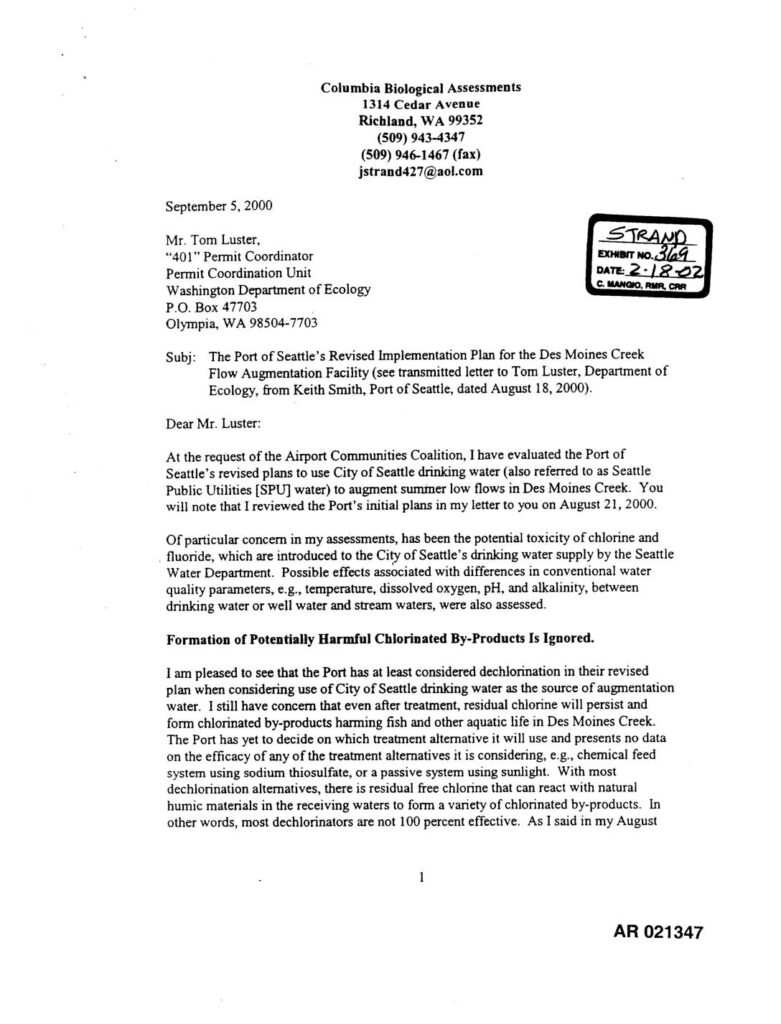
Exhibit AR021347. Letter dated September 5, 2000 from J. Strand, Columbia Biological Assessments, Richland WA, to Tom Luster, ‘401’ Permit Coordinator, Washington Department of Ecology, on behalf of the Airport Communities Coalition (ACC). Evaluates the Port Of Seattle’s revised implementation plan for the Des Moines Creek Flow Augmentation Facility. Raises concerns about: (1) residual chlorine and formation of chlorinated by-products after dechlorination using sodium thiosulfate or passive sunlight systems, toxic to fish at 3-6 ug/L; (2) fluoride in Seattle Public Utilities (SPU) drinking water at 1.0 mg/L exceeding LC50 for rainbow trout at 0.2 mg/L hardness 12 mg/L, and masking salmonid olfaction per Damkaer and Dey (1989) John Day Dam field tests; (3) temperature differences greater than 2-3°C causing thermal shock, pH and alkalinity differences causing osmotic shock; (4) inadequacy of well water as alternative without pre-treatment. Cites Foulkes and Anderson (1994), Angelovic et al. (1961), Pimental and Bulkley (1983), Liu et al. (1997), Nielsen et al. (1983).