Clean Air Act preempts state claims over aircraft pollution
After three years, a widely-promoted class action lawsuit on behalf of residents around Sea-Tac Airport has finally been heard in federal court. The September 23 opinion by the Ninth Circuit Court of Appeals is not good.
The original complaint tried to hold the Port of Seattle, and its two main tenants, responsible for the health and property impacts of air pollution generated by flights in two main forms: emissions from the engines and particles flaking off of the fuselage.
Complaint: Codoni and Geer v. Port Of Seattle, Alaska Air Group, and Delta Air Lines, Inc.
State vs. Federal
Plaintiffs originally sued in King County under Washington state law, using the same kinds of claims you’d bring against anyone who dumps pollution on your property: negligence, trespass, and nuisance.
In response, the Port and airlines were able to get the case moved to federal court where it has been waiting to be heard for two years.
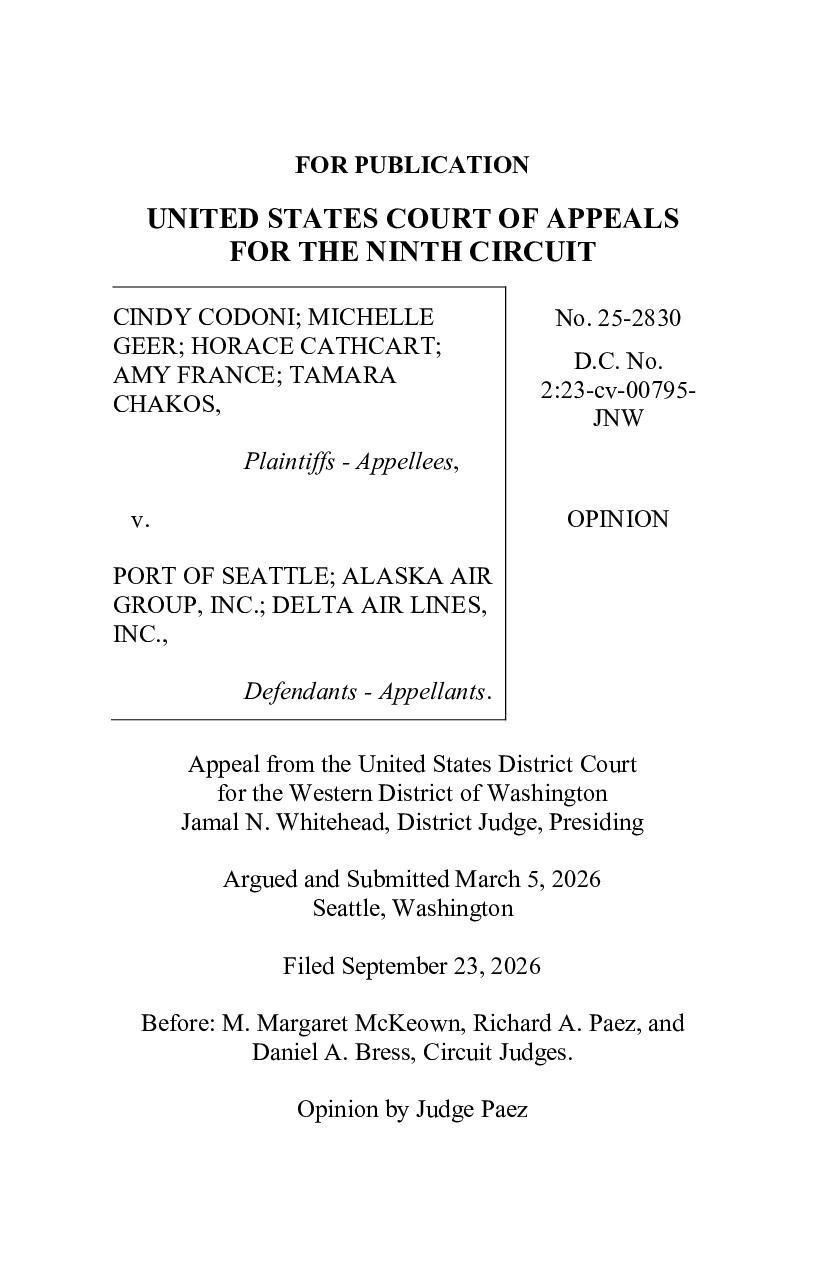
The Ninth Circuit ruled that the plaintiffs’ state-law claims on emissions are preempted by federal law, pointing out that Section 233 of the Clean Air Act explicitly prevents that.
Ruling: Codoni v. Port Of Seattle, No. 25-2830 (9th Cir. 2026)
This oral argument is pretty much everything you could want to know about airport community litigation. Judges acknowledge the harms, but the plaintiffs rely on extremely creative strategies to find arguments that will land. As just one example, Mr. Berman said he deliberately chose not to claim that the airlines were violating federal-law, because “We don’t have enough evidence… That is what discovery is for.” Wow.
On remand, they could try to make that claim again, or any other amendments they wish to make. However, the plaintiffs key strategy–relying on state laws governing air quality–is effectively dead.
What we think
The case drew a tremendous amount of public attention when first filed in 2023. Lead attorney Steve Berman has a track record of major victories, including tobacco litigation and more than one auto safety tort case. But federal law, and Section 233 in particular, is very clear.
Our position was to remain neutral until more evidence came to light supporting the plaintiffs’ claims. Bear in mind that this is not a question of justice. This is the law.
We understand the attraction of a big legal victory. The sought relief is something we strongly support. But STNI has a no distractions policy. Our ongoing mission is to focus community effort on solutions with the highest chance of real success. Now.
However, giving the FAA such broad control over aircraft pollution has made it almost impossible for airport communities to win these kinds of lawsuits, or even to improve the emissions standards for commercial aircraft–which have also languished. (We’ve noted twice this year that new emissions standards for Boeing aircraft keep getting pushed back again and again.)
Our task is not to blame the courts or FAA when they are enforcing the will of a dysfunctional Congress. Washington state continues to have the strongest federal delegation when it comes to aviation issues. But their track record on reducing aviation emissions is, overall, no better than any other state–arguably worse since they have that influence and they represent us.
It is time to push our delegation to put forward legislation. Reform the federal code to allow for a just legal action on airport community harms.