TagANES(18)
-
 2023-08-23 00:30
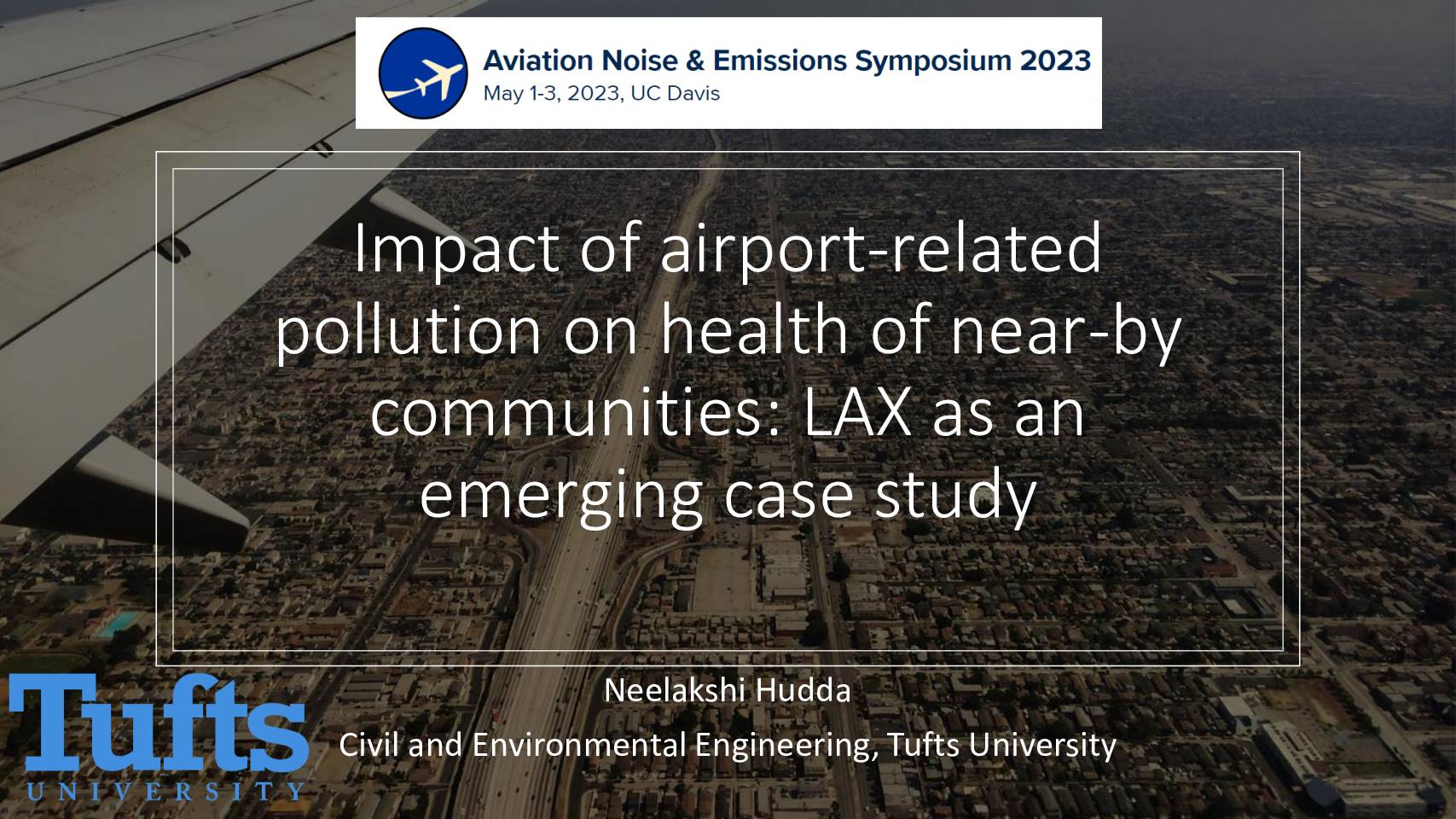
Impact of airport-related pollution on health of near-by communities: LAX as an emerging case study
Research has implications for large populations near airports: communities rank high on adverse environmental metrics -
 2023-08-23 00:29
ANES 2023 Community Engagement Fa Aces Darlene Yap Lee AICA Final 0
Over the last few years, the FAA has made efforts to improve its community engagement strategy by implementing tools and programs to address community engagement concerns. FAA published the Community Involvement Manual and Desk Guide and on-boarded all Chief Engagement Officers (CEO) 2019- 2020. Source: FAA (Modified) AICA FAA Community Engagement Scorecard (FAACES) • The Project Use responses on FAA’s community engagement to identify response themes and suggest recommendations • The Outcome Solicit and summarize feedback from community groups on their experience with FAA community engagement for local and national topics in 2020, 2021, and 2022 compared to pre-2020. Has there been improvement from the perspective of communities? ---Future FAACES report, link. https://aviationimpactedcommunities.org/faa-community-engagement-scorecard-faaces-may-2022-current/ Survey Context • Input via an On-line Form • Outreach to 77 Community Groups, 61% Response Rate • Outreach to communities that make up the Aviation-Impacted Communities Alliance (AICA) • One participant per community group • Engaged with the FAA during 2020-2022 • Does not include experiences with FAA community engagement before 2020 • FAA Survey Precedent • FAA Reauthorization Act of 2018 - Section 176, Community Involvement Review 2020 • Air Traffic Organization (ATO) internal survey • FAACES includes FAA Community Engagement for Local and National Topics AICA Local and National Topics 43% Local Topics Only 34% Neither Local or National Topics 21% 2% National Topics Only Responses 4AICA FAACES Survey Summation Highlights • Local topics • For example: new or changed procedures and noise complaints • National topics • For example: FAA advisory committees and… -
 2023-08-23 00:29
ANES Trifecta Elena Austin
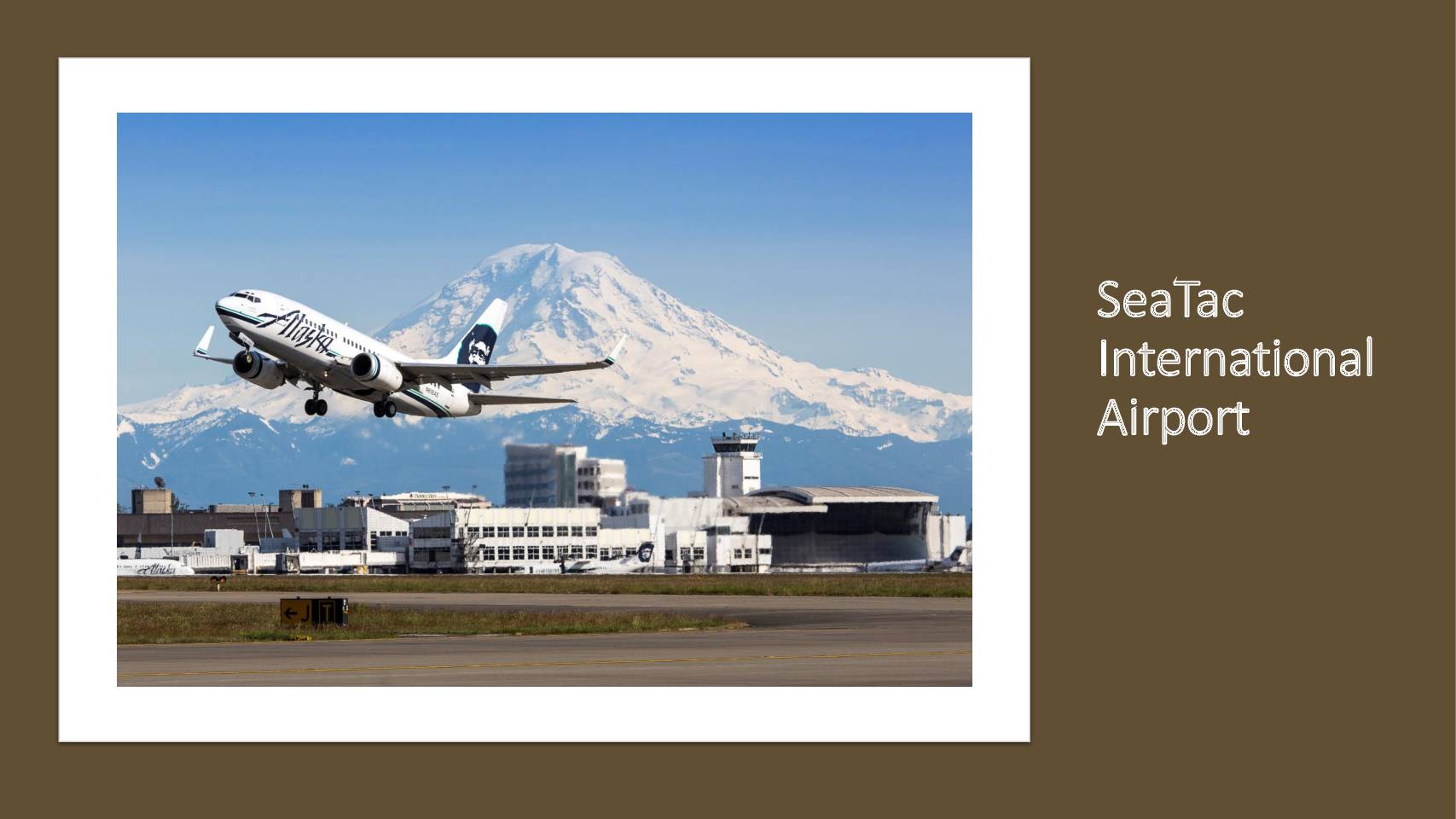
• Shifting the dialogue from airports being a “nuisance” to understanding the health impacts and having community members share their stories • Having a state institution leading the efforts to study the prevalence of pollution related to Jet A fuel (ultrafine particles) • Creating partnerships at local, state and federal level to move forward mitigation Washington State Investments 2017 $250,000 to study ultrafine pollution particles in a 10 mile radius around SeaTac 2018 $300,000 plus local match to study airport impacts on on public health, transportation, parking, public safety, property values and economic development 2019 Created Commercial Aviation Coordinating Commission to identify a new airport location 2019 $300,000 for a population health study to assess community health impacts of airports on children and adults 2020 Provided additional allowances for noise abatements in areas around SeaTac 2021 $940,194 for Healthy Schools pilot to reduce air pollution and improve air quality in schools 2023 Requested $1,393,223 to increase access to asthma interventions and study the benefits of indoor air quality intervention on health 2023 $412,000 for Puget Sound Clean Air Agency to set up two long-term air quality monitors in the airport community to establish a baseline and monitor health effects Research and Engagement Ultrafine Particle (UFP) Exposures Elena Austin, ScD Ultrafine Particles (UFPs) Background Ultrafine Particles unregulated but potentially important in determining health outcomes Health Effects more uncertain compared to PM2.5, associated with neurological and birth outcomes Important sources include diesel combustion (truck traffic, aircraft), wood- smoke and photochemical processes Variable… -
 2023-08-04 01:48
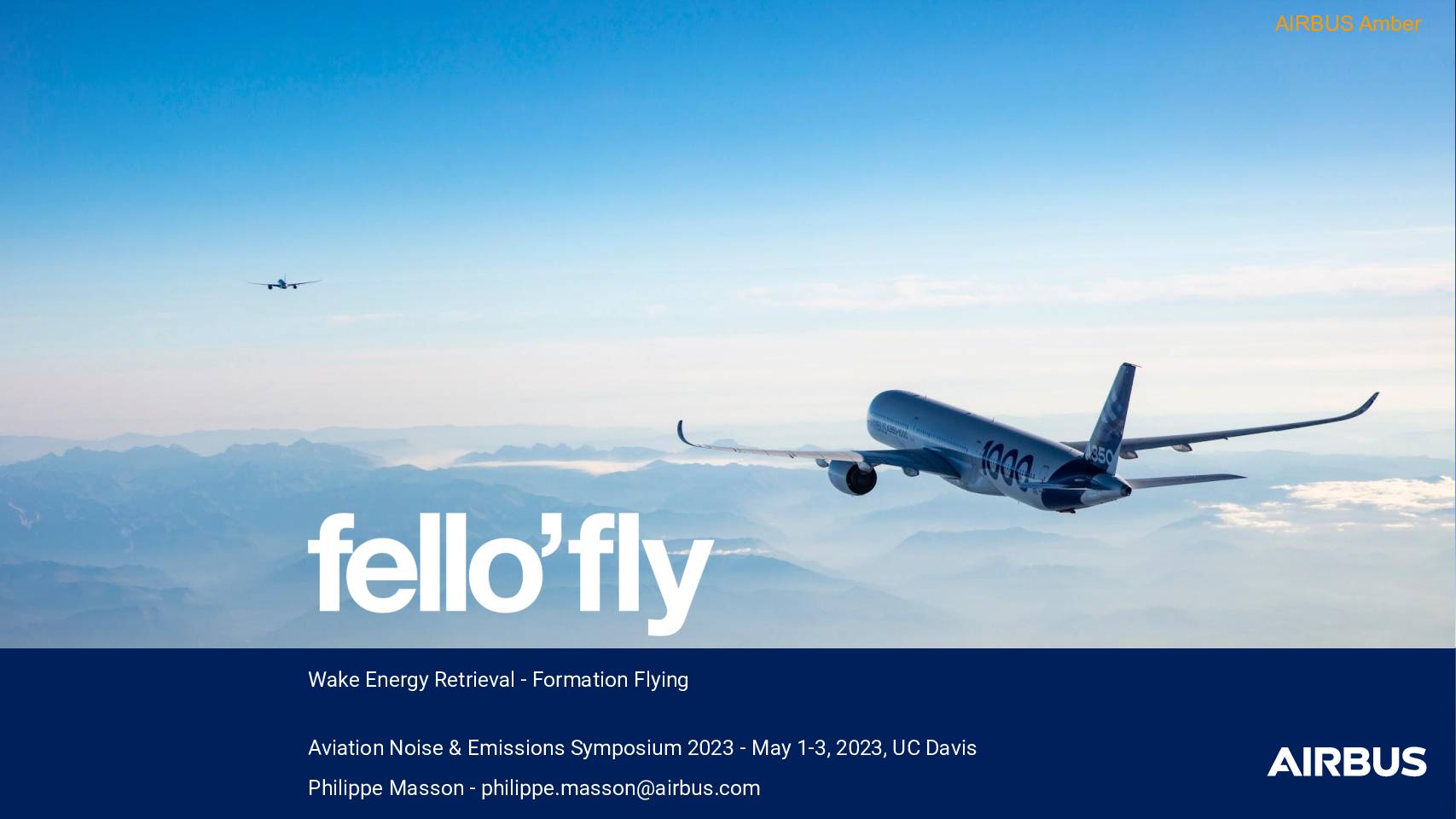
Wake Energy Retrieval
Aviation Noise & Emissions Symposium 2023 - May 1-3, 2023, UC Davis Philippe Masson - philippe.masson@airbus.com AIRBUS Amber https://anesymposium.aqrc.ucdavis.edu/ AIRBUS CONFIDENTIALAIRBUS CONFIDENTIAL Wake Energy Retrieval A large amount of kinetic energy is left behind aircraft in their wakes. Around 5% trip fuel & emissions reduction for a follower aircraft positioned in the smooth updraft Applies to sectors above 2000 NM Leader Follower Smooth updraft AIRBUS Amber AIRBUS CONFIDENTIALAIRBUS CONFIDENTIAL Wake Energy Retrieval Key parameters AIRBUS Amber AIRBUS CONFIDENTIAL Technology 5% fuel and CO2 proven savings AIRBUS Amber AIRBUS CONFIDENTIALAIRBUS CONFIDENTIAL https://docs.google.com/file/d/1FX7XxgihQQce2dzegHl2HOLP3hHsChsk/preview AIRBUS CONFIDENTIAL Initial Concept of Operations Pre-departure Post-departure pairing callout Rendez-vous Separation responsibility transfer Join-up (pre-OPTI) Join-up (OPTI) Formation Keeping Split 3 4 5 6 7 8 Oceanic CONOPS agreed with project collaborating partners AIRBUS Amber AIRBUS CONFIDENTIAL AIRBUS Amber https://docs.google.com/file/d/1wL58pkY0_demh6YnKCumZoa3m0COIukZ/preview AIRBUS CONFIDENTIAL Q&A More information : https://www.airbus.com/en/innovation/disruptive-concepts/biomimicry/fellofly AIRBUS Amber AIRBUS CONFIDENTIAL Thank you This document and all information contained herein is the sole property of Airbus. No intellectual property rights are granted by the delivery of this document or the disclosure of its content. This document shall not be reproduced or disclosed to a third party without the expressed written consent of Airbus. This document and its content shall not be used for any purpose other than that for which it is supplied. Airbus, its logo and product names are registered trademarks. © Copyright Airbus (2023 /fello’fly introduction to Aviation Noise & Emissions Symposium 2023) AIRBUS Amber https://anesymposium.aqrc.ucdavis.edu/ -
 2023-08-03 00:55
Aviation Noise and Emissions Symposium 2024 Logo
Logo and title graphic for the Aviation Noise & Emissions Symposium 2024 (ANES), hosted at UC Davis. -
2023-08-02 00:43
ANES 2023 Program Information
Adapting for Tomorrow, Today While climate change is an urgent challenge for every sector, forcing businesses and people to rethink their actions, the airline industry and affected communities are also facing even deeper challenges in attempting to alleviate continued noise, health and climate change impacts. This year’s sessions will take a deep dive into how aviation noise and emissions assessments -
 2021-04-02 22:17
Session 1 Jim Aller Dice Dispersion In The Age Of RNAV
Hi! My name is Jim Allerdice. I’m the Managing Partner and Chief Consultant for Terminal Operations, for ABCx2, LLC. ABCx2 is a community focused company that provides advocacy for communities with the FAA, Airports, and the Aviation Industry at large. We provide a voice for communities and interpret the technical language of the aviation industry in such a way as to provide meaningful, measurable and implementable solutions for communities impacted by aviation noise. What is dispersion? The process of introducing track variability by changing aircraft lateral position enough to spread out repetitive and intrusive noise events experienced by people living under highly concentrated flight paths. Presenter Presentation Notes Today, I want to talk to you about dispersion. Many communities believe that noise dispersion holds the answers to the impacts felt from aircraft operations. But first, we must find a definition of dispersion. What does dispersion look like in the age of RNAV? Well, for our purposes today, dispersion is… So, how do we get to dispersion? First, we must understand why the FAA likes Performance Based Navigation, or PBN, so much. Why does the FAA like PBN so much!? Safety Communications Reduction Pilot/Controller Workload Reduction Situational Awareness Improvements Efficiency Point-to-Point Navigation ELSO – Equivalent Lateral Spacing Operations Presenter Presentation Notes Implementation of PBN has shown up to 33% reduction in voice transmissions. Workload has been Reduced for both pilots and controllers – Less manual flying for pilots, less vectoring for controllers. Situational… -
 2021-04-02 22:16
ANES 2019 Session 5 Tim Johnson
#1 Strong regulatory and policy frameworksto create accountability and reduce uncertainty #2 Effective carbon pricing #3 Provide the consumer with information! Aviation Environment Federation Aviation Environment Federation aef.org.uk info@aef.org.uk @The_AEF -
 2021-04-02 22:16
Ses 0W 6621 Px H 0 Od 8R ANES 2021 Aircraft Noise Dispersion ABC X 2 Additional Materials Updated 20210223
Hi! My name is Jim Allerdice. I’m the Managing Partner and Chief Consultant for Terminal Operations, for ABCx2, LLC. ABCx2 is a community focused company that provides advocacy for communities with the FAA, Airports, and the Aviation Industry at large. We provide a voice for communities and interpret the technical language of the aviation industry in such a way as to provide meaningful, measurable and implementable solutions for communities impacted by aviation noise. What is dispersion? The process of introducing track variability by changing aircraft lateral position enough to spread out repetitive and intrusive noise events experienced by people living under highly concentrated flight paths. Presenter Presentation Notes Today, I want to talk to you about dispersion. Many communities believe that noise dispersion holds the answers to the impacts felt from aircraft operations. But first, we must find a definition of dispersion. What does dispersion look like in the age of RNAV? Well, for our purposes today, dispersion is… So, how do we get to dispersion? First, we must understand why the FAA likes Performance Based Navigation, or PBN, so much. What types of dispersion exist? Natural (or random) Associated with manually flown conventional procedures and ATC vectors Systematic Aircraft use alternative flight paths with very precise and predictable trajectories but in a controlled manner This type of dispersion is most associated with the use of satellite- based navigation capabilities Examples Radar Vectors to RNAV Open SIDs Additional departure tracks… -
 2021-04-02 22:15
ANES 2021 Presentation
Chapter 2: Chronology of US Aircraft Noise Regulation Chapter 3: Aircraft Noise Effects on Individuals and Communities Chapter 4: Aircraft Noise Measurement and Modeling Chapter 5: Airport Vicinity Land Use Planning Chapter 6: Airport Noise Mitigation Chapter 7: Potential Changes to Regulatory Policy INTRODUCTION Current aircraft noise regulatory policies are the product of decades of FAA promotion of U.S. civil aviation, per its 1958 - 1996 charter A century of generous federal aid to civil aviation has provided subsidies intended to socialize the costs of commercial aviation while privatizing its profits Since civil aviation is no longer an infant industry requiring such fostering, Congress relieved FAA of responsibility for promoting civil aviation in 1996 A quarter of a century later, FAA has yet to make meaningful changes to its regulatory goals CHRONOLOGY OF US AIRCRAFT NOISE REGULATION Airlines operated in a highly regulated, price controlled, city-pair environment until de- regulation in 1978 Competition changed the face of aviation post- deregulation, converting city-pair routes to hub- and-spoke networks Deregulation provided little or no incentive to industry to reduce aircraft noise emissions CHRONOLOGY (CONT.) HUD was first federal agency to act (to protect values of home mortgages it backed) The 1972 Noise Control Act named EPA as the lead agency for noise control The Aviation Safety and Noise Act (ASNA) reassigned EPA’s primacy in aviation noise control to FAA later in the decade FAR Part 150 (the implementing regulation for ASNA) defined a DNL of 65 dB (corresponding to a CNR value…