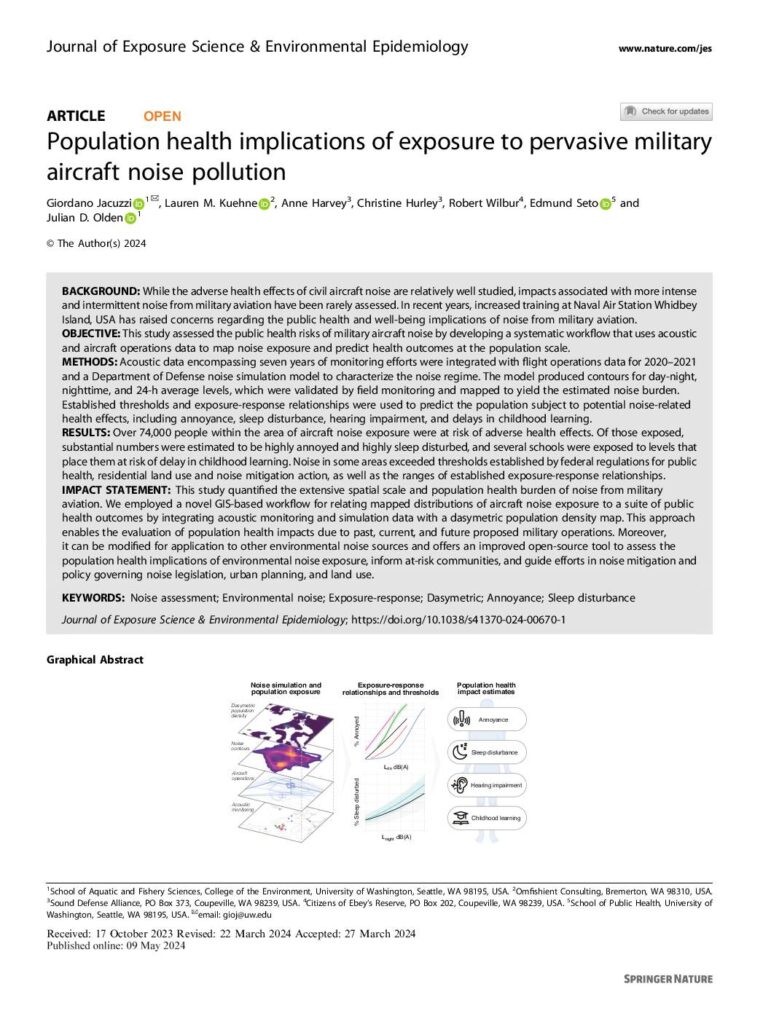
A 2024 study published in the Journal of Exposure Science & Environmental Epidemiology assessed the public health impacts of military aircraft noise from Naval Air Station Whidbey Island in Washington State, finding that over 74,000 residents were at risk of adverse health effects including annoyance, sleep disturbance, hearing impairment, and delays in childhood learning. Researchers integrated seven years of acoustic monitoring data with flight operations records and noise simulation models to map noise exposure across six counties in northwestern Washington. The study's findings and open-source workflow offer a reproducible tool for evaluating population health risks from aviation noise, with broader applications for informing noise policy, land use planning, and mitigation efforts.Open full document
Notes
This study assesses the public health risks of military aircraft noise from Naval Air Station Whidbey Island, Washington, by developing a GIS-based workflow integrating acoustic monitoring data and DoD noise simulation models to map noise exposure across the region. Over 74,000 people were found to be at risk of adverse health effects including annoyance, sleep disturbance, hearing impairment, and delays in childhood learning. The study provides a reproducible framework for evaluating population health impacts from military aviation noise that can inform communities, guide policy, and support future environmental impact assessments.