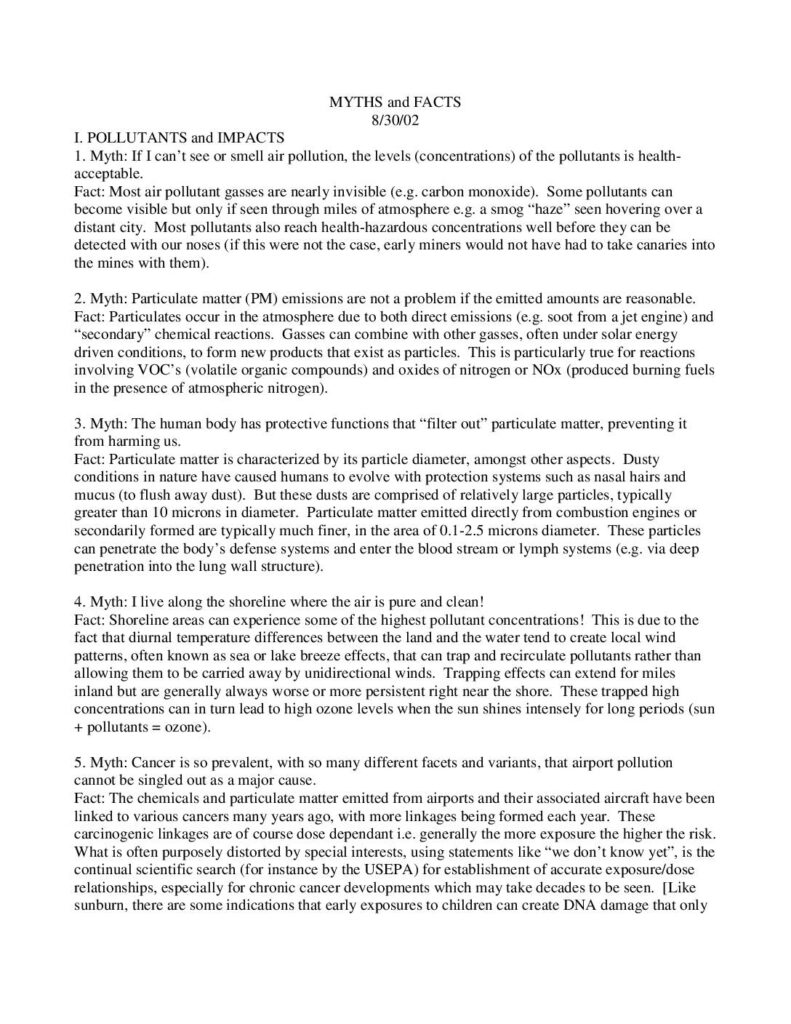
This document debunks common myths about airport air pollution, noise, and emissions regulation, explaining that invisible pollutants can still reach dangerous levels, that fine particles from jet engines bypass the body's natural defenses, and that shoreline communities like those near Sea-Tac may face higher pollution concentrations due to wind patterns. It also reveals that neither the EPA nor FAA effectively regulates aircraft emissions or noise in ways that truly protect nearby residents, as regulatory authority rests with bodies like ICAO that are dominated by airline and airport interests. Additionally, the document highlights that official pollution modeling tools may significantly underestimate actual pollution levels, and that so-called 'noise abatement' programs often fail to reduce noise at all.Open full document
Notes
Myths and Facts document dated August 30, 2002 addressing airport and aircraft air quality issues. Covers particulate matter (PM2.5, PM10), VOCs, NOx, ozone, carbon monoxide, and carcinogens from airport emissions. Discusses ICAO aircraft engine emissions certification standards, the ‘smoke number’ standard, EDMS (Emissions Dispersion Modeling System), ISC3 and AERMOD dispersion models, FAA regulatory authority over airports, USEPA limitations, and shoreline pollution trapping via sea/lake breeze effects. Notes that ICAO — not USEPA — regulates aircraft engine emissions, and that FAA’s EDMS model switch from ISC3 to AERMOD reduced prediction conservatism by a factor of approximately 12:1. Also addresses noise abatement terminology and sound insulation programs.