Notes
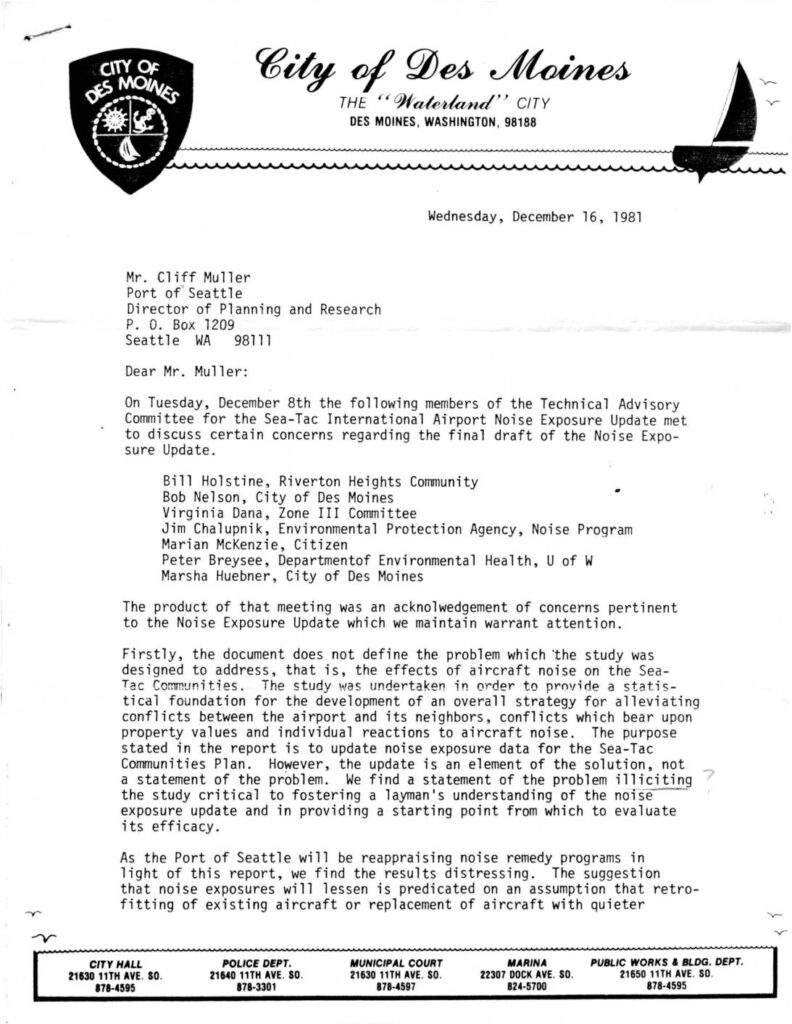
Letter dated December 16, 1981 from the City of Des Moines (signed by members of the Technical Advisory Committee for the Sea-Tac International Airport Noise Exposure Update) to Cliff Muller, Director of Planning and Research at Port Of Seattle. The letter conveys concerns raised at a December 8, 1981 meeting attended by Bill Holstine (Riverton Heights Community), Bob Nelson (City of Des Moines), Virginia Dana (Zone III Committee), Jim Chalupnik (EPA Noise Program), Marian McKenzie (Citizen), Peter Breysee (UW Department of Environmental Health), and Marsha Huebner (City of Des Moines). Key concerns include: failure to define the problem of aircraft noise effects on Sea-Tac Communities; the assumption that aircraft retrofitting or replacement will occur on schedule given economic conditions; the paradox that average noise levels are projected to decrease while flight operations increase, raising the number of noise interruptions not reflected in noise contours; inadequacy of average noise level (DNL) methodology to capture community noise perception; and the committee’s assessment that its technical advice was not utilized and that acknowledgement in the report falsely implies agreement with the study methodology and findings. References Sea-Tac Communities Plan, Noise Exposure Update, noise contours, noise remedy programs.