Notes
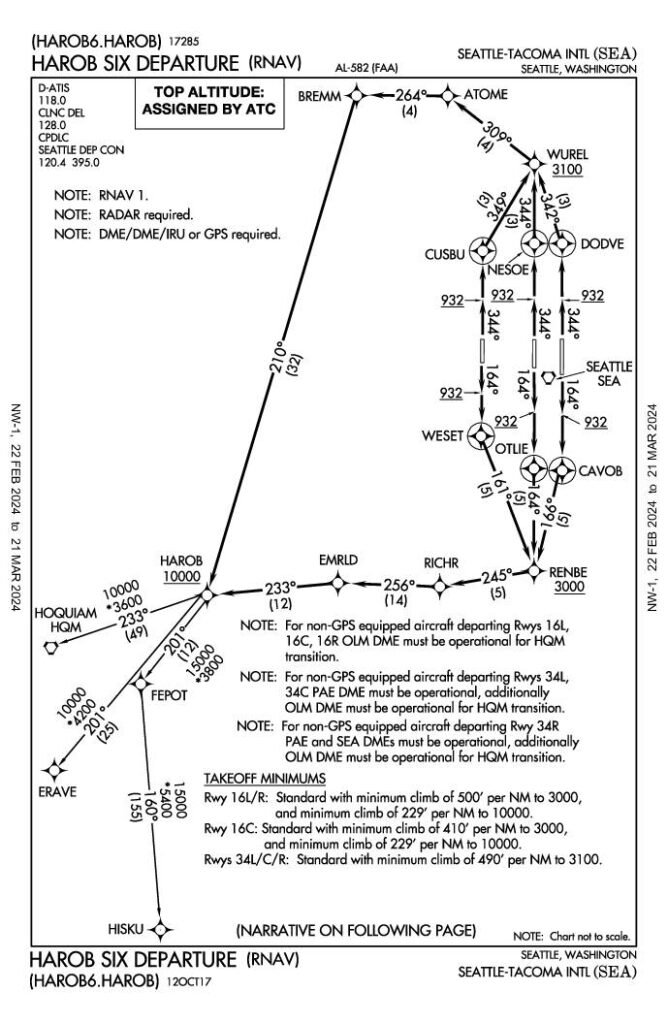
FAA Standard Instrument Departure (SID) chart AL-582 for the HAROB SIX DEPARTURE (RNAV), procedure code HAROB6.HAROB, from Seattle-Tacoma International Airport (SEA/KSEA), Seattle, Washington. Effective NW-1, 22 FEB 2024 to 21 MAR 2024, chart dated 12OCT17, revision 17285. Covers departure routes from Runways 16L, 16C, 16R, 34L, 34C, and 34R with waypoints RENBE, OTLIE, CAVOB, WESET, NESOE, CUSBU, DODVE, WUREL, ATOME, BREMM, HAROB, FEPOT, ERAVE, HISKU, EMRLD, RICHR. Transitions include HAROB6.HQM (Hoquiam), HAROB6.HISKU, HAROB6.FEPOT, and HAROB6.ERAVE. Requires RNAV 1, radar, DME/DME/IRU or GPS; non-GPS aircraft have specific OLM, PAE, and SEA DME requirements. Takeoff minimums specify minimum climb gradients of 490–500 ft/NM to 3000–3100 ft. Top altitude assigned by ATC; expect filed altitude/flight level 15 NM from SEA VORTAC. Seattle DEP CON 120.4/395.0, CLNC DEL 128.0, D-ATIS 118.0.