Notes
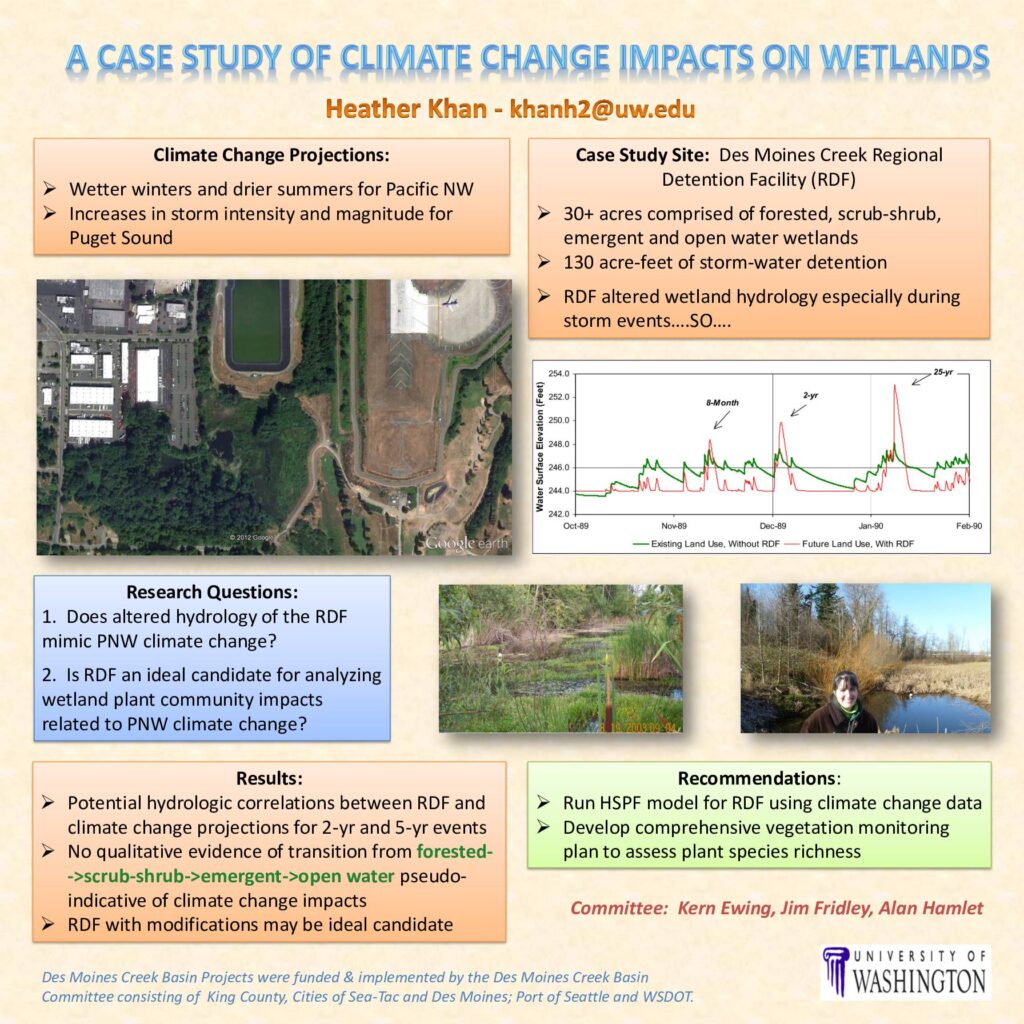
University of Washington research poster by Heather Khan examining climate change impacts on wetlands at the Des Moines Creek Regional Detention Facility (RDF), a 30+ acre stormwater detention facility with 130 acre-feet capacity comprising forested, scrub-shrub, emergent, and open water wetlands. Research questions address whether altered hydrology of the RDF mimics Pacific NW climate change projections (wetter winters, drier summers, increased Puget Sound storm intensity) and whether RDF is a candidate for analyzing wetland plant community impacts. Results show potential hydrologic correlations for 2-year and 5-year storm events; no qualitative evidence of forested-to-scrub-shrub-to-emergent-to-open water transition. Recommendations include running HSPF model with climate change data and developing vegetation monitoring plan for plant species richness. Funded by Des Moines Creek Basin Committee: King County, Cities of Sea-Tac and Des Moines, Port Of Seattle, and WSDOT. Committee members: Kern Ewing, Jim Fridley, Alan Hamlet.