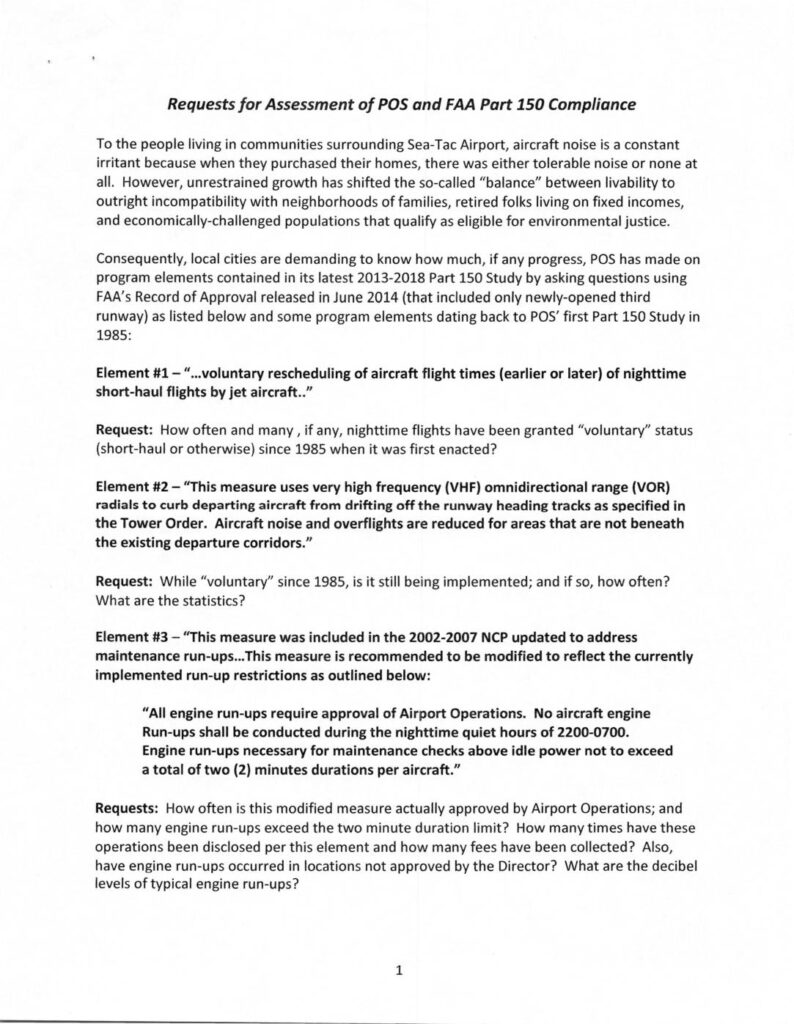
Local communities surrounding Seattle-Tacoma International Airport are demanding accountability from the Port of Seattle (POS) regarding its compliance with FAA Part 150 noise mitigation measures, some dating back to 1985. The document raises detailed questions about ten specific program elements — including voluntary flight rescheduling, engine run-up restrictions, noise abatement corridors, the Fly Quiet Program, and home sound insulation — asking for data on how consistently and effectively each measure has actually been implemented. Critics argue that despite decades of commitments, key noise reduction tools such as a Ground Run-Up Enclosure have been quietly dropped, while growing air traffic continues to harm residential neighborhoods and environmentally vulnerable populations.Open full document
Notes
Local cities surrounding Sea-Tac Airport formally request an assessment of the Port of Seattle’s compliance with program elements from its 2013-2018 Part 150 Study, as approved by FAA’s June 2014 Record of Approval. The document lists ten specific program elements—including voluntary nighttime flight rescheduling, VOR radial use, engine run-up restrictions, noise abatement corridors, Fly Quiet Program, FMS/RNP procedures, Ground Run-Up Enclosure construction, and sound insulation—and poses detailed compliance questions for each. The requesters challenge POS claims about noise reduction progress and question why certain noise mitigation measures, such as the Ground Run-Up Enclosure, were dropped from the Sustainable Airport Master Plan.