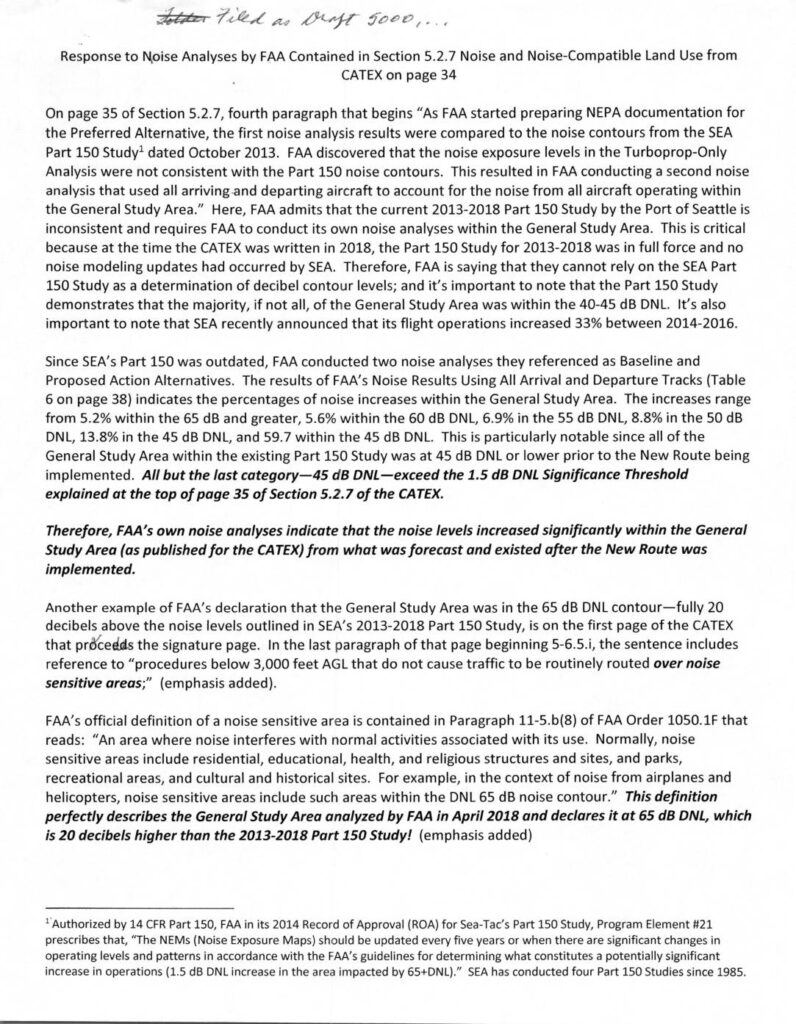
The Quiet Skies Coalition challenges the FAA's Categorical Exclusion (CATEX) for new turboprop flight routes over Burien, Washington, arguing that the FAA's own noise analyses show significant increases in noise levels that exceed the agency's 1.5 dB DNL significance threshold — contradicting the FAA's claim of no environmental impact. The coalition contends that the FAA's reliance on an outdated 2013-2018 Sea-Tac Part 150 noise study, which failed to account for a 51% increase in airport operations, led to inaccurate noise assessments and improper use of a categorical exclusion. Community members and the City of Burien are urged to join legal and political efforts to challenge the FAA and Port of Seattle's authority over flight path decisions affecting residents from Shoreline to Federal Way.Open full document
Notes
This document analyzes and critiques the FAA’s noise analyses contained in its Categorical Exclusion (CATEX) for the 250-degree turboprop turn over Burien, arguing that FAA’s own data shows noise increases exceeding the 1.5 dB DNL significance threshold. The Quiet Skies Coalition letter calls for community involvement to challenge the CATEX, citing inconsistencies between FAA’s noise findings and the Port of Seattle’s 2013-2018 Part 150 Study. It argues that the General Study Area qualifies as a noise-sensitive area under FAA Order 1050.1F, contradicting the CATEX determination.