Notes
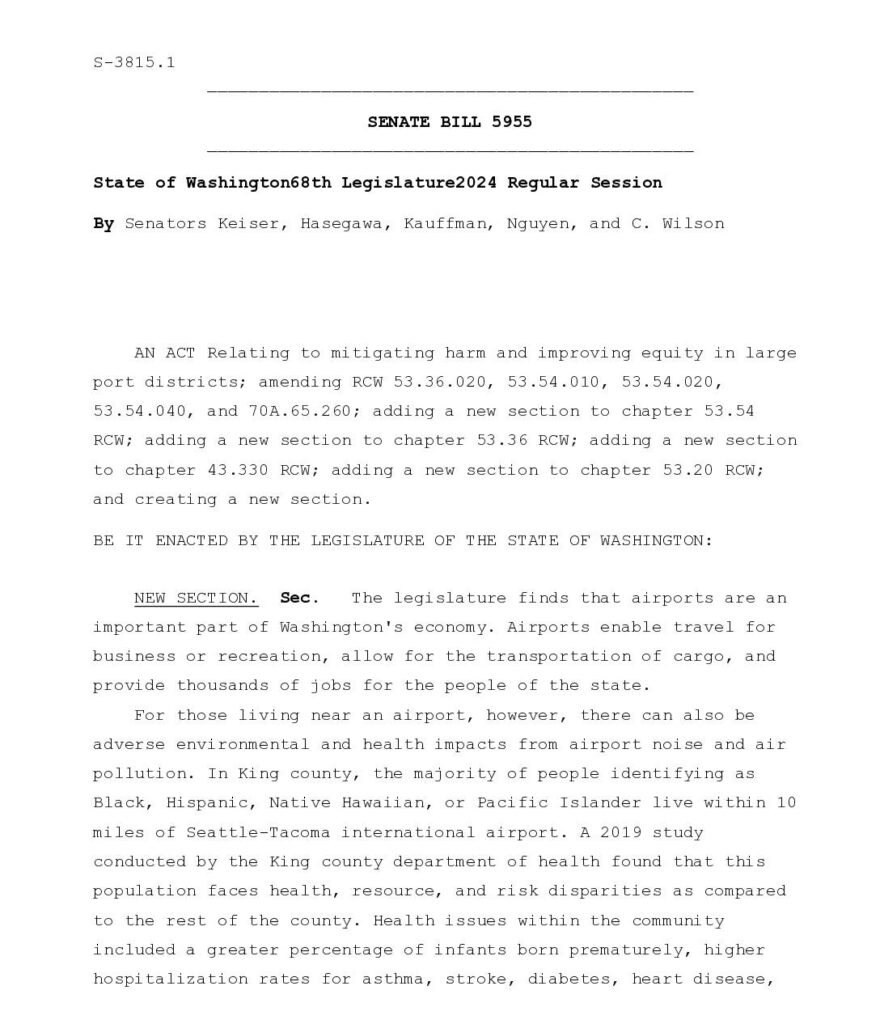
Washington State Senate Bill 5955 (SB5955), 68th Legislature 2024 Regular Session, sponsored by Senators Keiser, Hasegawa, Kauffman, Nguyen, and C. Wilson. Amends RCW 53.36.020, 53.54.010, 53.54.020, 53.54.040, and 70A.65.260 to require large port districts operating airports (specifically applicable to Port Of Seattle and Sea-Tac Airport) to dedicate portions of property tax levy revenue toward remedial mitigation programs addressing aircraft noise and air pollution. After July 1, 2024, at least half of any levy revenue increase must fund mitigation programs; after July 1, 2025, at least 1% of annual levy revenue must be used, increasing 1% per year to a maximum of 10%. Cites King County Department of Health 2019 study finding health disparities — including premature births, asthma, stroke, diabetes, heart disease, COPD, and lower life expectancy — in communities of Black, Hispanic, Native Hawaiian, and Pacific Islander residents living within 10 miles of Seattle-Tacoma international airport. Adds new sections to chapters 53.54, 53.36, 43.330, and 53.20 RCW establishing remedial mitigation programs including repair of failed mitigation equipment, sound mitigation, and air quality mitigation equipment for residential, recreational, and educational facilities.