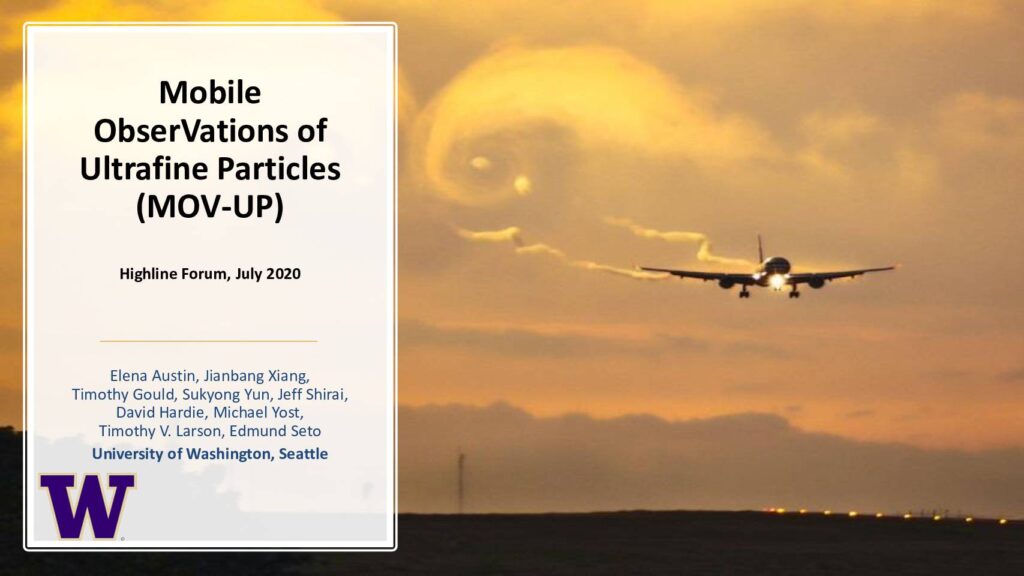
Researchers at the University of Washington conducted the MOV-UP study to measure ultrafine particle (UFP) pollution around Seattle-Tacoma International Airport and the neighborhoods affected by its air traffic. The study aimed to determine how much of the UFP exposure in surrounding communities comes specifically from jet aircraft, which emit extremely tiny particles (under 30 nanometers) along flight paths, versus other sources like diesel vehicles on nearby roads. Findings and community feedback were shared with local governments to inform air quality and noise policy decisions.Open full document
Notes
A University of Washington research presentation on the MOV-UP study, which investigates ultrafine particle (UFP) concentrations in areas surrounding Sea-Tac Airport. The study aims to assess aircraft-related UFP emissions, distinguish them from other sources such as diesel engines, and coordinate findings with local governments and community stakeholders. The presentation highlights that jet aircraft emit ‘ultra’ ultrafine particles (under 30 nanometers) below flight paths, which are currently unregulated.