The benefits and consequences for airport communities
In January 2025, the Trump administration began removing content from federal websites following Executive Order 14151. The order directed all government agencies to terminate DEI and environmental justice–related programs.
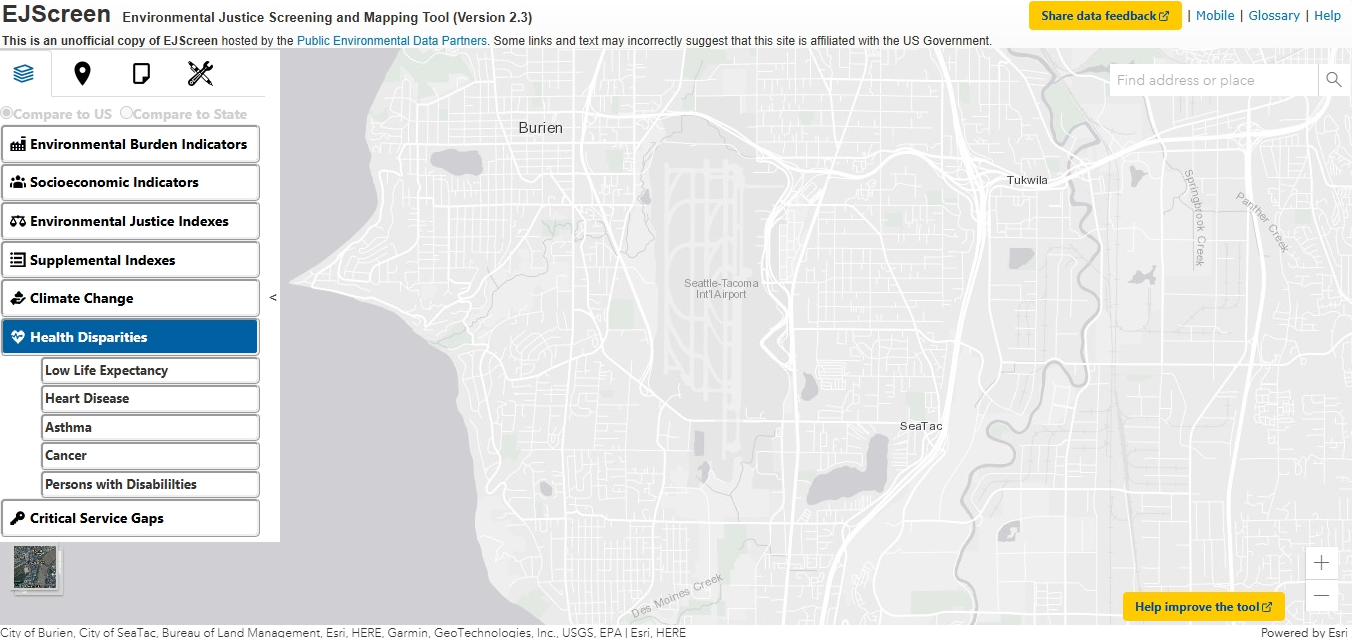
These include environmental justice and climate mapping using a nationally consistent dataset for evaluating the socioeconomic impacts of airports. These were key tools for airport advocates and their loss is a real blow.
These tools still exist — just not on EPA servers
Independent preservation groups, such as Public Environmental Data Partners have archived various applications and datasets including:
- Environmental Justice Screening and Mapping Tool (2021)
- EJ Screen (2024)
- Climate & Economic Justice Screening Tool
Why this Matters for airport communities
As we have learned with the Sustainable Airport Master Plan (SAMP), communities under major airport corridors — including Sea-Tac — do not deal with a single stressor. They deal with overlapping burdens:
- Aircraft noise
- Various forms of aviation pollution, including ultrafine particles and PM2.5
- Traffic emissions
- Stormwater contamination
- Socioeconomic vulnerabilities
- Public health impacts
- Reduced tax base
Researchers and local governments have relied on these mapping tools to quantify those cumulative burdens using a standardized methodology.
STNI is also currently using this data to develop the first socioeconomic impact maps based on Port of Seattle land acquisitions.
But there is only so much we, or any agency, can do without current data.
The ceiling
Although the State of Washington, King County, and even the Port of Seattle, continue to provide a number of similar tools, many of their data sources, ultimately derive from the Federal government. In short, when federal mapping tools go dark it cannot help but handcuff what researchers and policy makers can achieve at Sea-Tac.
What STNI is doing
In our role as historians, a portion of every donation we receive goes to support preservation groups. We want to do what we can to advocate for funding and policy changes to ensure that these tools are restored and refreshed.