TagThird Runway(157)
-
 2023-09-03 22:13
Helsell Fetterman Summary Of Correspondence And Documents Related To Agreed Order Materials Doe 2001 0001
2. Letter from State Legislators to DOE Director Tom Fitzsimmons, dated March 19, 2001. 3. Letter from Helsell Fetterman to DOE Director Tom Fitzsimmons, dated March 30, 2001. 4. Letter from State Legislators to DOE Director Tom Fitzsimmons, dated April 4, 2001.e 5. Letter from DOE Director Tom Fitzsimmons to Kevin Stock, Helsell Fetterman, dated April 11, 2001. Governor Locke’s Certification dated June 30, 1997 : In order to obtain federal approval and funding for its third runway expansion project, FAA regulations require the Port of Seattle to obtain a certification from the Governor of the state in which the project is located certifying that the state has reasonable assurance that the project will be designed, constructed and operated so as to comply with air and water quality standards. Governor Locke issued this certification for the Port on June 30, 1997. The Governor conditioned his certification explicitly upon completion by the Port of a study of the half century’s worth of hazardous wastes in the soils and groundwater at the airport site which was to be required by an Agreed Order under the State’s Model Toxics Control Act. Ecology and the Port were in the process of negotiating the Agreed Order when Gov. Locke issued his certification. The Agreed Order (discussed in detail below) was finally executed by the Port and DOE on May 25, 1999.a 1500 PUGET SOUND PLAZA 1325 FOURTH AVENUE SEATTI, WA 98101-2509 p.o. BOX 21846 SEATTLE, WA 98111_3846 PH: (206) 292-1144 FX: 4206) 340-0902 EMAIL: hf@helsell.com… -
 2023-08-25 11:54
Cutler & Stanfield ACC Strategy Options And Recommendations 04-19-1993 0001
This memorandum summarizes the alternative means by which the Airport Communities Coalition and its member cities ("ACC Cities") may influence to their advantage the -outcome of the proposed expansion of Seattle-Tacoma International Airport ("SEA'’) and recommends certain immediate and longer-term courses of action for the ACC Cities. This memorandum supplements and is based upon the legal analysis contained in the April 1993 report prepared by Cutler & Stanfield regarding legal issues which will arise in connection with the proposed expansion of Seattle-Tacoma International Airport. The memorandum is organized in four parts. Specific recommendations in the first two sections appear in bold type. MEMORANDUM: Strategy and Recommendations - Page 1 Prtnle8''dandanMeDdal The ACC Cities should recognize from the beginning that the present endeavor is a difficult one. While we are confident that the ACC Cities can successfully prevent the construction of a third runway at SEA there is no silver bullet which alone would be enough to absolutely prevent construction of the runway. Instead, the ACC Cities’ best opportunity for success in this controversy is through a series of incremental actions w}dch build a case (both legal and political) against the third runway. 11. STRATEGIC CONSIDERATIONS It is important for the ACC Cities to establish clear objectives early in this process. The seven goals set forth in the ACC Interlocal Agreement provide a guide for the objectives which the ACC Cities intend to achieve: 1. To stop the construction of any additional runways at SeaTac International Airport ; 2. 3. 4.… -
 2023-07-30 14:23
No Impact On Ground Water Comments Outfall 007 May 1997 Ab 0001
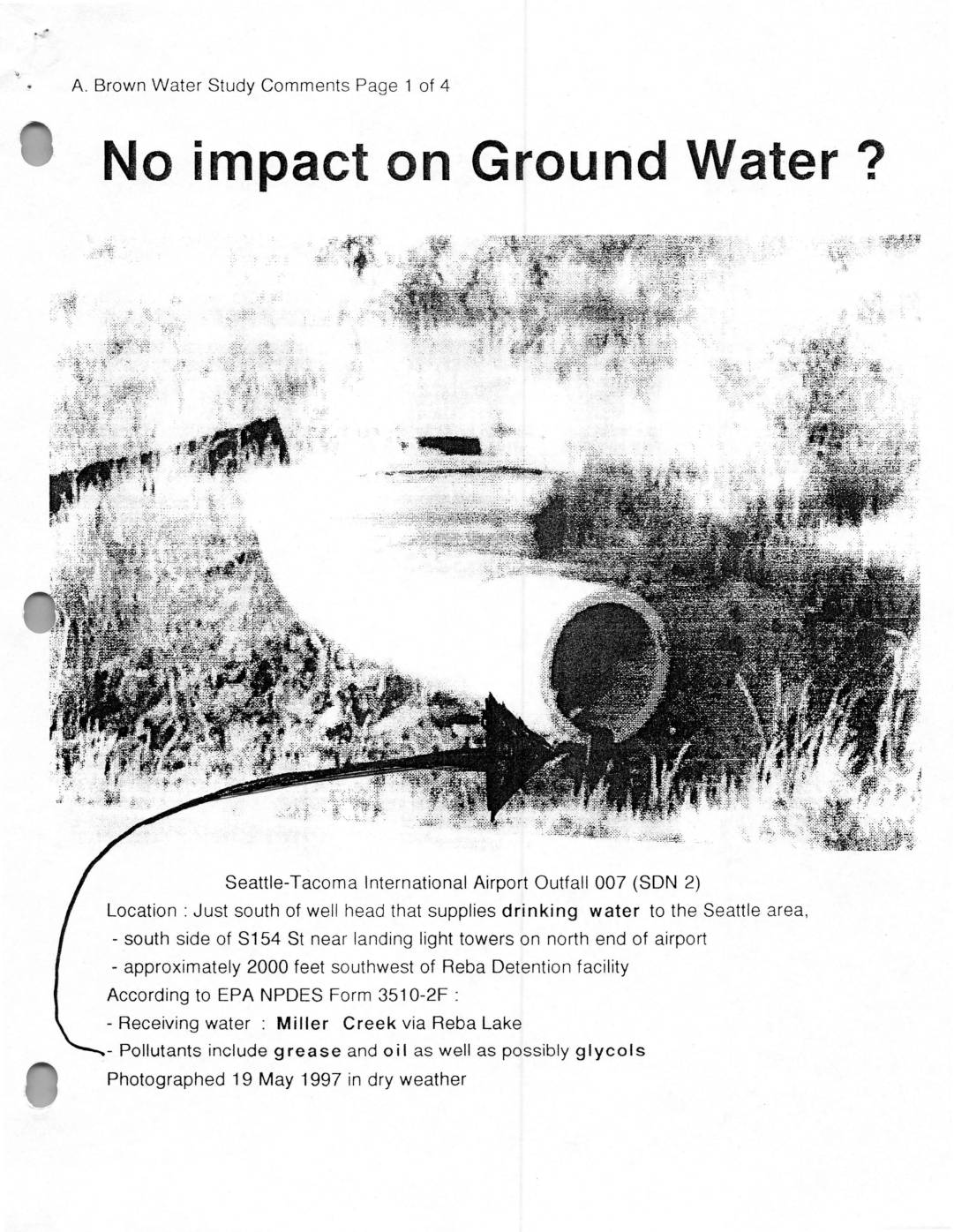
A. Brown Water Study Comments Page 1 of 4 No impact on Ground Water? Seattle-Tacoma International Airport Outfall 007 (SON 2) Location :Just south of well head that supplies drinking water to the Seattle area, - south side of 8154 St near landing light towers on north end of airport - approximately 2000 feet southwest of Reba Detention facility According to EPA NPDES Form 351 0-2F : -Receiving water : Miller Creek via Reba Lake -Pollutants include grease and oil as well as possibly glycols Photographed 19 May 1997 in dry weather ... A. Brown 239 SW 189 PI Seattle, WA 98166 June 1997 Page 2 of 4 (including cover page) Dept. of Ecology 3190 160th Ave SE Bellevue, WA 98008 ( 425)649-7251 Attention : Mr. Roger Nye Subject : Comments on DOE and Port of Seattle Agreement for Ground Water Study at Airport These comments are in addition to those made at the 21 May 1997 public meeting at the Burien library and do not replace those comments. The limited scope and nature of the study will yield overly optimistic results. It will not identify the magnitude of the existing water pollution or provide sufficient basis to predict the contamination levels if the Third runway is built. The Expert Noise panel in theory was not suppose to be addressing the Third Runway but in the end their results were twisted and applied to the Third runway. This study needs to openly address Master Plan Update impacts. Detailed Study Area… -
 2023-07-30 01:34
STIA MPU Final Supplemental EIS May 1997 Vol. 3 Of 3 1 Appendix G
This statement is submitted for review pursuant to the requirements of Section 102(2)(C) of the National Environmental Policy Act of 1969 (42 U.S.C. 4321 et seq); E.O. 11990, Protection of Wetlands; E.O. 11998, Floodplain Management; 49 USC Subtitle VII; 42 U.S.C. 7401 et seq; Department of Transportation Act Section 4(f) - 49 USC 303 (c ); 49 U.S.C. 47101 et seq; Washington State Environmental Policy Act (RCW 43.210); and other applicable laws. This Supplemental Environmental Impact Statement (SEIS) is a combined National Environmental Policy Act and Washington State Environmental Policy Act (SEPA) document. With regard to SEPA requirements, this Supplemental EIS represents the third step of a phased environmental review which began with publication of the 1992 Flight Plan Final EIS, which assessed alternatives for addressing regional aviation needs, and the issuance of the Final EIS for the Master Plan Update. This Final Supplemental EIS also contains a final conformity analysis, as required by the Clean,Air Act amendments. The Port of Seattle, operator of Seattle-Tacoma International Airport, has prepared a Master Plan Update for the Airport. The Plan shows the need to address the poor weather operating capability of the Airport through the development of an 8,500 foot long third parallel runway (Runway 16X/34X), separated by 2,500 feet from. existing Runway 16U34R, with associated taxiways and navigational aids. Other needs include: extension of Runway 34R by 600 feet; establishment of standard Runway Safety Areas for Runways 16RIL; development of a new air traffic control tower; development of a new north… -
 2023-07-30 01:33
STIA Master Plan Update Final Supplemental EIS May,1997 Vol. 1 of 3 Main Appendix A-C1
Volume 1 - Main TextandAppendices A through C-1 - This statement is submitted for review pursuant to the requirements of Section 102(2)(C) of the National Environmental Policy Act of 1969 (42 U.S.C. 4321 et seq); E.O. 11990, Protection of Wetlands ; E.O. 11998, Floodplain Management; 49 USC Subtitle VII ; 42 U.S.C. 7401 et seq; Department of Transportation Act Section 4(f) 49 USC 303 (c ); 49 U.S.C. 47101 et seq; Washington State Environmental Policy Act (RCW 43.21C); and other applicable laws. This Supplemental Environmental Impact Statement (SEIS) is a combined National Environmental Policy Act and Washington State Environmental Policy Act (SEPA) document. With regard to SEPA requirements, this Supplemental EIS represents the third step of a phased environmental review which began with publication of the 1992 Flight Plan Final EIS, which assessed alternatives for addressing regional aviation needs , and the issuance of the Final EIS for the Master Plan Update. This Final Supplemental EIS also contains a final conformity analysis, as required by the Clean Air Act amendments. The Port of Seattle, operator of Seattle-Tacoma International Airport, has prepared a Master Plan Update for the Airport. The Plan shows the need to address the poor weather operating capability of the Airport through the development of an 8,500 foot long third parallel runway (Runway 16X/34X), separated by 2,500 feet from existing Runway 16L/34R, with associated taxiways and navigational aids. Other needs include: extension of Runway 34R by 600 feet; establishment of standard Runway Safety Areas for Runways 16R/L; development… -
 2023-07-30 01:32
STIA Final Supplemental Environmental Impact Statement EIS MPU Vol 2 of 3 Appendices C2-F
This statement is submitted for review pursuant to the requirements of Section 102(2)(C) of the National Environmental Policy Act of 1969 (42 U.S.C. 4321 et seq); E.O. 11990, Protection of Wetlands; E.O. 11998, Floodplain Management; 49 USC Subtitle VII ; 42 U.S.C. 7401 et seq; Department of Transportation Act Section 4(f) - 49 USC 303 (c ); 49 U.S.C. 47101 et seq; Washington State Environmental Policy Act (RCW 43.21C); and other applicable laws. This Supplemental Environmental Impact Statement (SEIS) is a combined National Environmental Policy Act and Washington State Environmental Policy Act (SEPA) document. With regard to SEPA requirements, this Supplemental EIS represents the third step of a phased environmental review which began with publication of the 1992 Flight Plan Final EIS, which assessed alternatives for addressing regional aviation needs , and the issuance of the Final EIS for the Master Plan Update . This Final Supplemental EIS also contains a final conformity analysis, as required by the Clean Air Act amendments. The Port of Seattle, operator of Seattle-Tacoma International Airport, has prepared a Master Plan Update for the Airport. The Plan shows the need to address the poor weather operating capability of the Airport through the development of an 8,500 foot long third parallel runway (Runway 16X/34X), separated by 2,500 feet from existing Runway 16L/34R, with associated taxiways and navigational aids . Other needs include: extension of Runway 34R by 600 feet; establishment of standard Runway Safety Areas for Runways 16R/L; development of a new air traffic control tower;… -
 2023-07-30 00:01
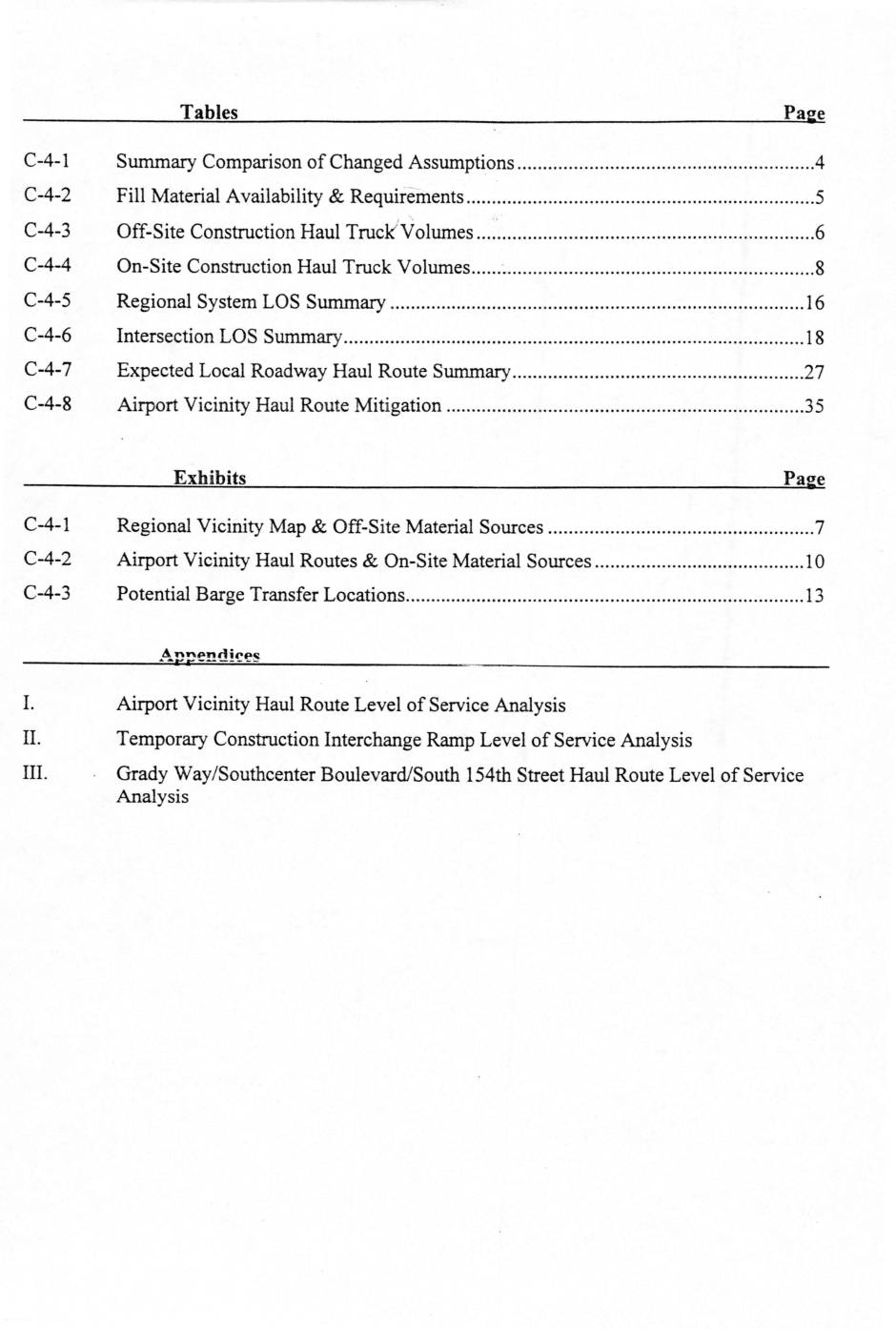
Stmpu 1997 05 Fseis Appendix C
Summary Comparison of Changed Assumptions e eeeeee8eee+eeee+ee©© +eee8e•ee•••• ••••eeee••e•••ee+••• ee ee = Fill Material Availability & Requirements ..5•••••+• e e•••••••••e•••••••e•••••••••••• •• •e•e• Off.Site Construction Haul TruckVol1 les •• •••+••••• • •••••+•••••••e•••••e•••• e• ee •••••• •••• e•• On-Site Construction Haul Truck Vol1 .es . . ••• + • •• e••••e•• • •• •••••e•• LOS S1 16e •e• •••••••+ee••• •••e•e•• 8 •••••e••••+•©•• ©•••+•••••••e•••••• •e•e• •• 18••••• •••ee•e••••••••••••ee•e• B•e•e•••• e •e• IP •+•• e •••• •e••e••e•• •••• Expected Local Roadway Haul Route 51 .27••••e•e •O•••• •••••••• 80•••OO••e••+•••• •• e• ©••• Regional System Intersection LOS Airport Vicinity Haul Route Mitigation ••••• ee •4••e•••eeeeoee•+• +©•ee©e©••• o•o•o••••• ••e•e••••9©eeeoeeee© ee ee JJ Exhibits Bl••ll•H• Page Cd- 1 C-4-2 C.4-3 Regional Vicinity Map & OfFSite Material Sources •e•e+•••••• e•e••••••••••+e•••e• ee ee Be ee ee see ee see e + e / )oR Vicinity Haul Routes & On-'Site Material Sources 10•••••• e •+••• e •+•••••e• • e•••+•+••••• Potential Barge Transfer Locations.... 13••+••••••••••••••8• e•e•••e•••ee• ••O•• •••+•e••••••••••e••• e •O•• •••• + + 4AAppe=dices 1. 11. 111 Airport Vicinity Haul Route Level of Service Analysis Temporary Construction Interchange Ramp Level of Service Analysis Grady Way/Southcenter Boulevard/South 154th Street Haul Route Level of Service Analysis Seattle-Tacoma International Airport Final Supplemental Environmental Impact Statement APPENDIX C-4 CONSTRUCTION IMPACTS REPORT ,/ 1. EXECUTIVE SUMMARY This Technical Report documents the additional analysis performed to supplement the Final EIS review of potential construction activities associated with the Master Plan Update improvements. These include dle construction of a Third Runway and associated projects, improvements to the Runway Safety… -
 2023-07-30 00:00
Stmpu 1997 05 Fseis Appendix D
forecast demand. As noted in the FAA guidance, the 1996 Master Plan Update has identified the Port’s capital improvement plan, and provides a realistic assessment of needs for accommodating 15.7 million enplaned passengers, which is expected to now occur in year 2005. The plan also reflects the longer-term needs, associated with 19 million enplanements, in a more conceptual fashion. e q tIl Some of the environmental approvals identified by the Final EIS and this Supplemental EIS, may expire within the next 3-5 years. FAA Environmental Guidelines (FAA Order 5050.4 A, Paragraph 102) states “Time Limitations for Environmental Documents b. With regard to approved final impact statements.....(1) if major steps toward implementation of the oroposed action (such as the start of construction, substantial acquisition, or relocation ctivities) have not commenced within 3 years from the date of approval of the final tatement, a written reevaluation of the adequacy, accuracy, and validity of the final =atement shall be prepared. .. .” The Clean Air Act Conformity rules specifically note that a conformity determination “lapses 5 years from the date of the final conformity determination” (40 CFR Part 51.857(a)). [ ! !! ; } p { }} 6. Additional planning will be undertaken at Sea-Tac in the future, encompassing facility requirements and environmental impacts, based on forecasts of short-term, intermediate ald long-term conditions. If these efforts are undertaken around the year 2000, it is anticipated that aviation industry conditions could stabilize, making air travel demand less volatile mId forecasting less uncertain. jf }… -
 2023-07-30 00:00
Stmpu 1997 05 Feis Appendix E
Port of Seattle Response to Highlin8 Water District letter in Draft E.I.S. for Master Plan Upiate at Seatac International Re: PI F-L LA) Dear Mr. Ossenkop and Ms. Hinkle: The response to our July 27. 1995 letter with regard to specific issues effecting the Highline Water District's existIng and future groundwater Issues were not adequately addressed. The District now has water rights to 17.5 million gallons per daY (MGD) of ground water within the Highline area What steps will be taken by the Port of Seattle to mitigate the contamination of the ground watel? VWlat steps will be taken by the Port of Seattle to mitigate the Ioss of ground wateF lecharge to the aquifers now being used and those that will be used in the future? These two simple questions were not addressed by the Draft Environmental Impact Statement for the Master Plan Update at Seatac InternatIonal Airport. We are expecting a response to our questions which would be acceptable to ou1 District. Sincerely , }h:/ /L &b,,A Keith A. Harris Manager. Planning/Construction KAH mat m 98032 . 824-0375 / FAX: 824-0806 JLN a6 '96 IQ: ISRM POS AV/CbC March 18, Ma. Barbara Hlnkle Port of BeattIe R> Box 68727 8©attle WA 98168 Dear MB e Hlnkl e : Thank you for the oppottunlty to aonnent on the FIn al Bnvironnantal Inpaot 8tateaant (FB18) for the Ha8t8r Plan Update laprovene IIta for Seattle-Taeona InternatIonal Altport+ We revIewed the rE:IB and hav© the £ollovlng coanent8. IIIL a 2+ If you… -
 2023-07-30 00:00
Stmpu 1997 05 Fseis Appendix F
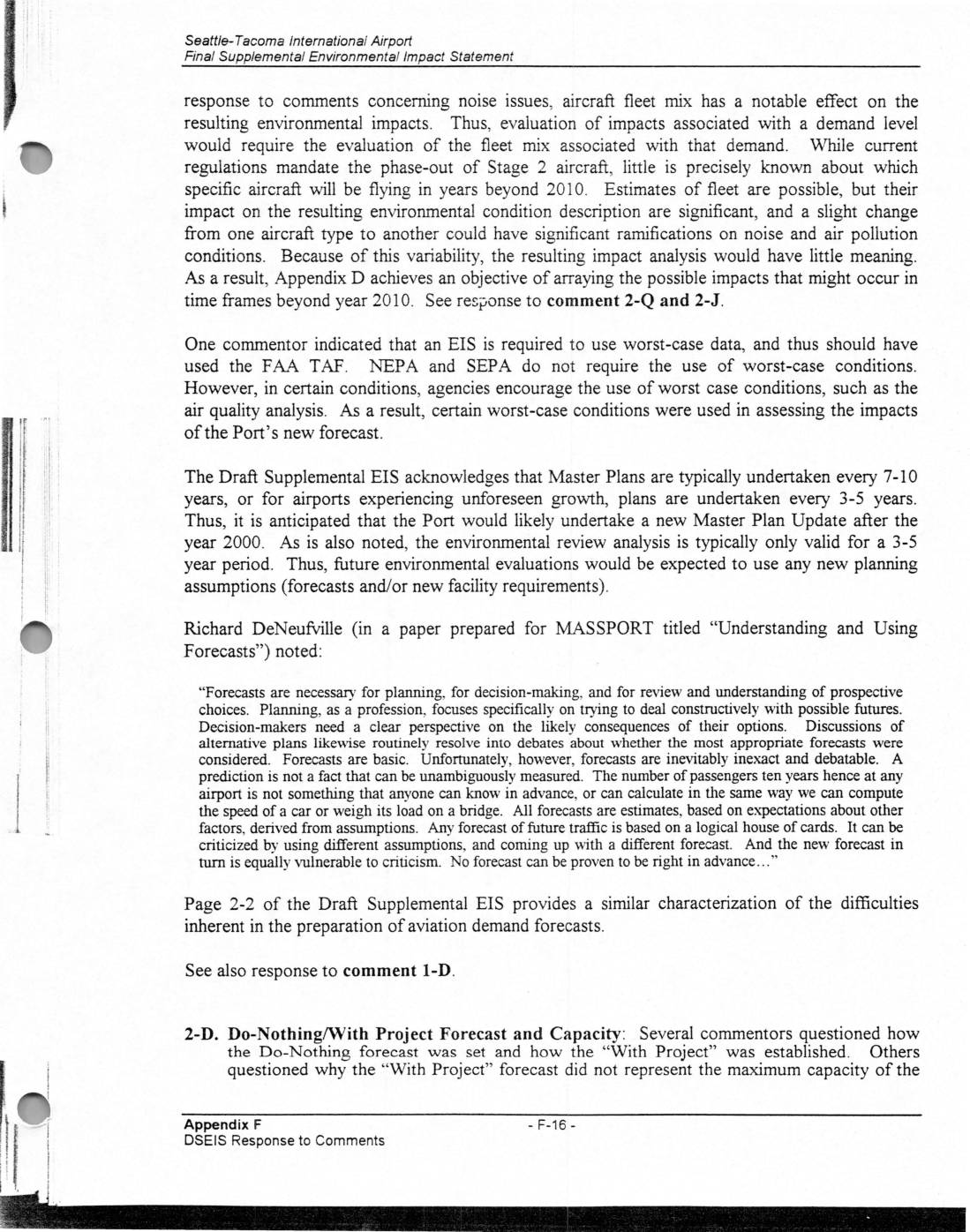
response to comments concerning noise issues, aircraft fleet mix has a notable effect on the resulting environmental impacts. Thus, evaluation of impacts associated with a demand level would require the evaluation of the fleet mix associated with that demand. While current regulations mandate the phase..out of Stage 2 aircraft, little is precisely known about which specific aircraft will be flying in years beyond 2010. Estimates of fleet are possible, but their impact on the resulting environmental condition description are significant, and a slight change aom one aircraft type to another could have significant ramifications on noise and air pollution conditions. Because of this variability, the resulting impact analysis would have little meaning. As a result, Appendix D achieves an objective of anaying the possible impacts that might occur in time frames beyond year 2010. See response to comment 2.-Q and 2-J. One commentor indicated that an EIS is required to use worst.-case data, and thus should have used the FAA TAF. NEP A and SEPA do not require the use of worst-case conditions. However, in certain conditions, agencies encourage the use of worst case conditions, such as the air quality analysis. As a result, certain worst-case conditions were used in assessing the impacts of the Port’s new forecast. The Draft Supplemental EIS acknowledges that Master Plans are typically undertaken every 7-.10 years, or for airports experiencing unforeseen growth, plans are undertaken every 3-5 years. Thus, it is anticipated that the Port would likely undertake a new Master Plan Update after…