TagSea-Tac Communities Plan(236)
-
STCP Draft Revisions Feb 1975 0001
a joint effort of tre pat of s6attle and kiN county TO: HOLDERS OF SEA-TAC COMMUNITIES PLAN WORKING DRAFTS Attached are additional pages to be added to your copy of the Sea-Tac Communities Plan Working Draft . Please insert pages by section (lower left) and page (1ower center) . Section 4.2.2, page 2-1 replaces an incorrect map and Section 4.2.3, page 3 replaces an incomplete page , CommunityChapter 6.2 , Noise Remedies , and Chapter 6 Development Programs , are complete revisions . Both should be given priority attention for your review q• wt of seattle • p.o. box 1209 • seattle washington 98111 • tel: (2CE) 587-3316 P IIlIIE COMPLETE RBViS:LOa Feb ,49 ::Lg 75 + a 4.2.3 ECONOMY AND EMPLOYMENT INCOME LEVELS: Median family income varies from a low of $3,600 in census tract 265 (White Center public housing) to $18, 700 in tract 286 (Normandy Park) . In genel: a1 , highest income levels prevail in the bank of residential develop– ment overlooking or close to Puget Sound , where view amenities are abundant , and in the more recently developed areas located south of the airport . Lowest income levels are in the vicinity of White Center and in the northeast portion of the studY area , along the slopes facing the Duwamish Valley and on the floor of the valley itself . As it might be expected , the lower-income areas also have the highest incidence of persons and families receiving public assistance as well… -
STCP – Summary Presentation, May 27, 1975
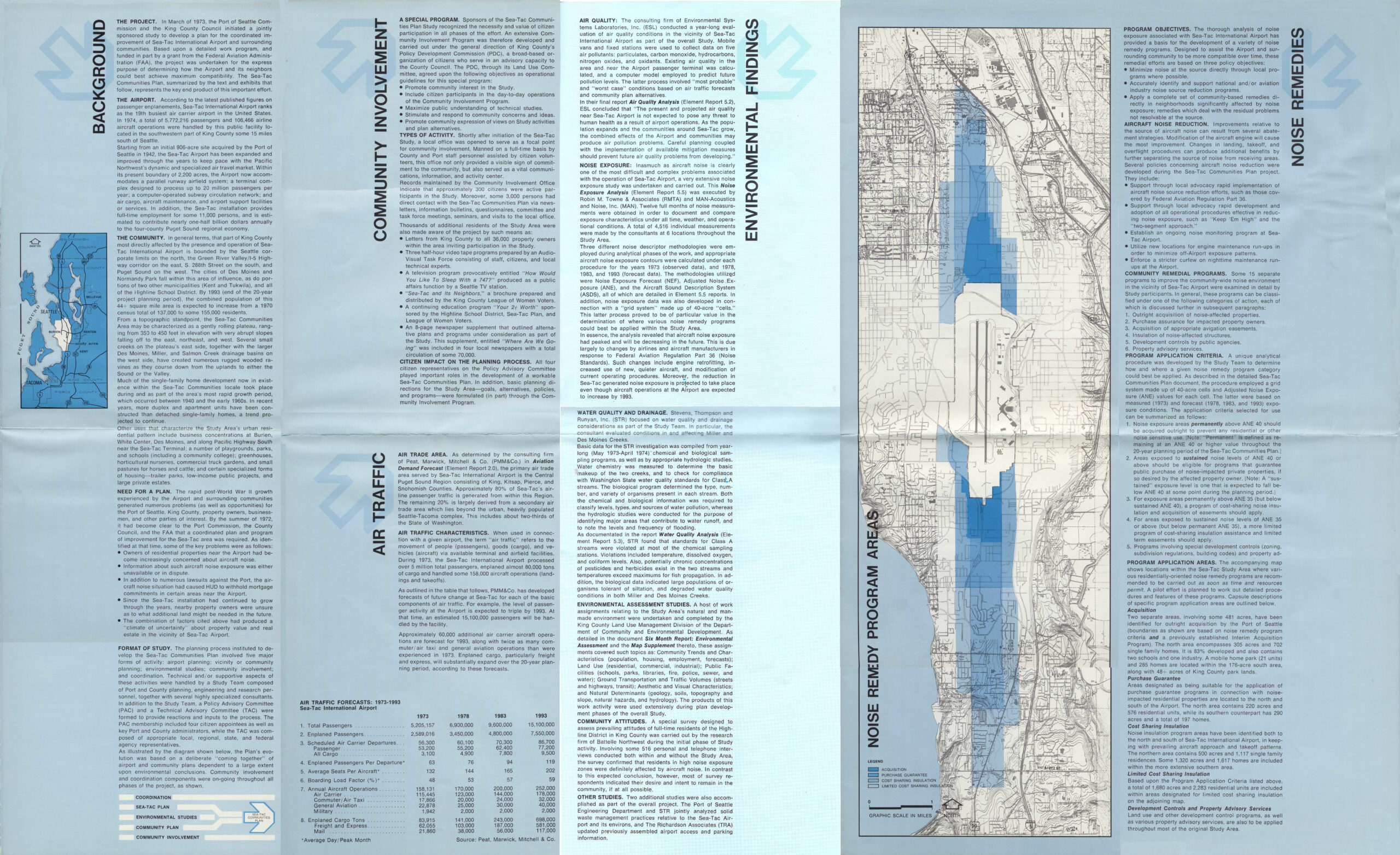
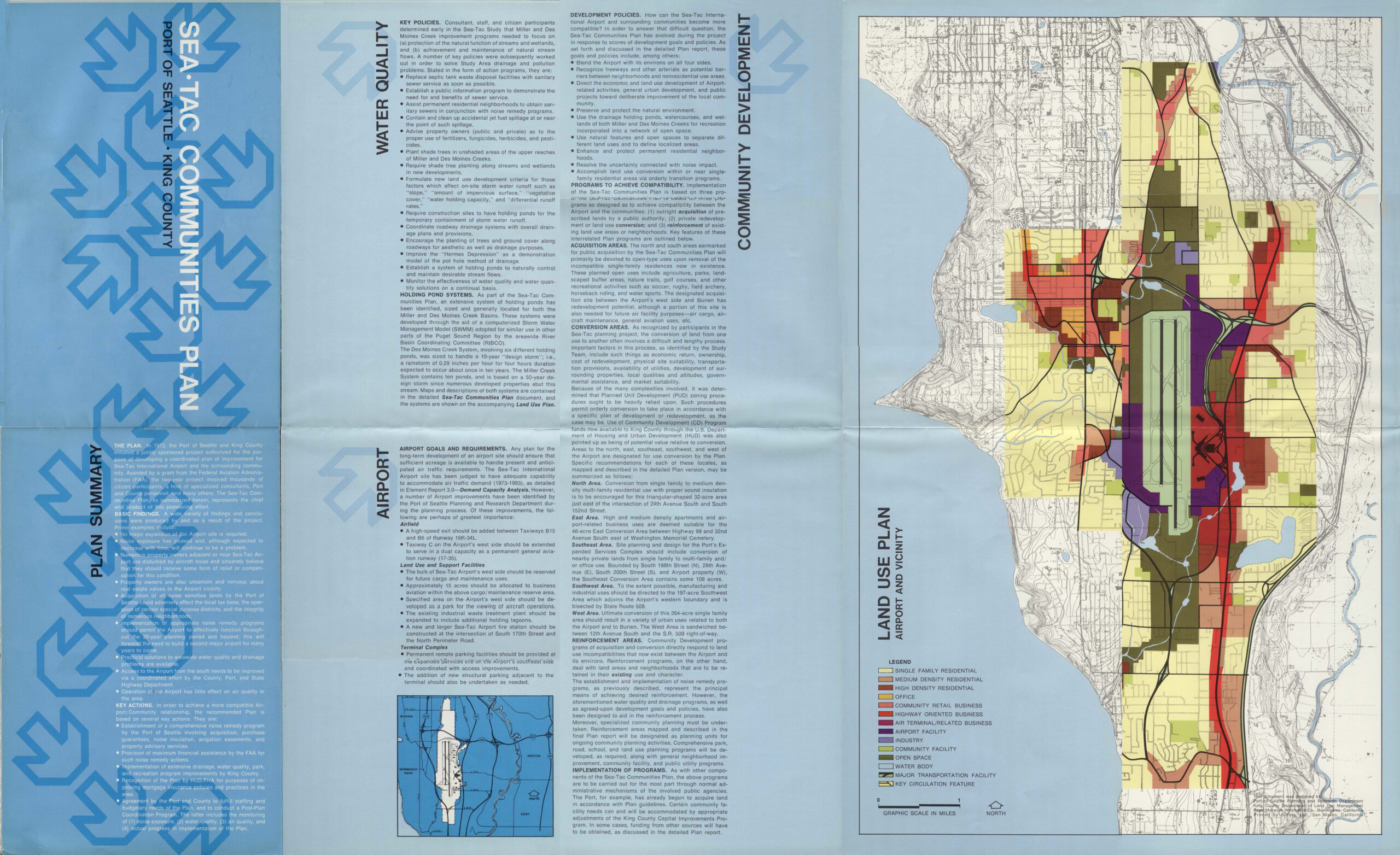
1-Q ~-JIIY WAS TEE SEA~TAC / CO:t:1HUNITIES PLl1.N r::-zGJECT UNDERTAKEN BY THE PORT OF SEATTLE AND KING COUNTY? A- The Project was jointl y authorized by the Port and the County in order to determine how best to acrneve maxi J,JUfll compatibility between Sea-Tac International Airport and the sun:-ounding e nvironment. 2-Q ·JHAT TYPE OF rROBLEl1S TRIGGERED THE NEED FOR THIS STUDY? A- A number of problems' associated vlith the present operation of Sea-Tac Ai rport wer e identif i ed some two years ago in support of the need to develop a joint plan of improvemen<: for the facility and the communities within vhich it is located. These problems, a s pinpointed at that time, were as follows: · (}.vners and occup ants of res:tdential properties near the Airport had become increasingly concerned about their exposure to the periodic annoyance of aircraft noisr>. . Information about the natr;re and extent of sue~ aircraft noise ex~ posurc vas either unavailable or in dispu t e. In addition to fo s tering numerous lawsuits against the Port of Seattle, the aircraft no i se situa : ion had also prompted the Federal Housing Administration (F.tlA) to ~'ithhold mortgage insurance conunitments in ~ertain a reas a ear the Airport. Since the Sea-Tac j_nstallation had continued to grow and expand follmving its desi gnation as a principle air carrier airport for the Seattle area in 1950, n£~arby property owners '"ere apprehensive as to what additional land might be needed in future years. 1he… -
STCP – Historical Document
King County Office of Community and Environmental Development Land Use Management Division CONTENTS Population and Enrollment Housing Economy and Employment Forecasts (to be written) Page References 16 Appendix A 17 .. COMMUNITY TRENDS & CHARACTERISTICS IN THE SEATAC COMMUNITIES PLAN STUDY AREA POPULATION & ENROLLMENT Growth trends- In 1970, the study area contained 137,000 persons, over 110,000 of whom resided within the Highline School District. The cities of Normandy Park and Des Moines, which are wholly contained within the study area , had a 1970 population of 4, 202 and 4, 099, respectively. Although some additional people live within the small portions of the cities of Seattle, Tukwila and Kent that lie within the study area, the majority of the population is in unincorporated areas. The portion of the study area north of the SeaTac Airport received its greatest spurt of growth during the 1940-50 decade, with a considerable levelling off in the rate of growth occurring thereafter. The growth curve for census tract 270, the Southern Heights neigh- borhood, shown below, is typical of growth trends in this northern area between 1930 and 1970. c: -0 :::1 Q. Q. - - --· f---- ---- -- - -- ----·- .:____ --· - - --- -+-----------+--- 0, 000 f---- --+---- - ------ ·· -- 1--- ------ --- ---··•· ·---- -- --------- ·--+------~- 1-------- ---- ----------+--------------~~-----~---.._- 5,000 ~~= ==-~-._----+-- f------==~~=- ~:-=~ -+---------+-v ----------·-·· 1,000 v ----~------+--- 1930 1940 1950 1960 1970 -1- POPULATION GROWTH CENSUS TRACT 270 sea-tac communities plan -. sponsors… -
STCP – West Sub-Area Planning Considerations
POLICY B: No more mass acquisition for noise impact reduction (based upon existing and forecast noise exposure.) POLICY C-2: Installation of sanitary sewers would accompany any major west-side development. ALT POLICY C-2: Due to the proximity to Miller Creek and evidence of s ~ptic overflow, the west side area should be sewered even if the low density residential neighborhoods remained. POLICY C-3: Shade trees should be planted along Miller Creek, betw'2e ;~ So 144th and so 160th. King County and the Port of Seattle should include shade tree planting as part of ~nJ open space drainage development plans for those area3. POLICY C- 5: King County and the Highline School Distric:.. v · • . ( 4.Jo erf-1 ~-.t/.ti) review fertilizer application at Sunset Jr. High anj Sunset Park, and establish that fertilizer usage is of proper amount and of the least polluting type . POLICY D-1: Construct the reccmmended Miller Creek pond system for the 58 year design storm. 'I/·~"/ - POLICY D-5: New cargo and maintainence development on the airport should provide for stormwater runoff control both during and after construction. POLICY D-7: S.R. 509 and new Des Moines Way construction should provide for control of stormwater runoff. -1- • POLICY E·-1 : Des l•ioines Way should be r econstructed and refor ested Also follows in the spirit of the Des Hoines Way Task Force r eport . (Walkways, bike trails, restoration of the original brick, etc.) POLICY (E-1): Des Moines Way an historical community coll ector ,… -
-
-
-
-
-
stcp video transcript SPL-SP-SST
Pat: Hello. Welcome to my home. My name is Pat Ashcroft and I live in Zone 3. This is the area designated by the Federal Aviation Administration as the high impact noise· area around the Seattle-Tacoma International Airport. They are not wrong . ... It is very noisy here. We not only have the aircraft noise, we have vehicular noise from Highway 99 on the west, and I-5 on the east. Added together, this noise makes it almost impossible for us to enjoy our home as others instali!I in quieter areas do. We cannot use our sun deck. We cannot entertain in the evening; have backyard barbecues. The noise interrupts our T.V. watching, our telephone calls, and our sleep. It is extremely noisy here. Noise is a problem in other areas, too. One reason is· the increase in population. More people, more cars (they have doubled in the last twenty years), more air- planes (they have risen three to four percent) . Also, our standard of living has raised. This means more appliances in the home, more motor boats, motor bikes. People are just now beginning to realize that noise is a problem. In fact, the En- vironmental Protection Agency recently stated, "Whereas noise levels sufficient to induce some hearing loss were once confined to factories and occupational situations, noise level approaching such intensity and duration are today being recorded on city streets and, in some cases, in and around the home." Various organizations are working to alleviate the noise…