Date: February 25, 2020 Location: Conference Center, Sea-Tac International Airport Presiding: Commission President Peter Steinbrueck Commissioners present: Steinbrueck, Ryan Calkins, Sam Cho, Fred Felleman, Stephanie Bowman (arrived shortly after start) Staff: Steve Metruck (Executive Director), Lance Lyttle (Managing Director, Aviation), Aaron Pritchard (Commission Policy Manager), Paul White (Commission Clerk), and presenting staff as named in text


[0:36] STEINBRUECK: Well, good afternoon, everyone. This is Commission President Peter Steinbrueck, reconvening the regular meeting of February 25th, 2020. The time is now 12:06. We are meeting at the conference center at Sea-Tac International Airport.
Present with me today are Commissioners Calkins, Cho, and Felleman. We expect Commissioner Bowman momentarily.
We begin today’s meeting by acknowledging the indigenous peoples of the Duwamish and Coastal Salish, who have stewarded these beautiful lands and waters since time immemorial. We must commit to doing the same for the planet and for generations to come.
This meeting is being digitally recorded and may be viewed or heard at any time on the Port’s website, and may be broadcast by King County Television. Please stand for the Pledge of Allegiance.
[Pledge of Allegiance recited]
Okay, item number three, approval of the agenda… Are there any motions to add or rearrange the orders of the day, or requests to remove items from the consent agenda calendar? Is there a motion to amend? Okay, I guess we’ll have to have a conversation — well, actually we’re going to have the conversation, it’s on the agenda, so — yes? No? I’m sorry, hearing no motion to revise the agenda, please show the preliminary agenda approved without objection. Actually, I’m sorry — I’m going to motion to pull item—
[speaker unclear — commissioner]: There’s been a motion. Is there a second to table item 8?
[several commissioners]: Second.
STEINBRUECK: It’s been moved and seconded. All those in favor, please say aye.
[all]: Aye.
STEINBRUECK: Opposed, say nay. Motion carries. Item tabled. And, uh, Clerk — typically, I think under the rules, you’ve tabled to a specific future meeting.
[2:53] CLERK (Paul White): There you go — you know, this tables indefinitely, under the rules of Robert’s Rules.
STEINBRUECK: Yeah, um, thank you for that.
[speaker unclear — commissioner]: So, because of the structure of the Port Commission, postponing indefinitely and postponing to a time certain have the same effect — which is to say the item will not be taken up during today’s session.
CLERK: So it’s not absolutely necessary to explain when it’s going to come back on the agenda, but it certainly is acceptable to do that. That’s all I wanted to clarify.
[speaker unclear — commissioner, likely Bowman]: May I add, though — for the record, I would like to take this up as soon as possible, because I think it’s important. Could we specify the next meeting — what’s the date — so we don’t delay this?
CLERK: So the next regular meeting will be on March 10th.
BOWMAN: So if that could be a friendly amendment to the motion, makers and amenders—
[speaker unclear]: I don’t think we even need an amendment, just an intention to bring it up on March 10th.
BOWMAN: Fine, that addresses the issue.
STEINBRUECK: Okay. So we’ve approved the amended agenda. Executive Director’s report, item four.
[4:56] METRUCK: Good afternoon. I’d like to begin my remarks by sharing five announcements.
Recently the Port held its third annual Innovation Awards recognition event, celebrating innovation throughout the Port — critical to our success as an organization. For this award we received 13 nominations, representing innovative and collaborative projects by over 100 Port employees, all 11 Port employee resource groups, and hundreds of college and high school interns.
The winner was the Media Washing Machine, which was also voted by employees as the People’s Choice Award winner — no, this is not a fake-news-cleansing algorithm, but a machine to remove gunk from oyster shells that are used as filters for stormwater runoff. These machines were constructed by teams in Marine Maintenance from old spare parts, and were very inventive in making sure these oyster shells were used effectively in the system.
The event also included the fourth-quarter winner, the Pier 66 shore power submarine cable project, which identified an innovative approach to bringing shore power to our cruise terminal at 66 — less expensive, with less impact on waterfront businesses, pedestrians, vehicles, and utilities. Honorable mention for stakeholder impacts went to the Shilshole Bay Marina interactive real-time map project, which will increase customer satisfaction, improve operational efficiency, and increase revenue.
Since we last met, our airport had its annual FAA Federal Aviation Regulation inspection, also known as the Part 139 — a mandatory, extremely comprehensive four-day, one-night inspection touching almost everything we do on the airfield. Impressively, the airport passed this comprehensive audit with no findings for a second year in a row. This is a very rare occurrence for any airport, and speaks to the extremely high caliber of the team, headed by Lance Lyttle, that we have at the airport across multiple disciplines. Please join me in recognizing our staff, who work diligently behind the scenes to keep Sea-Tac operating safely daily.
[7:12] STEINBRUECK: Could I just ask the airport employees present to stand up?
[applause]
METRUCK: I know there’s more than that — they’re a modest group.
On another issue: our staff at the airport and at the seaport have all been working hard monitoring the impacts of coronavirus (COVID-19) on our operations. As you know, the Port follows guidance provided by public health experts at the federal Centers for Disease Control and Prevention, Customs and Border Protection, the U.S. Coast Guard on the maritime side, Washington State Department of Health, and Public Health Seattle–King County. During any public health incident we rely on these officials to provide the latest risk analysis and recommend scientifically proven steps to keep employees and our community safe.
Since implementation of restrictions, CBP and CDC have screened hundreds of incoming passengers for signs of coronavirus infection. So far there haven’t been any additional infections found, and we’re continuing to coordinate with federal, state, and local representatives in response to the virus.
The airport has increased, as I’ve reported before, our use of disinfectants and cleaning of high-touch areas, and made more hand sanitizer available to arriving passengers in our international arrivals Federal Inspection Service area.
At this point we’re continuing our sensitivity analysis for economic impacts of COVID-19. It appears revenue impact, as a result of lower spending, will affect parking, taxis, TNCs, meals, gifts, and other items. At present our financial operating reserve can cover these amounts. The lower spending levels result from our limited number of affected flights into China — those flights account for a reduction of 0.3 to 0.4 percent of travelers, which limits this year’s overall growth slightly, so far, year to date.
Switching to the cruise industry: Royal Caribbean has announced an added itinerary from Seattle for 2020 with their vessel the Millennium. Celebrity Cruise Line reported they cancelled cruises in other parts of the world, but cancellation rates have leveled off. A survey indicates over 60 percent of cruise travel booking agents report seeing a slowdown in advance bookings in other regions of the world; many travelers are waiting to see if virus concerns continue. Respondents also indicated they believe North American cruises were safest. As a financial backstop, we have in place minimum annual guarantees on our leases. We continue to monitor these developments and will report on impacts as we go forward.
[10:20] FELLEMAN: I think it’s important to note the MAGs [minimum annual guarantees] that exist, so the impact on us is mitigated somewhat by that — but I wasn’t understanding: is a cruise line going to show up early while our factory trawlers are still in place, and therefore there wasn’t a slip for them, and would they sit at anchor in Elliott Bay?
METRUCK: That’s an operational question — I don’t know that one offhand. I know we have a cruise ship coming in starting April 1st, but I’ll have to report back to you on that, because I’m concerned by such a suggestion — we have done this before, we have done cruise ships at anchor.
FELLEMAN: Anyway, I’ll look into that. I assume, if 66 is open, that they would use a berth.
METRUCK: I’ll look into that.
CALKINS: I had a similar question about flights that have been cancelled to Asia — there’s probably no way to speculate on when flights might be restored, or what would be required for flights to be restored.
METRUCK: I think it’s a combination of demand and the travel limitations put in place by the federal government.
CALKINS: Okay, so a lot of uncertainty there.
METRUCK: Still a lot of uncertainty — we’ll continue to report on that.
CALKINS: I would just ask that we be kept updated on additional flights that might be cancelled. Right now it’s really limited to China, but areas like South Korea and other places around the world are also considering doing the same, so if we could just be updated on what the airlines are thinking — whether they’re going to be proactive in cancelling flights, or if the FAA or CDC suggests cancellation of flights — I’d like to be updated on that.
METRUCK: It becomes a combination — the China flights were cancelled, but they’re also decreased based on demand for those flights. We will report on those developments as we go forward.
Commissioners, I’d also like to point out recent activity around the proposed new cruise facility at Terminal 46. As you may recall, we launched our SEPA EIS scoping period last fall. Earlier this month we released the scoping report, which summarizes comments received on topics for the environmental review. In addition, last month we released the revised Request for Proposals to the shortlist of proposers being evaluated as potential investment and operating partners for the new proposed cruise facility. The proposers’ responses were due February 20th, and the evaluation team is reviewing what was received.
Included in the revised RFP was new language requiring homeport cruise vessels at the new berth to be equipped with shore power capability and to use shore power when at berth. In addition to shore power, the Port also required cargo handling equipment to have zero tailpipe emissions, participation in regional air quality planning, and prohibiting discharges at berth. Staff looks forward to providing an update on this project at the March 24th Commission meeting.
Over at Shilshole Bay Marina, progress is being made on the remodel of the south and central customer service facility buildings. Each building will provide 2,700 square feet of space, with restrooms, showers, and laundry rooms, as well as family units that are all ADA-accessible. The laundry area is nearly double what’s currently on site. Solar panels will generate 70 percent of the heat needed for each building, and radiant heat pumps will keep the spaces dry and warm. The northwest restroom will be an 800-square-foot structure with gender-neutral restrooms and separate shower rooms. The new facilities are expected to open by May and are on budget.
Moving to today’s meeting, I want to highlight four items on our agenda: item 8A — well, it’s just action taken on that, I’ll pass that item. Item 8B is authorization for additional funding to the existing Sustainable Airport Master Plan, enabling continued work on the environmental review, including additional stakeholder outreach efforts. Finally, item 9A is an update from the Biometrics Working Group.
Commissioners, this concludes my remarks.
[14:35] STEINBRUECK: Thank you, Director Metruck. At this time we’re going to begin an additional item on our commission agenda, which is committee reports, if there are any. Our Commission Policy Manager, Aaron Pritchard, has some updates for us on this topic.
[14:47] PRITCHARD: Good afternoon, Commissioners and Executive Director. I’ll go through each of the committees and touch lightly on the issues they covered, the subject matter, and a little about the recommendations. All the recommendations eventually come before the commission — this just allows commissioners to dig in on a couple of topics before they come to public session.
The Aviation Committee met Tuesday, February 18th, and reviewed two topics: ground transportation at the airport, and the airline five-year CIP. The wide-ranging conversation on ground transportation focused on the ground transportation policy directive passed last year. There was a lot of discussion about implementing a Transportation Management Association, which will bring together employers around the airport to figure out how to reduce single-occupancy travel to the airport, among other things — you’ll see talking points coming out of that on how we can help employers improve commute-trip reduction. The airline five-year CIP conversation focused on changes the aviation team is making in how they bring major projects forward, in packages and programs versus smaller projects, so you can get a better view of what the airport’s doing.
You’ll hear more about the biometrics special committee, which reviewed the biometric air exit policy recommendations.
The Audit Committee met on 2/11 and closed out an important meeting on a single topic — the architects-and-engineers contracting levels — and I believe that issue is now closed for the Audit Committee.
The Aviation/Energy Sustainability Committee met on 2/12, with a very interesting presentation from WSU on a long-term study on potential Northwest regional feedstock production for sustainable aviation fuels. Dr. Wolcott came up from WSU, and we discussed it for almost two hours — it was a very good presentation. The committee has recommended this come to full Commission as soon as possible in a study session, given the importance of this issue. We’ll get a look at some environmental topics the airport’s already worked on, short-term improvements coming out of the MOU group, and a full briefing from Dr. Wolcott and the team on the study.
FELLEMAN: On that topic — it would be beneficial at some point to hear from Delta Airlines, which has also announced a study of potential feedstock sources that are local and sustainable. I think they’ve committed up to $2 million for that work here in Washington State, so I’d like to hear an update on that as well, and we can perhaps share best practices.
PRITCHARD: That’s great.
[speaker unclear — likely a Port staffer or Felleman]: The WSU study was funded by the Port — we tasked them to do that. And as far as the biofuel, the cellulosic forestry products — southwest Washington seems to be the richest area, and I think there might actually be dovetailing with Delta’s analysis too, which is always good — the industry voice is particularly important here as well. It’s definitely spurred some interest around municipal solid waste too.
PRITCHARD: The Equity and Workforce Development Committee reviewed a proposed workforce development policy, getting some of the concepts down so we have a way to bring forward a briefing to the full commission, which has now been pushed to March 24th, but we also have community meetings taking place in the April timeframe. That policy is under development, and we hope to have a review back to the committee soon so we can share it with the rest of the commissioners.
[speaker unclear — commissioner]: Will that work be informed at all by the memorandum of agreement/understanding with the city and county under Priority Hire, and the likelihood of an eventual interlocal agreement — is that in some way tied to the work program for the workforce development committee?
PRITCHARD: They are related, and some of the analysis we’re getting from legal will help us look at those contracts, but it’s not going to direct that work — those contracts are already functioning. So I think they have a relation.
[commissioner]: Okay, all right. Any other questions? [to Pritchard] I’m sorry, do you have more?
PRITCHARD: I’ll just finish up: the Arts and Culture Board met and discussed the 2020 work plan, and received updates on several ongoing art installations.
[commissioner]: Always so important. I look forward to future reports that help expand transparency and the deliberative process here at the Port Commission.
STEINBRUECK: So thank you, Aaron.
PRITCHARD: Thank you, Commissioner. I can give you a real-time update on the cruise vessel — it will not be at anchor, it will be at Terminal 91, and it will be plugging into shore power.
STEINBRUECK: Good, thanks. Okay, with that, I think we’re moving on to item five, which is public comment. The commission will now accept public comment. Any written materials can be given to the Clerk for distribution to commissioners. If you wish to speak, please sign in and identify the specific item you are addressing. We’ll limit comment time to two minutes per person, and we’ll begin with Jordan Van Voast.
[20:42] JORDAN VAN VOAST: [before starting] I just wanted to let President Steinbrueck know I’ve been subpoenaed to testify at a hearing, so I might have to walk out abruptly — if I walk out on anybody’s testimony, I apologize, it’s nothing personal. Thanks.
Good afternoon, Commissioners and staff. My name is Jordan Van Voast, and I’m a licensed acupuncturist and co-president of Dharma Friendship Foundation. I’m here today to comment on the T-46 project. I sent you an email with a long list of concerns, and I’ll limit it to the issue of fuel for cruise ships. To the extent the cruise ships participate in the fossil fuel economy, all the risks of being part of the consequences of fossil fuels apply.
I did a little research on where the oil for Seattle’s cruise ships originates, and the best I can figure is it comes from the North Slope of Alaska, is pumped to Valdez via the pipeline, then shipped via tanker along the same route the Exxon Valdez took in 1989, when it dumped 11 million gallons into Prince William Sound. That area is still recovering — you can still find oil oozing out of the sand. Many species — orca, pigeon guillemot, and one other I can’t remember, herring — haven’t recovered yet, according to science. Some of the oil may also come from the Canadian tar sands, an environmental disaster of epic proportions.
At each stage of this process there are multiple risks for oil spills. With the Trans Mountain Pipeline coming, they predict a 700 percent increase in tanker traffic through the same channels, up through the San Juans, which are quite treacherous in any weather. It’s really only a matter of time before there’s some kind of collision — whether a cruise ship is involved or not — when we’re dealing with fossil fuels we’re putting our fate into that whole system. Thank you very much.
STEINBRUECK: Thank you, Jordan. Our next speaker is Cynthia Spies, followed by Jennifer Lee.
[23:33] CYNTHIA SPIES: Hi, I’m Cynthia Spies, an independent security researcher and Seattle resident. My comments are regarding biometric air exit — the use of biometric technology at the Port of Seattle. It’s a disturbing precedent, backed by a publicly elected commission — make no mistake about it, this technology will not be contained. This lays the foundation for a future dystopian world where everyone’s movements are tracked and logged.
The Port is being two-faced: RFP 19-86 was open for bids before any approval or policy requirements on the use of biometric technology have been finalized by the commission, and the Port’s biometric report itself uses wording throughout that assumes not only that the commission will grant approval, but that such approval would support existing CBP implementations unaltered. Together this implies Port staff are close-minded and biased against the concerns raised by the public, and that this whole process — especially the Biometrics External Advisory Group — is nothing but a pointless charade, with staff and commissioners ready to rubber-stamp anything the airlines or CBP request.
In addition to the concerns raised by the external advisory group, I’d like to point out that Congress did not mandate that anyone, including foreign nationals, be required to give their biometric data to airline or cruise ship companies. If CBP needs the data, CBP should be the one gathering it. Additionally, the Port is under no requirement to operate this technology on behalf of CBP.
Regarding the principle of voluntariness — the report states there are two problems: the opt-in/opt-out procedure, and unintended image capture. However, none of the Port’s own recommendations address that opt-in/opt-out problem, and none address the insufficient or non-existent opt-out signage or communication from CBP. CBP’s own materials show their plan for biometric tracking of all travelers, citizen and non-citizen, international and domestic — it’s in CBP’s own interest to have poor signage and poor communication. They have no reason to help travelers, or the Port, thwart them. CBP is not your friend, they’re not your partner, they’re paying you lip service. Don’t rubber-stamp the use of mugshots at the Port. Thank you.
STEINBRUECK: Thank you. Jennifer Lee, followed by Stan Shakuma.
[25:42] JENNIFER LEE: Good morning, Commissioners. My name is Jennifer Lee, and I’m the Technology and Liberty Manager at the ACLU of Washington. I’d like to thank the Port of Seattle Commission for being the first port in the country to push for a conversation on whether face surveillance technology is compatible with our democracy and civil liberties. However, as a member of the Biometrics External Advisory Group formed to provide feedback on the Port’s biometrics policies, I’d like to raise concerns on both the policymaking process and the recommendations for air exit that have been shared.
First, we’re concerned that while the Port is in the very process of determining if and how it should allow facial recognition, it has already posted an RFP for a shared-use, Port-owned facial recognition system for airline use at departure gates at Sea-Tac International Airport. Though we’ve been told the sole purpose of the RFP is market research, the text of the RFP itself states the Port is already committed to helping CBP install a biometric air exit system, and that it “supports the industry trend of using facial recognition.” Commissioners who voted for the resolution on biometrics adopted at the December 10, 2019 meeting stated the resolution was intended to leave open all possibilities, including that the Port might not permit deployment of any public-facing biometrics. There’s a contradiction here: the Port cannot legally state it’s committed to deploying a permanent biometric system to prospective bidders while telling the advisory group and public that no commitments have been made.
Second, the Port staff draft recommendations on air exit shared with the advisory group recommend that the Port work collaboratively with CBP and airlines to roll out facial recognition. We strongly disagree with this recommendation. The Port should not be facilitating the infrastructural expansion of face surveillance technology that is rife with race and gender biases. Even if this technology were perfectly accurate, its use poses great threats to our constitutionally protected rights and civil liberties. The Department of Homeland Security and the aviation industry as a whole have explicitly stated their common vision of widespread deployment of face surveillance. In our non-transparent system, where data is increasingly shared between public and private entities, it’s difficult if not impossible for travelers to meaningfully consent to provide biometric information to some entities but not others. The Port should not provide cover for CBP to roll out its mass collection of biometric data. We ask the Port to reject participation in facilitating the expansion of face surveillance. It chills civil liberties. Thank you.
STEINBRUECK: Thank you. Stan, followed by Elena Perez.
[28:19] STAN SHAKUMA: Good afternoon, Commissioners. I’m Stan Shakuma, president of the Seattle chapter of the Japanese American Citizens League, one of the oldest and largest civil rights organizations among Asian Pacific Islanders. I was quite happy at the beginning of this session that we all pledged to one nation with liberty and justice for all — I hope that was not a pro forma pledge, and that we all take that to heart.
I’m here to offer a cautionary tale about biometrics, face-to-face surveillance in particular, and unintended consequences. In 1942 — 78 years and six days ago — the President signed Executive Order 9066, which authorized the military to declare certain zones from which they could clear people out, whether citizens or not. There is nothing in that order that specifies Japanese and Japanese Americans would be the ones affected; however, that is exactly how it was implemented. General DeWitt and his assistant, Karl Bendetsen — who incidentally hailed from Aberdeen, Washington — wrote and promulgated the orders that cleared people from the West Coast, including all of western Washington, actually all the way to the Columbia River, for the duration of the war. This is the largest violation of constitutional civil rights in the history of this country.
Today we face arguments again of national security, and on the economic side, of efficiency, in promulgating new technologies. I would just caution the commission that for marginalized communities — communities of color, Muslims, the poor — these are not incidental-consequence-type things. For most of us in this room, if we think of something bad happening with facial recognition, we think we’re going to miss a flight, we’re going to ruin a vacation. But for marginalized communities, they’re thinking: we’re going to get arrested, we’re going to get deported, we’re going to be separated from our families. I hope you’ll take this into serious consideration whenever you decide on facial technology. Thank you.
STEINBRUECK: Thank you. Elena Perez, followed by Andrew Kidde.
[31:14] ELENA PEREZ: Elena Perez, with Puget Sound Sage. I want to start by saying I was very encouraged in December to hear Port commissioners calling for greater transparency and accountability in response to decisions about the use of facial recognition technology at the airport, and very excited to have you here, Commissioner Cho, to continue this conversation.
On December 10th we urged you to defer action on the motion — we felt you had not fully heard from civil liberties and data surveillance experts, as well as communities most impacted by this technology — and that request was denied. Instead, a Biometrics External Advisory Group was established to respond to our concerns about lack of transparency and accountability. But that group, intended to be a space for community stakeholders, has instead been overwhelmingly stacked with industry and agency representatives who have already expressed interest in having facial recognition technology at the Port. In fact, two corporations that stand to profit directly from this decision — Microsoft and Amazon — have seats at that table. These two corporations are not obviously stakeholders at the Port, and they have a track record of lobbying in opposition to strong privacy regulations around surveillance technology.
To date, the impact of biometrics on communities of color, immigrants, and refugees has not been fully explored, and you still have not received substantive feedback on this issue. As such, we urge you not to allow any further action by Port officials to lay the groundwork for facial recognition, like the RFP, until you hold a robust public hearing dedicated to this issue. We know you as individuals are deeply concerned about this and feel obligated to protect the public. We’re asking you today to take back control of this process and help the public achieve clarity about what you, the commissioners, are moving forward and what you are not. Thank you very much.
STEINBRUECK: Thank you. Andrew Kidde, followed by — [clerk corrects name] — thank you, Andrew.
[33:30] ANDREW KIDDE: My name is Andrew Kidde. I’m a resident of south Seattle and a member of 350 Seattle’s leadership team. I’m here to ask you to put real sustainability back in the Sustainable Airport Master Plan process. Real sustainability means clean air for the kids in south King County who must now breathe the ultrafine particles and other pollution that rains down from the flight path. Real sustainability means a stable climate for kids all over the world looking at a life lived in an escalating climate emergency.
Make no mistake, we already live in a climate emergency. It’s not like other emergencies — the communities that are hit rarely think disaster is around the corner. People in Australia were enjoying spring last October, unaware that in a few months they’d be driven to the edge of their continent by raging fires. People in Paradise, California thought they were living in paradise until the Camp Fire destroyed their town. People in Houston thought things were fine before Hurricane Harvey caused $125 billion in damage. I could go on.
The climate emergency is like a Russian roulette gun, and the more climate pollution we emit, the more ammunition we put in that gun, and the resulting climate disasters will be increasingly frequent and devastating. We must stop pretending we can meet anticipated aviation demand over the next 30 years. Unconstrained aviation demand is projected to skyrocket, and along with it the associated climate pollution, which by recent estimate could grow to 27 percent of climate pollution by 2050. We have a choice: we could add more ammunition to the climate Russian roulette gun, or we can say enough is enough. It’s time to make the future safe for our kids. It’s time to say no to airport expansion.
STEINBRUECK: Okay, thank you. Bernadine Lund, followed by Monty Anderson.
[35:49] BERNADINE LUND: Hello, my name is Bernadine Lund. I live in Federal Way, and I’m a member of Quiet Skies Puget Sound and also associated with 350 Seattle. For the last several months I wanted to talk about the SAMP. I wanted to thank you for extending the time on the SAMP so all the appropriate elements can be included, including a revised demand forecast.
The SAMP demand forecast shows an increase in both 2027 and 2032, but does not show the increases since 2012, with the addition of the Third Runway. Showing all these increases in comparison to what was originally projected would show you’re serious about getting a fair evaluation from the NEPA/SEPA reviews. The FAA only considers emissions for a few miles during an airplane takeoff, which is very misleading — instead you could calculate greenhouse gases based on the amount of fuel pumped, which would give a more accurate picture of the airport’s impact on local and global communities. Once in the upper atmosphere, the gases and pollution circle the world — I don’t know how many people here remember Mount St. Helens blowing up, but I was in Seattle and lived in Olympia, and the smoke did circle, did end up going across the country.
Rather than always projecting increases in flights, I suggest you have a SAMP that just shows you’re maintaining a steady course — why does it have to show increases, it could just say we’re holding steady, or we’re even decreasing. You could hold flights steady, or even reduce them, until there are less-polluting modes of transportation that can be developed and implemented. Some examples of cities saying no to increases include Mexico City, which just said no to increases at their airport on September 11th. So I just challenge you to look at other forms of transportation, and think of other ways you can use the airport. Okay, thank you.
STEINBRUECK: Monty, you’re up next — Monty Anderson, followed by David Goebel.
[38:20] MONTY ANDERSON: Hello, my name is Monty Anderson. I keep wanting to call your CEO — what’s your title, Steve — Executive Director. Thank you, Commissioners, for letting me speak. We came down here today to touch on a couple of things — I want to once again thank you for your partnership. We have thousands of people out here working, making a fair wage, with family health care, paid time off, vacation pay, grievance rights — and it’s very important to the community, I think, that people realize the Port is a huge generator and one of the best employers we have in this area.
We have great numbers out here for apprenticeship, and I appreciate you, workforce development. I wanted to comment briefly — talking with Commissioner Bowman about maybe an idea coming up where we could have some in-house glaziers work on some of the local homes here that are getting insulated from sound. I just want to let everybody know I’d be very interested in meeting with the Port and finding out if we could get more people from the community into these good-paying apprenticeships and work here at the Port, if there’s an opportunity. We’re open to work with you. Thank you very much.
STEINBRUECK: Okay, thank you.
[40:02] DAVID GOEBEL: Hi, my name is David Goebel. I’m the president of the 501(c)(3) Vashon Fair Skies. I come today to speak on agenda item 7A, which is an update from the Port noise office. As all of you, and probably a lot of people watching from home, know by now, we’ve been engaged in a long struggle with noise monitors on Vashon Island due to the implementation of NextGen. To this end, thank you again for Motion 2019-14, passed last November. However, since then the process concerning the noise monitor has been completely opaque, so I can only presume it’s making forward progress — this in spite of the most relevant elected government body on Vashon, the Vashon Park District (we don’t have a city, we’re unincorporated), attempting to provide input by passing an official resolution.
I would ask that the Port of Seattle try to find some way within its bylaws to deputize me personally to work more directly with the noise office on the Vashon noise monitor. I’m not looking for a badge or anything like that, just for your blessing to volunteer my time, experience, and motivation to help bring about our shared goal of the most effective monitor siting and operation. My educational background is in physics, and my professional background is in software engineering — I have a lot to offer.
Finally, I need to take off — I have a two o’clock meeting at Microsoft in Redmond — so if I leave before other people have made public comment, or during the presentation on 7A, please take no disrespect.
STEINBRUECK: All right, thank you. Next speaker is Ernest Thompson — David, you’re not part of the Parks Board, are you? [aside] — followed by JC Harris.
[41:52] STEINBRUECK: Nice to see you, Sam — I’m glad you got elected.
[41:57] JC HARRIS: I’ll just get right to it — being here to get through two minutes. First of all, I’d like to say that Mr. Kidde and the 350 organization would like to double down on that — it’s time to start thinking about not expanding Sea-Tac but downsizing or changing it, at least from Sea-Tac Airport to a hyperport.
The state of Ohio — the northeast Ohio area-wide coordinating agency — just committed $1.2 million to a feasibility study for a hyperloop between Chicago and Cleveland, 300 miles, doing it in — at 700 miles an hour that would be 28 minutes. They’re already at the EIS stage of development of this project, and now apparently Pennsylvania and New York want to join in for the area up there. Also, in June of last year the Department of Transportation approved five million dollars for a budget study for hyperloop in general.
It is time for us to get on board. It amazes me that with the budget the Port of Seattle has, we are still, in our ever-so-progressive state, doing nothing — and we could be using our airport people to prepare for that. We also have Boeing — instead of making jets, they should be making hyperloop, because at the end of the day, in terms of domestic travel, it’s clear to rational thinking and scientists and others that jets are actually zombies — they’re dead, they just don’t know it.
The other thing I want to bring up real quickly is about the coronavirus — there’s a website I’d recommend, medcram.com. It’s for medical professionals, but I’m sure you’re all highly educated and can follow along. They have daily updates on the big picture and the medical issues surrounding coronavirus, in real time.
On N95 masks — my question is for the Executive Director: do you have quantities of those you can give your employees here, because you cannot get them on the open market now? I bring that up because, as I was walking up the stairs, I noticed one of the Asian air crews completely wearing masks and nobody else was — that creates an atmosphere of panic. Thank you.
STEINBRUECK: Thank you, JC Harris. Followed by Liza Rankin.
[44:27] JC HARRIS: Good afternoon, Commissioners. I have three asks in two minutes. First of all, thank you for your support of HB 2315, the port package update bill, and thank you for getting off the dime on the port package program in general in today’s presentation.
The first ask: I would appreciate it if you’d read the report I sent to Commissioner, former President, Bowman about six months ago, where she asked me about the history of the port packages — why the system had so many problems in the beginning. In 25 words or less, I’ll tell you: it’s the old engineering aphorism, you can have it fast, cheap, or good — pick two. The Port was under tremendous pressure to provide systems for up to ten thousand homes as a predicate to doing the Third Runway. That’s why we are where we are today.
The second thing: I basically got this whole port package effort rolling three years ago by canvassing about 3,000 homes in the area and all the AIP grant contractor invoices, and we vetted the worst of the worst — we’ve done all of the triage. So when the bill gets passed, God willing, we will have a list for you of priorities — which you’re going to need, to decide who to do first, and so on.
And the third ask: what I want is for you all to look at our list and take that into consideration in prioritizing which systems to work on first. These people deserve it — we’ve already done 99 percent of the vetting.
Finally, I would like my group — since we’ve identified all of the homes — to have a seat at the table with your noise program when they’re rolling out this program. You have not done anything to this scale in over a decade, and the community deserves to be able to watch and have a voice in how you scale up this program. It will give them the confidence that things are going to go better next time. I am preparing a memo for Director Metruck, and I look forward to a positive reply. Thank you.
STEINBRUECK: Thank you. Liza Rankin, followed by Bernard Koontz — and I just might say, Council Member Harris, thank you for your upcoming participation on the advocacy trip to D.C.
[47:35] LIZA RANKIN: Hi, my name is Liza Rankin, and I’m on the school board at Seattle Public Schools, and I’m also a born-and-raised lifelong Seattleite. I came today prepared to listen to a conversation about the Maritime and Marine Science High School, but apparently that item’s been moved, so instead I’m going to take the opportunity to speak briefly about my support for it, as a citizen of the area and as a school board director — and just to clarify, I’m here as a school board director, but not speaking on behalf of the full board; we were just told about this meeting yesterday, and mobilized to come down.
During my campaign I was able to participate in Commissioner Calkins’s summit about the maritime academy, or Maritime High School, and it’s really exciting to me, both as a Seattle citizen and as someone who writes policy now for education, that in our region — which is really defined by its waterways — we have the potential for this opportunity to better engage the young people of our communities in stewardship, knowledge, and active participation in taking care of and learning about our oceans and waterways.
As a school board director, the potential for partnerships between the different entities is extremely exciting. I know Highline School District has expressed great interest in leading this project, which we are highly supportive of. The potential opportunities for our students — especially those furthest from educational justice — to access this kind of education, and to empower them to be great stewards and have pathways to great careers, is extremely exciting, and something I’d actually like to see come down even into K–5, engaging students in knowing about your work and about the ocean that supports all of us. Thank you very much.
STEINBRUECK: Thanks. Bernard Koontz.
[50:06] BERNARD KOONTZ: Good afternoon, Port Commissioners. My name is Bernard Koontz, and I lead the design of secondary instruction in Highline Public Schools. I’m here today to express Highline’s continued enthusiasm, support, and gratitude for the Port’s leadership in maritime education. Highline Public Schools appreciates the Port’s leadership in convening stakeholders to collaborate for the common interest of our students and the economic vitality of the region. Specifically, I appreciate the alignment of the Port’s and Highline’s shared common values around racial equity, highlighted at your last public meeting, and the work of your Office of Equity, Diversity, and Inclusion. This is also evident in Highline’s recently adopted equity policy, and shared across the other partners being brought together — the other school districts and many other entities.
The school system’s highlighting bold and innovative — raise back — aviation is an example of this innovation, focusing on partnerships and career-oriented learning. Additionally, Highline’s bold goal to have all students graduate bilingual and biliterate is an example of our commitment to equity, specifically valuing who our students are and who they can be. With our experience and innovative approach, we are very excited to embark on launching this new school. As we enter the next phase of planning and working together, we will begin tackling a thousand and one details and logistics, and through that work I know our common focus on equity will be our guide. I look forward to the ongoing work and the many benefits it will yield. Thank you.
STEINBRUECK: And unless there are others signed up — I don’t see that there are — that concludes our public comment session.
[speaker unclear — commissioner]: Yes, please — I also just want to acknowledge we’ve got former Board Member Jill Geary here as well, who has been instrumental in crafting the model that was selected by the advisory group, so thank you for coming too.
STEINBRUECK: Thank you. So we’ll now advance the consent calendar. I don’t believe there are any items that have been requested to be removed, so the chair will entertain a motion to approve the consent calendar, covering items 6A through 6E.
[commissioner]: So moved.
[commissioner]: Second.
STEINBRUECK: All those in favor, say aye.
[all]: Aye.
STEINBRUECK: The motion carries — the consent calendar is approved.
That brings us to agenda item 7A, Noise Programs Briefing.
[52:34] METRUCK: Commissioners, this item was a briefing regarding the long-standing noise mitigation program that traditionally insulated homes and Highline schools and college buildings. The program has made positive progress over the years, as will be noted in today’s briefing; however, there’s still a large amount of noise abatement work yet to do. In addition to more homes and schools, the upcoming work will include apartments, condominiums, and gathering places like churches. This briefing will explain what work is completed and what’s to come, followed by a motion for commission consideration to accelerate the remaining insulation work to benefit the community surrounding the airport.
At this point I’ll turn it over to our presenters: Lance Lyttle, Arlyn Purcell, and Stan Shepard.
[53:19] LYTTLE: Thank you, Commissioners and Executive Director Metruck. Today we want to share information about the airport’s ongoing noise programs, and on the possibility of accelerating the sound insulation program. This acceleration is for the programs already approved in the Port’s earlier noise remedy study, called the Part 150 update. Accelerating these programs means the work we’ve already planned to do continues, and in addition, we’re able to do more sound insulation in the cities around the airport. These programs include insulating several apartment and condominium complexes, places of worship, and even voluntary acquisition of some homes and apartment complexes. By accelerating this work, we reduce noise impact sooner on residents around the airport. We know this is very important to the community, and it’s been raised at our Noise Advisory Roundtable. We will also discuss the risks associated with accelerating these programs, and I want to thank staff for their hard work assembling this information. Now I’d like to ask Arlyn Purcell and Stan Shepard to begin the briefing.
[54:33] PURCELL: Good afternoon, Commissioners and Mr. Metruck. I’m Arlyn Purcell, Director of Environment and Sustainability for the airport, and I’m here with Stan Shepard, Senior Manager of our noise programs. We’re here today to talk about noise programs in general, but also, as Lance mentioned, a concept we’re very excited to pursue — acceleration. Acceleration of our sound insulation program does have risks, which we’ll discuss today, but it also demonstrates our commitment to reducing noise impacts in our near-airport communities. Our briefing will be followed directly by a motion to provide direction, and we look forward to the commission’s guidance on that. I’ll now turn it over to Stan Shepard.
[55:14] SHEPARD: Good afternoon, Commissioners and Executive Director. Today I’m going to go over four main points: a noise programs overview; our sound insulation programs that are ongoing; the acceleration of those programs; and a recommendation on that.
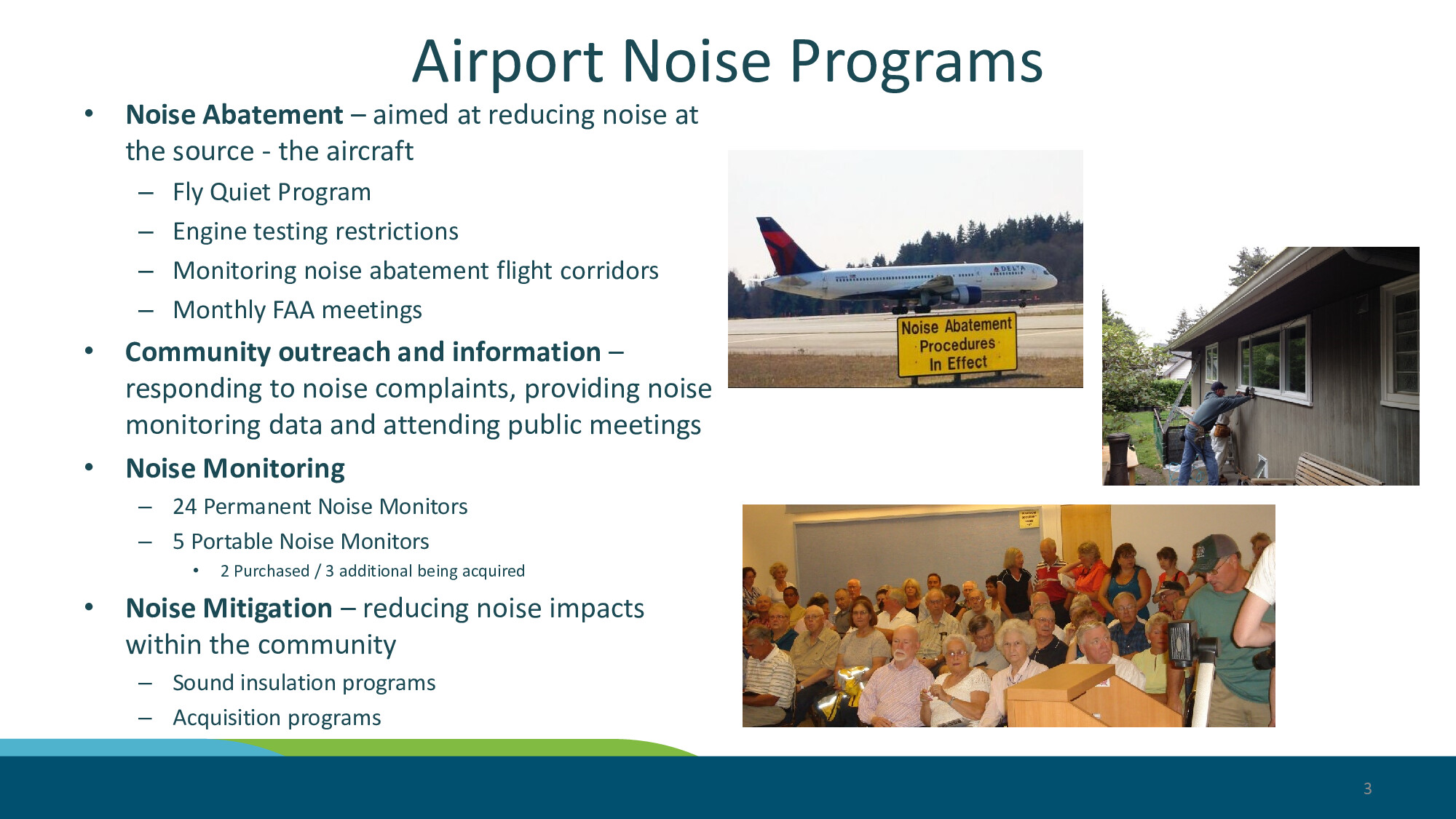
The airport noise programs are comprised of four areas. Noise abatement — focusing on where aircraft fly and how the noise emitted impacts the community; we also work with the FAA regularly to make sure they’re aware of everything going on with our noise abatement programs. Community outreach — anytime we can get into the community, we’re happy to provide information on our programs; we have a noise hotline we answer in our office, and a recording line you can leave comments on — we get about a thousand complaints a day, even more during summer.
Noise monitoring — we have 24 permanent noise monitors, and at commission direction we’ve purchased two additional portable noise monitors and are in the process of purchasing three more. We’re working on training for staff, setting up procedures and legal agreements with our legal department, and working on outreach details, which we’ll report back on. We’re also testing the two portable monitors in-house right now to make sure they’re operating correctly before we get them into the field.
Sound insulation is our last one on the list — noise mitigation consists of acquisition programs and sound insulation. Sound insulation is putting sound-rated windows, doors, and ventilation systems in homes to reduce noise within those homes; we’ll talk more about that as we go along.
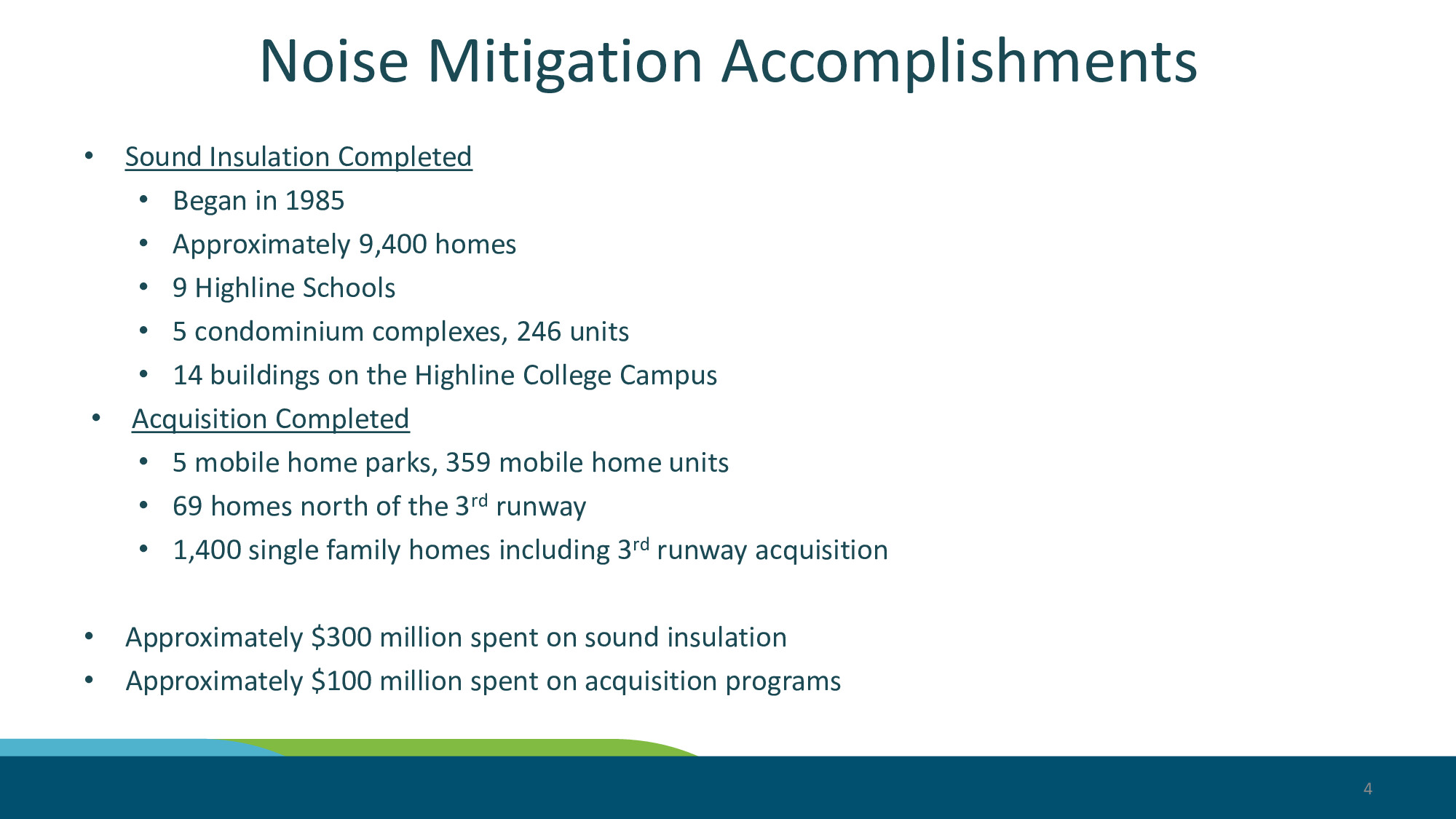
We’ve had this program since 1985. We’ve insulated a lot of buildings — 9,400 homes — and worked with the Highline School District (more on that as we go along). We’ve completed five condominium complexes in the past, and a number of buildings at the Highline College campus. A lot of acquisition programs have been underway with mobile homes, since mobile homes can’t be adequately sound insulated — the preference is to purchase and relocate them; we had five parks very close to the airport where that was accomplished. Total cost on that is around $100 million on acquisition, $300 million on sound insulation programs.
The other aspect of our programs is the Sea-Tac Stakeholder Advisory Roundtable (StART), established in 2018, which also has a sub Noise Working Group, consisting of community partners, airlines, and airport staff, working on ideas for finding noise reduction within our programs.
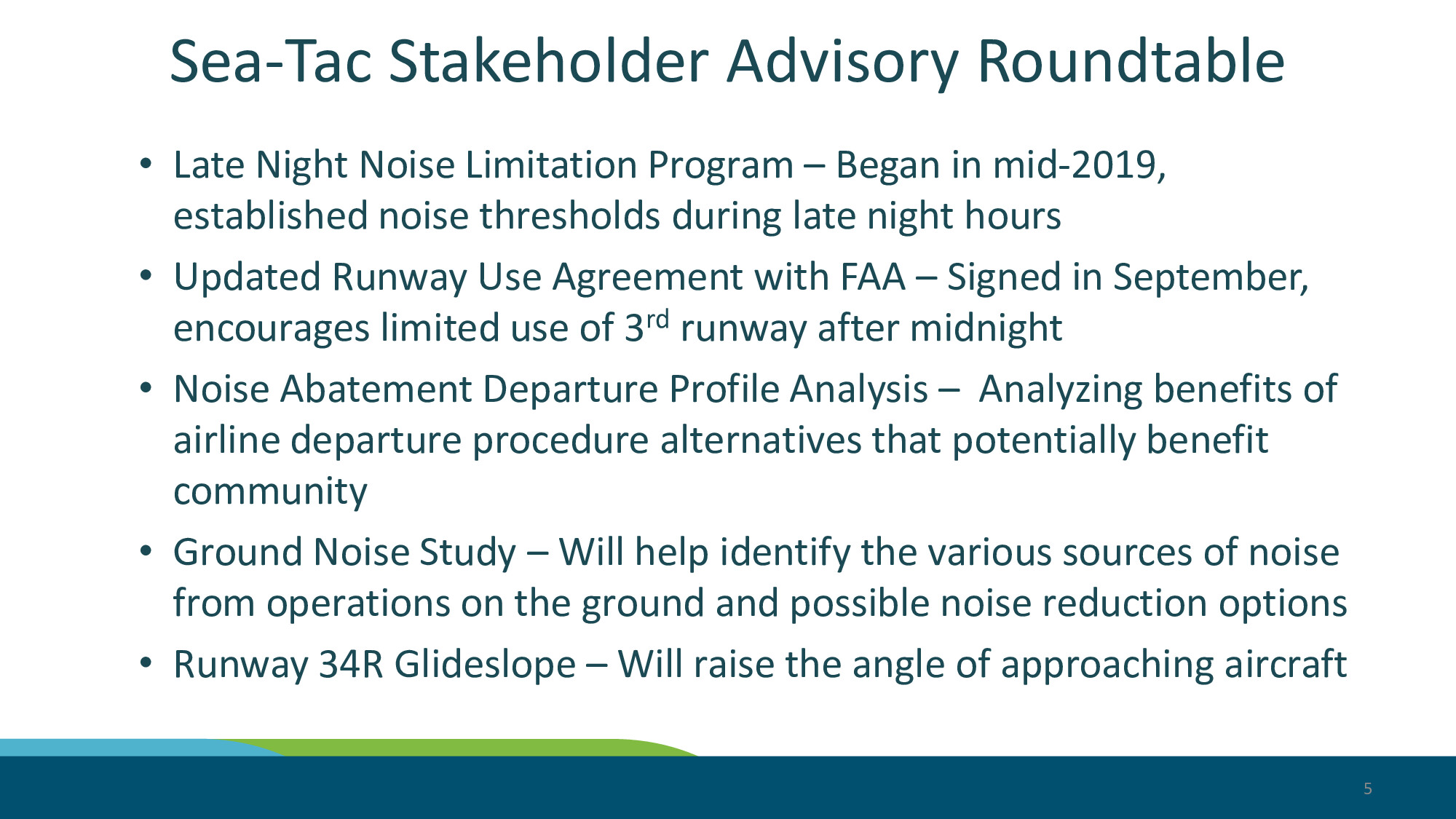
At the top here we have what we call the Late Night Noise Limitations program. This began in 2019 as a way to find ways to reduce noise from the loudest aircraft operating during nighttime hours. We established noise thresholds around the airport, and aircraft that fly over those monitors and break that threshold are identified — we contact those airlines and try to remove those aircraft from nighttime hours, or change them to quieter aircraft.
FELLEMAN: That’s a voluntary program, is it not?
SHEPARD: Yes, it is — I just wanted us to be clear about that.
FELLEMAN: Very good point.
SHEPARD: So, one success we’ve had: EVA Airlines recently gave us exciting news that they’ll be switching out the 777 during nighttime hours for a 787, which is a dramatic noise reduction.
[commissioner]: What airline is that?
SHEPARD: EVA Airlines.
The other program is the Runway Use Agreement, reducing use of the Third Runway during nighttime hours — we’ve worked with the FAA on this, and went from approximately 20 aircraft flying approaches into that runway during nighttime hours to approximately one or two. Another success. We’re undertaking a ground noise study now, too, to figure out what noises are being emitted from the airport, and whether there are ways to mitigate that from getting out into the community — whether through operational procedures or physical structures.
We also have, on our 3/4-Right glide slope, a slightly lower glide slope than the rest, based on some old technology, so we’re looking at ways to increase that.
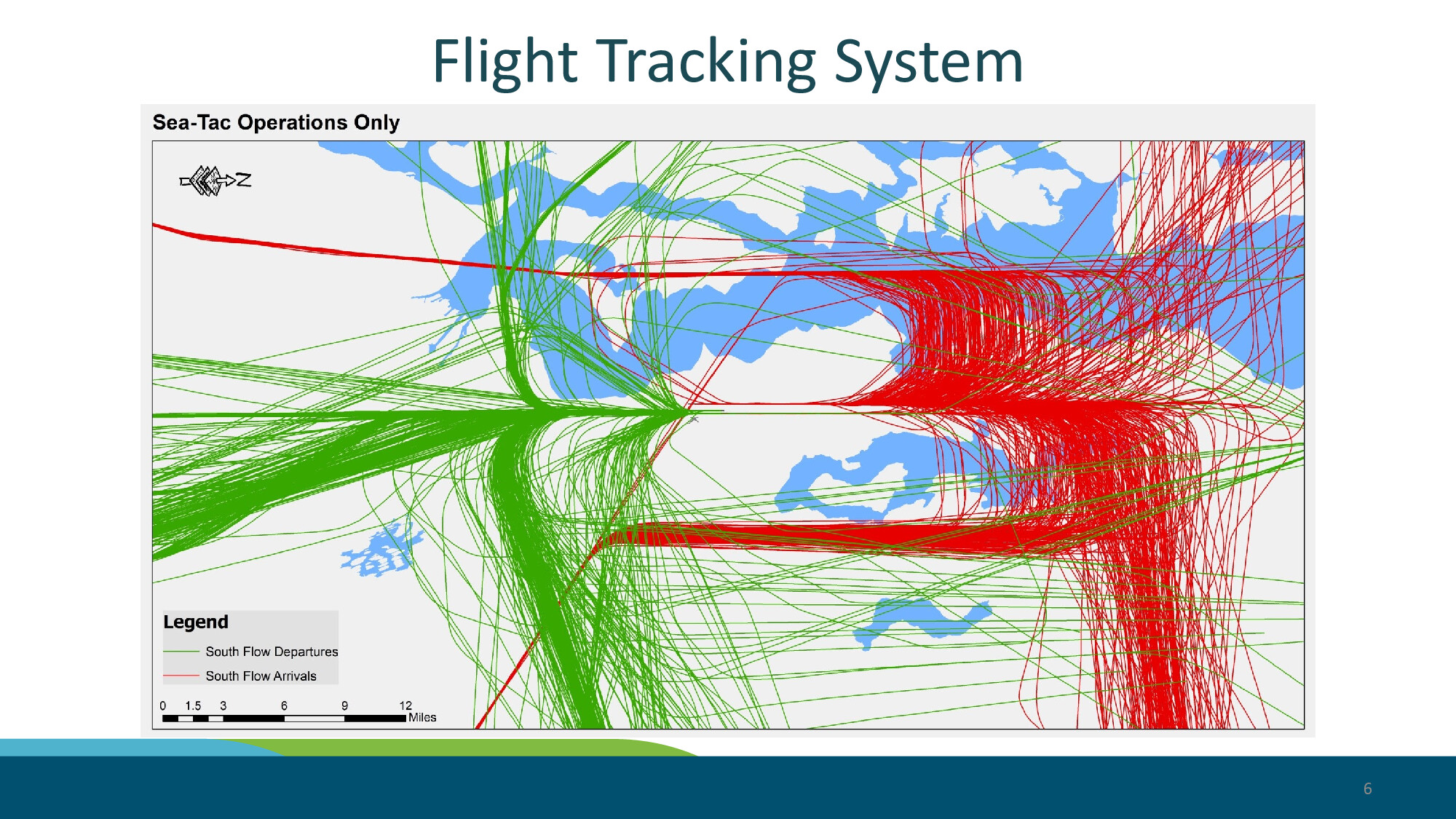
Just to give you an idea of what else we do in the office — we track every aircraft that comes into and out of the airport; I call it “noise art,” but it’s really just showing every aircraft approach and departure. This is an example of a south-flow operation — red lines are approaching aircraft, green lines are departures. Every line represents an aircraft, and we know the statistics on that too.
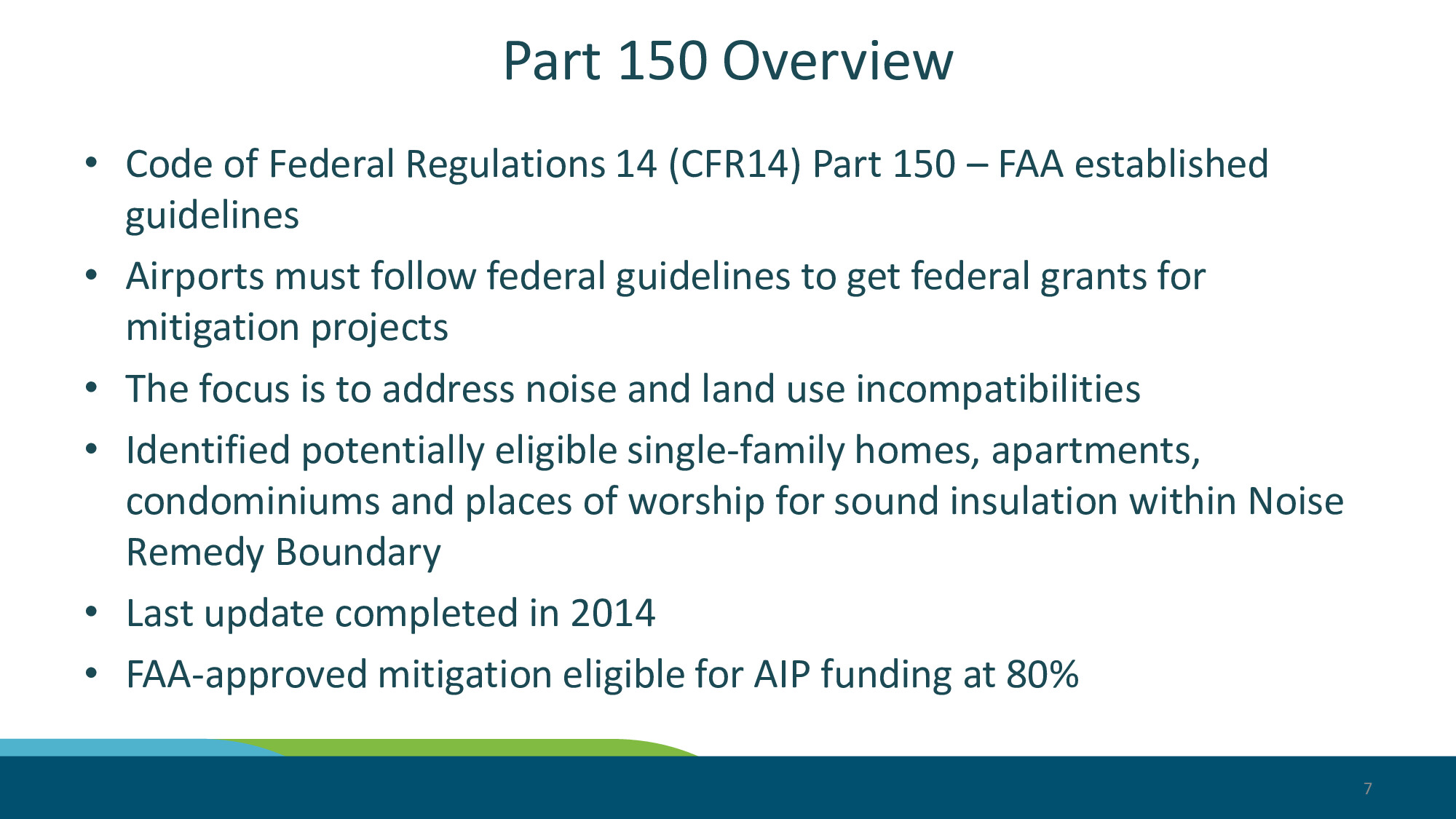
We also have what we call a Part 150, the section of FAA regulation that guides our airport noise programs — as long as we’re accepting grant money for noise programs, we have to follow it. It’s an opportunity to go through and evaluate all our noise programs and see if there’s something we could change or do better. When we undertake a Part 150, we evaluate noise impacts in the community and find ways to mitigate them — eligible mitigation includes residential housing and some public buildings eligible for the sound insulation program. Once the FAA approves our mitigation plan, it provides us the ability to apply for FAA funding grants at approximately 80 percent of project values.
BOWMAN: Stan, just a quick question — according to the memo, before 2014, the previous Part 150 was 1985, is that correct?
SHEPARD: No — the previous Part 150 was completed in 2002.
BOWMAN: Okay, yeah, that was in the memo. So when would the next one be?
PURCELL: I’ll address that a bit, because there’s overlap with the environmental review. As part of the environmental review for the near-term projects, we’ll be preparing noise contours, which will show whether there’s been a change from the ones Stan is about to show you, and where. Based on that, we’ll coordinate with the FAA on the decision to formally update the maps for Part 150 and then do a Part 150 program. I don’t know the exact timing.
BOWMAN: So, hypothetically — let’s say the contours became narrower because planes got quieter, but we had obligations previously, for when planes were louder, that were never completed. I’m just wondering — is this retroactive?
PURCELL: That’s a really good question, and it does get sensitive and tricky, because technically, if the contours are narrower and a residence is no longer within the contours, then it’s no longer eligible for FAA reimbursement as part of a Part 150 program. If that situation were to occur, we’d need to think about how to treat those.
BOWMAN: Well, again, I’m not saying I know how this would turn out — I just wanted to raise that for serious consideration when and if that happens. And this is a two-factor qualification, correct — there’s the noise contour, and then once you’re deemed within it, a test is done on the residence, is that correct?
PURCELL: That’s correct, and I’m going to go over that — just being within the noise contour doesn’t ensure you qualify. You then have to go through the test — there are other qualifications too, including when it was built — and it also has to go through a noise audit to determine noise levels in the house.
BOWMAN: Okay, so one more follow-up — were audits done on all these houses, and only some updated? Or do we not know what the eligible houses were, back in the day?
SHEPARD: Back in the day, we don’t know that. All the homes that have applied right now for the program — we’re moving forward with the ones we’ve had applications for. We completed some last year — 17. We’ve completed two this year, and we have another 25 or so that we’re working on getting noise audits for this year. As homes trickle into the program, as we can convince homeowners to participate, we’re getting them qualified.
[commissioner]: Did anybody cross-check to see how they compared with JC’s list?
SHEPARD: I have not seen JC’s list.
[commissioner, likely Bowman]: No, I’m going to let you — I think we can answer that question two slides in.
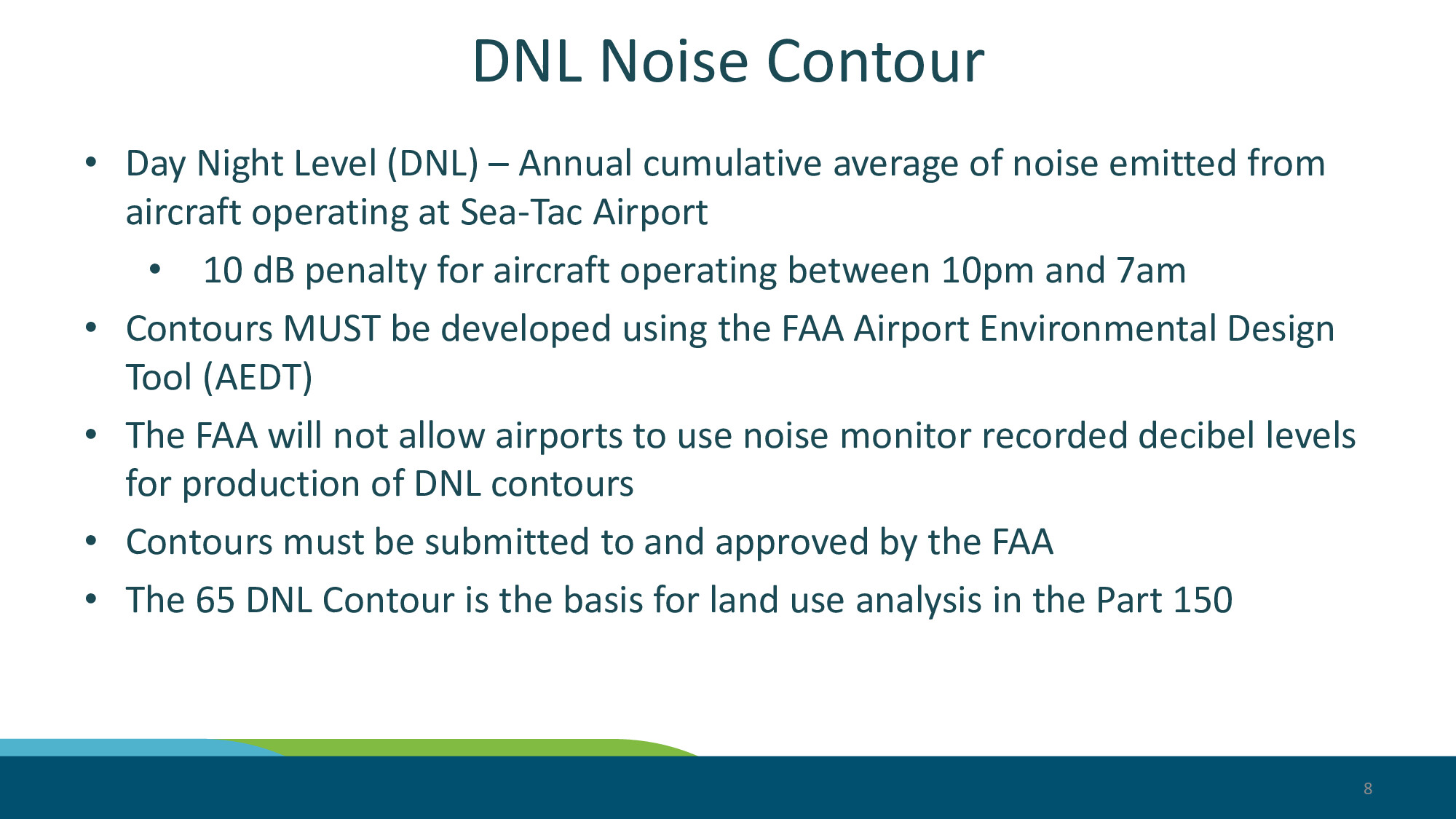
SHEPARD: Okay. So we’re going to start talking about that noise contour, and how it’s depicted — what we call a DNL, day-night noise level. It’s a noise metric that’s pretty common in the aviation industry, and required by the FAA in evaluating our noise programs and determining a boundary and eligibility. DNL is an annual cumulative metric with a 10-decibel penalty for aircraft operating during nighttime hours, when people are home for the most part and it’s quieter. The FAA plot applies that penalty for every aircraft that flies over; it’s required to be calculated through the Airport Environmental Design Tool, which contains an extensive database of aircraft noise levels for each aircraft type. The 65 number is significant — that’s the area the FAA allows for mitigation.
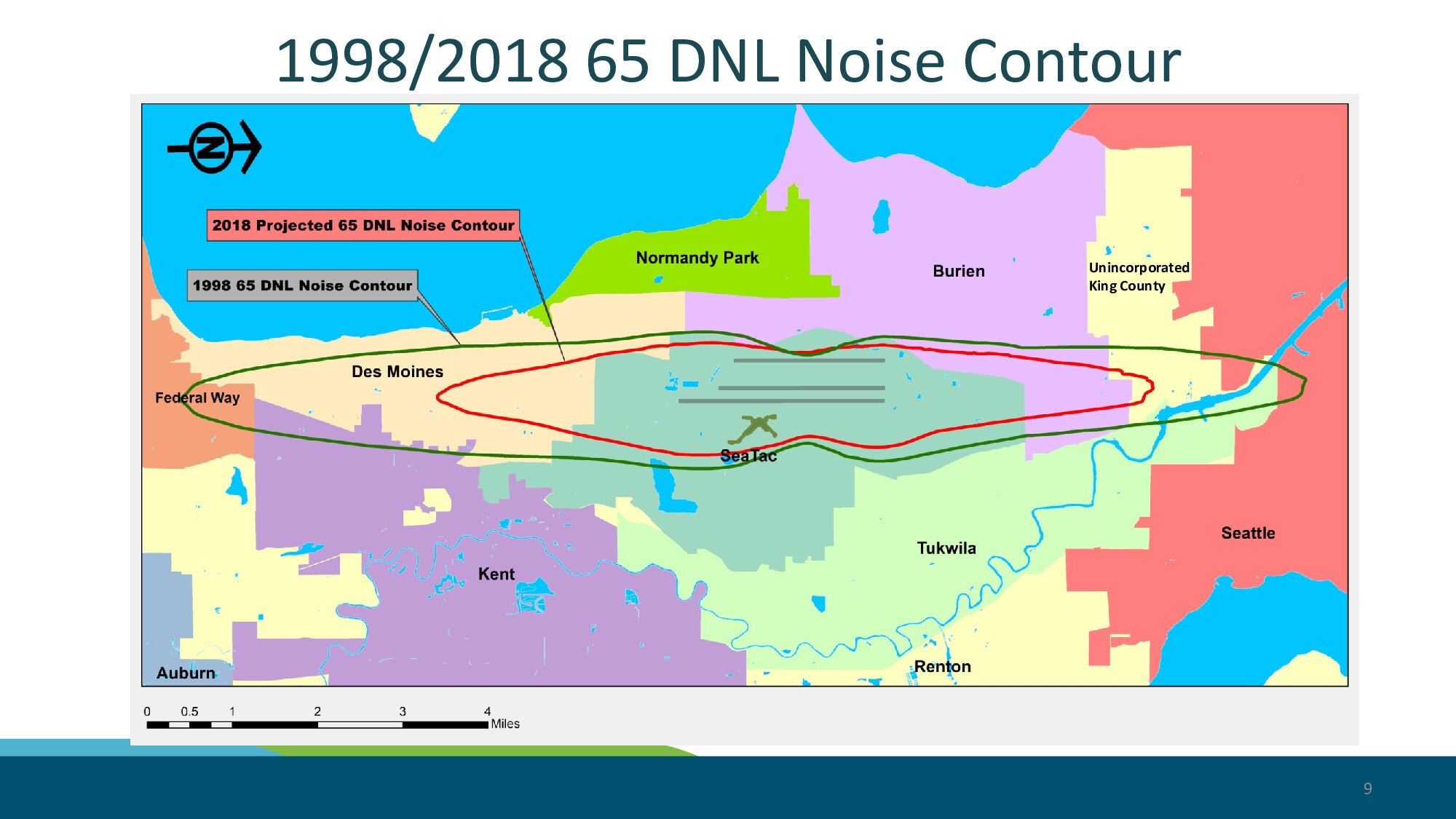
This shows the contours — I put up two different contours to show the difference between the 1998 timeframe and the 2018 timeframe. In 1998 we had a lot of noisier, louder aircraft out there — like the 727 and older 737s and 747s — so that’s a very large contour. The one closest in, the red one, is the 2018 projection from our last Part 150 — you can see a lot of those aircraft were taken out of service, so it’s become smaller, thus quieter.
FELLEMAN: This is back to Commissioner — the memo says approximately 10,000 homes were considered potentially eligible in 1985, but only 9,400 were completed — that 600-home delta — what happened to those when the new noise contour came into being in 2014?
SHEPARD: We’re down to about a thousand left within that red contour that are eligible at this point.
FELLEMAN: No, I’m asking about the larger 1985 set — I don’t know how many didn’t choose to participate.
PURCELL: Well, your memo says 600 weren’t done —
FELLEMAN: It could be about 600 — but my question is, what happened, are they still eligible?
PURCELL: No, they are not.
FELLEMAN: They’re outside — between the green area and the red area — no longer eligible according to whom?
PURCELL: The FAA.
FELLEMAN: Yes, but — I want to make sure we’re on the same page — you mean they wouldn’t be eligible for FAA reimbursement of grant funds?
PURCELL: Correct — we could not use FAA grant dollars on that program.
FELLEMAN: If any homes are outside — got it, okay, thank you.
[commissioner, likely Bowman]: Further clarification — the 600 homes she’s trying to identify — obviously not everybody in the zone asked to be insulated, and that’s — do you have a sense of those 600, how many were eligible and desired?
SHEPARD: Well, I’ll put it this way — we’ve been sound insulating out there since 1985, sending applications, identifying everybody eligible. They’ve done door-knocking on numerous occasions over the years trying to get those people to participate, and they have not. There are a lot of reasons people don’t want to participate — personal reasons, whatever. What we’re finding now is a lot of those homes are turning over to new homeowners who are willing to participate, so we’re getting those homes in a little at a time, and we’re still doing outreach — probably twice a year — to homeowners who haven’t participated yet.
BOWMAN: So do we have documentation that we actually touched all the homes that were eligible during that interval, and the amount of folks who actually responded and desired it?
SHEPARD: We do have some documentation.
BOWMAN: It would be good to know — it’s obviously going to be a smaller number than 600, but if they raised their hand and we didn’t get to it, it’d be great to know how big that number is.
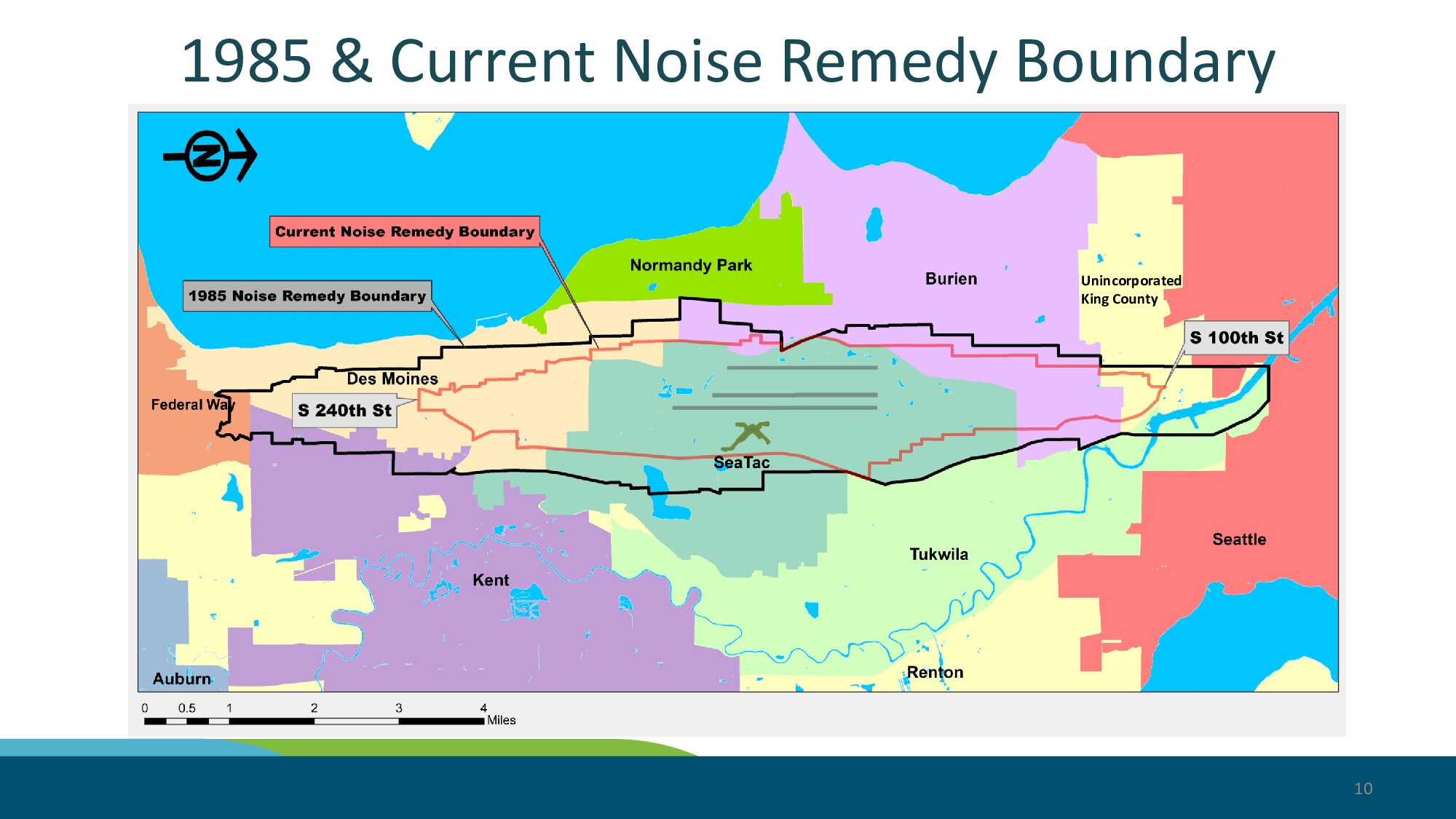
SHEPARD: Okay. [continuing] If you look at the contour before, this is almost identical — this is what we call the noise remedy boundary, and it’s got jagged lines because we take the noise contour and account for natural boundaries — streets, cul-de-sacs, communities, parks — to be more inclusive. This is the area the FAA allows us to do that mitigation in. The big boundary is based on 1985; when we went through our last Part 150 study the FAA required us to reduce that to match the contour, so you’ll see the smaller one, the red one, inside.
FELLEMAN: Stan, may I ask — can we be really accurate when referring to what the FAA “allows”? They allow us to get grant reimbursement — we can go in and do whatever we want with our own money, but if we want grant reimbursement we need to follow their rules.
SHEPARD: Yeah — as long as it’s not airport revenues, which is also regulated.
FELLEMAN: Thank you.
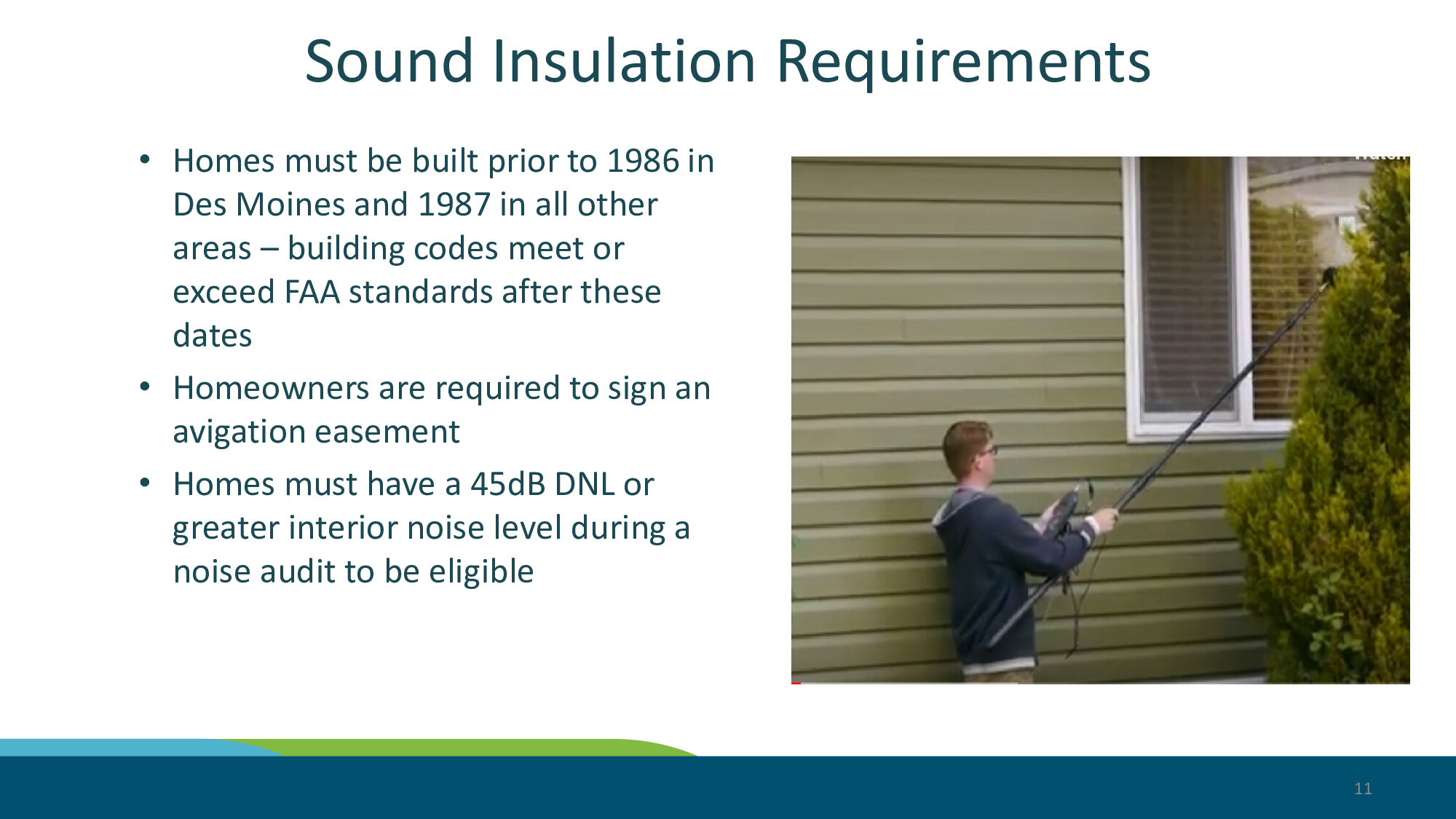
SHEPARD: Yep. So here’s the sound insulation requirements we had this question on earlier — for one thing, it has to be inclusive to that boundary. And homes built in Des Moines in 1986, or 1987 elsewhere, are not eligible, because that’s when communities enacted building codes that met or exceeded the FAA’s noise reduction requirements. It also requires homeowners to sign a navigation easement — that gives the Port air rights over the property, required by state law and encouraged by the FAA, and it gives the Port an asset in exchange, since we can’t just give something away.
[commissioner]: So it’s one thing to have the air rights, but let’s say all of a sudden we wanted planes to fly a couple thousand feet lower — are the air rights the same?
SHEPARD: The air rights are the same, but there’s a DNL number located in that avigation easement, and if there’s — I believe — a 1.5 DNL change on that number, there could be some questioning on it.
[commissioner]: Okay, so there is a threshold — it’s not just unlimited?
SHEPARD: Correct.
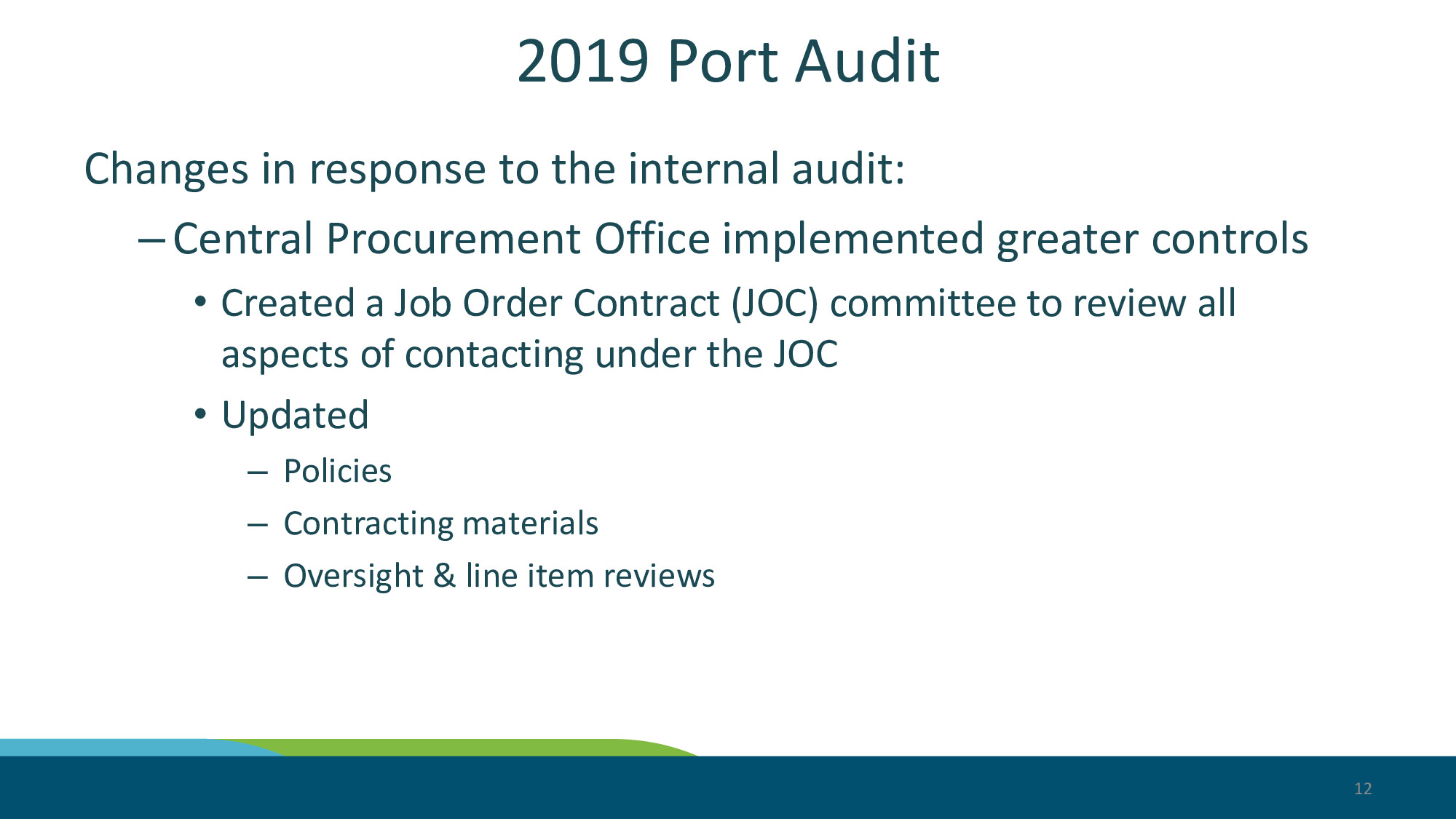
In 2019, as most of you are aware, the Port went through a noise audit of the noise programs internally, reviewing the sound insulation programs under the first job order contract, and it identified some areas of concern regarding contracting. After that, additional controls were put in place by the Central Procurement Office, including additional reviews of contracting, an oversight committee of cross-divisional staff, and controls on allowable line-item pricing. So a lot more controls were put in place for job order contracting with these programs; CPO is still the lead department managing the JOC.
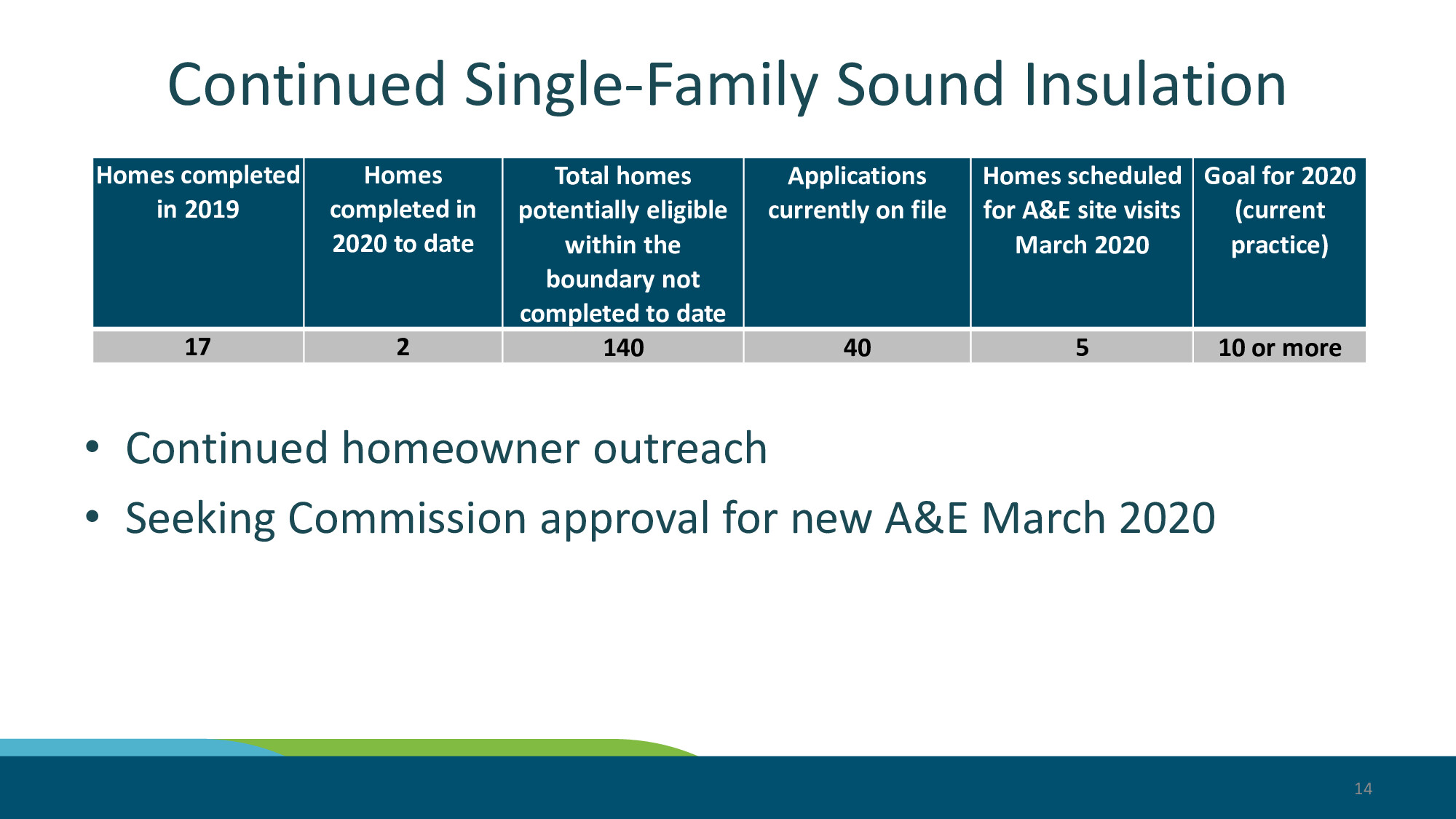
Now I’ll transition to our ongoing sound insulation programs. This chart gives an overview of the single-family sound insulation program — we completed 17 homes in 2019, two completed to date this year, 140 remain potentially eligible based on all the criteria, and we’re working through 40 additional applications to determine eligibility. We have a goal to complete at least 10 or more this year, and we’ll come back to commission next month for approval of an A&E contract to continue.
[commissioner]: Are the addresses of those places publicly knowable?
SHEPARD: They’re in our office, so they’re public documents.
[commissioner]: All right, so if we’re not cross-checking for JC, he could do so.
[commissioner]: May I ask a quick question — 17 in 2019 — how does staff determine which homes they’re going to retrofit?
SHEPARD: We take the applications that come into the office, and as they come in, we turn them over to consultants, who go out to the home and do noise testing to determine eligibility. It’s a first-come, first-served basis right now.
[commissioner]: And how long does that process take, from application to completion?
SHEPARD: It can take six to nine months, sometimes, because we have to make sure they’re in the contracting phase — one of the harder issues is requiring them to get a subordination agreement. If we’re going to put a navigation easement on a property with a mortgage, and we don’t get a subordination agreement from the lender, we risk losing that easement if the property goes into bankruptcy or default. So they’re required to get that agreement with the lender, which takes an enormous amount of time.
[commissioner]: And probably most homes have mortgages.
SHEPARD: Most homes have mortgages — that’s one of the biggest challenges we have right now.
[commissioner]: Can we just put a pin in that issue? I’d love to understand if there’s any way to help homeowners get through that process more quickly.
SHEPARD: Yeah, we’re definitely — that sounds like a big stumbling block.
[commissioner]: Did Sam have a question? Okay — continue.
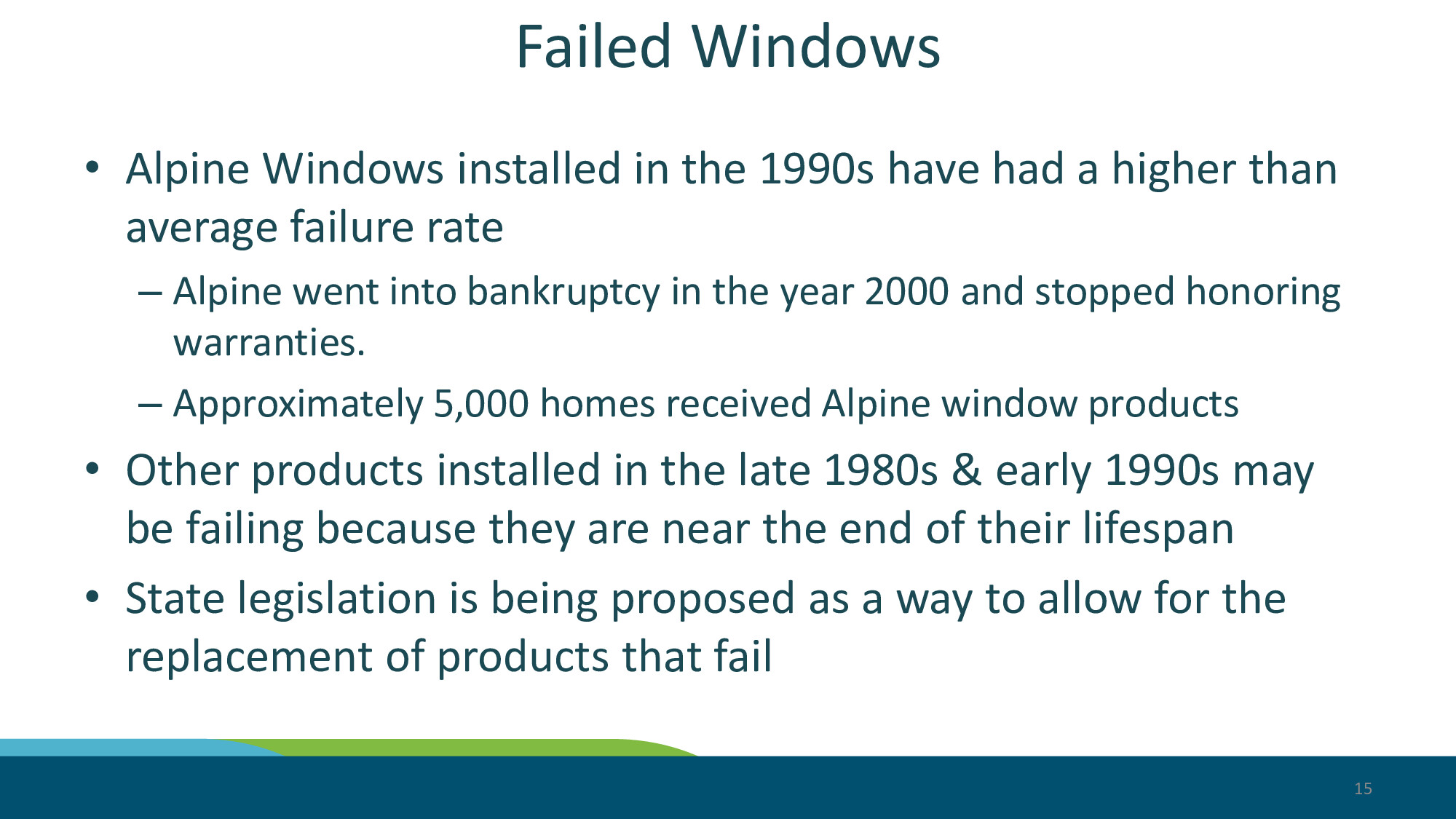
SHEPARD: The other thing we want to touch on is failed windows. There are two potential issues here. We know a manufacturer used in the 1990s, called Alpine Windows, had a higher-than-normal failure rate. Alpine went into bankruptcy around 2000 and stopped honoring warranties, and there are about 5,000 homes out there with those windows. We also know homes from 1985 through the 1990s are getting old and may be hitting the lifespan of those products too.
What typically identifies a failure is interior seals warping between the frames, rails not working, or fogging of the windows. There’s state legislation currently proposed to allow the Port to undertake replacement of those products, and my understanding is that’s now in the Senate Rules Committee.
[commissioner]: Since FAA is funding much of this, why do we need state approval for replacement?
SHEPARD: The state approval gives us the ability to go into a parcel one time — it’s specifically stated within the state codes, so we’re trying to get that changed too.
[commissioner]: It just seems to me I don’t understand why they have jurisdiction over this — they’re not paying for it, the state’s not paying for it.
PURCELL: The state charters the Port and gives us our ability to do the work we do, and it also outlines all the noise programs. But the idea is it’s not the FAA that would fund the replacement, it would be us — the state is saying it’s your obligation to fix this even if you don’t get FAA funding. The proposed legislation would give us the authority to conduct it, and we’d need to do it with our own funding.
[commissioner]: And how many of these homes — do we know how many are part of the 1985 contour versus the 2014 contour?
SHEPARD: I don’t know that, actually.
[commissioner]: That would be great information to have. So it seems there’s something distinct about failure — one is lifespan, the other is a defect. It wasn’t a failure of ours that this company had bad seals — so the FAA doesn’t have any acknowledgment of that? Single-pane glass will last longer, right, but we know this has a finite lifetime — but if one is clearly shown defective, FAA can’t come back and help sponsor reimbursement?
SHEPARD: The FAA has not been able to do that. In fact there’s a lot of discussion at the national level on this — not just a bad manufacturer, but products around the country put in during the ’80s and ’90s that are getting past their lifespan too. There’s a lot of discussion nationally with other airports and the FAA to see if there’s a solution.
[commissioner]: Is there any way to tell whether some of the problem was actually the installation itself, versus the window?
SHEPARD: I haven’t seen a bad installation that caused a window to fail. I have seen one bad installation we found and were able to go in and fix. We’ve audited for installation as well as product quality.
PURCELL: Yeah, I think installation, from what I’ve seen, has been fairly decent — we have great contractors now. From what I saw going back and looking at some of those ’90s installations, I haven’t seen a lot of failures on the installation side; there was a lot of product failure in the early ’80s because of the relative newness of insulated glass applications, when the energy code went into place — pretty widespread and fairly easy to detect, but installation doesn’t really affect the unit glazing or seals.
SHEPARD: Back in the early 1980s there was a concept of putting a storm window on the interior of the house, which was bad — we had to go back in and remove those because it became an egress issue. That’s how they started to figure out these products, until the newer STC-rated windows came along.
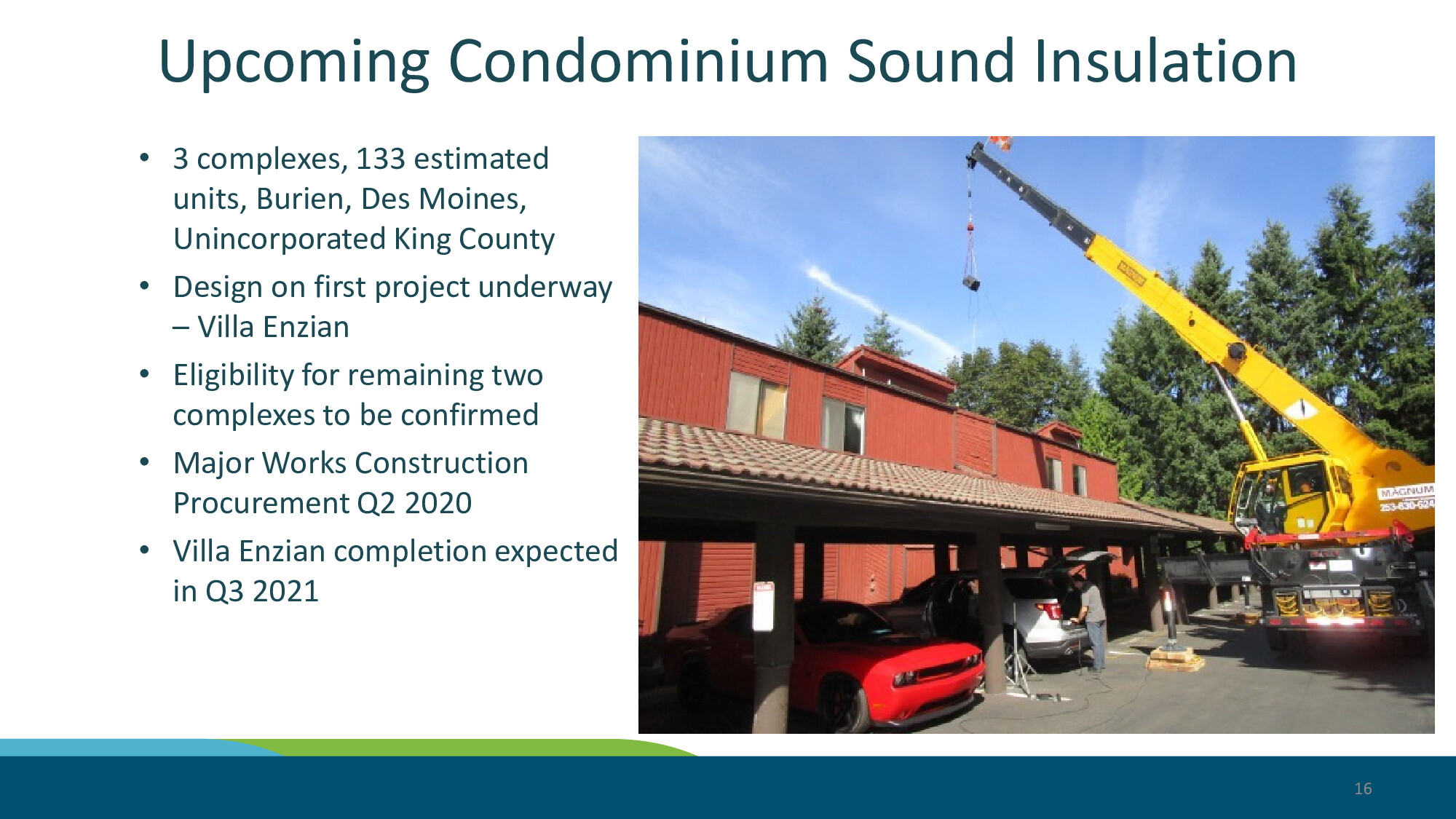
So, upcoming, we have condominium complexes in the program — one is called Villa Encanto (?), south of the airport. This is a picture of us trying to sound-audit this building — we had to haul a big speaker up on top to see where the intrusion was coming from, from the upper portion. Three complexes are in that program — we’re doing the first one, with a couple more coming, and we’ll come back to commission for another procurement for major works in Q3.
[commissioner]: Does this include attic insulation? I didn’t see that listed.
SHEPARD: No, it doesn’t — that isn’t typically an area that provides significant noise reduction. The areas that provide reduction are windows, doors, chimneys — the thinner portions of the house.
[commissioner]: So what’s the speaker doing on this one?
SHEPARD: There are skylights and some upper windows up there, so —
[commissioner]: Does it pay for energy efficiency?
SHEPARD: No.
[commissioner]: I’m just saying, though, we don’t get FAA funding to replace the best source of improving insulation.
SHEPARD: Right.
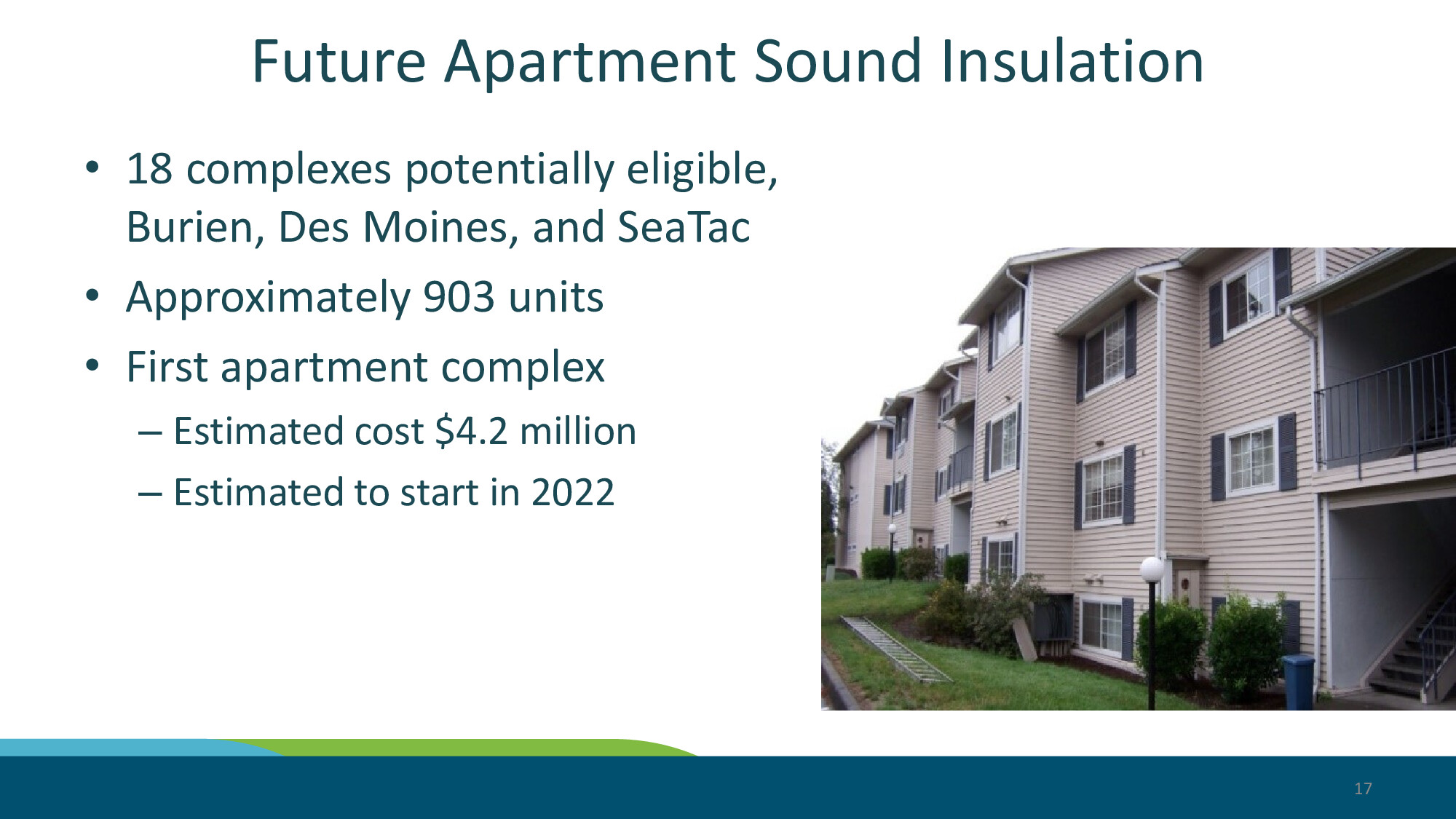
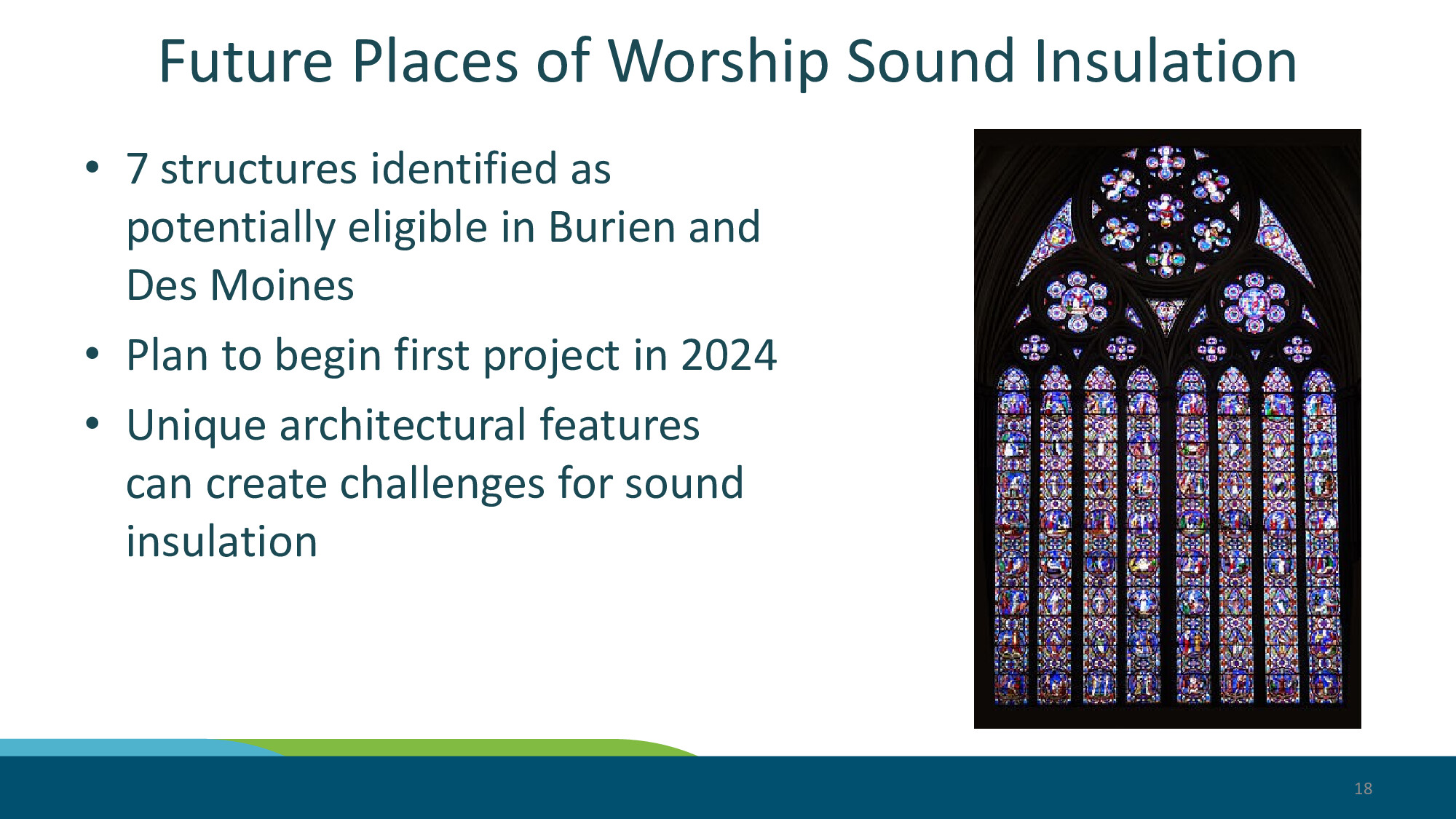
Apartment sound insulation is another outcome of the Part 150 — 18 potentially eligible complexes, across all jurisdictions surrounding the airport, about 903 units. Our estimated start is 2022 under the current CIP plan. We also have places of worship, expected to begin in 2024, with seven structures — that presents some very unique challenges; not to say it hasn’t been done — there are architectural and acoustic consultants around the country who’ve done this for other airports. I put up a window as an example of how you’d cover that kind of window with acoustic-grade glazing to get noise reduction.
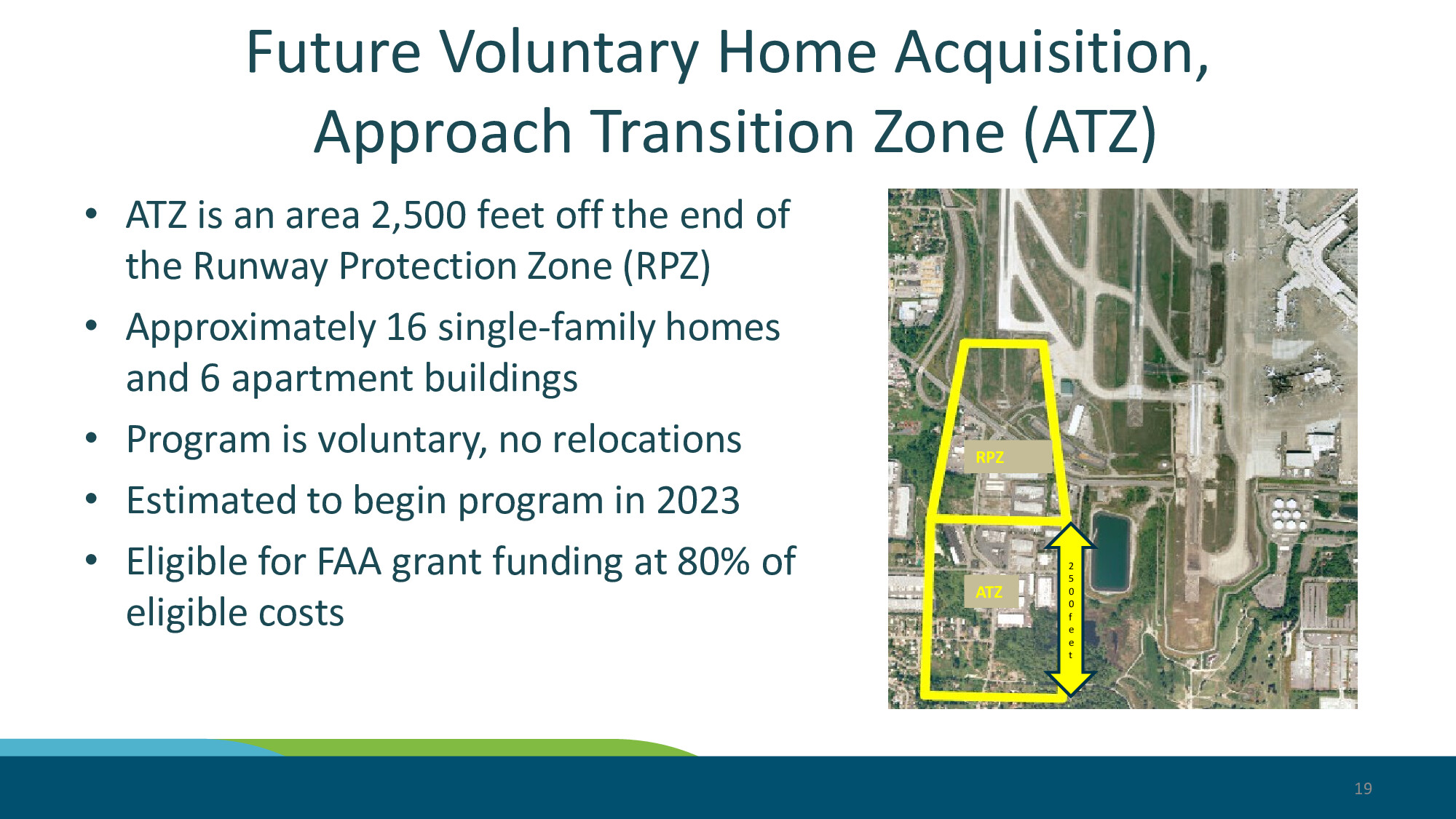
Another is the approach transition zone, about 2,500 feet past the runway protection zone — we had the same thing at the north end of the airport, where we completed purchase of homes around 2009. This is proposed to be a voluntary acquisition area south of the Third Runway, approximately 16 single-family homes and six apartment buildings, planned to begin around 2023.
[commissioner]: Can you just clarify — no relocations?
SHEPARD: If it’s a voluntary acquisition plan, this would help people get out of the area if they wanted to — it wouldn’t be a paid relocation program, we’d just be purchasing their homes.
[commissioner]: But this policy has always been in place — since the Third Runway, people could ask to be bought out in that zone?
SHEPARD: Not in the south approach transition zone — we hadn’t moved forward with this project; there were a lot of questions related to the SR-509 right-of-way, the WSDOT area that goes through that center portion, where they were purchasing land — we were understanding what the area would look like once they’d finished.
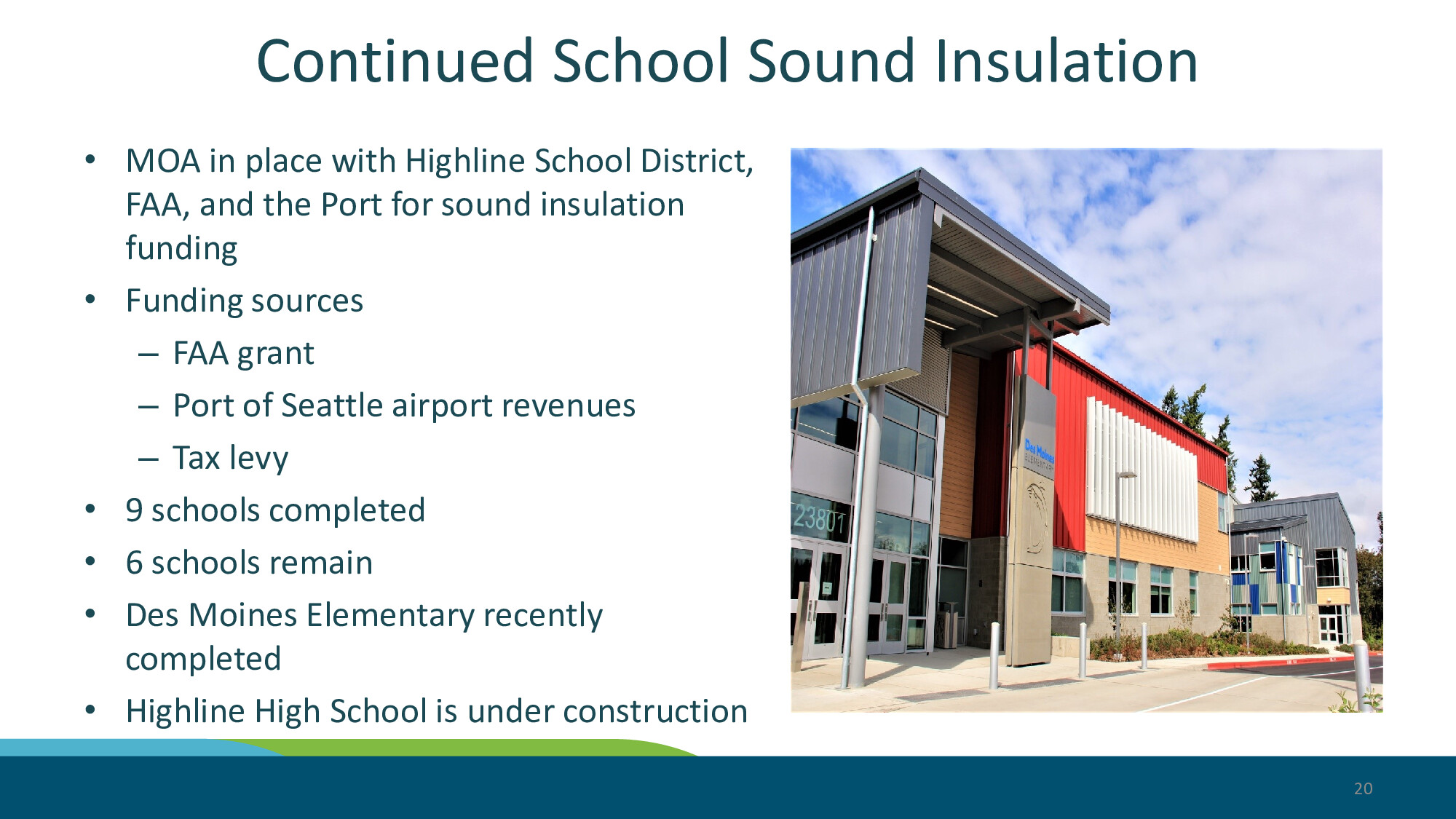
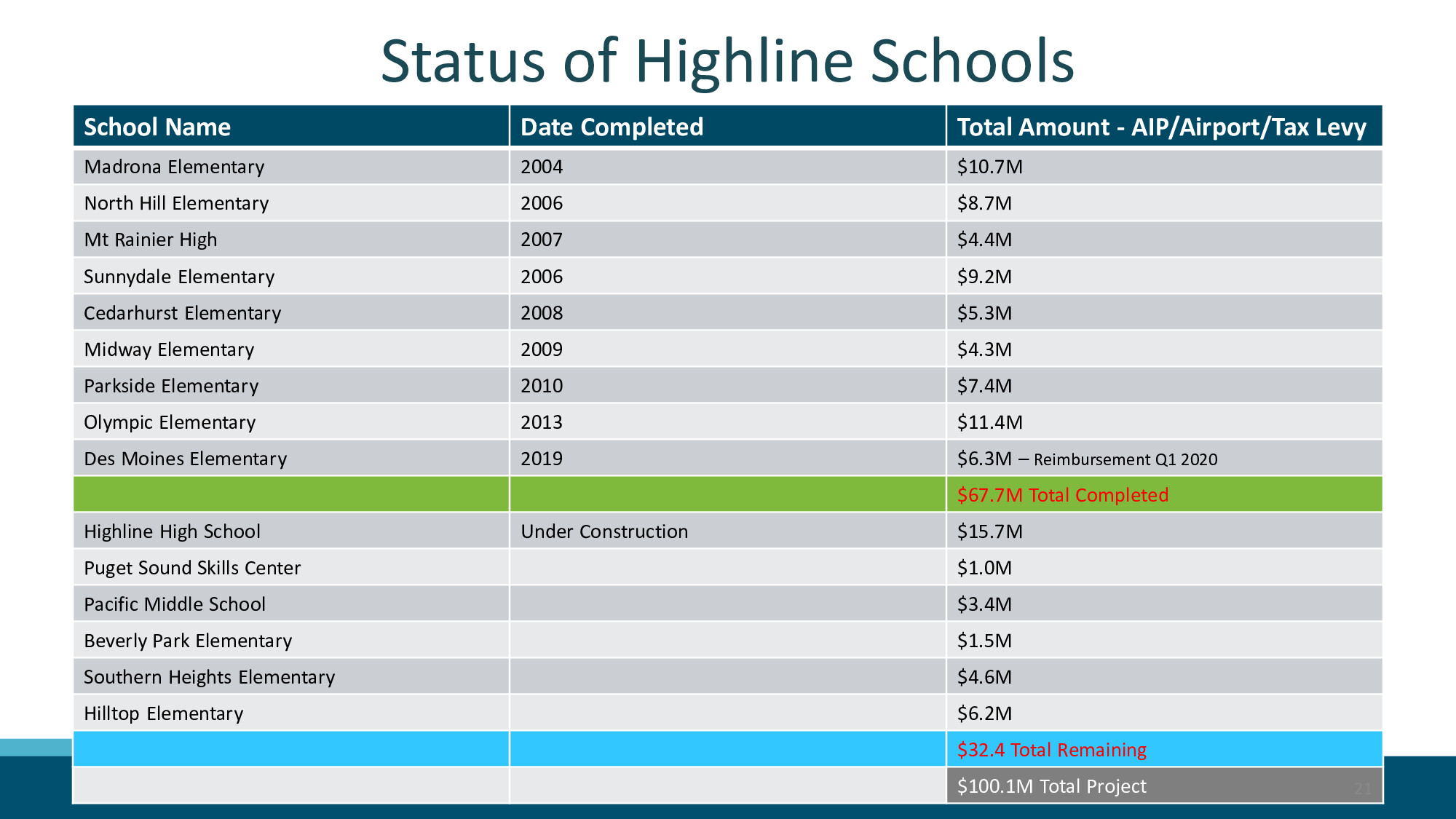
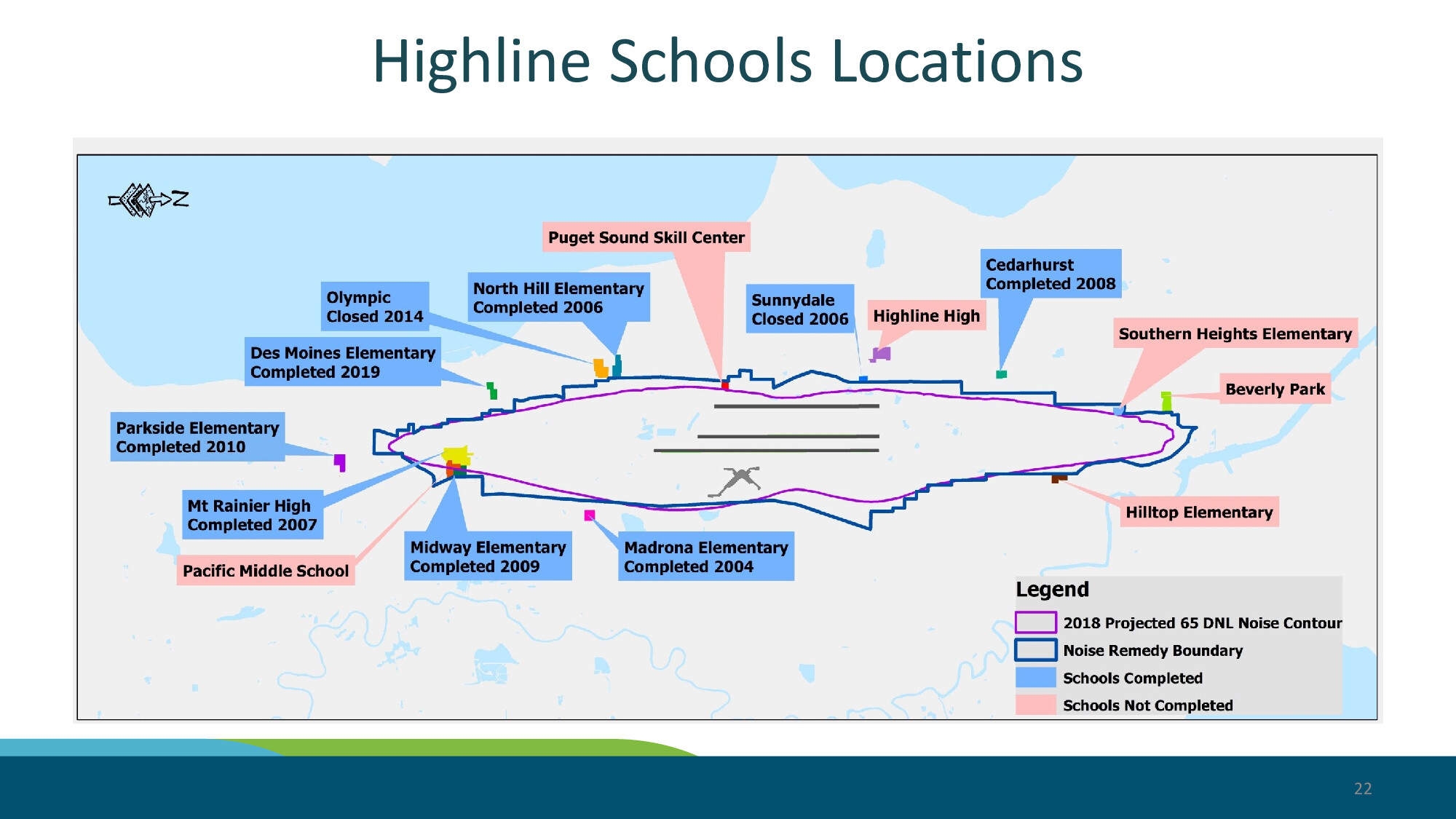
The Highline school insulation program has a memorandum of agreement signed in 2002 to help fund reconstruction of schools impacted by noise — a $100 million agreement between the Port and the FAA, a combination of FAA grant, Port of Seattle airport revenues, and it’s the one source of tax levy funding the airport uses. Nine schools have been completed, six remain, and completion is really dependent on the district’s construction schedule and voter-approved bonds for each school — we’re holding until they come forward with their construction plans. The picture on the right is Des Moines Elementary, completed last year, and we’re now working on Highline High School, under construction.
This is a list of schools completed, with those remaining below the green line — about $32 million remaining.
[commissioner]: Is there a prioritization of the remaining schools, given they’re dependent on the district’s construction schedule?
SHEPARD: What they prioritize goes through their school board and is brought forward to us.
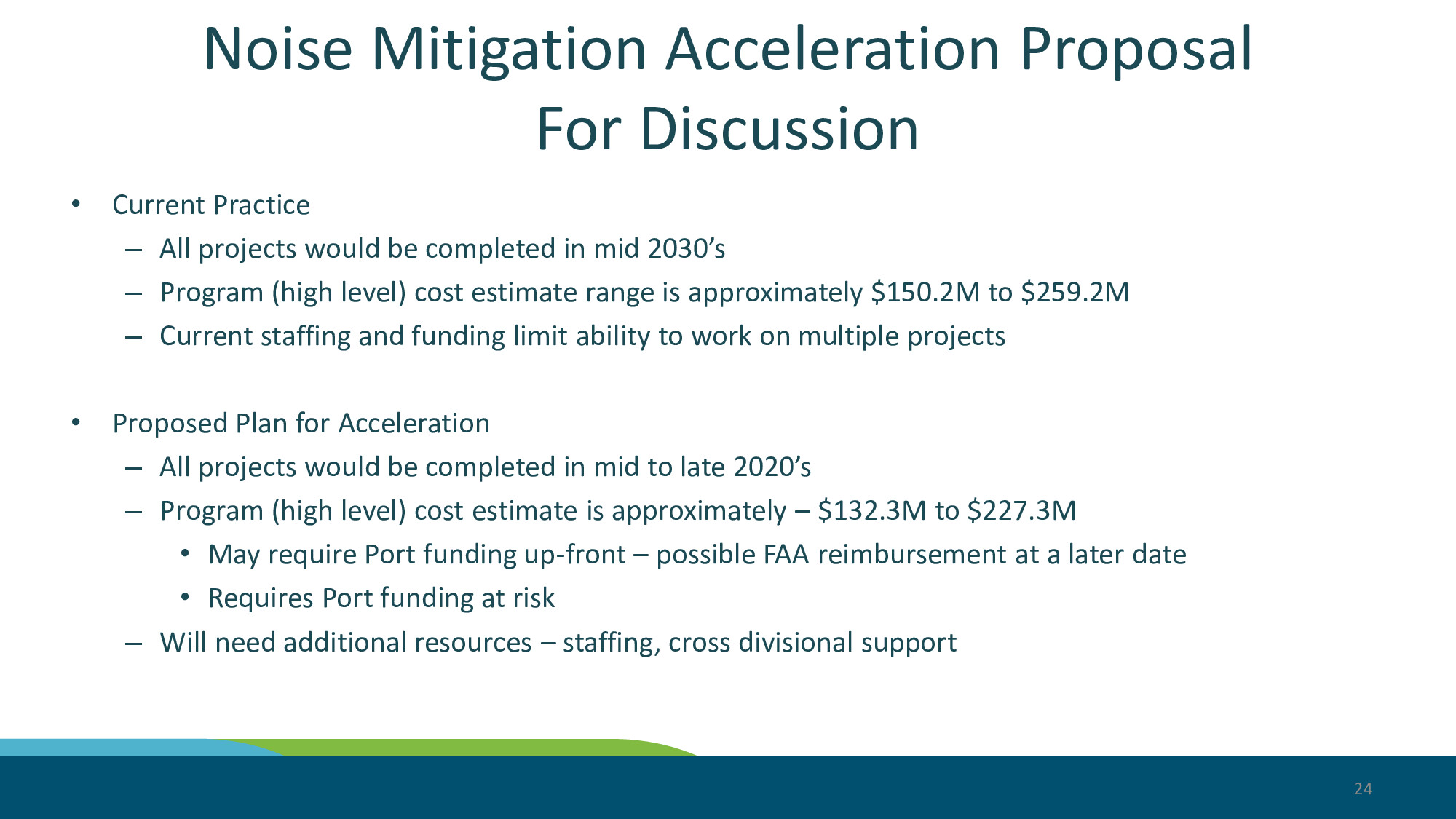
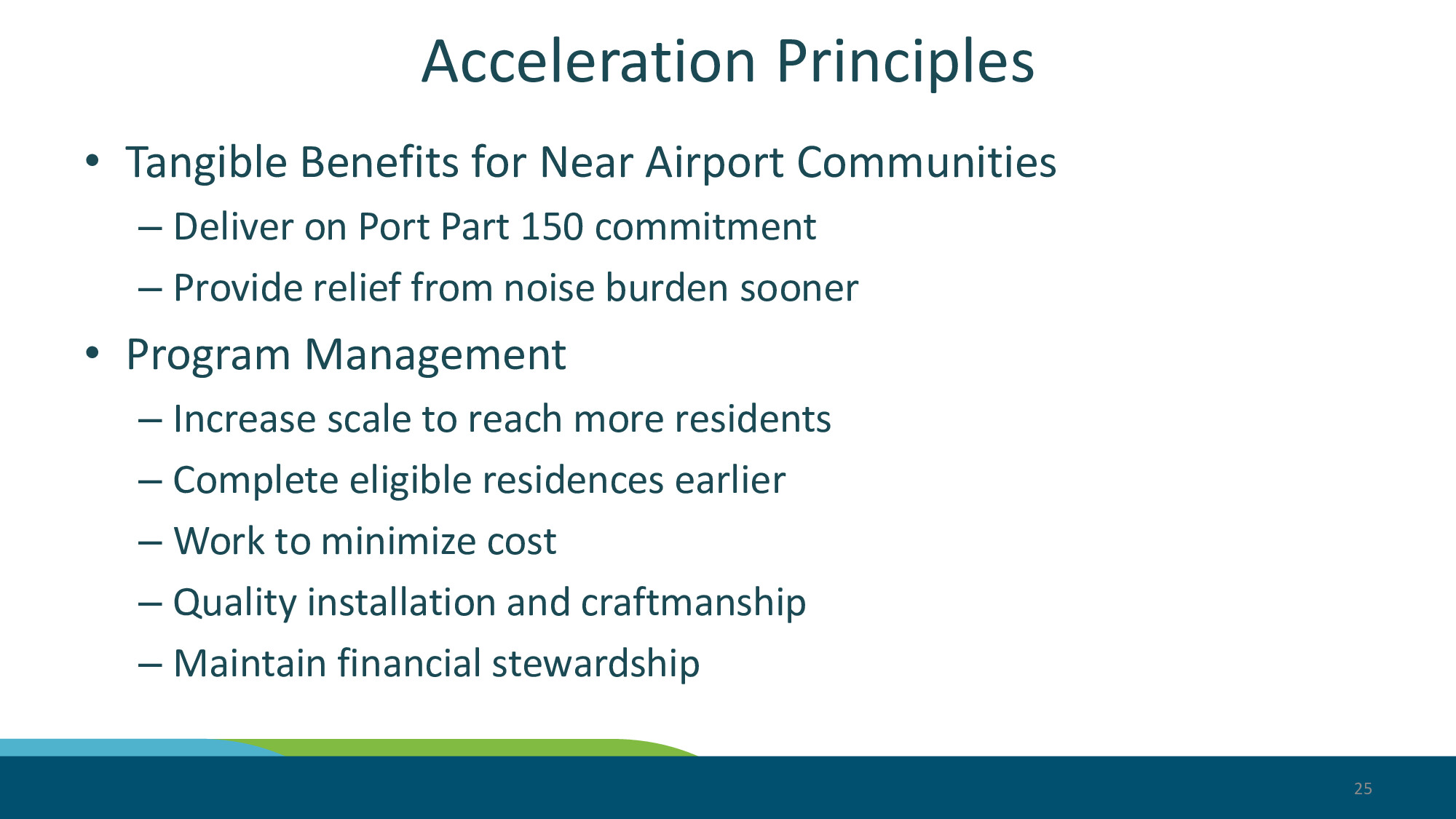
Now we’ll transition into talking about acceleration and how we can accomplish it. There’s the current practice, getting all our programs done under the current CIP plan in the mid-2030s, and a proposed accelerated plan condensing that down to completion in the 2026–2027 range. The goal of acceleration is delivering on our Part 150 commitments as quickly as possible, increasing the installation rate to get everything done sooner, without compromising cost or quality.
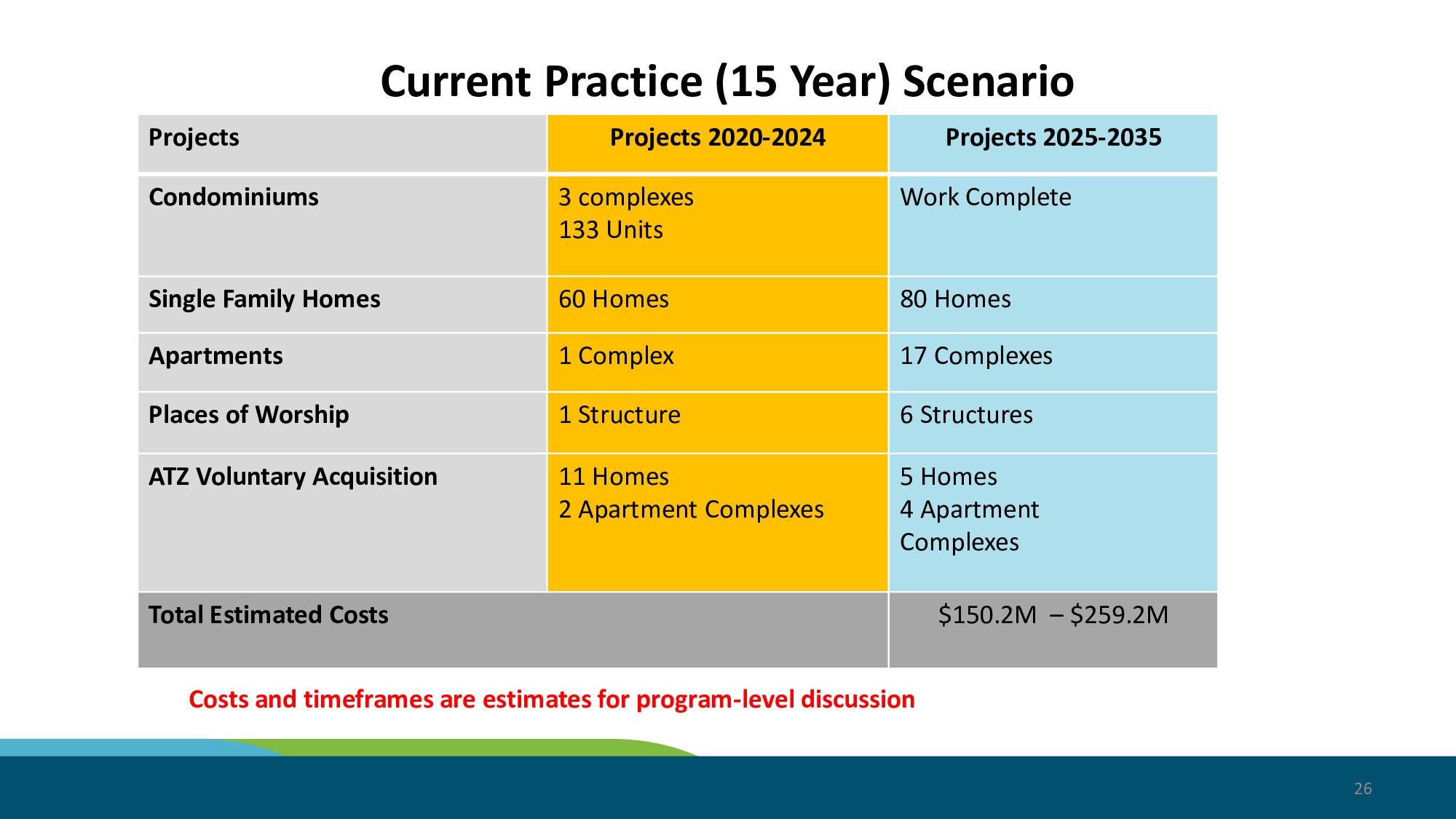
On this slide, the projects listed are everything approved in our last Part 150 and potentially eligible — under current practice, it’s going to take 15 years given schedule, staffing, and money. The yellow represents what we’re undertaking in the next four years; the blue shows the remainder through 2035 — about $150 million to $259 million range.
[commissioner]: I want to make sure we’re cognizant that this doesn’t include the potentially 5,000 homes with failed windows.
SHEPARD: The failed windows aren’t in this — as we get further into the presentation about how we might address that, I want to make sure we’re considering it.
[commissioner]: Okay. And this cost — is that our cost, or is 20 percent of that our cost?
SHEPARD: That’s a good point — this takes into account that the FAA will most likely fund this plan, based on our CIP plan presented to the FAA. About 80 percent of that cost is FAA grant-funded, 20 percent our cost.
[commissioner]: Okay, it would be good to show that this number is only 20 percent of that —
[commissioner]: I just think that number should be shown as the 20 percent — so it’s 52 million that would be essentially our obligation if we continue with current funding.
SHEPARD: Right, about 30 million to about 52 million — I used the high number.
[commissioner]: Sure — that total estimated cost range is before FAA reimbursement.
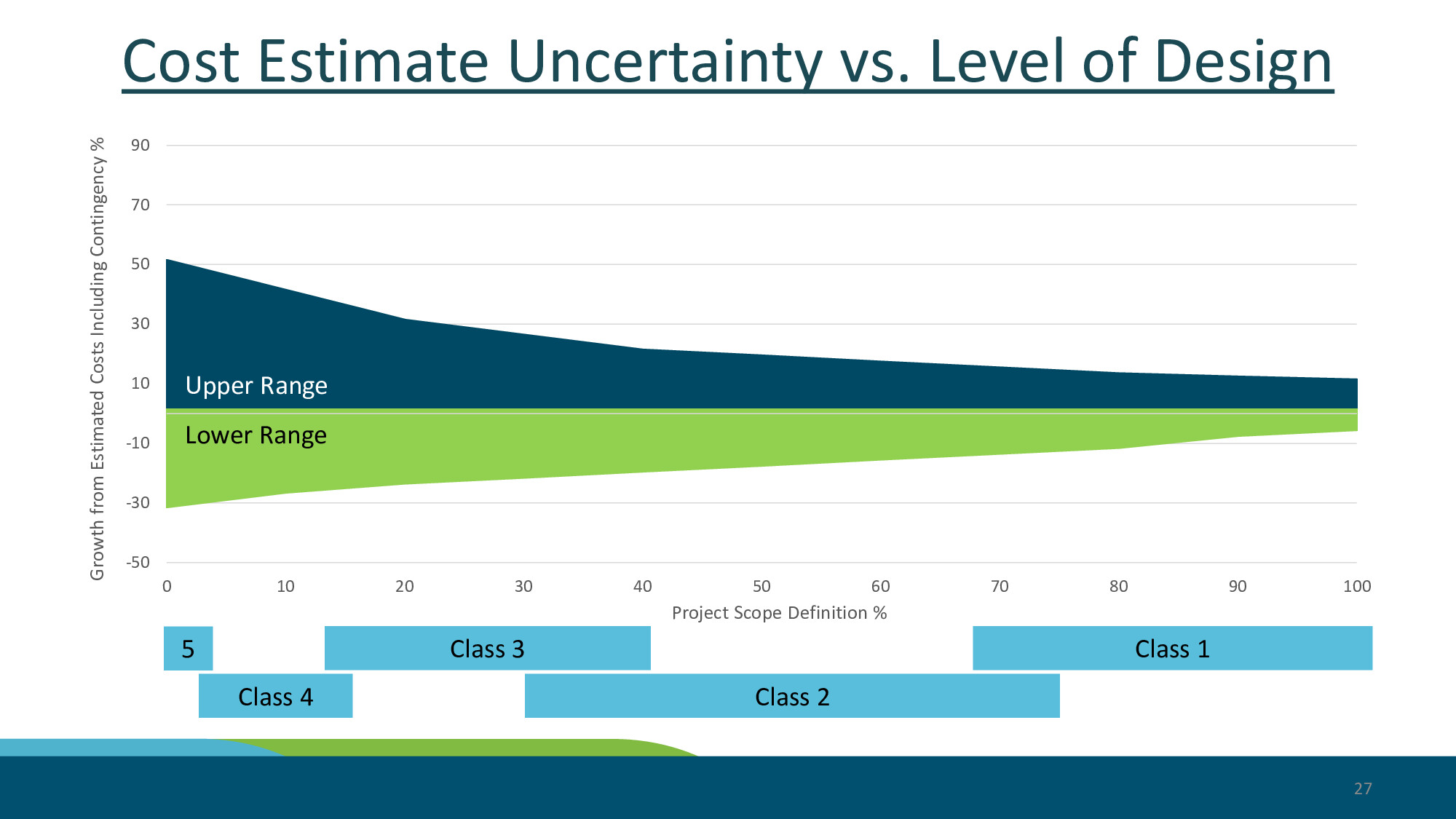
SHEPARD: Yep. Just to show you the uncertainty — we’re at what we call Class 5 estimating, the very left end, since we haven’t gotten into any of these buildings yet and don’t know exact cost estimates, so it’s a huge range.
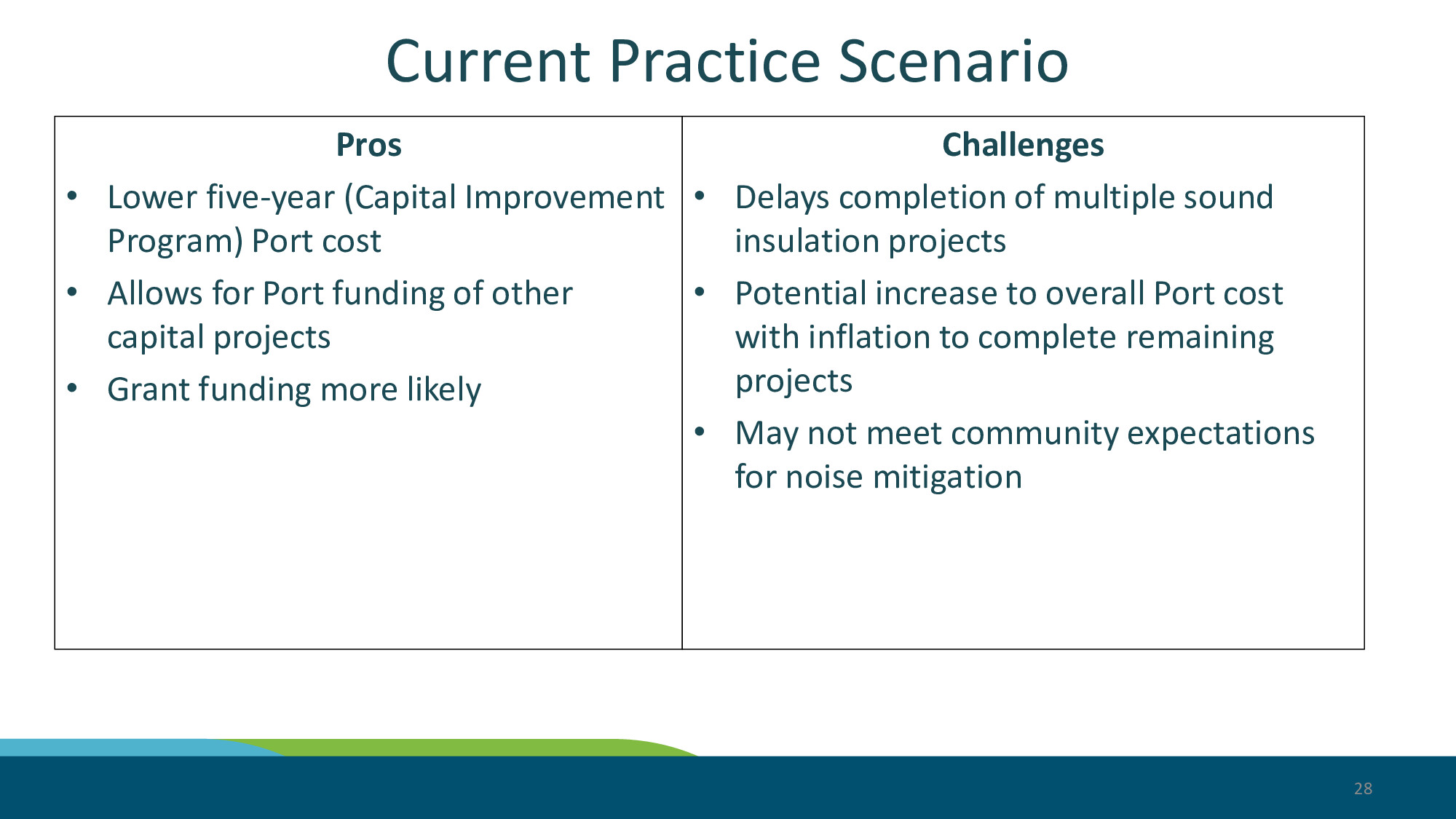
The current-practice scenario plays within the current five-year funding plan — it doesn’t take away funding from other capital projects, and grant funding is more likely with this scenario. The downside: it’s going to take us a long time to get it done.
[commissioner, likely Bowman]: Can we stick on this a moment — this, for me, is really important, that we’re clear about what we’re trying to accomplish, and for me it’s getting the most homes done in the quickest time, most cost-effectively. I hope we can come to some resolution about what exactly we’re trying to achieve, because that influences what the pros and cons are. For me, the idea that a “pro” is a lower five-year CIP is not a pro — if what we’re trying to accomplish is more homes, more quickly, more cost-effectively, then that’s not a pro. Steve, I hope you and Lance can come to, with commission direction, a really clear outcome we’re trying to achieve.
METRUCK: Well, grant funding is an issue there on the pro side.
BOWMAN: It is — I’m not calling that out, I’m just saying, for me, those are the outcomes we’re trying to achieve, but we need to compare it against something. So it sounds like this is about a million and a half bucks a year out of our pocket in the 2035 timeframe.
SHEPARD: Yeah, with the 20 percent, it’s about a million and a half dollars a year.
BOWMAN: So whatever we’re going to do has to be relative to what this scenario would cost us.
SHEPARD: Yep.
[commissioner]: Commissioner Bowman, going back to your goals on slide 25, it does talk about the principles — I think your principles are included there, just — I understand what you’re saying about calling those out, that as we go forward making decisions we need to keep those front and center.
BOWMAN: Yeah — back to that slide, it’s sort of, we’ve buried the lede — it’s “provide relief from noise burden sooner” — that needs to be at the top, that’s what we’re trying to accomplish, and these are the ways we do that. So I just want to be really clear about what the outcomes are here.
[commissioner]: One more thing, I guess, to underscore the point — we’re behind schedule, so this desire to “get ‘er done” is to catch up. I think that’s an important time framing.
PURCELL: So that’s the current scenario — [Stan will show] the accelerated one, showing the advantages you’re talking about, Commissioner — you’ll see that on the next slide, maybe the next two.
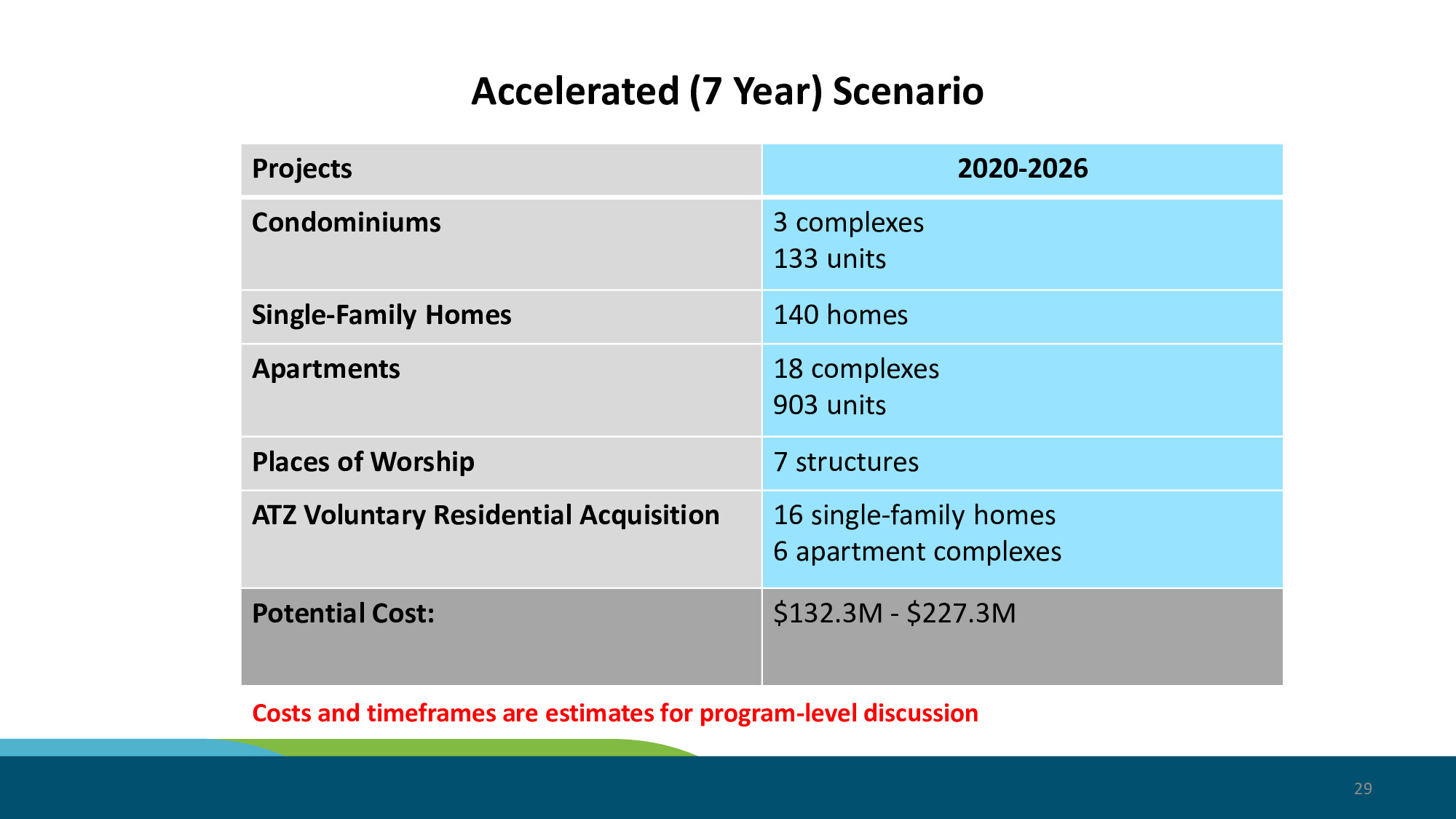
SHEPARD: All right, so let’s move to that one. The accelerated schedule takes all the programs from the other slide and condenses them into a seven-year scenario. We met with a lot of staff, program management, and looked at what’s feasible, and believe this meets that criteria. The big change you’ll see is all 18 apartment complexes, 903 units, put into that timeframe too — a lot of work condensed in. It does lower the cost a little, down to about $132 million to $227 million, based on reduced escalation over fewer years, getting everything completed within that 2026 timeframe.
BOWMAN: I’d add, in response to my earlier question, this also does not include the failed windows, in terms of timing, cost, or anything — we’d really have to figure out how to work that in.
[commissioner]: So, clarification — are we talking about the same projects being done, just done a little earlier? I didn’t understand — you mentioned this would allow us to get to something we wouldn’t have done otherwise.
SHEPARD: No — if you look at the 2020–2024 timeframe [in the prior slide], it only has one apartment complex and one place of worship. What we’re doing is taking all of that and condensing it down into the seven-year, 2026 scenario. It’s just taking all of it and making it quicker.
[commissioner]: But it saves money — which is the amazing thing.
SHEPARD: Well, it’s escalation.
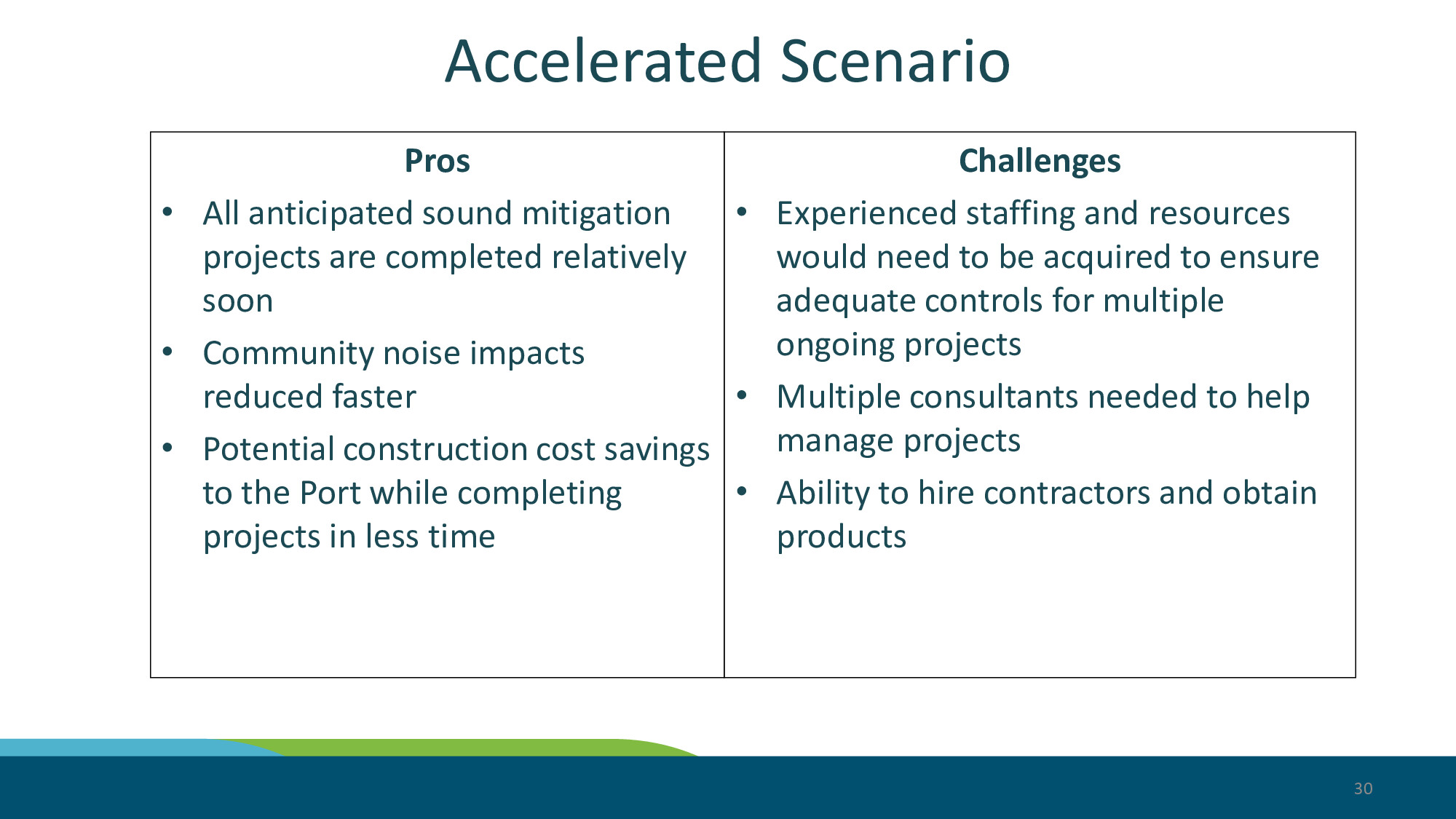
So for the accelerated schedule: getting it done quicker provides noise reduction to the community sooner, provides lower possible costs based on escalation, but will require more staffing and resources, and some dependency on the ability to hire contractors and obtain products — it may strain the industry, since we don’t have a lot of manufacturers for these STC-rated windows, so if other airports are ordering at the same time, it could strain the industry.
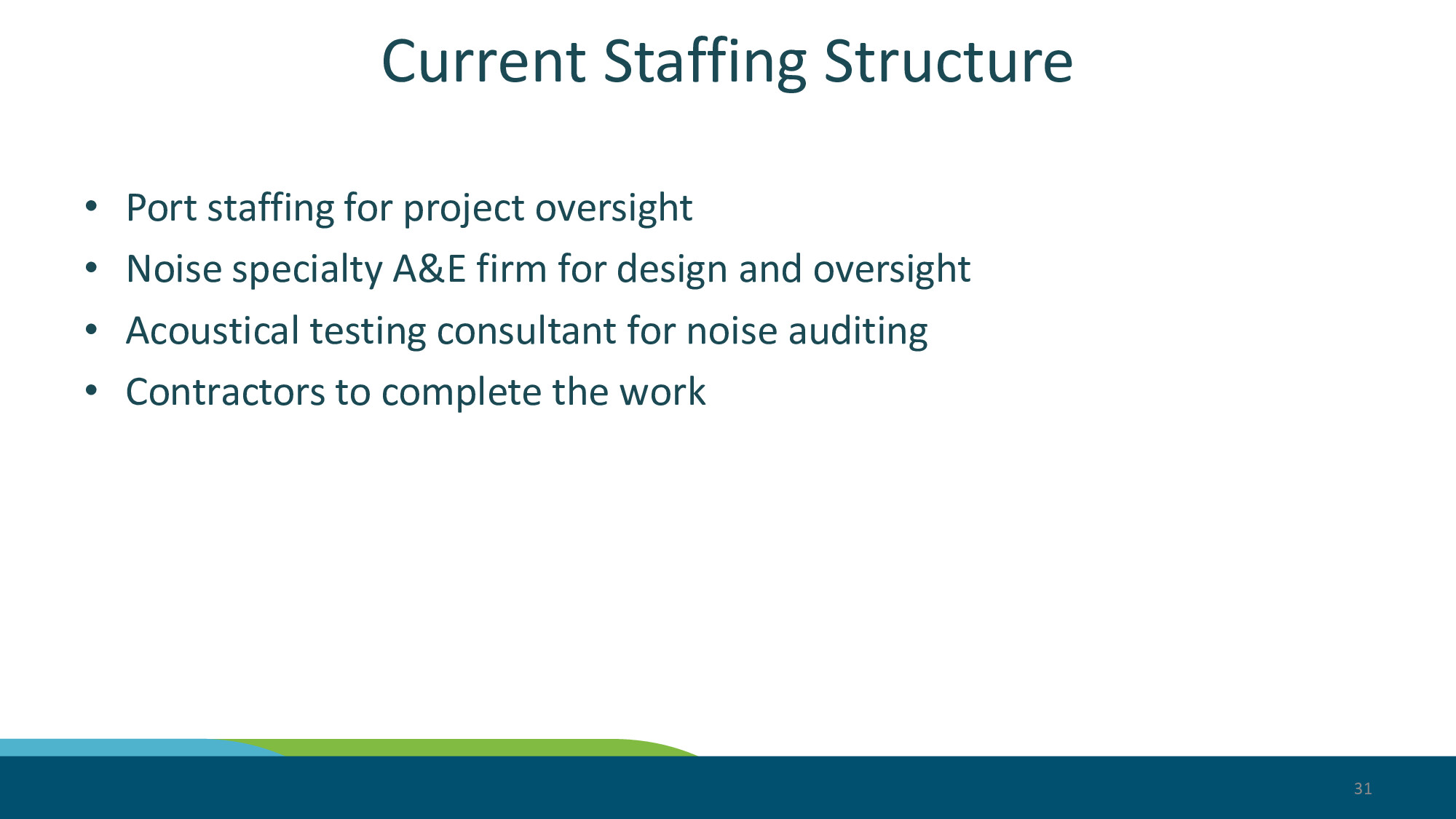
How our programs work today: Port staffing for each project and oversight — internal staff do a lot of homeowner outreach and work with them on documents, plus project management. Noise and specialty A&E firms and acoustical testing are consulted out, and contractors are contracted to complete the work.
[commissioner]: You don’t have to do this now, but could somebody send me a complete list of all the different positions and who’s doing what? I know we have a small team internally, and almost all of this is done by outside vendors, correct?
SHEPARD: Yeah.
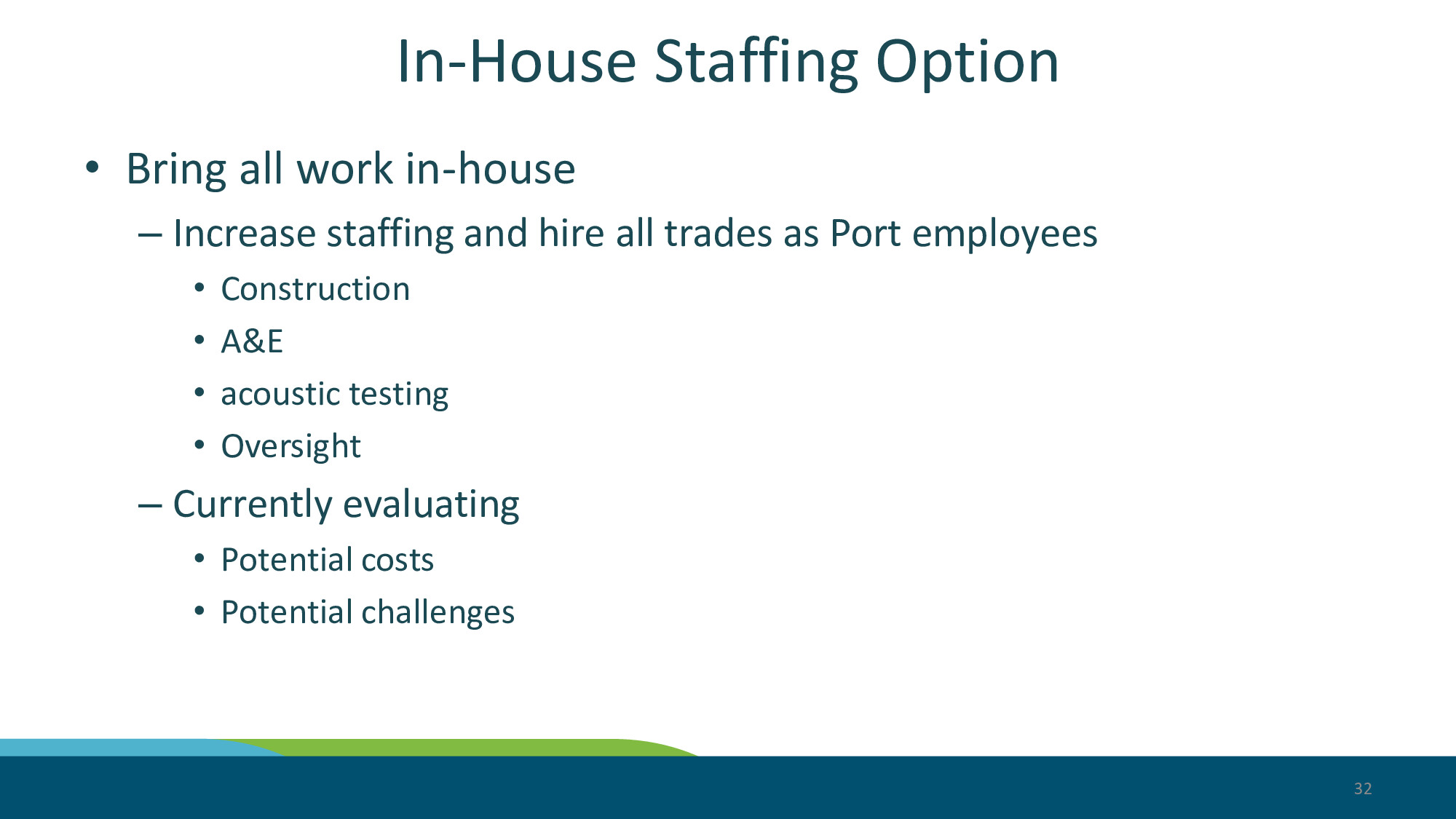
So we’ve also been asked to look at in-house staffing options — reviewing bringing all the trades in-house. Preliminary work has been done, and more will be needed; this could apply to all elements of the program, or maybe just some, with others contracted out.
BOWMAN: I wanted to be clear on this one, because it isn’t stated quite properly — I’ve been the one asking for more information about what it would look like if we brought some of this in-house. It’s not all in-house — I recognize there are certain contractors with specific skill sets we don’t need full-time at the Port, so I want to make sure we’re delineating between the two. And I also wanted to make sure, Steve, that as you continue to evaluate this, you’re looking at the 5,000 packages that failed, because the initial look was just at homes within this 15-year plan, and not the possibility we might go back and do the 5,000 — that changes the denominator considerably if that legislation passes.
FELLEMAN: And I’d also request that if this in-house option is further studied, it be studied in comparison with the acceleration plan — because if it doesn’t accelerate, why are we doing it?
[commissioner]: Yeah, we’re just looking at — going back to the principles — not in isolation, it has to be compared side by side with the acceleration plan if it’s going to be taken seriously.
SHEPARD: Yep. So we’re continuing that work, and I’ll get back to you on the 5,000 referenced houses.
[commissioner]: Are they all houses, or apparently condos too — are they all within the current DNL boundaries, or are some outside the old boundaries?
SHEPARD: Most likely some are outside.
[commissioner]: And is that a legal issue in that regard, and how does that get funded?
PURCELL: We definitely need to look into that — we don’t have a program set up for that.
[commissioner]: It would not likely be funded through any grant or state support, I’m guessing.
PURCELL: Correct.
[commissioner]: You know, one of the appealing things about the program, however it’s done, is the potential for apprenticeships — it’s the kind of work where you don’t have to be a skyscraper builder to get good jobs, and I think the potential for apprenticeship programs can be accomplished both ways — I could imagine contracts that specify a certain number of apprenticeships as a qualification to do the job. I certainly wouldn’t want to miss this opportunity for that kind of labor — and while they’re up there, they should put up solar cells, whatever, you know what I mean.
SHEPARD: Okay. [next slide] I’m not sure this slide is titled correctly — “Further Program Improvements” — it’s really about how we’re going to move forward and take a look at what we’re doing if we accelerate. We’d like to hire a consultant to evaluate and structure implementation of this program, to ensure we’re using efficient contracting methods and staffing. We’re also hoping to create more synergies with the King County Weatherization program, to work together on projects eligible for both — we’ve had some great initial discussions on that.
[commissioner]: One of the other potential synergies I saw was in your depiction of schools completed versus the pink ones that haven’t been — six schools left — and you said part of the FAA reimbursement program includes HVAC on schools?
SHEPARD: It does — anything associated with keeping it quieter inside.
[commissioner]: I’m wondering about evaluation of HVAC — while they’re there, to know what those systems are and their capabilities.
SHEPARD: The school actually hires all the contractors and maintains that work; we’re really overseeing the work to make sure it fits federal procurement guidelines and provide funding. But we could certainly try to understand the capability, and give you a characterization of what those systems are and their capabilities.
For the acceleration staffing needs, we need to add at least a few additional employees — one to the noise office and one to the project management team, to start, and understand the program before working on future structuring. We’ll also need additional support through external relations, cross-divisional staff, Central Procurement, legal, and everything else will have a role.
[commissioner]: Stan, back to the previous slide — hiring the consultant to evaluate structure and implementation — would that also identify the challenges the program faces? For example, the homeowner mortgage sign-off issue — it would be great to understand every single obstacle we face in accelerating this program.
SHEPARD: That’s exactly what I want to do — I left that last bullet point, “unforeseen risks,” to capture that.
[commissioner]: That would be wonderful — that was the first time I heard of that, and I could see that being an incredible impediment. What percentage of the time lag is that aspect?
SHEPARD: It would be huge to know. Our staff and consultants have spent an enormous amount of time on that, way beyond what I’d ever anticipated, and I think identifying the impediments — whether we can control them directly, or whether they’re state or federal — would let us have action plans for removing those roadblocks.
[commissioner]: Sounds like an addition to our legislative agenda, state or federal.
SHEPARD: Yep.
A couple of bullets I’d highlight: grant funding is not guaranteed — so where does funding come from if we don’t get it? We’ll pursue these projects as if they were in compliance with federal procurement rules, because at some point down the road the FAA could reimburse us for money we spend upfront. So they’re reimbursable, but if we don’t get grants this could take away from other capital projects that need funding, and if projects exceed $10 million they’d be subject to an airline majority-in-interest (MII) vote.
FELLEMAN: Just really quickly — I’ll confirm with general counsel — is there anything prohibiting us from using our general property tax levy for this, for noise insulation? I know we already do it for some schools.
SHEPARD: No — we would be able to use levy funding for these kinds of projects. There are a lot of considerations in deciding which homes and whether they’d be covered by FAA or not.
FELLEMAN: Right, but that just wasn’t listed as a potential funding source, and if we’re trying to accelerate the program, I want us to think outside the box. My personal view is these homeowners are bearing the brunt of living near the airport, which everybody in King County uses, so I’d like us to consider, as we go through the budget process, using tax levy dollars if we’re looking for additional funding. And second, Lance, I hope we can talk in our next SLOA — our Signatory Lease Agreement with our airlines, I’m sure nobody knows what that means except Lance — about looking to the airlines to pick up a bit more of this cost. And let’s be clear: if we don’t get a positive MII vote, we can still go back six months later and do it anyway, correct, Lance?
LYTTLE: Yes, based on the current lease agreement.
FELLEMAN: So I want to make sure we’re clear that the airlines could say no, but we can still do it anyway.
[commissioner]: The question I’d suggest is that the probability of FAA reimbursing is probably higher the sooner you do it, because we don’t know what the program will evolve into.
PURCELL: Not necessarily — if we took all those programs and put them in today’s timeframe, the FAA said it’s very unlikely they could provide that much funding to us. Looking farther out, it’s maybe more probable that years down the road we can get reimbursed — that assumes the program still exists, but ultimately it’s a congressional appropriation, not FAA discretion, if they had the money.
[commissioner]: To what extent have we notified or worked with the FAA to let them know we’re doing this ahead of time?
SHEPARD: We’ve worked with the FAA — we typically submit a five-to-ten-year grant schedule of our projects. We’ve included all of this accelerated program to say, “this is coming your way, heads up if you can do it.” They won’t commit to it — they’ll say next year we’ll give you a certain amount, but not commit past that. But they said put it in there — it doesn’t hurt, so we can program it out, and if the money’s available nationally, we can get the allocation to our region — it might happen.
FELLEMAN: If there’s documentation of that, I’d like the community to know we’re actually pursuing this in real life — that this is good intention, but the fact is, if it’s a document that’s publicly releasable, I think it’s in good faith.
PURCELL: I’m not sure what document that’s in, but sure, we’ve had meetings with them.
SHEPARD: I’ve been through all the risks — I’ll point you to the acceleration risk summary slide, and the last three bullets. Not all homeowners may choose to participate — this is a voluntary program, as I said for single-family sound insulation, we’ve been trying to get them in for years and they’re not coming in, so we don’t know how many will participate. Not all properties may qualify by the noise audit — we’ve had some that didn’t qualify because the home is already quiet enough inside. And future state and federal legislation may expand program authority — the boundary areas, the failed windows, and there’s still talk with the FAA nationally about whether 65 DNL is the appropriate metric.
The last thing — staff recommendations: hire that one additional program manager in noise programs and one in PMG; hire the consultant to analyze the program and put it into place; we think the cost estimate is somewhere in the range of $200,000 for that. We can begin structuring the accelerated program and hopefully begin working around 2021 — and in the meantime our work planned for 2020 would continue to move forward, we’re not stopping anything.
METRUCK: Commissioners, if I can add a few things to the recommendation, to answer the question about how best to move forward effectively — I plan on asking John Okamoto from the executive review panel, and Dave [Soike], because this is related to aviation, and this is how important it is to me and the staff to accelerate this — having him involved to assist the noise team in refining the objectives, the metrics, and the best ways to move forward. I’m committing to doing that, and right now, actually, Dave handed me this morning, forwarded from staff, the FTEs — I’m prepared to sign that tomorrow if the acceleration is approved, so I can move forward immediately and not delay.
Are there further questions on the briefing we’ve just heard?
CALKINS: Commissioner Calkins — this is an area outside this program where we don’t often work, in housing, and I think it’s important to note that right now, for our communities throughout King County, housing is in an extraordinary lack of supply, so to the extent this program shores up the ability to live in these homes longer, I think that’s a good thing. Also, having raised the question in December about how much interagency work we were doing, I’m really pleased with the staff’s results — knowing we’re working with the King County Housing Authority and others to identify ways to stretch our dollar and improve not only the noise issue but quality of life in general for folks living in these homes. I want us to continue thinking outside our normal lane on these projects, to think about how we might expand housing opportunities — this is a massive budget, and if we can use it to catalyze other development projects adjacent to or as some sort of replacement, I do think we want to examine that. We are so short on housing, particularly affordable housing, and many of these units fall into the category known as NOAH — naturally occurring affordable housing — and we want to make sure these are not taken out of the market.
STEINBRUECK: Okay, Commissioner Felleman.
FELLEMAN: I’m a big fan of the StART noise program, and I really appreciate the summarization of accomplishments — I salute Lance for starting it and continuing it, and hopefully everybody eventually sees this is worth continuing to participate in. The one place I know there’s concern, while noise is an overwhelmingly important thing to our community, is not everybody can watch SAMP or StART deliberations over noise — we heard today David Goebel talking about wanting more transparency on the monitors, and although I’m delighted you’re testing them in-house, you wouldn’t have known that, right? And JC’s talking about cross-checking, what are you prioritizing — it seems to me these are huge undertakings, and we really appreciate the recommendation to move forward. I’m wondering whether this could include more of a community engagement process as part of the additional staffing — is this not an opportunity for some sort of stakeholder group? I feel about StART that if people knew how much good was going on, they’d feel better about it — why hide a good story, and why not be open to our communities having something to tell us every once in a while?
BOWMAN: If I might — I had a similar point. I think it’s not just telling the story, it’s getting community input about what the priorities are — that’s really critical, hearing from the people who live in these communities what they want done first. I’d ask staff consider getting that input as part of this process — is it the schools, the houses of worship, the apartment buildings — get their input.
I know we have a motion in front of us, and I wanted to ask my colleagues if we could table this for just this meeting, because I think it needs a little more work in terms of specificity. Steve, I’d ask that you, Lance, and the team work on — essentially the motion says the ED “shall take necessary actions to accelerate the airport sound insulation program” — you know me well enough by now, I talk about specific, measurable outcomes, and “acceleration” could mean many things. I’d like us to be very clear with the community about when it’s going to get done, how much is going to get done, so we and our staff have clear expectations moving forward. Third, as I mentioned, clearly identify the outcomes — for me, more homes, more quickly, hopefully at lower cost. And fourth, really consider more funding options, like the property tax levy.
And Stan, I’d add — you’ve heard me say this before — I don’t consider this an acceleration, I want to see it at light speed, absolute light speed. I know you and the team have — and I wanted to compliment you, because in your memo, on page three, which most people wouldn’t have read, you called out that “in prior years, the Port’s approach had been to proceed with noise program projects to the extent that Airport Improvement Program grants are available” — we’re making a complete shift, we’re prioritizing this whether or not the grants come, and we’ll make that consideration as it comes before us, but it’s a shift, so thank you for calling out how it used to be done, but we’re doing it differently moving forward. For me, this airport continues to meet the demands of the community, but it’s having more and more pressure on those who live around it, and we have to put those people first — this is a community health and social justice issue. I really appreciate all the work you’re doing to push it forward, but again, let’s do it at light speed, and let’s be really clear about what we’re going to accomplish.
[commissioner]: For elucidation on this — we do have the goal here, an accelerated scenario with a price tag — this is the current recommendation. I’m wondering, in respect to what you’re suggesting, whether we could pass this as a minimum, a starting point that could be built on — because there was a lot of work that went into saying this is doable, seems to be grant-fundable, it’s certainly enumerable — we have numbers of buildings and dollars. So my inclination is I don’t want to get in the way of it, but I don’t know whether the language that needs clarity is in the means of acceleration — do we get benefits from doing it in-house versus —
BOWMAN: No, I want to be able to say to the community, “we’re giving direction to staff, and by motion, you will complete these projects by this timeline” — that’s what we have right here.
[commissioner]: Well, accelerated —
BOWMAN: I think it’s pretty clear what’s not clear is the implementation — the means of implementing the program, and there are a number of options, trade-offs, risks, and challenges — but I think this is more of an important turning point about a determination to significantly advance this program in much less time, and the ways to do it aren’t going to be suddenly apparent next week — that’s part of the call for the consultant to come in, assess, and recommend how we balance these challenges with the goal this motion states. So I don’t have any discomfort moving forward with the motion, to signal this is where the commission wants to go with this insulation program at this time.
METRUCK: Commissioner, if I can just — regardless of what action you take today, I need to develop a plan that addresses all the issues Commissioner Bowman raised, and all the questions from all the commissioners about the different options and courses. What we need to do now is our due diligence, putting the plan together that reads those principles in here, but clearly stating the goals as the outcome, and this is the pathway to do that. I think some of the work is looking at whether it’s right with the existing structure, or taking more risk — some of those options — that’s what I’m hearing from commissioners too. I have that as a takeaway, and as you pointed out, Commissioner Steinbrueck, that’s not a two-week job — I was planning to come back with that plan, especially with additional resources as we move into the budget process. I’ll get back to you — I can’t give you a direct timeline, but that’s to help inform your discussions.
[commissioner]: Would you expect to bring back an implementation plan with more specific cost figures and funding options?
METRUCK: That’s specifically what the consultant is hired to do, in part — contracting methods and potential efficiencies. It’s not left as a “not to do.”
[commissioner]: Yeah, this is expressly one of the takeaways — I see this as addressing Commissioner Bowman’s concerns, as at least a starting point.
[commissioner]: I agree — if we can get efficiencies to do more, all the power to us, but I see this as enumerated enough for my support. I think we should move on with item 7B, read into the record, so we can discuss the motion and take a vote.
[speaker unclear — likely clerk or Steinbrueck]: Agenda item 7B, Motion 2020-04, a motion of the Port of Seattle Commission directing the acceleration of the sound insulation program at Seattle–Tacoma International Airport.
[commissioner]: Commissioner Calkins, did you have something?
[commissioner]: Oh, I’m sorry, I thought you indicated — Commissioner Cho?
BOWMAN: I’m writing an amendment — I think I’ve got it done, we could take a stretch break.
[commissioner]: A stretch break would be good.
[break]
BOWMAN: Okay, ready for my amendment? I’d like to introduce the following amendment — on line 20, reading the first part of the sentence: “The Port of Seattle Executive Director shall take the necessary actions to accelerate the airport sound insulation program” — and I would add, “in order to complete the program by 2026.”
[commissioner]: Is there a second?
[commissioner]: Second.
STEINBRUECK: Thank you — it’s been moved and seconded, and now we’re discussing the amendment.
FELLEMAN: I would say “no later than 2026.”
BOWMAN: Even better — I’ll accept that as a friendly amendment.
CLERK: Okay, so read it one more time.
[commissioner]: I have a question for Stan — knowing it’s a voluntary program, what is “completion”?
SHEPARD: I would say we have all the homes sound insulated and finished, and acquired — so if a homeowner refuses to participate, or to be acquired —
CLERK: Line 20: “The Port of Seattle Executive Director shall take the necessary actions to accelerate the airport sound insulation program no later than 2026.”
STEINBRUECK: Any questions or comments? All those in favor of the amended language — [and then we’ll vote on the main motion] — so moved, it’s been moved and seconded. All those in favor, say aye.
[all]: Aye.
STEINBRUECK: Opposed, nay. Is there any discussion on the amended motion? Is there a motion to approve the amended motion?
[commissioner]: So moved.
[commissioner]: Second.
STEINBRUECK: All those in favor, say aye.
[all]: Aye.
STEINBRUECK: Opposed, nay — the motion carries. Now get to work.
[laughter]
[2:04:35] STEINBRUECK: The next item on the agenda is item 8B — authorization for the Executive Director to execute an amendment to the existing Sustainable Airport Master Plan environmental review personal services agreement with Landrum & Brown, for an increase of $3.4 million, for a new contract amount of $6.4 million. Commissioners, you were briefed on this item on January 28th; additional funding is required to complete environmental review and support continued stakeholder engagement and outreach regarding the Sustainable Aviation Master Plan. Presenters are Arlyn Purcell —
[commissioner]: Welcome back, Arlyn — and Steve Reibolt.
[commissioner, likely Felleman]: Can I take a moment of personal privilege here — I was under the impression we were going to pull the discussion of the legislative agenda, and I was going to recommend an initiative to lend support to the state’s budget for giving Highline School additional funding to pursue a high school there. Because I thought this was going to continue while we tabled the current motion until the next commission meeting, which I won’t be able to attend, I want to make clear — from my perspective — that while the state legislature deliberates their budget, I am very much in support of that budget proviso getting into the supplemental budget, to give Highline School, I think it’s a quarter of a million dollars, to continue their good work.
[commissioner]: Might I suggest a procedural mechanism that would help — Paul, I’d be happy to draft a letter I could circulate among the five of us, and commissioners could choose to sign on, and I’ll make sure it gets sent to the appropriate folks making that decision in Olympia. Does that work?
FELLEMAN: Let’s see the writing — in support of Highline School to pursue — I will, you and I have emailed — there’s more complexity to this than simply redirecting those funds, but I think this is an off-topic discussion now, since we’ve tabled it — it was going to be a conversation, I was going to put it in the legislative agenda, I didn’t want it to fall off the discussion entirely — I offered an amendment.
STEINBRUECK: You know what it is now. All right, so we’re moving on.
[commissioner]: All right, good afternoon — Lance Lyttle is actually going to say a few words of introduction.
[2:07:32] LYTTLE: Good afternoon again, Commissioners, and Steve. Today we’re coming to you for authorization of additional funds for the environmental review of the Sustainable Airport Master Plan Near-Term Project, also known as SAMP NTP. As you know from the briefing last month, we’ve extended the schedule for this work, and had some other changes as well — including the decision to develop two separate documents, for the federal process and the state process. In addition, we developed an updated forecast. These changes, as well as adjusting the work to respond to scoping comments and extensive outreach, have increased the scope and budget beyond what was contemplated and authorized by commission back in 2015. That was a very different schedule and approach — at the time we anticipated completing the planning work in 2016. The staff team and consultants have done a very good job accomplishing all the additional work on the environmental review since the 2015 authorization; however, we do need to add a significant level of funding. We’re here today requesting this increase so we can continue the work the environmental review analysis and documentation of a study of this complexity requires. I appreciate your consideration, and would now like to ask Arlyn Purcell and Steve Reibolt to speak to the details.
[2:09:00] PURCELL: Thank you, Lance. Good afternoon again, Commissioners and Mr. Metruck. I’m here with Steve Reibolt, Senior Environmental Program Manager. As Lance said, we’re asking for a budget increase today so we can continue to be responsive to public concerns regarding the environmental review. The requested funding will support expanded outreach, additional technical analysis, and preparation of separate NEPA and SEPA documents, all of which we think are important to complete a thorough and responsive environmental review. I’ll turn the presentation over to Steve Reibolt for the details.
[2:09:37] REIBOLT: Good afternoon, Commissioners and Executive Director Metruck. In late January we provided an update on the SAMP near-term projects environmental review forecast and schedule; at the end of that presentation I noted we’d be coming back asking for additional funding to complete the SAMP near-term projects environmental review.
This presentation requests an increase to the contract budget by $3.4 million, for a total contract value of $6.4 million. There are six slides total — the first three review our progress and accomplishments, and the last three provide an overview of the justification for the increase.
As discussed in January, the project schedule has been updated and hasn’t changed since we presented it. The gray dots represent completed items, the green dots key milestones, and the blue dots milestones where agency and community engagement occurs. Key milestones include agency and public review of the NEPA environmental assessment (EA) in fall of this year, a decision from the FAA on the NEPA EA in spring 2021, release of the SEPA environmental impact statement (EIS) for agency and public review in late spring 2021, and a decision from the Port on the SEPA EIS in fall 2021, concluding the environmental review process for the SAMP near-term projects. If there are any additional impacts to the schedule, we’ll keep you updated.
Since completion of the SAMP planning process, we’ve completed a variety of major milestones, including a robust agency and public scoping process where the Port received thousands of public comments. An outcome of scoping was a scoping report outlining topics and themes to be reflected in the environmental review; an update of the aviation demand forecast that included constrained operating growth scenarios; and we’ve submitted the draft purpose-and-need documentation to the FAA.
There are four primary reasons for the requested budget increase. First, delay in the SAMP planning process and coordination with planning staff to better understand and validate assumptions made during the SAMP, and identify where additional planning is needed to support the environmental review — this includes updating the aviation demand forecast and developing the constrained operating growth scenarios. Second, continuing our extensive stakeholder engagement and community outreach with the release of the draft documents for agency and public review. Third, in response to public comment, additional technical environmental analysis — including air quality, human health, environmental justice, noise, greenhouse gas emissions, and transportation. And lastly, the increase is also a result of separating the NEPA and SEPA processes and documents, which includes agency and public comment periods at the release of both the NEPA EA and the SEPA EIS.
I wanted to give an example justifying our budget request — as part of scoping, the Port initiated a robust outreach and engagement process that went beyond what was originally scoped, including one agency meeting, four public meetings, an online open house, outreach through a multitude of online resources, over one hundred thousand mailings, and materials provided in five languages. The Port anticipates this enhanced outreach with the release of the draft EA and draft SEPA EIS.
At this time I’m requesting the commission’s authorization to increase the SAMP environmental review contract by $3.4 million, for a total contract value of $6.4 million. That concludes my presentation — questions or comments?
FELLEMAN: I have one or two. On page four of the briefing memo, the scope of work lists primary tasks — some of that outreach, I’m guessing, is what you laid out here — are you indicating it would be done entirely by a consultant, including the outreach? Because that was listed as part of the justification for this 180 percent increase in the original funding for this work, and I’m trying to see a specific comparison of the current scope of work under the current contract versus the amended contract with a change in scope, in those specific areas, as the justification you outlined. So, is this the original scope of work, or the new, expanded scope?
REIBOLT: The scope of work you see in the commission memo is originally what was scoped out in 2015.
FELLEMAN: Under the three million.
REIBOLT: Under the three million, yes — that’s all existing scope.
FELLEMAN: So where is the expanded scope, in a level of detail to compare?
REIBOLT: The expanded scope can fit within a lot of the original scope authorized in 2015 — what we’re doing is going into more detail. We’re spending more effort on outreach and engagement, doing additional technical analysis in air quality, transportation, and other areas, so it still falls within the same scope, we’re just doing more of it. The commission memo provides the tasks at a summary level.
FELLEMAN: I guess that’s a bit baffling to me, that it would be increased by that much and the additional level of work — I don’t know when — and is this all under contract, or is some of this work undertaken by Port staff?
REIBOLT: The outreach work has been, and would continue to be, done by a combination of Port staff and consultants — for example, at the public open houses we’ve probably had 15 or 20 Port staff at each, but it takes a lot of consultant help to put those on.
FELLEMAN: Does the amount you’re requesting authorization for represent an amendment to an existing contract, or a combination of costs associated with the expanded environmental review? I’m trying to get at some accountability here.
REIBOLT: It would be an amendment to an existing contract that would allow us to complete the existing scope of work.
PURCELL: There are certain things we anticipated would be included in the global scope. Lance, to that point — I was surprised by the separation of NEPA and SEPA — I always thought we knew that from the outset, since I was asking for a combined review, and we said, well, the FAA does what they do.
PURCELL: At least from the time I’ve been at the Port, the intent was to do a combined NEPA/SEPA document, which we thought would be the most efficient way to proceed. After scoping, it became clear that wasn’t going to work for the FAA or for us, so we decided to split the two documents, and that adds quite a bit to the cost, because we’re talking about a second process — a second set of public hearings, a second set of responses to comments. So I know this number seems substantial, but we’re talking about a lot more process than originally anticipated, and I think, looking back to when the original contract was authorized, there was a much different idea about the amount of work to be done than we understand now, given public concerns and the FAA’s position.
FELLEMAN: Well, I think you have four or five bullet categories of what’s unanticipated, but you don’t break out how much the delta is for each of those tasks. I’m just trying to get back to this question of the SEPA/NEPA process — when we had public hearings, that was a combined effort with FAA, so we have to do all that again just for the SEPA review — so everything done to date still counts, if that makes sense?
PURCELL: Right — but after scoping was done, we agreed to go our separate ways for the draft document.
FELLEMAN: Okay, so there’s no redundancy in that — correct — so in a sense we’re just doing a smaller document, we’re not doing — it seems it would take more work to coordinate with the FAA than for us to just do a SEPA analysis on our own. I don’t understand how that becomes more expensive if it doesn’t provide any additional public process.
REIBOLT: It does provide — maybe I wasn’t clear enough in my prior answer — the scoping work was done for both agencies; going forward we’re doing sequential documents. The NEPA document will be released first, there will be public hearings, comment, and responses for the NEPA process, the FAA will make its findings, and then the SEPA draft document will be released, with its own hearings, comments, and responses. So we’re taking on the responsibility, rather than letting FAA do the outreach for both.
FELLEMAN: All right — and quite frankly, I think that’s better than leaving it to the FAA, who’d do the bare legal minimum, and what you’ve done here is far more robust.
REIBOLT: Right — and that helps explain the redundancy, because we’re not letting the FAA do the bare minimum. The outreach — although Steve included it as one example of the changes in cost — is just one part of it.
FELLEMAN: So you gave some examples of things we probably didn’t contemplate before scoping — when we did the scoping work with the community, there were other things added — could you give a few more examples?
PURCELL: We presented recently to commission on the update to the forecast, which ended up being quite an involved process — as we discussed at the prior meeting, we ended up having to prepare a constrained operating growth scenario, reflecting that we’re nearing the limits of what we can accommodate — that’s not something that typically happens at an airport or in an environmental review, it’s new, so there was no way we could have anticipated that being part of the original scope or budget. That’s one example. In response to comments received during scoping, we’ve added a number of components of technical analysis to the SEPA part of the review — Steve went through a list, but those again weren’t contemplated as part of the original scope. So I understand it seems like a lot of money, but it’s also, to me, a positive story, because we’re trying as best we can to be responsive to public comments and concerns, and be as thorough as possible — the desire to split the document into two is also to try to be as responsive as possible to public concerns. If we’d kept a combined SEPA/NEPA document, I think it would not have been nearly as responsive as this revised approach will be.
FELLEMAN: Okay — and we’re happy to follow up with details if you’d like — I just don’t know why you didn’t break out the budget for that. That, to me, was — of course additional modeling could be the lion’s share of the expense —
PURCELL: We hired staff subsequent to this starting — we have an additional south King County staff person supplementing this work, which will be very important.
FELLEMAN: I’m sure it would anyway be more comprehensible had you provided us with more specificity in terms of changing scope and costs associated with that, rather than general areas of where the increase occurred. The other question I’d like to ask: is any of this increased cost associated with additional analysis called for since this work began, for a proposal that’s been submitted to the Port for changes to the master plan — and if so, how much?
PURCELL: I don’t know the answer to your second question. The answer to the first is yes — our planning department is doing a review of the material that was submitted. We have included a contingency in the budget anticipating — we have included a contingency not knowing what the results of that review might be. If the results turn out one way, we’d end up not spending that money; if they turn out another way, there’s another possibility. So there’s a placeholder there for expanded scope to do additional environmental review — for consideration of new information that’s been received — and I’d expect that through the draft environmental review we’ll have more analysis required for any additional proposals or comments that come in suggesting alternatives.
FELLEMAN: So maybe a better way to put this is: we’ve really tried to take our charge seriously, to consider and screen potential alternatives — we’re trying to be as deliberate and thoughtful as we can, and not knowing what the results of that work might be, we’ve tried to build in a fair amount of money into the budget to anticipate the possibility of some kind of extra review, whatever those costs.
FELLEMAN: Sure — and mitigation options need to be evaluated and costed out as well. But is it all within the context of the same original terms of purpose and need?
PURCELL: Yes — we’re not altering that, I’d hope, at this point, or expect I should say.
FELLEMAN: I think we need to be clear about additional costs that resulted from materials submitted subsequent to the closure of scoping.
PURCELL: Okay, we’ll follow up with you on that.
METRUCK: Happy to. I think one way to look at this too is: this is the money that was budgeted, and then you have the tasks associated with it, and rates for doing the work — these are all accounted for, and it’s more like — you’ve used this funding, and now we’re forecasting additional tasks to be done according to that, expanding toward that. So it’s not open-ended — this is specific work, and we would only expend against the work that’s actually done, in accordance with —
FELLEMAN: It’s not like I anticipate what may come through the draft environmental review that could entail additional costs —
PURCELL: Well, we have tried to be generous about the amount we’re assuming would be needed to respond to comments, but I think the most important point is that the purpose and need doesn’t change.
FELLEMAN: Correct — if we change purpose and need, we break this open again, right?
PURCELL: Right — so whatever the analysis, whatever variables, mitigations — whatever purpose and need is, is the same. We shared purpose-and-need statements with the public during scoping, and that’s what we’re using in the environmental review, with some backup documentation.
STEINBRUECK: Okay, other questions or comments? All right, Commissioners — is there a motion to approve this authorization?
[commissioner]: So moved.
[commissioner]: Second.
STEINBRUECK: All those in favor, please say aye.
[all]: Aye.
STEINBRUECK: Opposed — motion carries.
Agenda item 8C — introduction of Resolution Number 3771, a resolution of the Port of Seattle Commission relating to the Flight Corridor Safety Program 2019 at Seattle–Tacoma International Airport, providing for the acquisition of certain real property interests located in King County, Washington, for the program, authorizing negotiation or condemnation, and directing other actions consistent with the program and aviation safety. Commissioners, you last received a briefing on this January 28th. This action establishes and preserves the last-resort option to remove necessary trees for our flight corridor safety program. Presenter is Marco Milanese.
[2:28:35] MILANESE: Commissioners and Executive Director Metruck, we’re before you today to provide an update on the Flight Corridor Safety Program, and to seek authorization through a resolution to exercise eminent domain authority, also known as condemnation, if needed for the program. After introduction of the condemnation resolution today, staff will return to commission on March 24th for final action.
My name is Marco Milanese, and I’m the Community Engagement Manager here at Sea-Tac Airport, in the External Relations department. Behind me are two other representatives who can help answer questions: Marie Casey, Senior Port Counsel, who provides legal support to the Port’s Flight Corridor Safety Program team, and Adrian Winder, a principal at Foster Garvey PC, who works with Marie and the team and has specific experience with condemnation processes.
The Flight Corridor Safety Program is an ongoing Port effort to remove and replant trees around Sea-Tac Airport that have grown, or will soon grow, into FAA-designated flight surfaces. Removal of obstructions ensures the airport’s compliance with FAA regulations, state law, and the airport’s operational requirements. Whenever trees are removed, the Port has instituted environmental best management practices, including replanting lower-height trees and native shrubs on-site and, if not possible, on nearby sites without height restrictions. The Port has replanted more than four times as many trees and shrubs as it removed, and is in the second year of monitoring the success of these new plantings, part of a five-year commitment. To date, 783 trees have been removed on Port property, and 3,684 trees have been planted in their place.
On January 28th, the commission authorized the program’s next cycle of work — 174 trees in this cycle, a significant decrease from the initial number identified for removal, almost exclusively on non-Port public and private property. To break it down: 104 trees are on WSDOT property, primarily on the future right-of-way for the SR-509 extension; 26 trees are on Highline School District property, primarily on or near the former Maywood School site south of the airport; 20 trees are on City of SeaTac property; 18 trees are on eight private property parcels; and six trees are on Port property.
The Port will coordinate directly with all property owners before any work commences, and will negotiate with each property owner to secure a permanent easement over the property should any trees require removal in the future, to help protect the flight corridor from future obstructions. The goal will always be to secure agreements and easements voluntarily. Port staff has had multiple contacts with all property owners, by phone or in person, and all conversations have gone very well.
It’s important to emphasize that condemnation will always be a tool of last resort. Nevertheless, there are potential scenarios where the Port might need to begin a condemnation action to effectively implement this program. The Port is not seeking to take anyone’s home or the entirety of someone’s property — condemnation, in general terms, means a court proceeding used to acquire an interest in property. Scenarios where the Port might need to pursue condemnation include: the Port might not be able to establish contact with a property owner or interested party like a lender; the property owner might refuse to engage; the property might be abandoned; voluntary negotiations may fail for a variety of reasons; or title to the property may be unclear and require clarification or timely action by the owner or lender that does not transpire. In any of those situations, condemnation might need to be pursued to remove obstructions and secure the appropriate property rights.
Authorizing the use of condemnation ensures the Port can meet statutory and regulatory obligations, ensures primary flight surfaces are not impacted by obstructions, and ensures the work is completed in a timely manner. Whether the property interest is acquired voluntarily or through condemnation, the Port will obtain an appraisal from a qualified appraiser to determine fair market value, and there are also certain tax benefits for property owners who convey a property interest under potential condemnation.
Whether or not a condemnation action actually needs to be filed, Port staff has had multiple conversations with all property owners to keep them informed and let them know the program would include a request to authorize potential use of condemnation if needed for a particular property. All property owners understand condemnation is a tool available if needed, but that the Port intends to work directly with them cooperatively on all aspects of the work on their property.
In fact, some of the work connected to this program has already begun: early survey and appraisal work on some private property parcels has occurred; an access agreement with the Hillgrove Cemetery Association is almost final; the Port continues to work closely with WSDOT; and on Highline School District property, tree removal work has already concluded, along with removal of several high-priority trees on WSDOT and City of SeaTac property. All tree removal work that needed to occur prior to March 1st — the beginning of the four-and-a-half-month bird nesting period — is now complete. Staff will use the nesting period for negotiations with property owners, specifically working toward agreement on permanent easements on each property. On July 15th, tree removal work can resume, with the goal of removing all obstructions by the end of 2020, barring adverse weather. Tree and shrubbery planting will begin on all sites once trees are removed and site prep is complete.
As said before, no signs to this point suggest a condemnation action will be needed with any of the properties where obstructions currently exist; however, it’s a tool the Port should have ready to efficiently and effectively implement the program. Staff will return to commission March 24th for final action on the resolution. We’re now able to take any questions.
FELLEMAN: I’d like to start by thanking you for undertaking this less-than-pleasant task — none of us are thrilled about cutting trees — but my confidence in how this is moving forward has a lot to do with the fact that you’re at the helm of it, and the due diligence you’ve shown, similar to your work at Highline, makes me feel much better about something we wish we didn’t have to do. So thank you for all your due diligence, and of course the special accommodations for the cemetery — I’m interested in how that goes. I wish you good luck, and hopefully those folks follow through with what they said — keep us posted.
[commissioner]: I’d like to add my praise — I think this is a remarkable turnaround from where it was a year or two ago, with the prospect of over 3,000 trees identified, brought down to about 10 percent of that amount, through some careful analysis, scrutiny, and field work. I think the beneficiary here is the community, because this was mandated by FAA, and we approached it with exceptional due diligence and care. I want to offer my strongest praise to the staff who’ve worked on this program, for a job well done, not yet finished — and it looks like there are about 11 or 12 properties that would receive this notice, is that right, to carry out this pro forma action?
MILANESE: They’ve already received the notice — but we made sure we called them all in advance, so they knew this letter was coming.
STEINBRUECK: So this is an introduction of this resolution — unless there are more questions, we can have a motion to approve the introduction.
[commissioner]: So moved.
[commissioner]: Second.
STEINBRUECK: All those in favor, please say aye.
[all]: Aye.
STEINBRUECK: Motion carries — thanks very much.
FELLEMAN: I would like to make sure the community is kept apprised of the legislation moving forward to reduce the match requirement for the ACE Fund, which Commissioner [Creighton?] and I were very committed to — in addition to all the mitigation you’ve done, this unfortunately-million-dollar additional asset hasn’t been able to be spent down due to a pretty onerous 3-to-1 match, and I understand there’s a bill moving to bring it down to 2-to-1 — hopefully that’s getting closer. It’s not at this point, is it?
[commissioner]: I thought it was — well, it might be something we can bring up through proviso, but I believe it was still moving; we’ll check on that, and if not, we’ll ask the community to get back on it next session — we won’t give up if it died this session. I think it’ll stay on our legislative agenda, because it applies to this and a whole host of other programs, and it’s an important part of being able to serve the communities.
FELLEMAN: Okay, thank you for that.
STEINBRUECK: And I think we can now ask the clerk to read in item 8D — adoption of Resolution 3770, a resolution of the Port of Seattle Commission adopting the charters of the following standing committees: the Aviation Committee, Equity Committee, Waterfront and Industrial Lands Committee, and Energy and Sustainability Committee, and amending the charter of the Audit Committee as adopted in Resolution Number 3613 and subsequently amended June 28, 2016 and July 11, 2017.
Commissioners, you were briefed on these at our last meeting — adoption of this resolution will approve the charters and scopes of work for the commission committees. I think we’re going to hear from Aaron — Aaron Pritchard, is he in the room? This is the second reading.
[commissioner]: It is — but I have an amendment, a minor one, I don’t know if he wants to add more, but we should dispense with this fairly quickly — I think we have two amendments, actually.
[2:40:23] PRITCHARD: Good afternoon, Commissioners, sorry about that. Before I bring before you today the five committees for a second reading — as you’ve seen earlier today, we’ll report in public session some of what the committees are reviewing and the recommendations offered. We discussed the roles and responsibilities for the committees at introduction on February 11th. We have two minor amendments to be included: one, proposed by Commissioner Steinbrueck, would add the Office of Equity, Diversity, and Inclusion strategic plan implementation to the Equity and Workforce Development Committee for review, and clarify that the committee would gather and evaluate information, rather than just gather it — it’s always good to do some evaluation. And Commissioner Bowman’s amendment changes the name from “Equity Committee” to “Equity and Workforce Development Committee,” to highlight the continuing importance of workforce development to the Port and the region.
STEINBRUECK: Is there discussion or questions on the proposed amendments? Hearing none, let’s have a motion.
[commissioner]: This is inclusive of the two sets of amendments we’re voting on now.
STEINBRUECK: It’s been moved and seconded — comments?
[commissioner]: Is it red-lined somewhere?
[commissioner]: There’s a handout on this, if they were submitted in a timely manner — should be in your paperwork.
[commissioner]: These are mostly qualitative refinements, so I think they’re good ones.
STEINBRUECK: Okay, very good — all those in favor of the proposed amendments, say aye.
[all]: Aye.
STEINBRUECK: Opposed, nay — motion carries, the amendments are approved. Main motion, as amended, to approve — is there any further comment on the main motion, which has already been introduced — Resolution 3770. No comments? All those in favor, please say aye.
[all]: Aye.
STEINBRUECK: Opposed, say nay — motion carries.
I should just add that this is an important step toward some process improvements with regard to institutionalizing some of our primary policy areas, and allowing for a deliberative process to occur at the committee level, as opposed to reinventing this every year, which has been somewhat the pattern, with the exception of the Audit Committee — is that correct? We have reapproved the charters of these committees, and it’s become clear there are key policy areas these committees represent that have become more or less institutional — doesn’t mean the scopes can’t change, but the organization of how we deliberate this work through committees is the important thing to note. I appreciate staff’s efforts and commissioners’ support for these process improvements, combined with a higher level of reporting to full commission, as you heard earlier today. We expect these committees will meet more or less quarterly, as committees of two commissioners — more may join, but it needs to be noticed and published as a study session, is that correct, Clerk?
CLERK: That if additional committee members join, they would have to be noticed as public.
STEINBRUECK: Yes, and that’s something not to be discouraged — where other commissioners want to be part of that deliberative process, it does not take a vote other than to recommend to full commission at the appropriate time. So that’s a quick summary of what we’re doing here.
[commissioner]: The bylaws proposal says to “discourage” —
[commissioner]: Well, then maybe that needs to be changed — words like that shouldn’t appear in the bylaws.
STEINBRUECK: Okay, well, with that, the motion carries, and we’re done with that business. On to the next — agenda item 8E, introduction of Resolution 3772, a resolution of the Port of Seattle Commission amending Resolution Numbers 3761, 3742, 3744, and 3754 regarding bylaws governing the organization and transaction of business of the Port of Seattle Commission.
Commissioners, this triennial exercise to review commission bylaws has resulted in several technical and substantive revisions, and the presenter is Mr. Paul White.
[2:45:33] WHITE: Commissioners, Mr. Metruck — for the record, I am Paul White, Commission Clerk, and I’m here to present a series of commission bylaws revisions and request introduction of Resolution 3772. I’m going to stick pretty close to my script, but I wanted to note a couple of things, because we heard some things today about roles and responsibilities during public comment.
I just want to point out — refresh our memories — that the bylaws are not your rules for the commission about everything; they are your rules of procedure. We mustn’t forget you also have a Delegation of Authority, which defines your relationship to the Executive Director and Port staff — what activities staff can take on their own versus what they have to come to you for authorization on. So keep in mind this is one piece of a puzzle, largely a procedural piece, about how we conduct our business as a public group when the five of you are sitting here together.
The bylaws require review every three years — this triennial review has just been completed, providing an opportunity to propose some improvements. The vast majority of these are textual changes for better clarity, and while I won’t spend time on those today, you’ve all received in advance the red-line showing every text change.
Transparency is one of the most important values embraced by the Port of Seattle Commission and its priorities for governing the Port district — we take seriously our commitment to conduct our affairs openly and accountably, in the public eye, with significant public engagement. Innovation and flexibility are also important values — we take pride in finding new ways to accomplish our goals and challenge past assumptions, biases, and status quo. So it’s natural that flexibility without compromising transparency is a theme of many of the rule changes before you today.
For example, special or temporary committees of the commission — such as the current Aviation or Energy and Sustainability committees — have always enjoyed the flexibility to gather with subject matter experts at locations and times convenient to the busy and dynamic schedules of all involved, without activating the considerable administrative machinery that comes with advance meeting notice, early publication of materials, fixed schedules, electronic recording setup, and scheduling of public meeting rooms. We’re proposing that this flexibility be extended to standing committees. Why? We believe this does not reduce transparency, but instead helps ensure committee work will be more public, not less.
First, no committee composed of Port commissioners has delegated authority to make decisions on behalf of the Port Commission — they’re all limited to less than a quorum by bylaws, and their charters explicitly prevent them from exercising governmental functions. They’re strictly advisory bodies — a good way to think of them is like staff meetings at which two commissioners attend, to help guide staff’s policy-related work and keep it aligned with commission priorities. None of these groups can make a decision for the commission, nor can they prevent the full commission from considering any subject. The fact that they’re limited to two commissioners is actually a significant control that keeps them from operating that way.
BOWMAN: Second — bylaws and committee charters require committees — I understand when you have three commissioners you have a quorum, but in the charter of a committee, if there are still only two members of the committee, but a third commissioner attends, would that not still be an advisory group, not able to take final action if in fact for that public — and I don’t understand whether that needs to be, quote unquote, a “public hearing,” or could it be, not just a study session as was suggested — so, the discretion of taking public comment and all that, certainly we’d need notice and all those encumbrances, but a committee meeting open to the public with three commissioners present, but only two actually being members of the committee — does that automatically afford them decision-making authority, if the charter expressly says it doesn’t?
WHITE: Keep in mind — and I think general counsel has a few thoughts on this — that the charter of the committee is a control on the committee’s activity, it is not a control on the commission’s activity, fundamentally. What happens when you have three members present is that you are actually present as a board, not just as one of your committees — that’s a function of the fact that you’re quite a small board.
BOWMAN: I really find it implausible to interpret it that way — if the commission charters a committee to do a certain thing, the commission is delegating that authority to two individuals to make advice; adding a third commissioner doesn’t change that.
[commissioner, likely Felleman]: Well, certainly, I’m not the lawyer, but I just find it — to be a public — you are right, in the first instance, that adding a third member does not give the committee any additional authority — the committee is still limited, and doesn’t have power to act on behalf of the commission — that doesn’t change. What does change, when you add the third commissioner, is that it becomes a public meeting — there’s a quorum of the whole commission, and so you have to follow all the procedures for a public meeting.
BOWMAN: And could it be a study session rather than a meeting, where the formality of public comment could be at the discretion of the committee rather than an obligation to have a half hour set aside?
WHITE: There are provisions I’ve drafted for study sessions — you could call it a study session, it’d still be required to be open to the public and treated as such, but the difference is the discretion of the committee whether or not to have a public comment period.
BOWMAN: Is that the primary distinction between a study session and a meeting?
WHITE: Well, a study session is a public meeting, and currently there are no explicit restrictions on what you would or wouldn’t do during those — we do have some proposals around that. What I’d like to do, on this question of whether the commission being present as a quorum makes a difference to a committee meeting — not to take anything away from what general counsel said — I think it’s perhaps a largely untested area for us; I don’t know that the answer is very cut and dried, that a quorum of the commission meeting together is limited in the way we want to suggest it is.
[commissioner]: And I just want to say, I don’t think that’s well established — but if we limit ourselves, in chartering the committee, as a quorum, saying we are limiting our quorum ability for the purposes of a committee, that seems to be the will of the commission.
[commissioner]: I might take a cut at this too — my concern is not for the current iteration of the commission, we’re all quite collegial and like-minded on most issues, but my concern about creating a norm that says when the three get together as part of a committee, they abrogate their right to make any decision, functionally — we may all agree to that, but by statute, those three can now make a decision, they could overrule the earlier will of the commission, because now they have the authority as a quorum to make a decision as a commission. And the reason I think it’s important to make this distinction is we may not always be a commission that’s so closely aligned.
[commissioner]: Right there at the meeting — not the charter —
[commissioner]: No, the charter — yeah, so I think this question, if I may, is one we can think about, and having maybe more language built in to make clear that sort of activity would not be able to occur under the bylaws — it wouldn’t be an allowed action under our bylaws.
FELLEMAN: If I could comment here — most other governmental bodies have committees with more than a quorum attending — they don’t take final action, they make a recommendation, that’s routine. The only requirement is that it be in public, and perhaps recorded, but there’s nothing preventing more than two commissioners from meeting, as long as it’s in public — you can call it a committee, a standing study session, whatever — that’s pretty much irrelevant from a legal standpoint.
[commissioner]: That’s right — and the charters for city council and county council governments set up subcommittees the rules describe — they have their meetings in public, and refer to the full council — and the value of that, in my experience, is that it helps support a deliberative process with more people participating, toward the ultimate goal of a final action through the full commission as authorized by law. But that is not to obviate the fact that it is bureaucratically more challenging, requiring more preparation — that’s why I was asking if the study session didn’t require recording, didn’t require public comment —
[commissioner]: But it still has to be noticed — we’re still inviting the public to come and view, and at discretion, depending on the number of people or subject, participate — but to have that discretion as a study session seems more in the spirit of what we’re thinking, having a public deliberation but no action.
BOWMAN: I know we have to introduce this for the first reading, and this is important work, and I think we have a lot of questions — I will say I’m a little concerned that we have folks who testified on biometrics eager to get to that topic, so I’m wondering if we could provide some of our comments to the clerk and talk a little longer offline — I have questions as well, I just want to be sensitive to the public. I want to put this on hold and go to the next.
[commissioner]: Perhaps it’d be helpful to point out there’s nothing in the bylaws provisions that would prevent a third commissioner from attending a committee meeting — in fact there have been, since 2017, provisions to allow that very thing to happen. So that’s not being taken away in any of these provisions — but they can’t take actions.
[commissioner]: So, Commissioner Bowman, are you suggesting that since this is the introduction, we could introduce it, and in two weeks have a study session and discuss it — or at the end of the meeting?
[commissioner]: That’s the order right now.
[commissioner]: Well, let’s just get it introduced —
[commissioner]: Working — and amendments can be filed now, of course.
[commissioner]: All right, and I’d be happy to do it two-and-one, with other commissioners together — that would be helpful, but a lot of work went into it, we shouldn’t do this again — it’s been out there a while, let’s not get too bogged down —
[commissioner]: But this was one of the more substantive issues, so I’d like to move that we have this first introduction.
STEINBRUECK: All right, it’s been moved — is there a second?
[commissioner]: Second.
STEINBRUECK: All those in favor, please say aye.
[all]: Aye.
STEINBRUECK: Opposed, nay — motion carries. Thank you, well done, Commissioner. Okay, that brings us to presentation item 9A, Biometrics Working Group progress update.
[2:58:20] [presenter — likely Eric Schinfeld]: Commissioners, this is an update on the progress of the internal Biometrics Working Group and an external advisory group established by commission at the December 10, 2019 meeting. As of today, the working group will have met four times, and the external advisory group two times. This is the midpoint update, with the first set of policy recommendations, as both work groups progress toward their March 31st deadline for policy recommendations. Presenters are Veronica Valdez and Eric Schinfeld.
[2:59:00] VALDEZ: Good afternoon, Commissioners and Executive Director Metruck. I’m Veronica Valdez, Commission Specialist at the Port of Seattle. I’m joined by Eric Schinfeld, Senior Manager of Federal Government Relations and Interim Commission Chief of Staff. We’re here today, as Executive Director Metruck mentioned, to provide an update on the working group and external advisory group’s efforts developing policy for public-facing biometrics at Port facilities.
Last December, the commission passed a motion approving seven biometrics principles: justified, voluntary, private, equitable, transparent, lawful, and ethical. You also established a working group tasked with translating those principles into enforceable policy recommendations governing the use of public-facing biometrics technology at the Port, by the end of Q1 2020, and a policy by Q2 2020. An external advisory group was also stood up to provide feedback on the working group’s policy recommendations. Lastly, the motion also put a hold on implementation of any new or expanded use of biometrics at the Port, within our jurisdiction, until after the commission approves policy recommendations and adopts policies.
[3:00:21] SCHINFELD: Hello again, Commissioners — Eric Schinfeld, Senior Manager of Federal Government Relations. We wanted to spend some time on the process, because on topics as important and substantive as these, the process is just as important as the product. We have two groups working very hard: first, the Biometrics Working Group, internal staff here at the Port — a cross-section of all potentially impacted or engaged staff: airport, seaport, legal, law enforcement, everyone in between. We’ve had four meetings; our fifth is this coming Friday.
Second, the External Advisory Group, directed to us in the motion passed December 10th — that motion explicitly identifies the kinds of stakeholders to include: industry representatives, community stakeholders, and technology experts, and everyone in between. I want to say how grateful we are for this large group taking time out of their busy schedules to join us — this is a very challenging conversation, with stakeholders on all sides, and people have attended and given feedback, which we really appreciate. I also want to be clear that we designed this process to make sure everyone on the external advisory group has the opportunity to have their opinion expressed, respected, and captured — that’s why we hired a facilitation firm, BDS, which not only designs the agenda for each meeting but facilitates to make sure no one group dominates the conversation. To their credit, BDS has also reached out to individual stakeholders between meetings to make sure all perspectives are captured.
As mentioned, the working group has met four times, will be five as of this Friday; the external advisory group has met two times, will be three as of next Friday. One of the most important decisions we made was realizing that developing “biometric policies” for public-facing biometrics port-wide would be incredibly challenging, given the numerous caveats needed for each use case — biometric air exit and air entry, mostly under CBP federal jurisdiction, is very different from things like ticketing and bag check, which is different again from how law enforcement might use biometrics. So rather than cram that into one use case, we’re developing five different use cases.
The first, which you’ll hear about today, is biometric air exit — CBP’s program using facial recognition for departing international air passengers. We’ll also have recommendations for biometric air and cruise entry — CBP’s use of facial recognition for arrivals of international passengers, as well as individuals departing a cruise ship, who are technically considered international passengers with some distinction — we’ve drafted but not yet vetted this with the external advisory group. We’ve also drafted but not vetted non-federal biometric passenger processing — facial recognition for bag check, ticketing, and things like Clear would fall under this category — as well as biometrics for customer functions, like access to corporate lounges, parking garages, rental cars, and finally biometrics for law enforcement and security functions. We’ll come to you eventually with all five sets of recommendations — there will be similarities between them, but we’re doing them separately given the very different issues related to federal versus non-federal jurisdiction.
Before I turn things over to Veronica to talk about biometric air exit specifically — we’ve really tried to have as much transparency and accountability as possible in this process. In addition to meetings of the working group and external advisory group, we have a project webpage on the Port website with minutes and materials of the external advisory group, drafts of all the policy use cases, and we’ve communicated by email and in person with external advisors, and other external stakeholders we want to keep in touch with. It’s really important that we do this process right, and are really clear with everybody about every single thing we’re doing.
[3:05:26] VALDEZ: I wanted to spend some time leveling set on what biometric exit is. At the airport, it’s a CBP function — CBP is congressionally mandated to have a biometric entry and exit system. CBP can exercise their authority to implement air exit themselves, or work with airlines or the airport to do it for them. It verifies whether a departing individual is truly the same person who entered the U.S., and allows CBP to determine if a foreign national overstays their authorized time. Biometric air exit occurs at the departure gates of international flights.
This chart shows how it works. First, the airline sends a roster/manifest of all travelers on that international flight to DHS, which prepares a temporary gallery of images pulled from photos taken by CBP during entry inspection, U.S. passport photos, U.S. visas, other travel documentation, and photos from previous DHS encounters. Next, at the departure gate, each international traveler’s photo is taken — either by a CBP-owned camera, or equipment provided by the airline or airport authority.
FELLEMAN: Can I just make sure we clarify — at step two, that’s where passengers have the ability to decline the biometric, correct? Can we make sure we highlight that this is the point where you do not have to do this?
VALDEZ: Correct — thank you. So, the photographs are encrypted, and personal identifying information is stripped, and sent to a cloud-based matching system via a secure connection — CBP’s biometric matching service is called the Traveler Verification Service (TVS). Then TVS compares the new photo with the gallery DHS prepared, and returns identity verification match results, and a unique identification number. If there’s a match, the traveler boards; if there’s no match, the traveler’s documents are screened manually with a gate agent.
I want to be clear that airports and airlines are not mandated to participate in the CBP biometric air exit program, but the two dozen or so airports nationally that do it, do it voluntarily, because they believe in the benefits.
[commissioner]: So it means you have the choice to do it yourself, but if you don’t, they’ll do it for you?
VALDEZ: Correct — it’s not that they’re opting for it, they’re just not doing it, and CBP does it for them.
FELLEMAN: I was wondering — several of the comments from the public were about why are we complicit, what’s the benefit of us doing it if CBP’s going to do it anyway? The one place I’ve always felt our responsibility really lies is making sure the opt-out option is explicit and clear — but what is the value added?
SCHINFELD: If I can take that, Veronica — I think that’s really the essential point, Commissioner, because CBP has the authority to come into our terminal and do biometric air exit without our permission, as they’re currently doing. The real choice is whether we want them to do it, or we want our staff or airline staff to do it — that’s ultimately a policy decision you’ll make. But the difference is: if CBP does it, CBP will follow their own guidelines and rules; if airport and airline staff do it, they’ll be more compelled to follow the policy recommendations we’ve included here, which I’ll walk through in a minute — things like signage, communication, training standards, layout to ensure no unintended image capture. I think what that training and communication is about — as Veronica said — is that no one, U.S. citizen or not, is required to use facial recognition on a departing international flight; it’s a voluntary system, so it’s essential that whoever is doing it, particularly if it’s airline staff under our choice, makes it really clear to people that you do not have to use facial recognition to board.
FELLEMAN: Nothing precludes the airport from doing more than CBP or the airlines, in terms of signage —
SCHINFELD: That’s exactly right, that’s what the recommendations are.
FELLEMAN: No, I’m just saying they could run the program, either the airlines or CBP, but we can put up as many signs as we want — that doesn’t preclude us, at least from the sign itself.
SCHINFELD: That is correct. As Eric mentioned, CBP has already begun implementing this at Sea-Tac with Lufthansa flights, and has begun conducting screenings on some Hainan, Emirates, and Virgin Atlantic flights.
[commissioner]: Did you have a question?
SCHINFELD: So this is a matrix, very small and hard to read — we didn’t put this up for people to read it, we’ve included the full 30-page biometric air exit policy recommendations in your packet and the public materials, so anyone who wants to follow along can. What we wanted to show visually is how thorough we’ve tried to be at the task you assigned us in the December 10th motion — to translate the biometric principles into tangible, enforceable policies. What we have not done — and I want to make this clear, since “recommendations” may be confusing — we are not recommending whether or not the Port should install a biometric air exit system. Our task is to put forward recommendations for how, if the Port authorizes itself and/or its airlines to do a biometric exit system, they would comply with the biometric principles you put forward. Ultimately it’s your decision whether to approve that, or defer to CBP to operate the program as they see fit.
You’ll see seven columns for the seven principles you put out, and starting on page eight, we’ve laid out not just the recommendations, but all the stakeholder concerns and feedback — we want to be very transparent that just because this is the internal working group’s staff recommendation, there isn’t full consensus from the external advisor group. We don’t want anyone there to feel railroaded into agreeing with something they don’t agree with, so we’ve listed the concerns in the document too, for full transparency, so when you make policy decisions you know where everybody stands.
[commissioner]: Isn’t there a column for cost? If we took it on, is it our cost?
SCHINFELD: There would be cost to us if the Port installed a common-use system; if it were the airlines installing a proprietary system, we would not have a cost. We didn’t include cost here because our task specifically is mapping the principles to enforceable policies — but let me briefly talk about the categories, and we could get you a ballpark, actually, we have that.
Contrary to anything CBP would require or disallow — we don’t have authority to deal with federally regulated issues, so we’re very clear in the document about what’s CBP regulation and what’s within our ability.
[commissioner]: And are the participants clear on that as well, in terms of the recommendations coming through the working group?
SCHINFELD: It’s certainly a topic we’ve had a lot of discussion on — CBP is part of our external advisory group, and there was robust discussion last time from all stakeholders trying to get from CBP what the program is, what it isn’t, what jurisdiction they have and don’t have. We continue to have that conversation.
[commissioner]: Are we confident that, to the extent CBP’s basic task is achieved, these will be complementary, honored, and adhered to in the overall project?
SCHINFELD: If CBP implements biometric air exit, we will have no control over that — we can still do some signage and things like that. If we’re more in control of the program, we’d have the ability to implement many more of these recommendations.
[commissioner]: I see — so that needs to be well understood.
SCHINFELD: Yes, but this application goes beyond CBP’s jurisdiction as well — so some of our recommendations are the ones fully within our jurisdiction, important regardless of whether CBP exercises its jurisdiction or not. Our number one priority is our travelers — making sure they’re informed of their rights, those rights respected, and doing everything we can to ensure transparency and accountability even in areas we don’t control.
[commissioner]: Could we not have an MOU with CBP adopting the protocols we think are appropriate? We already have their letter endorsing your principles.
SCHINFELD: We’re always engaging with our federal agencies about what they can do and how they can work with us best, but ultimately CBP has federal jurisdiction on customs and border protection, and they will follow their own rules and guidelines. The point is, even if we wanted to assert ourselves, we can’t — so we’re asking them to adopt things we think are important, where we couldn’t do it if we ran it ourselves. We’re not asking CBP what to do — we’re talking about what we will do, whether or not they do it or we do it. The recommendations are about us, not CBP, because we can’t tell CBP what to do. And the letter in Appendix D is their expression of support for our principles.
Justified — is there a justification for using biometrics for this purpose? We talk in that section about how this is essentially an automation of a CBP process, so it has inherent justification, but regardless, it’s important to ensure it’s not mass surveillance — our definition of mass surveillance, from the December 10th motion, is one-to-one use of facial recognition, not multiple people, and not without acknowledgment. Our recommendations here include making sure there’s an approval process if airport or airline staff request this, fully vetted against the principles, against any other policies we pass, and against CBP’s regulatory policies to ensure compliance with federal law; working with vendors to ensure that compliance; and — importantly — that if the Port decides to implement a common-use system, meaning we purchase cameras every airline would be required to use, we wouldn’t have multiple proprietary systems competing with our common-use system, for simplification, control, and maximum transparency and accountability.
Private — obviously extremely important, that people’s data is private. Most privacy rules are controlled by CBP, since the data goes to their database and algorithm. However, we believe the opportunity here is making it clear to people what CBP’s privacy policies are — they’ve published a long list of privacy impact assessments we can share — and where we might have control, if the airport or airlines do this, is ensuring no third-party access, and no use beyond CBP’s use for boarding an international flight — this isn’t the airline going to sell you a flight to Hawaii with that data.
[commissioner]: But how do we guarantee that?
SCHINFELD: CBP has an auditing process, and we have some recommendations about working with CBP to get that audit data, as well as look at how we can do our own additional performance evaluation.
[commissioner]: If I remember correctly, when CBP testified, they hadn’t even done their first audit yet.
SCHINFELD: They have not done their first audit yet — they’re starting now, for Atlanta. One thing CBP said at our last external advisor group meeting is they’d be willing to put into agreement with us access to audit data, if that’s important to us, if we decide to implement biometric air exit.
Equitable — incredibly important, this issue of whether the system is as good at recognizing non-white men. NIST, a federal agency, studied every algorithm and found some are really bad at recognizing different subgroups — a hundred times worse at recognizing Black women than white men. That’s not good. The good news, if you want to call it that, is CBP’s algorithm was either the first or second most accurate in all those NIST tests, and the CBP algorithm is required regardless of who runs the camera, since it feeds into CBP’s TVS system, which uses CBP’s algorithm, judged by NIST as one of the most accurate, not only overall but within subgroups. We also have recommendations around our welcoming port policy, engaging diverse groups, immigrant and refugee groups, to make sure they understand their rights and the complaint process, in multiple languages, in culturally sensitive ways.
Transparency — signage, a communications plan, an accountability report we’d publish annually covering what we’re doing, whether it’s working, audit data, performance evaluation data, and any complaint data. I’ll be honest, I’ve stolen a lot of this language from Senator [Carlyle], who has a bill moving through the state legislature — I don’t know if it’ll pass, but it doesn’t matter, we’re going to use his language on accountability and accountability reports because it’s really good language, and we’ve incorporated it into our recommendations.
Lawful — pretty straightforward, we should follow the law, but maybe less straightforward: we’re going to become one of the lead advocates at the state and federal level for stronger laws on facial recognition and biometrics more broadly. An important example: right now, CBP says by regulation they won’t require anyone, citizen or not, to submit to facial recognition to board a plane — it’s entirely voluntary, but that’s just a CBP regulation; it would certainly be better if that were congressional law, so we’re sure of its permanence, since they could change their mind. That’s the kind of thing we’d advocate for — turning CBP’s very good privacy and voluntary regulations into permanent law.
Ethical — we talked about reaching out to immigrant and refugee communities, our welcoming port policy, but one recommendation is creating a Technology Ethical Advisory Board — this goes back to the justified principle, where folks said, okay, you have a process for approving these, but how does the airport managing director know whether this is a good thing to approve? Some of it is whether it aligns with the principles and policies, but we believe a technology ethical advisory board would help us really think through the pros and cons — some of this gets down to, you could use biometrics, but do you have to? Is it worth the cost-benefit of convenience versus loss of privacy and civil liberties? That board would be helpful for biometrics and probably a number of other technology issues as well.
And finally, voluntary — we’re pleased that CBP’s regulations say it’s not required, whether CBP or the airport/airlines are doing it, that anybody submit to facial recognition to board an international flight — fully in line with your principle to be voluntary. But that regulation doesn’t matter if people don’t know it’s the regulation, or feel pressured regardless of whether it’s allowed. We’ve heard stories from other airports of people complaining that nobody told them it was voluntary, or that a gate agent made it annoying to opt out. We need it to be really clear in our communications, and have training standards so that if it’s the airport or airlines doing this, everyone’s trained to a certain standard, so customers are clear they don’t have to do it, and if they opt out, it’s done respectfully, without disadvantaging or inconveniencing them unnecessarily. And then the voluntary piece around unintended image capture — we can design standards for how cameras are pointed, what kinds of cameras, filters, backdrops, to make sure nobody walking by in the background gets their image captured — even if they did, that image would be thrown out, but it shouldn’t happen anyway. This should be 100 percent voluntary, no mass surveillance, meaning one-to-one and willing participation.
So those are the kinds of recommendations we’ve put in here. We’ve gotten feedback from stakeholders, which we’ve included as stakeholder concerns, and we’ll be able to accommodate and edit our recommendations to include those concerns, but we didn’t do that yet, for transparency’s sake, so you could see what those concerns were before we incorporate them into the final report.
I realize that’s a lot in a short time — let me end by saying: we don’t have a ton of control over a lot of the CBP biometric air exit program — and I’m not just talking about whether they do it or not, they will do it whether we do it or not, it will happen at Sea-Tac Airport. We don’t control their algorithm, their privacy standards, or some of those things — but I hope you see, from this long list of recommendations in this 30-page document, that we have a ton of things we can and should do, whether it’s CBP or us doing it, to maximize our efforts to protect the privacy, civil liberties, and general rights of our travelers and visitors. Let me stop there — I can answer other questions, and want to turn things over to Commissioners Calkins and Cho, who’ve spent a lot of time on the biometrics special committee vetting these recommendations.
CALKINS: Thank you, Eric — just a reminder, Sam and I met with staff to go over the recommendations February 18th, in our first committee meeting; we have another coming up end of March. I’ll say it’s bracing to be told you don’t have the power to do something, but in certain areas there’s no two ways about it — that was the first real concrete realization about certain areas. I’m deeply appreciative of the work staff has done to delineate where we do and don’t have control, and to make a clear case for why, when we have the ability to select control, we can do what we think is especially important, even though there’s a budget implication and some reallocation of personnel. After reviewing this, I think carving out the biometric air exit policy in particular, so the ongoing work of the committee and working group can focus on areas where we do have control, is a wise recommendation. Sam?
CHO: Yeah — so, first I want to thank the staff for their stellar work on this — I think it’s true that we’re the first port in the country to have this extensive a conversation on this issue, so thank you, and I want to thank the folks who testified today — we really value your perspective, and I want to preface my statements by saying I share your concerns about potential biases these systems may have — I tend to believe that if it’s created by humans, it probably has human biases involved, and as the son of immigrants, as a person of color, this is at the top of my mind when we think about biometrics and AI at the Port, and that’s why I volunteered for this special committee, to make sure this gets all the attention it deserves.
I think we’re faced with a tough decision here — let me be clear about what the decision is and what our options are. The choice is not whether or not the biometric air exit plan is executed — that’s not the choice. The choice is whether we, as a Port, want to take this on, or abdicate that to CBP or the airlines. Not an ideal choice, but those are the options. I want to make it clear where I stand: the external advisor group has come up with seven principles I think should be applied to every use of biometrics and AI at the Port, and it would be a shame if we let CBP or someone else run with this and these seven principles aren’t adhered to at all. So right now I’m leaning toward making sure we do as much as we can to adhere to those principles, and that might mean we take on this system ourselves as a common-use system — and I know that scares people, but at the end of the day, the choice isn’t whether we use this system, it’s who uses it and who has control over whether those seven principles are adhered to. I want to make that clear for everyone in the audience, and my colleagues, because it’s a very clear distinction — we do not have a choice on whether this is being used, the choice is whether we have a stake in this game or not. I generally don’t like the idea of kicking the can down the road, saying that’s not our problem — I think as a commission we should take responsibility, push these seven principles, and make sure we’re doing everything we can to make sure there are no mistakes, and that we don’t break these seven principles. That’s all I wanted to say — happy to answer questions.
CALKINS: There were a couple other issues I wanted to raise. First, while we as a commission don’t have the ability to set federal policy, we do elect representatives who can, and I think as the leading port on this issue, our voice will carry significant weight — so as we look at both the biometric air exit policy and biometrics policy writ large, I’d hope that by the next federal legislative agenda we have recommendations for how that federal legislation can be improved.
The other is, as we’ve drunk from the fire hose of biometrics information, I’m quite stunned at the range of technologies, in terms of potential for abuse, breach, or harm — from things applied through crowds, large numbers of people, with very few filters and controls, and access to data loosely held — so high concern for breach or abuse. I’d suggest, from our communications with CBP — since this is not the establishment of a new database as people come through, but verification against an existing database dating back decades — on that spectrum of potential for abuse, breach, or harm, it’s fairly low, and that’s encouraging, even though we don’t control it; I rest somewhat assured the likelihood of abuse is fairly low. And it’s an area where, if we take control of the establishment of the system at Sea-Tac, it gives us the opportunity to put best practices into place immediately, that wouldn’t even lower the threshold for abuse.
FELLEMAN: Getting back to the relative merits of us doing it versus others — the airlines have been doing this longer than anybody and developed their own expertise — but the point raised was uniformity, of having the airport do it, so that whosever technology we choose is consistent across all systems, so if there’s a problem identified, it can be corrected across the board. How much weight did you put on that consideration?
SCHINFELD: Yeah, I think there are really three scenarios: one, we don’t allow ourselves or the airlines to implement, and CBP does its own thing with their own technology and process. Second, we don’t take control, but allow airlines to implement their own proprietary systems. Third, we put in a common-use system. The reason there’s a recommendation that if there’s a common-use system, all airlines use it, is both practical and policy-driven — practically, most of our gates for international departures are used by multiple carriers, and the only thing worse than one facial recognition camera at the gate would be six of them, which wouldn’t work well logistically. But more important than the practical considerations is our belief that if there’s going to be port or airline use of facial recognition to board international flights, if we choose the vendor, the camera, the software, we have the most control over how it’s pointed, where and how it’s used, what filters we put in to avoid unintentional image capture, and privacy standards — and having that control matters, because if this is happening and we decide to allow it, we should only allow it if we’re exerting maximum control to protect our travelers. A common-use system provides advantages to do that.
I’d also suggest a common-use system controlled by us ensures a high, consistent level of training for those who administer it — we found in examining complaints about this system elsewhere that although people are advised it’s an opt-out system, if the person staffing the camera makes it difficult to opt out — even something as minimal as rolling their eyes, or making a big deal of pulling them out of line — then effectively it’s not an opt-out system. So we need to ensure training is up to standard, so a passenger who’s chosen to opt out can do so without any negative implications.
VALDEZ: If I can add — of course, the training would apply to airline staff even under a common-use system, since airlines would be using the common-use system, so the training issue is in place regardless of who’s deploying it. Also, this is a technical standard, so there’s not a lot of variance in which equipment can be deployed or how — there’s a difference in equipment, but a technical standard on a lot of these systems.
FELLEMAN: Going back to standardization through compliance with the technical standard — that’s where CBP is looking for compliance, to meet the criteria, so there’s not a variance on how it’s done.
[commissioner]: I think the standard is really at the capture point — you can have a certain DPI on your camera, but lighting and angles are probably where you have more control — there is a standard, but probably more control over that.
CALKINS: I would imagine that’s one of the potential upsides — I had another thought I had a senior moment on, I’ll get back to it, sorry, I’m kind of addicted [to the topic].
STEINBRUECK: Okay, other questions or comments? All right, this has been very — let’s have some really quick final —
VALDEZ: So, as Eric mentioned, next steps are to continue drafting policy recommendations for the several use cases listed. We’ll continue to engage with the special committee — Commissioners Calkins and Cho — as we go through that process, and with additional community members and outreach channels — everything’s posted on the program page, so anyone listening can go look and provide feedback, or reach out to Eric directly, as he mentioned. Lastly, we’re marching toward the March 31st deadline to provide policy recommendations for the remaining use cases — it’s aggressive, and we thank the working group and external advisory group as we go through that. We plan a full commission briefing on those policy recommendations April 14th — stand by for that.
SCHINFELD: I’d say I’m not sure why there are two question marks after “complete all policy recommendations by March 31st” — that is the direction you gave us in your motion, and we plan to do that. I will say, though, even more important to me than meeting your deadline is fully vetting these recommendations through our external advisory group and stakeholders — so while we’ll have drafts of all the policy recommendations delivered by March 31st, we very well might continue to engage stakeholders for feedback on those drafts over the following months.
[commissioner]: Eric, those two question marks — there was a fingers-crossed emoji there.
SCHINFELD: Okay.
[commissioner]: I just heard one dynamic — this is ultimately a great upside for CBP if they don’t have to pay for it, right — alleviating that budgetary concern?
SCHINFELD: I’d say, not to get too much into cost-benefit, since we’re not here to recommend whether CBP should do it — we wouldn’t have to pay for cameras, but the “cost” to us of CBP doing it is that they’d take officers from international arrivals — already about a 60-to-90-minute delay on average — and use them for international departures instead, so the cost to us would be increased delays in international arrivals. So it’s not just a free lunch — these are real considerations for the traveling public.
[commissioner]: The only other thing — one of the public comment issues was the timing of the RFP relative to the deliberations — it looked like we were ordering equipment as if we’d already decided to buy it ourselves.
SCHINFELD: Let me be clear — we were really clear with our external advisory group, by email and in person, about what we did there, as referenced in public comment: we told them we’re moving forward with this so we can get feedback from the vendor community about the state of the technology, to better inform our policymaking. We cannot make a procurement on that RFP, because you, as a commission, have not voted to authorize it — it would literally be illegal for us to make a procurement. So that RFP, while released, in no way commits you or the Port to doing anything unless and until you implement these policies and decide to authorize that — but the data are to inform our decision on whether we’d buy it ourselves. If the airlines did it, they have their equipment; if CBP did it, they have theirs; we needed to understand the state of the technology and what it would mean for us, which is very important to our policy.
[commissioner]: I think the public should understand the considerations — as long as it was over $300,000 we’d have something to say about it.
SCHINFELD: What we did ask is to ensure vendors were given the principles you passed, and asked to show how they can meet these principles for this RFP — so if they’re not meeting the privacy principles we laid out, that’s one vendor we won’t look further into. That’s how we were looking at it — the state of the technology is great, but if it’s not meeting our principles, we won’t go forward with it.
[commissioner]: I wanted to add — I think the case Ms. Lee from the ACLU made was more about the RFP language, that it indicated we were moving forward, and I think Commissioner Cho did an excellent job delineating exactly what the question is before us — it’s not “if,” it’s “how.” So we need to be really clear about the problem statement moving forward — perhaps we weren’t when we formed the working group, there was so much confusion, everything on pause, “are we going to do this” — but the fact is it’s already happening, so again, back to how do we do it so it protects the public and gives us the most control.
SCHINFELD: As a Port, as a commissioner, we don’t read the RFPs, so I apologize if the public — and let me be clear, we agreed yesterday to remove that language from the RFP, and will release an addendum to all vendors making clear that language should not be in the RFP, because ultimately the only commitment we can make is a commission decision on whether to move forward — it doesn’t matter what airport staff agreed to a year or two ago, you are the policymaking body, and your motion is clear that we will only move forward if you approve it.
[commissioner]: One final question before we wrap — what’s the expectation for tracking with the opening of the International Arrivals Facility in the fall, with implementation of whatever system we decide on?
SCHINFELD: Just to be clear, we’re discussing biometric air exit — departing international flights. CBP has full control over the Federal Inspection Services (FIS) area, where arriving international flights are — the International Arrivals Facility we’re building is in FIS. CBP will decide whether to install facial recognition technology in the IAF/FIS — we have absolutely zero control over that. These recommendations are only about exit, not arrivals; we’ll continue to monitor and track, but it’s not in our control.
[commissioner]: Can I add one thing — in particular with the International Arrivals Facility — Lance, I wanted to give you some information: I arrived in Miami from an overseas flight about three weeks ago, went through their FIS, took the train to the second terminal, about eight minutes away, got my bags checked a second time to go domestic, all within 70 minutes — it was remarkable, because they must have had 50 kiosks — I know you’d know the number, Lance — but it was significant, and the pictures make a big difference. There aren’t enough CBP officers to go around, there’s never going to be, so this is important technology, but if we’re spending a billion dollars on our International Arrivals Facility, it needs to work — we can’t have the delays we have now.
[commissioner]: So it sounds like we either have no control, or less than no control — for international arrivals, which is a separate topic.
SCHINFELD: So we have exit and arrivals, and as you move along the list, you get more and more control the farther along you go — that’s why I think you shouldn’t anchor yourselves just on this one application; if you look at some of the concerns from public comment, about surveillance and some of the other clearly out-there applications, the commission’s principles can clearly apply outside the airport itself. So it does seem like, if this is happening, having our control over it is the best we can do to assure public safety.
CHO: The good news, in my rough analysis, is that in the areas where we have more control — cameras located in our lobbies, for instance — is that information used for purposes of mass surveillance? We do have control over that, and the next phase of the work is going to be essential to establishing a good policy that ensures it doesn’t go that direction. The good news is we do have control over that.
SCHINFELD: Let me highlight that point — and I’ll get over my skis a little — it’s my belief there will be many potential uses of biometrics the Port does not endorse. I don’t think we’ll allow biometrics in every single nook and cranny of every Port facility. This use case, fortunately or unfortunately, we don’t have that luxury with — but some of these others bulleted here, we’ll have a much different set of recommendations. The point being, just because we make a decision one way today doesn’t mean we’ll continue to make that decision the same way on other uses of biometrics.
[commissioner]: But we could make those decisions with greater control if we harness this at this point.
STEINBRUECK: Okay, let’s move on to item 9B.
[3:51:44] [presenters — Ken Warren and Radmila Solvick]: Thank you — North Satellite Modernization budget increase briefing. This briefing will go into detail on how and why the current North Satellite Modernization project cost estimate at completion is forecast greater than the budget authorized by the commission. Scope changes, additional soft costs, unforeseen conditions, and remediation are just a few of those cost drivers. This briefing lays out the intention of the project team to return soon for commission authorization. Presenters are Ken Warren and Radmila Solvick.
[3:52:18] WARREN: Good afternoon, Commissioners and Executive Director Metruck. We’re here to provide a briefing on the North Satellite Modernization Project. The budget was authorized for construction in August 2017. As you recall from past briefings, we’ve been evaluating our estimated completion — we now know more about the project, and what lies ahead, and are projecting a need for additional funds.
[technical difficulty]
Our forecast today indicates a 5.9 percent increase, equating to $40 million. We’ve broken this into categories — changes in the process of negotiation, changes necessary to complete the project, added scope, support costs, and differing site conditions have all been contributors.
So what does that mean to you, Commissioners? It means there have been many small, incremental changes impacting our forecast — with the exception of contaminated and unsuitable soils, which is about $8 million. We’re also planning a $5 million management reserve, controlled by Executive Director Metruck.
To further break out what the funds represent — I’d like to highlight a few: completing the design development allowance, which we’ve reported for some time was higher than expected, given market conditions since 2017 when the project was authorized; the phasing complexity and complications with the passenger circulation path during construction — the central core, the escalators, where we have people moving through the project while we’re constructing it. Cost impacts to the budget are both capital and expense-related. We also continue to exceed our predictions for the soils.
Moving forward, we continue to work on risks — our team expects phasing resources, construction gates and gate availability, and temporary system removal at the end of the project all to be mitigated; we’ve included these risks in our request. Phase One taught us how to be successful — and how sweet that is — reflecting on our experience and striving for continuous improvement is our team’s nature; we continue to capture lessons, achieve better results, and communicate them to our fellow teams and stakeholders for implementation port-wide.
I’d like to now allow Rad to talk about small business.
[3:55:48] SOLVICK: So the next couple of slides deal with small business and apprenticeship participation. First, I’d like to tell you the good news — both are meeting, or are projected to meet, goals and requirements. This is going to look a little different than what you’re used to seeing with Diversity in Contracting, which was established in 2017, prior to this project. What happened is the contractor already on board planning the project sat down with the construction management team, CPO, and the Office of Social Responsibility, looked at the work at hand, and tried to come up with work packages that could be bid to small businesses without affecting overall project efficiency.
Right now we’re looking at the SCS [Small Contractors and Suppliers] participation requirement — SCS is a list of contractors certified within King County — [percentage figures, hard to read on the chart]. We have a goal on the left-hand side in yellow — our contract requirement — and right now we believe we’re going to exceed that, which is the middle bar, showing how much commitment we have to date — not all of those subcontractors are fully contracted yet, but we believe we’ll get there by the end of the job. The blue chart on the right is what we’ve paid to date — the project is about 64–65 percent complete, so some of these are well on their way to meet or exceed the goals.
Similarly, with apprenticeship participation — left-hand bars are goals, right-hand bars are current utilization — we meet and exceed all of those as well.
Our project schedule continues to track based on our 2017 authorization. Our partner, Alaska Airlines, is collaborating with us to continue our focus on schedule — we expect to deliver on time. Our contractor is to be commended for their dedication and work — I believe our contracting methodology, coupled with Hensel Phelps, Hermanson, VECA, and our other subcontractors, exceeds our expectations.
Now, the show-and-tell portion: here’s an exterior shot of Phase One, the expansion north of the 1973 terminal, opened January 23, 2019. Here’s a great 1973 photo showing the construction, nearly 48 years ago. Here we tracked the facility just prior to construction, upper left; where we are today, that picture taken last week; and where we’re headed, lower right. You can see the concourse being constructed, and we plan to enclose the building envelope soon. In addition, our marketplace is really beginning to take shape, showing great views to the west.
Our baggage expansion is complete — upper left picture; the grand elevator, lower left, is beginning to take shape; and the airfield shot from the west shows construction progress. The Concourse C train station and escalator replacement at Concourse C opened in January, completing our Concourse C program work. The art piece is also installed — upper right picture — our preserved plant wall has been determined, the black leaf sculpture in the center has been procured, and the John Grade “Boundary” piece has been constructed — you can see it in the bottom right, currently in storage at his facility, waiting to be installed in the marketplace.
We’d also like to recognize our partner Alaska Airlines — you can see here how the original satellite was prepped for the final jet bridge installation, four months prior to the July 1973 opening. Alaska Airlines has expressed support, verbally and in support of our request, and notified me of that today.
Again, we know it’s challenging to report this financial news, but it’s important that we be transparent, that we improve our delivery, and continue to improve on completing the program’s scope, schedule, and budget. We invite any questions.
BOWMAN: Sure — not necessarily a question, but maybe go back to the “factors driving increase” slide — I’d ask, for Steve or Lance — you did an excellent job on Phase One, but many of these things are things we’ve experienced on other projects over the years — market conditions, contractor availability, phasing complexity (I think of the IAF in particular), scope additions, and especially the contaminated and unsuitable soils — I’d ask the team to really think about how, as we plan future projects, it feels like we’re surprised by these things, but there are common themes across our large capital projects at the airport. I don’t know what the plan is, but bring us some recommendations about how we’re not continually saying there’s not enough labor, the soil is bad — we know the soil is bad — so as we move forward with SAMP and other projects, we’re anticipating that in advance.
WARREN: In developing this program we did a lot of preliminary work — we potholed 100 different locations around the existing project before we started, and estimated our contaminated soils based on those findings. Everywhere we’ve dug since then has found contaminated or unsuitable soils, so it was a bit of bad luck in our plan, not to say we didn’t do our due diligence back in 2015–2016 — it’s just, perhaps in the future—
BOWMAN: Maybe double the number you’re planning on?
WARREN: Yeah — that’s where I was going, because we had the same issue with the IAF, where the first soils didn’t seem bad, and then—
BOWMAN: Right — so perhaps we shouldn’t trust all our own information when developing these programs early on — that might be a good lesson to reflect on as we move forward.
[commissioner]: I think it goes back to lessons learned from other projects, including two independent estimators, which we’ll build into process improvements we bring back to you on our capital delivery system overall.
BOWMAN: When you say “potholing,” is that a core sample?
WARREN: Yes.
BOWMAN: How deep do you go?
WARREN: Depends on the area — decided by the engineers at the time, based on data we have on the materials out there — anywhere from several feet to maybe 10 feet down; it’s also controlled by how deep the excavation will go. We’re not required to chase it, we just deal with what we find — primarily working around the satellite in the top six feet or so, excavating and recompacting to provide the new ramp concrete area, so we have infrastructure for the satellite of the future.
BOWMAN: Obviously you don’t go shallower than that. So what are we finding — PCBs?
WARREN: A lot of fuel and glycol.
BOWMAN: Not exactly surprising.
WARREN: No — not surprising things. For the most part the glycol isn’t a big deal, but when it gets to a certain concentration, and our contractor tries to compact it, it has to meet the FAA requirements, it tends to be more like sand — the soil conditions out there are very sandy, it used to be a lake bed area. When you combine that with the glycol, it tends to be more like putty than a hard compaction soil, which we need for a good base course for the ramp concrete.
BOWMAN: Do you have to go deeper with foundations, or is it just a bigger cleanup?
WARREN: There are a number of different remedies we use.
BOWMAN: Is that part of the cost?
WARREN: Yes — it’s not just cleanup.
BOWMAN: I’m just thinking there are actually dogs now that can detect PCBs — you can walk a dog through a parking lot and detect them, that’s what King County does — it seems like some of this we could almost guarantee in advance.
WARREN: This is primarily fuel and glycol, which would be even easier to detect. Many times we remove the material and bring in other material to replace it, to get compaction. We’re trying to deliver this project quickly, and a lot of decisions have to be made fast — if we start having trouble in the middle of a rainstorm with compaction, it might be easier to remove it and move forward with our concrete, which incurs additional costs, but keeps the overall schedule — we have 18 months to go, and we’re working diligently to deliver.
[commissioner]: Speaking of which — is this project still on time for the expected completion date? What’s the percent complete?
SOLVICK: About 65 percent.
[commissioner]: And what’s the expectation that this additional authorization gets the job done?
WARREN: I wouldn’t be here before you if I wasn’t confident. I’m confident in what we know today — we met this afternoon to check where our forecast stands, and we’ve continued to forecast since we set our number in early November; I’m pleased to report our number hasn’t changed. We do continue to work in the ground since November, so we’re discovering things, but we’ve forecast additional mitigation within this request — so far, things are aligned.
[commissioner]: Well, appreciate the clarity of your presentation and your directness with us on the explanations — I’d also comment that the original budget, $672 million, this 5.9 percent increase is not a huge amount in that context; nevertheless, we need to look at lessons learned. What was the delivery method for this — GC/CM, or what some call CMAR?
WARREN: Right — yeah, we leverage that methodology every day, that’s important to note, as it can have a big impact on success.
[commissioner]: What’s the biggest number — “changes in process”?
WARREN: Those are changes that are underway, in process, or under negotiation — sometimes it’s work in place, sometimes work we’re yet to install — things like the nursing suite, the restroom jobs. We worked really hard to complete the restroom design in late 2018, opened January 2019, going as fast as we could to incorporate everything stakeholders wanted for the best restrooms we could have on January 23rd — there are costs to that.
[commissioner]: I also wanted to ask about the small business participation goals — these weren’t shown as percentage goals, they were dollar goals, correct? How does the increase, even though relatively small, affect these goals — do the goals change with the additional $40 million?
SOLVICK: The goals shouldn’t change, because they don’t change with change orders — the goals are established on the original contract and tracked against the original contract.
[commissioner]: I do want to offer praise for the accomplishments here — fairly significant, meeting or significantly exceeding original goals in some areas.
SOLVICK: Purple is what we’ve actually paid; green is the total committed participation, meeting or exceeding in all categories. Particularly noteworthy is the apprenticeship participation achievement, which points to an excellent working relationship with the prime contractor and their commitment.
[commissioner]: If they’re in the room, they deserve praise for achieving those results — I wanted to call that out.
SOLVICK: Thank you, Commissioner, we’ll be sure to pass that on to the contractor.
[commissioner]: Change of scope is one of those things that isn’t a fault, it’s a choice — how much of that wedge is ours versus the airline’s — how much do we own of that?
WARREN: Good question — probably more on the Port side than Alaska’s — restrooms, the nursing suite. It’s tough to dig into, because a lot is work in place, but we’d note a lot of these items aren’t high-dollar in and of themselves — but with a multi-year program, and a lot of requests, it’s a whole lot of little issues, not one massive thing. To highlight another issue: the building is not quite as level and plumb as we’d expected — the 48-year-old building. We did value engineering back in the day and expected a simple overlay of the terrazzo; when we took the building apart over the last few months we found that if we did that overlay, we’d actually be into the sand bed on the south end, and you can’t do terrazzo like that — so we had to pull all the terrazzo out and reset the building to match the new expansion piece, so the floors work properly and the building isn’t leaning. So we’ve discovered some things that would be considered a differing site condition, but also part scope change, since in hindsight maybe we should have anticipated that.
[commissioner]: I have a level you can borrow.
[commissioner]: Any more questions? All right, thank you — this will come back for authorization.
[commissioner]: We plan on returning March 10th.
STEINBRUECK: March 10th, okay. All right, thank you very much for a very good presentation. We have one remaining item — any referrals to committees, or any other commission member announcements or reports?
[commissioner]: Matt pulled out of the committee today, so — well, good work, good work.
STEINBRUECK: All right — yes, meeting is adjourned. Thank you all, have a good evening.
[end of meeting]