Asking for Airport 101. Or at least, another 30 days.
Highlights of today’s meeting agenda were the introduction of the budget calendar, our request for a 30 day extension to the SAMP NTP DEIS Public Comment Period, and the latest (but surely most entertaining) problem with the International Arrivals Facility.
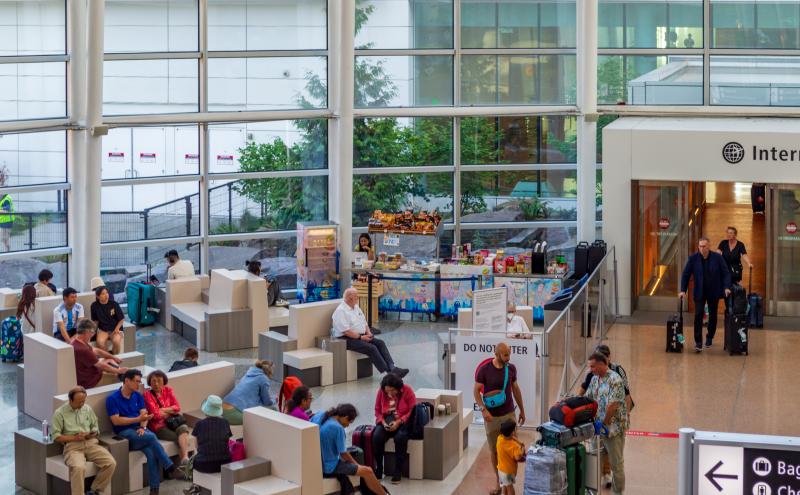 Public Comment began with a frequent traveler’s complaint on the (literally) rock hard seating in the IAF. He is not wrong. The space is named after Gina Marie Lindsey–possibly the stoniest airport director in Port of Seattle history. We always tell people who are frustrated by airports: watch people who fly for a living.
Finance 101
As a special purpose district, the Port functions very differently from other local governments. Many aspects of its finances would be more familiar to people in for-profit businesses than that of a city or county. Its most notable features are its two large enterprise funds — businesses inside a government agency, like the US Postal Service. Where it gets tricky is that a massive portion of their funding comes from federal grants — especially at Sea-Tac Airport. Because use of that money is so tightly constrained by the FAA, it creates even more confusion for the public. In short: the vast majority of airport revenue can never be used for the things community members ask for most.
Today’s calendar was high-level, but provided an overview of where the airport is at. Commissioner Felleman asked a pointed question: How is it that revenues keep climbing year on year at both the airport and the seaport, and yet Finance claims overall profitability is tightening?
Finance was reluctant to over-simplify, but noted that costs from FTEs (full-time employees) are up 20% post-pandemic, while the revenues the Port can retain have not kept pace.
They also gave their take on the regional economic forecast. Despite ongoing problems with war and inflation, they seem cautiously optimistic. Local indicators on employment and inflation have both improved slightly.
For us, the important item was a $400 million bond financing program. Speakers noted that as recently as last week, their calls with the bond rating organizations had been positive.
Takeaway: we keep reiterating how different this is from the Third Runway. The SAMP is several orders of magnitude larger than previous expansions, and yet bonding seems to be of no major concern.
30-day SAMP NTP extension
One of our founders, JC Harris, asked commissioners for a 30-day extension to the SAMP NTP DEIS public comment period.
Good afternoon. My name is JC Harris. I’m here today on behalf of Sea-Tac Noise.Info. I did not expect to say this, but I’m suggesting that you extend the SAMP public comment period another 30 days. STNI was initially a bit skeptical. Our lens is that we’ve been at this ten years — and the SAMP is essentially a redo from 2018–2019.
However, you may appreciate that management in all of the fence-line cities has less than 48 months of experience. And I don’t just mean the city managers — I mean the planning directors, the people assigned to the Part 150 program.
This is awkward for them. Imagine being an absolute expert, the commander of a battleship, and then being assigned on day one to a submarine.
Airports are like nothing else in planning and infrastructure. It should be unthinkable to bring somebody in on day one and assign them this kind of new material. They do not have the support systems you take for granted. They should, but they don’t.
The Port has done its job on ‘community engagement’. But people still struggle to understand the basic concept of how you get so much more throughput on the same footprint. It’s hard to overstate this — the average person still correlates ‘airport expansion’ with 17 million cubic yards of fill dirt and a new runway because that has been their only experience. It’s taken a long time to get them to understand that you can make this massive an expansion without building something.
We’re starting to see people finally come together on this–just in the past few days, and I think it would improve the quality of the comments you get by an order of magnitude.
We are sympathetic to schedules. But we watch these things fairly closely and do not think this would cut into your schedule. If we did not see real improvement in the public, and did not think you could also meet your goals, we would not raise the possibility.
We acknowledge this as a change in position. We had largely agreed with the Port that 60 days should be adequate, given how little the plan differs from the 2018 process. That is no exaggeration. The 2026 SAMP is almost a do-over of 2018. Other than changing a few numbers, the Port could have used the same posters at their town halls because the projects have not changed.
Why we changed It has been extremely challenging to explain to the public, or to electeds, what the SAMP even is. Mr. Harris noted how hard it has been to explain that they can dramatically increase throughput without building a Third Runway. Most people still associate airport expansion with big construction projects.
There have been major leadership changes at all three cities in the SAMP ILA. All three city managers have been on the job less than two years; Burien’s interim city manager came on less than 60 days ago. The development directors at all three cities have also changed. These six people are the primary interfaces with the Port on StART, airport committees, and Part 150. In every airport community, anything to do with noise depends on those administrators.
We have frequently been critical of citizen airport committees. Airports are far too complex to learn well in a short period of time. The fallback was always that there would be professional managers at the cities. The SAMP has created a perfect storm: Little expertise from electeds, little from well-meaning members of the public, and little from the backstop, the new administrators closest to the fence-line committees. This has left cities in a very tight spot.
Our last article on the Commission listening session noted that lack of focus — most comments did not deal with the SAMP. The public comment period is supposed to be a process to make 31 construction projects better. It is not a referendum on general mitigation plans. Without more focus, or even basic education on what the SAMP is and what a quality comment looks like, the odds of improving the actual projects are low.
We want to acknowledge Commissioner Hasegawa for noting that many of the things the public commented on are not part of the SAMP but are equally valuable — land stewardship (tree canopy) and the Part 150 program. Perhaps her comment will spur that discussion.
There is now, finally, more focus. It may have taken until the night before the test, but we believe more people–including those crucial administrators are finally locked in. We think they will know how to use 30 extra days well.
Airport 101
One difference between 2018 and today: back then the Port would bring in someone precisely to provide an Airport Noise 101 presentation. That did not happen this time. What community members needed this time was that–and more. They needed a complete Airport 101.
It is unfair to call the Port-sponsored Town halls uninformative — we could walk up to any of their extremely knowledgeable people and get detailed answers. But that is only because we knew what to ask. Most people don’t know what they don’t know, making the entire process essentially, a one-way door. Airport 101 could have validated our main message: how an airport can increase flights by a third without more land or more runways–the essential message of STNI.
Why aren’t people asking more detailed questions about the projects themselves? The general public has spent the bulk of its time on cumulative impacts and not drilled down into the projects. This is understandable because it requires experts and more time. The Port got that wrong, but the community also gave them something of a free pass by not mentioning it enough. Hopefully management got the message today.
Takeaway: With the Port of Seattle you only get what you ask for.
The Port can still meet its scheduling goals by offering another 30 days. How are we so sure? Precisely because the process is so similar to 2018. We criticize the communities for not keeping up. But the Port has had a very long time to prep–and its plans are likely ready to go.
Adding 30 days costs them nothing, but it may improve the quality of comments — from residents, but especially from the professionals the cities have spent a great deal of money to retain.
Having analyzed over 400 comments from the 2018 process, we found the vast majority were also about general unhappiness, rather than items the Port can and should be required to examine in detail.
It wasn’t just the chairs
 Almost all major airport construction projects have issues. The International Arrivals Facility (not part of the SAMP) was rife with cost overruns and engineering problems. The seating mentioned during public comment was the least of those. As originally built, the facility could not accommodate the wide-body aircraft it was designed to hold!
That was one project. The SAMP is thirty-one. If given another 30 days, the cities should dig in hard on as many as possible — with the goal of making all 31 as good as they can be for residents–and perhaps save all taxpayers these kinds of after-the-fact problems.
I just found this site. I have to be careful about commenting about SEA as it took two years to find a lawyer after years of harassment from managers, directors union officials at SEA for reporting hostile and unsafe workplace.
Boilers, Industrial Refrigeration, Construction, HVAC systems were my career prior to going to work at SEA in 2011.
The mechanical plants were overbuilt to accommodate growth SEA airport planners have been working on for many years. I ran the steam/ refrigeration/ Ice Plant for years.
The plan is already working.
Comments are fine.
Bend over.