IBA’s Sustainability Watch: September 2026
Written by Archie Brown, Senior Analyst
IBA’s sustainability team has modelled commercial passenger aviation emissions through to 2050, also including our own state-policy baseline scenario in the analysis. Rather than applying a top-down growth rate, it combines IBA’s aircraft series-level delivery and retirement forecast with projected demand, utilisation and load factors. RPK is derived from ASK and load factor, while emissions are calculated by aircraft series and include explicit efficiency assumptions for future models against comparable in-service aircraft. Dedicated freighters are outside the scenario’s scope.
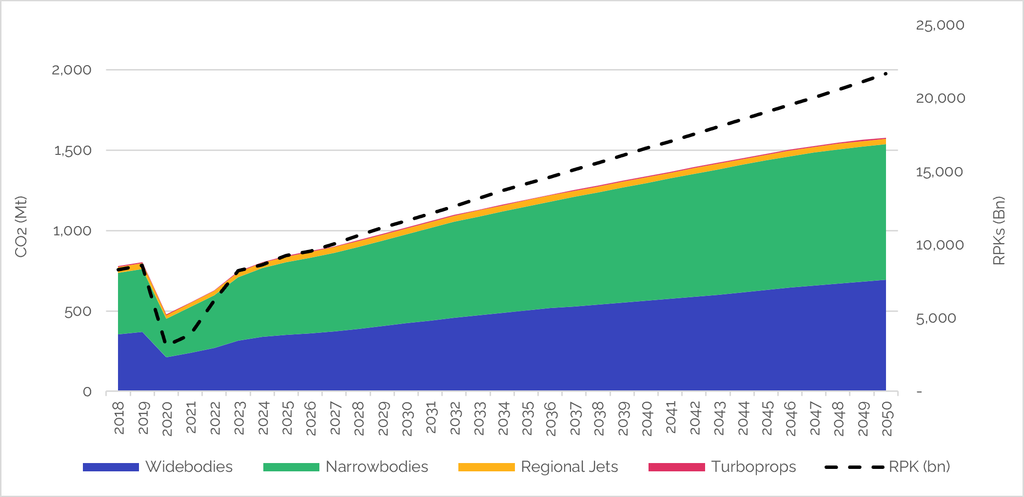
Absolute emissions by aircraft class vs global traffic
Source: IBA NetZero, market forecasts
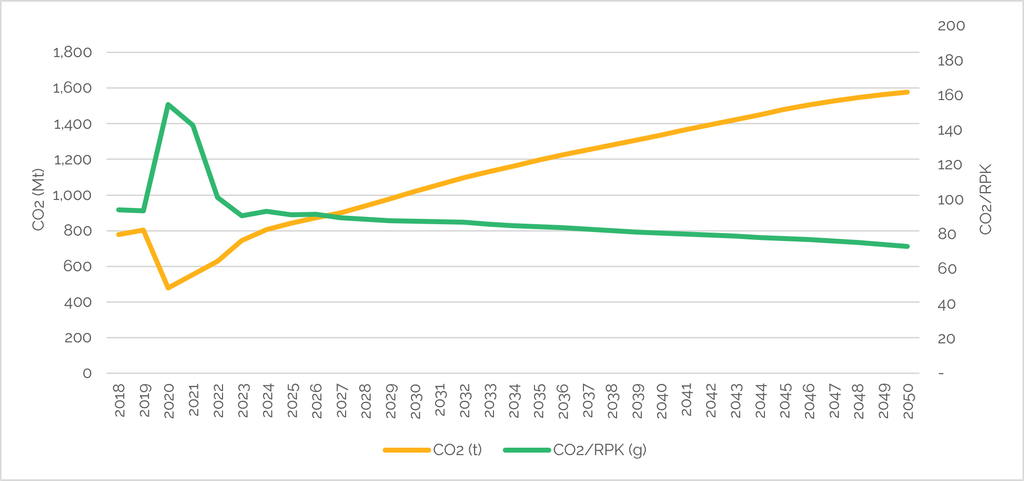
Under these assumptions, annual emissions rise from approximately 843MtCO₂ in 2025 to 1,583MtCO₂ in 2050, an increase of 87%. RPK increases more rapidly, from 9,250bn to 21,650bn, or 134%. Average emissions intensity consequently falls from around 91gCO₂/RPK to 73gCO₂/RPK, an improvement of 20%.
Fleet renewal drives this relative decoupling. New-generation and future aircraft lower fuel burn against their benchmark types, but the fleet expands from around 29,800 aircraft to more than 56,000, alongside higher utilisation and load factors. The activity effect therefore exceeds the efficiency benefit: passenger aviation becomes materially more efficient per unit of traffic, while absolute emissions continue to rise.
Absolute emissions vs emissions intensity
Source: IBA NetZero, market forecasts
By 2050, narrowbodies account for approximately 844MtCO₂ and widebodies 693MtCO₂. Together they represent 97% of forecast emissions. Zero-emission aircraft enter the baseline only from 2046 and comprise around 0.3% of the fleet by 2050, having an impact replacing pockets of local/regional travel.
The scenario is a baseline market outlook, rather than a net-zero pathway. However, the detailed bottom-up modelling of aircraft deliveries, retirements, fleet efficiency and passenger demand provides a robust benchmark for testing the credibility of airline and sector net-zero pathways. It quantifies the reductions required beyond expected fleet renewal and helps determine whether pathway assumptions are operationally realistic. Closing this gap will require materially greater SAF deployment, alongside additional operational measures and carbon policy intervention.
All data shared in this analysis was taken from IBA NetZero – our aviation intelligence platform. If you would like to find out more about our digital solutions, book a personalised demo here.