The sparsely attended meeting of electeds and administrators from the Highline Cities and Schools was held at the Des Moines Police Station and featured two updates of interest to readers:
SAMP SEPA DEIS Summary
Port Environmental Manager Steve Rybolt is charged with reviewing public the 490 comments provided. He stated that though this number is less than the 1800 received during the December 2025 NEPA EA, those early comments were ‘far less robust.’ Many comments were commenting on separate aspects of the SAMP and would be broken down into ‘probably thousands of individual comments.’ The Port promises to publish the raw comments sometime in October although their responses will not be available until the final decision is published tentatively set for January 2027.
Part 150
There was also discussion of the upcoming phase 2 of the current Part 150 program. This is always a fraught discussion because the participants are unfamiliar and the material is so dense. As one activist in another city warned us years ago, “Part 150 took three years and we spent the first two just learning the terms. Fair. That is exactly what makes it so hard to make progress.
Phase 1 concerned setting the noise contour map, largely a consultant job using the deeply flawed DNL65 standard.
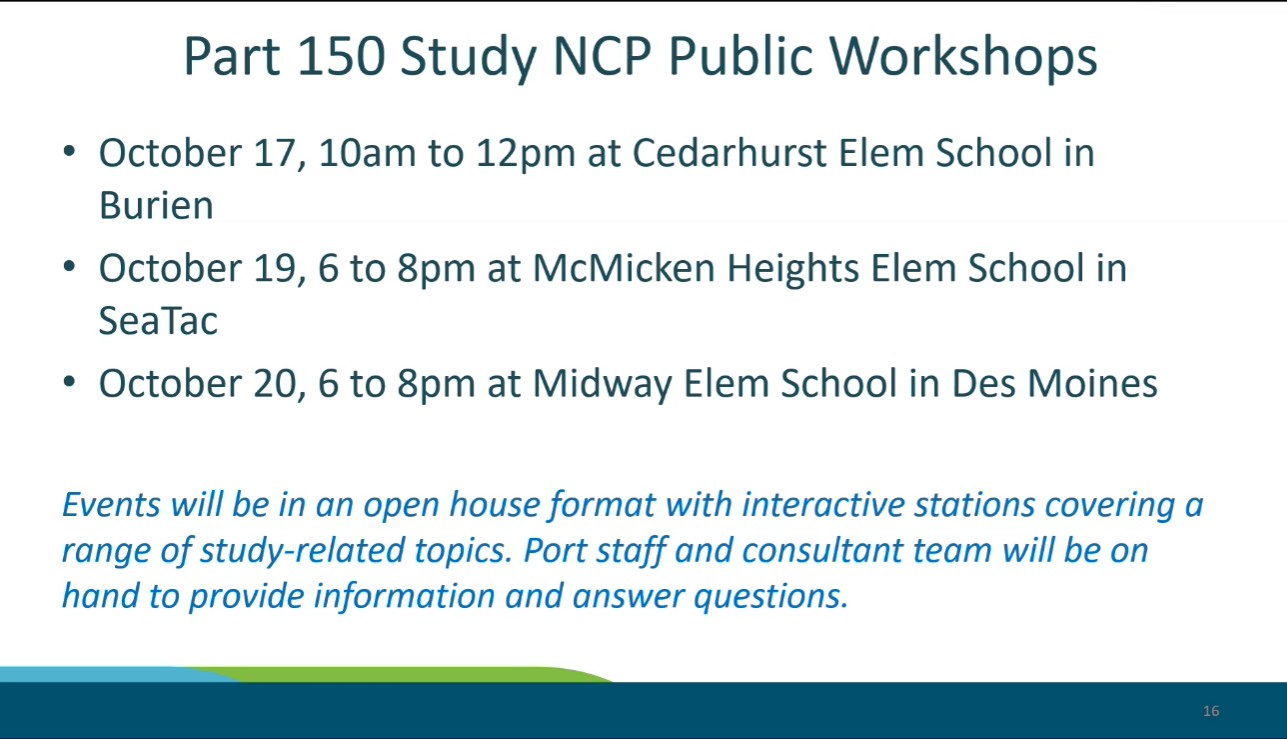
Phase 2 will provide three more community town halls to discuss how the contour may affect the communities. More to come soon.
Since any discussion of noise becomes a discussion about everything, several related concerns were raised.
Port Package Updates — Back to 1993
The 2024 SIRRPP allocated $5 million of Port money for existing system updates. The Port has encouraged a basic misunderstanding as to what that money has been spent on. To date all monies have been spent on studies and none on construction. However, staff announced that eight homes would be updated in 2027 at an average cost of $130,000 per home. But none of those costs will be paid by the Port either. Let’s do the numbers.
1993, 450, 190, 8
The Port said it had reached out to roughly450 properties which were sound insulated before 1993, that about 190 homes had been acoustic tested, and 8 found eligible. Why 1993?
1993 –> 450
The first major sound insulation program in America was done near Boston/Logan Airport in the 1980’s. Modern window construction did not become widely available until 1993. A large number of those older systems have not fared well. After much lobbying by Massachusetts electeds, that year became the cut-off for FAA reimbursement on second-chance sound insulation. When applied to Sea-Tac that narrows the pool to 450 homes inside the current DNL65. 450 remaining structures sound insulated before 1993. That represents less than 5% of the original number of Port Packages installed.
450 –> 8
For the SIRRPP, the Port added an addition requirement of acoustic testing–a requirement which did not exist for the vast majority of previous Port Package installs. That gets the number they intend to fix next year down to 8.
$5,000,000 –> 0
But in terms of out-of-pocket cost, the number is close to zero because using those two filters guarantees FAA reimbursement. To date the Port has spent none of their own money fixing any Port Packages, and shown no hint of doing so.
But only if you apply!
One other note. The entire FAA grant program is voluntary. That means that the Port can spend its own money on any sound insulation program it chooses. It also means that if it wants FAA reimbursement, it has to decide to apply for those grants every year. It is easy to commit to fixing eight homes in a year–especially when you’re getting reimbursed.
It’s also important to remember that the Port has still not spent a dime of its own money on fixing Port Packages. Even when it could be reimbursed, it slow-walked applications for grants for many years. That lead many homes, apartments, condos and house of worship left hanging.
Slums
Des Moines City Manager Katherine Caffrey had a very direct interaction with the Port noise team, fearing that the expected shift in noise boundary and reduction in property values might lead to creating slums in surrounding communities. Her concerns are not exaggerated.
Airports don’t just create annoyance. They permanently transform not only the landscape, but also the buyers and investors, both residential and commercial. Forever.
- Older/weaker housing stock attracts buyers looking for the least expensive possible living space. But data shows these are often not people with the long term interest or wherewithal to gentrify their neighborhood.
- It also selects for developers with incentives in being located near an airport: hospitality right next door, but almost none beyond half a mile. After that the commercial market looks more like logistics, warehousing and light industrial–services that support aviation. These can help rebuild tax base, but too often they do not provide add-on community benefits
We applaud City Manager Caffrey for speaking directly. It does no good to be coy about these issues. The future harms she perceives are real, generational, and we risk nothing by saying so.
Unfortunately, the cities have not yet understood that there is no one at these meetings with the authority to do anything except listen–and offer to pass on one’s concerns.
In the meme, an outraged ‘Karen’ demands to “speak to the manager!” In the case of the Port of Seattle, who is that?
Presentations
Highline Forum Agenda – September 23, 2026
Part 150 Noise and Land Use Compatibility Study Update
Port Jobs: Expanding Opportunities. Building Success.
1We question that number. The tally for Appendix O show 583 comments received during the NEPA EA process.