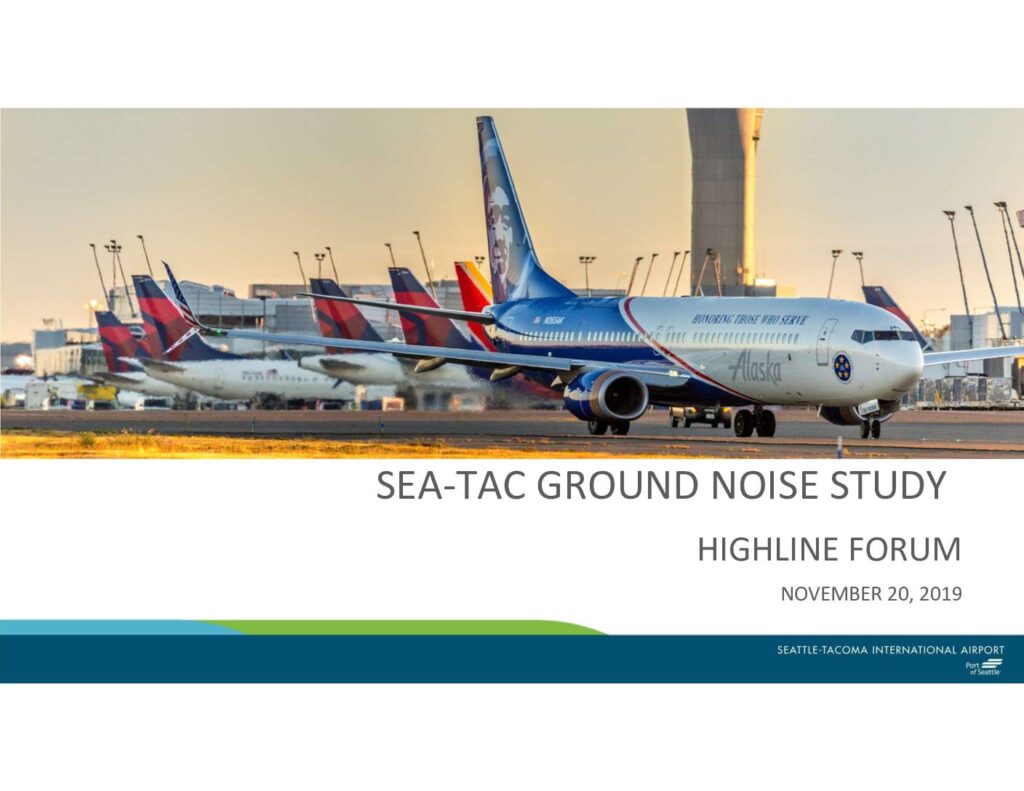
This document presents findings from a Sea-Tac Airport Ground Noise Study, shared at the Highline Forum on November 20, 2019. It explains how aircraft ground noise travels and changes with distance, noting that sound levels drop by 6 dB every time the distance doubles and are further reduced by atmospheric absorption and soft ground surfaces. The study also covers how temperature gradients affect noise, with sound bending upward in normal conditions and downward during temperature inversions, potentially increasing noise impacts on nearby communities.Open full document
Notes
A presentation delivered at the Highline Forum on November 20, 2019, covering the Sea-Tac Ground Noise Study. The presentation explains sound propagation principles including spherical spreading, ground effect, and refraction due to temperature gradients. It illustrates how temperature inversions and lapses affect the bending of sound paths from ground-level aircraft operations.