Notes
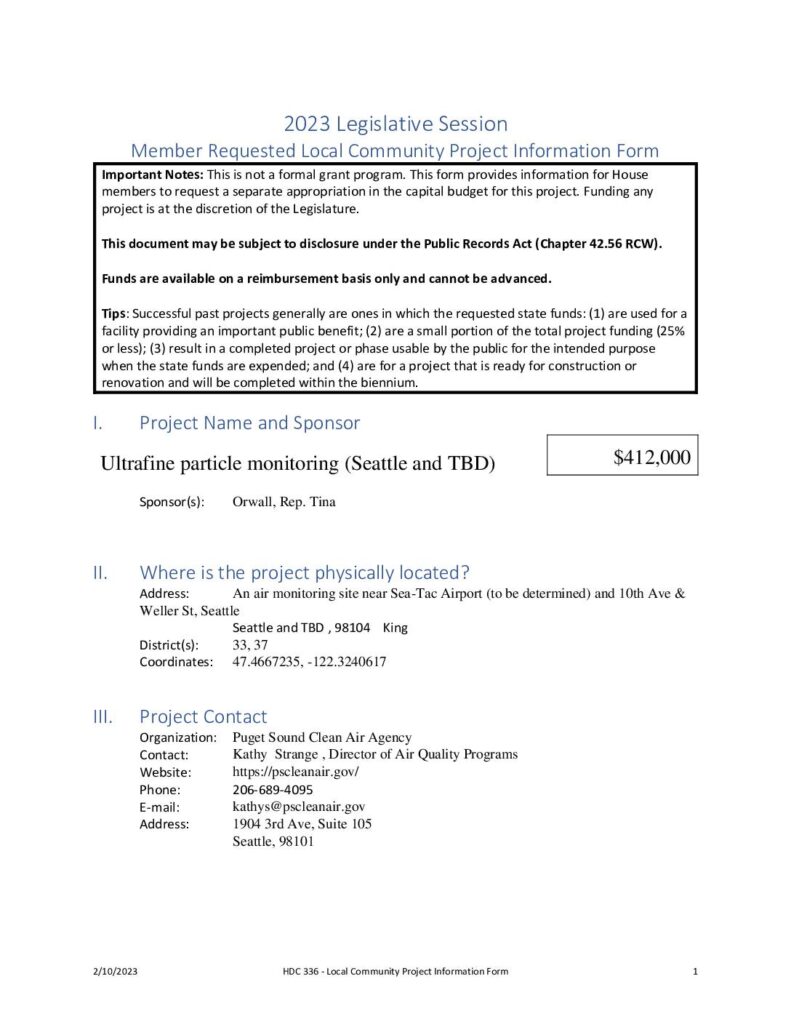
Community Projects are a recent innovation in the State Legislature. Essentially, House members sponsor their own grants which are funded as capital projects. In this case, $340,000 is being allocated for two ultrafine particle monitors to be handed off to Puget Sound Clean Air Agency (PSCAA). One will be in Chinatown, at the confluence of I90 and I5–some of the most heavily impacted roadway emissions in the area. The other is to be placed near Sea-Tac Airport. Since they are fixed-site, the intention is to create ongoing monitoring stations.
The remainder of the money will go to the University of Washington to prepare an analysis of the first year of data. This establishes a couple of precedents: first that PSCAA will be using equipment similar to UW. Standardizing is good. Second, as hard as it seems to believe, long-term monitoring has never happened near Sea-Tac Airport. Also this establishes a cost to do the annual reporting, in this case $60,000, which can be funded subsequently by any agency, including cities.
Three other points: This is only one monitor near the airport. It was always the intention of the Sea-Tac Communities Plan to establish a network of air quality monitors around the airport. This is a controversy in the field–some scientists feel that a single device may be ‘good enough’. But others are aligned more with that original STCP work–that more monitors will need to be placed in order to establish the proper science. Also, this money is only a particle counter. It does not provide a qualitative analysis of those particles and again, that kinds of work will need to be done. Finally, UW has become a ‘go to’ for all things involving aviation emissions. At some point the task of monitoring must become commoditized. That is, the process stops becoming ‘research’ and becomes true monitoring that can and should be taken on by independent labs in the same way that other routine environmental reports are done (eg. monthly water district tests.)