TagRegional Commission On Airport Affairs(36)
-
 2023-04-24 15:13
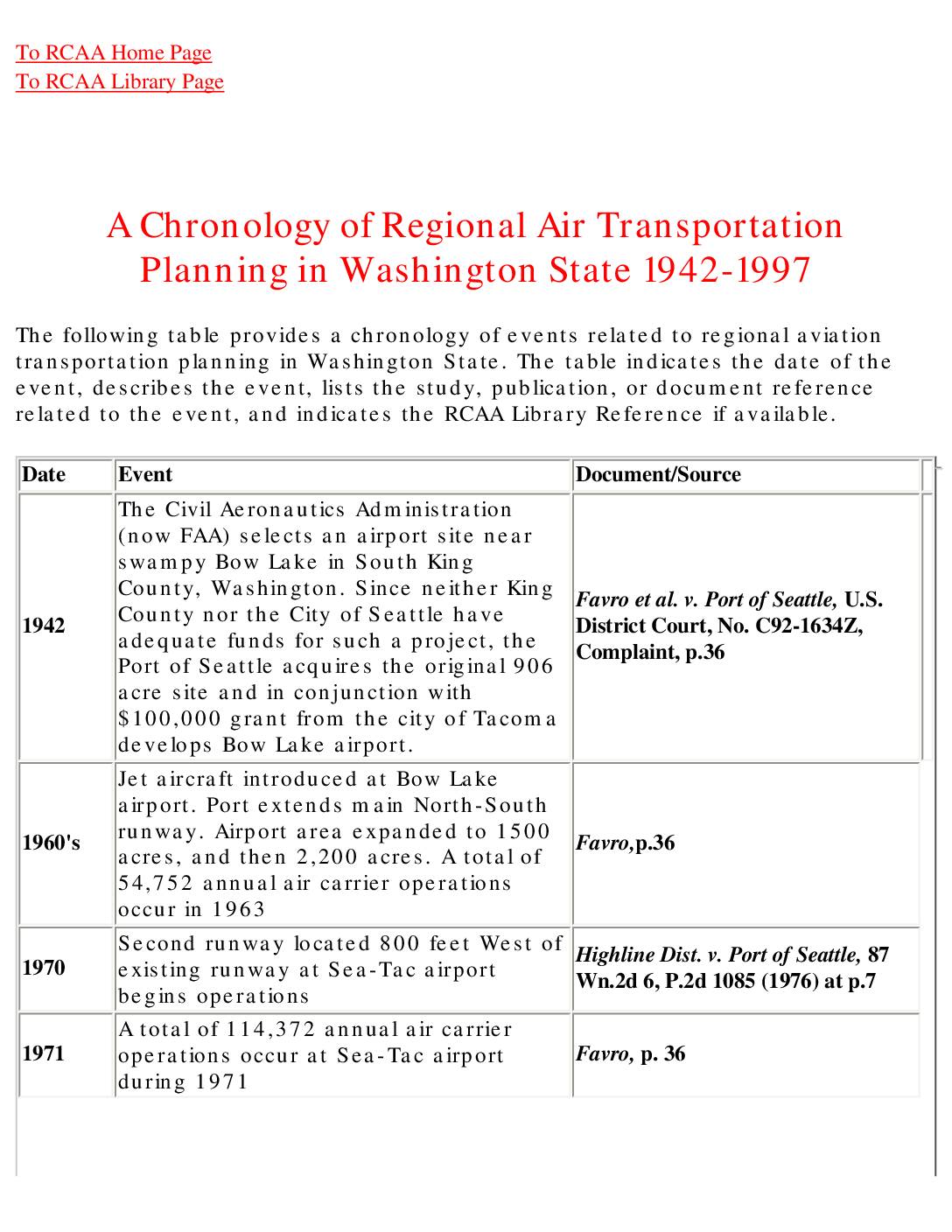
Chronology of Regional Air Transportation Planning in Washington State, 1942–1997
The following table provides a chronology of events related to regional aviation transportation planning in Washington State. The table indicates the date of the event, describes the event, lists the study, publication, or document reference related to the event, and indicates the RCAA Library Reference if available. Date Event Document/Source 1942 The Civil Aeronautics Administration (now FAA) selects an airport site near swampy Bow Lake in South King County, Washington. Since neither King County nor the City of Seattle have adequate funds for such a project, the Port of Seattle acquires the original 906 acre site and in conjunction with $100,000 grant from the city of Tacoma develops Bow Lake airport. Favro et al. v. Port of Seattle, U.S. District Court, No. C92-1634Z, Complaint, p.36 1960's Jet aircraft introduced at Bow Lake airport. Port extends main North-South runway. Airport area expanded to 1500 acres, and then 2,200 acres. A total of 54,752 annual air carrier operations occur in 1963 Favro,p.36 1970 Second runway located 800 feet West of existing runway at Sea-Tac airport begins operations Highline Dist. v. Port of Seattle, 87 Wn.2d 6, P.2d 1085 (1976) at p.7 1971 A total of 114,372 annual air carrier operations occur at Sea-Tac airport during 1971 Favro, p. 36 http://www.rcaanews.org/ http://www.rcaanews.org/water/libr1.htm 6/29/73 Highline School District files suit against Port of Seattle for damages allegedly caused by"noise, vibration, and smoke from aircraft landing and taking off at the airport". Highline at p.8 1973 King County and the Port of Seattle issue the Sea-Tac… -
 2023-04-24 15:13
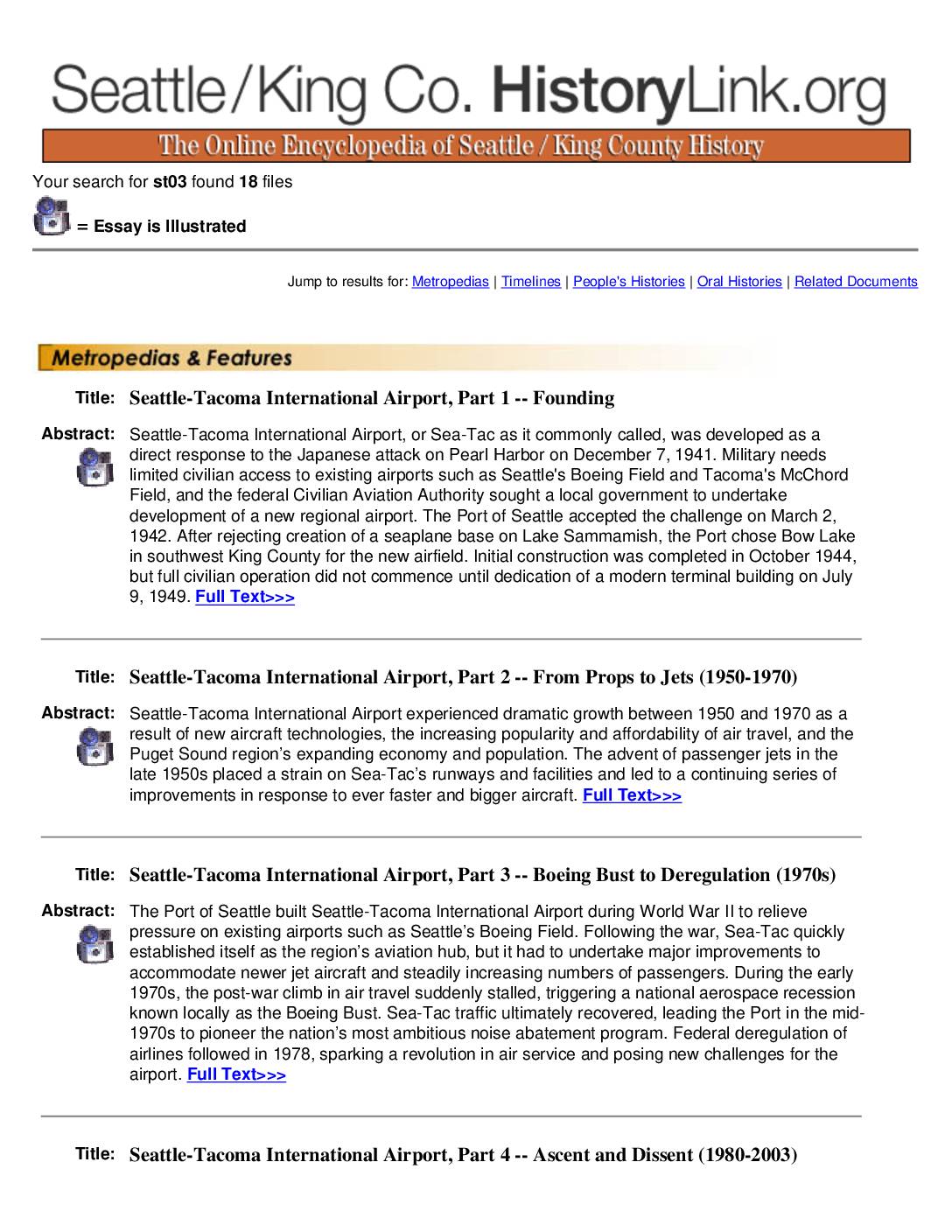
HistoryLink – Sea-Tac Airport History, 18 Articles
Your search for st03 found 18 files = Essay is Illustrated Jump to results for: Metropedias | Timelines | People's Histories | Oral Histories | Related Documents Title: Seattle-Tacoma International Airport, Part 1 -- Founding Abstract: Seattle-Tacoma International Airport, or Sea-Tac as it commonly called, was developed as a direct response to the Japanese attack on Pearl Harbor on December 7, 1941. Military needs limited civilian access to existing airports such as Seattle's Boeing Field and Tacoma's McChord Field, and the federal Civilian Aviation Authority sought a local government to undertake development of a new regional airport. The Port of Seattle accepted the challenge on March 2, 1942. After rejecting creation of a seaplane base on Lake Sammamish, the Port chose Bow Lake in southwest King County for the new airfield. Initial construction was completed in October 1944, but full civilian operation did not commence until dedication of a modern terminal building on July 9, 1949. Full Text>>> Title: Seattle-Tacoma International Airport, Part 2 -- From Props to Jets (1950-1970) Abstract: Seattle-Tacoma International Airport experienced dramatic growth between 1950 and 1970 as a result of new aircraft technologies, the increasing popularity and affordability of air travel, and the Puget Sound region’s expanding economy and population. The advent of passenger jets in the late 1950s placed a strain on Sea-Tac’s runways and facilities and led to a continuing series of improvements in response to ever faster and bigger aircraft. Full Text>>> Title: Seattle-Tacoma International Airport, Part 3 -- Boeing Bust to… -
 2023-04-24 15:13
RCAA Truth in Aviation – Summer 1999
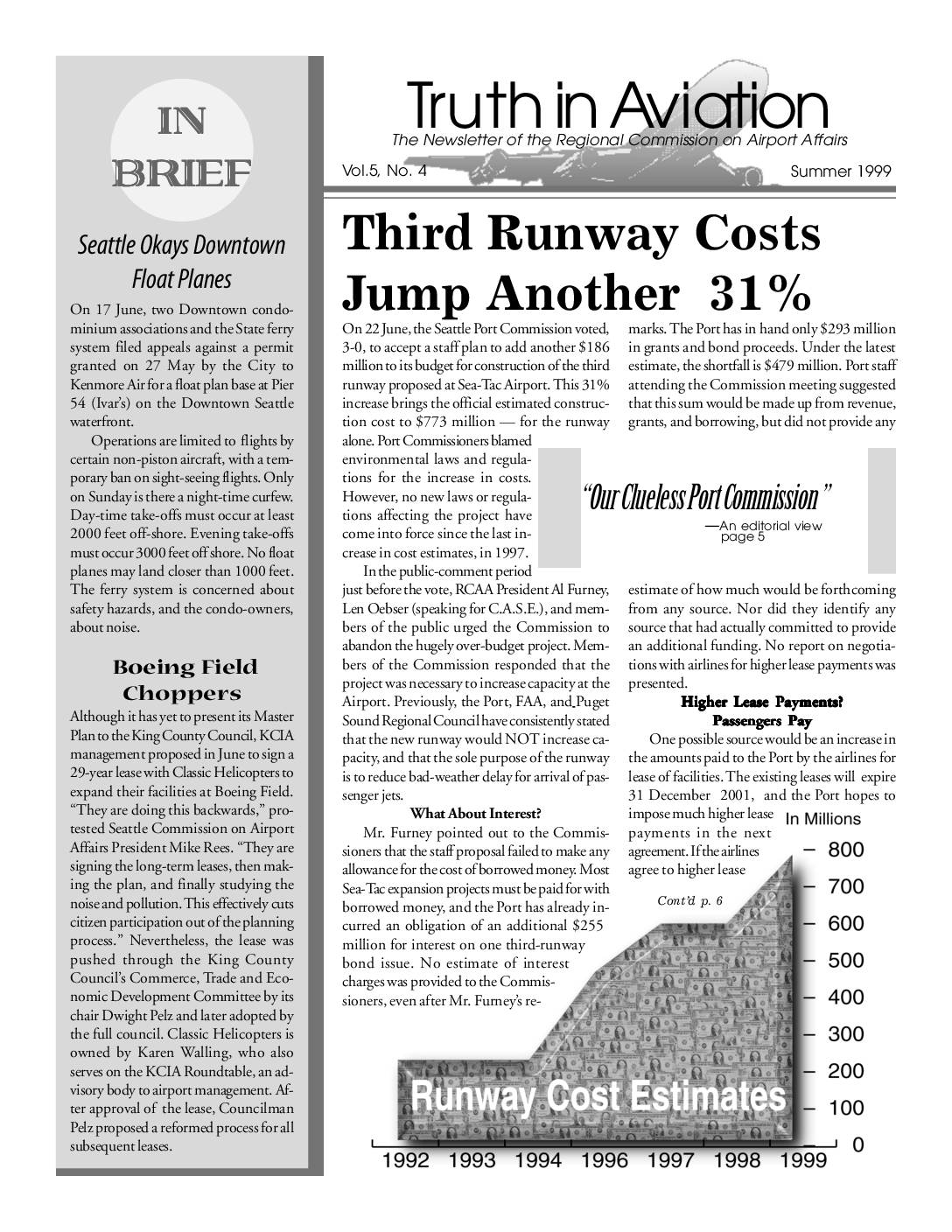
The Newsletter of the Regional Commission on Airport Affairs Vol.5, No. 4 Summer 1999 INININININ BRIEFBRIEFBRIEFBRIEFBRIEF Third Runway Costs Jump Another 31% “Our Clueless Port Commission ” –An editorial view page 5 Seattle Okays Downtown Float Planes On 17 June, two Downtown condo- minium associations and the State ferry system filed appeals against a permit granted on 27 May by the City to Kenmore Air for a float plan base at Pier (Ivar’s) on the Downtown Seattle waterfront. Operations are limited to flights by certain non-piston aircraft, with a tem- porary ban on sight-seeing flights. Only on Sunday is there a night-time curfew. Day-time take-offs must occur at least 2000 feet off-shore. Evening take-offs must occur 3000 feet off shore. No float planes may land closer than 1000 feet. The ferry system is concerned about safety hazards, and the condo-owners, about noise. Boeing Field Choppers Although it has yet to present its Master Plan to the King County Council, KCIA management proposed in June to sign a 29-year lease with Classic Helicopters to expand their facilities at Boeing Field. “They are doing this backwards,” pro- tested Seattle Commission on Airport Affairs President Mike Rees. “They are signing the long-term leases, then mak- ing the plan, and finally studying the noise and pollution. This effectively cuts citizen participation out of the planning process.” Nevertheless, the lease was pushed through the King County Council’s Commerce, Trade and Eco- nomic Development Committee by its chair Dwight Pelz and later adopted by the full… -
 2022-09-12 15:33
2004 NPDES Bg
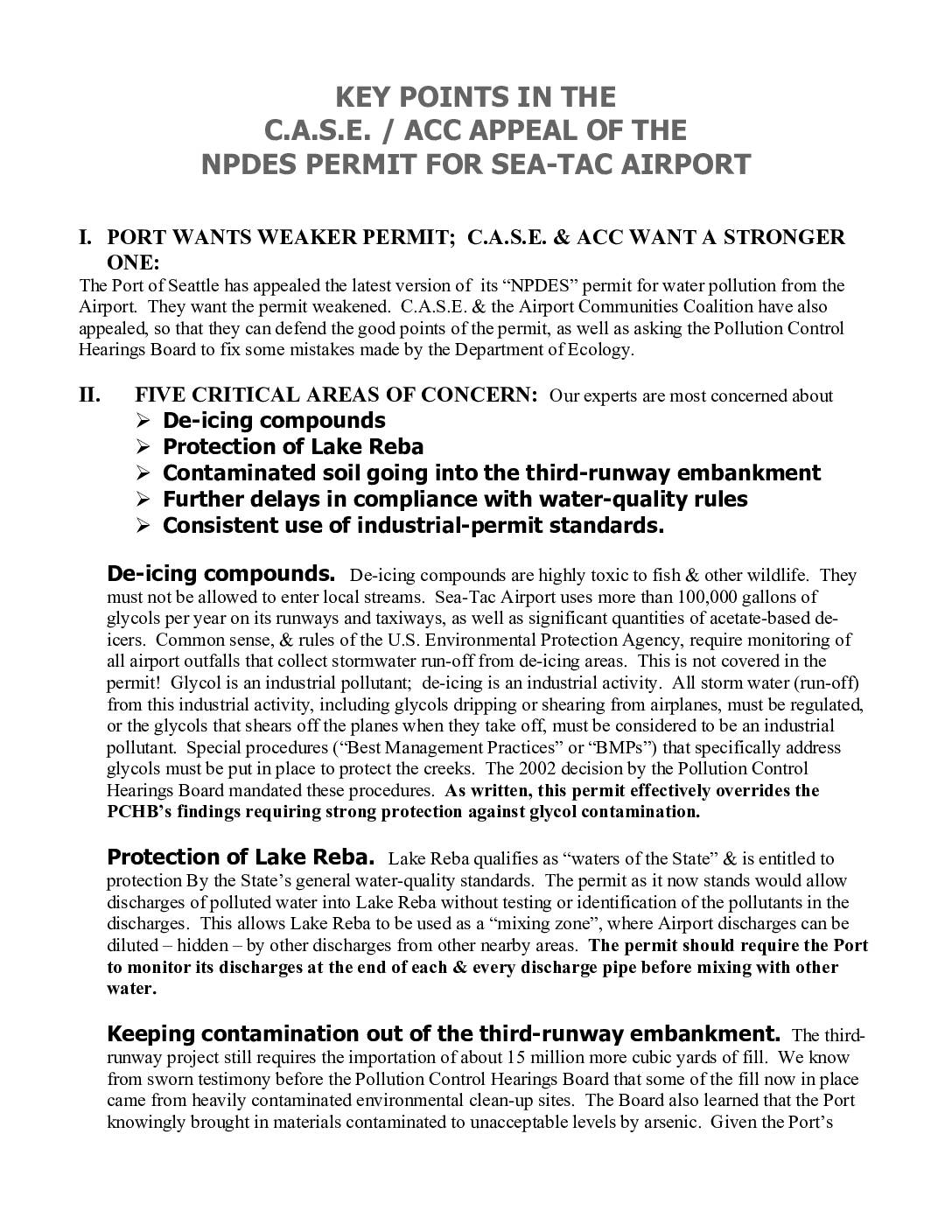
The Port of Seattle has appealed the latest version of its “NPDES” permit for water pollution from the Airport. They want the permit weakened. C.A.S.E. & the Airport Communities Coalition have also appealed, so that they can defend the good points of the permit, as well as asking the Pollution Control Hearings Board to fix some mistakes made by the Department of Ecology. II. FIVE CRITICAL AREAS OF CONCERN: Our experts are most concerned about De-icing compounds Protection of Lake Reba Contaminated soil going into the third-runway embankment Further delays in compliance with water-quality rules Consistent use of industrial-permit standards. De-icing compounds. De-icing compounds are highly toxic to fish & other wildlife. They must not be allowed to enter local streams. Sea-Tac Airport uses more than 100,000 gallons of glycols per year on its runways and taxiways, as well as significant quantities of acetate-based de- icers. Common sense, & rules of the U.S. Environmental Protection Agency, require monitoring of all airport outfalls that collect stormwater run-off from de-icing areas. This is not covered in the permit! Glycol is an industrial pollutant; de-icing is an industrial activity. All storm water (run-off) from this industrial activity, including glycols dripping or shearing from airplanes, must be regulated, or the glycols that shears off the planes when they take off, must be considered to be an industrial pollutant. Special procedures (“Best Management Practices” or “BMPs”) that specifically address glycols must be put in place to protect the creeks. The 2002 decision by the Pollution… -
 2022-09-12 15:33
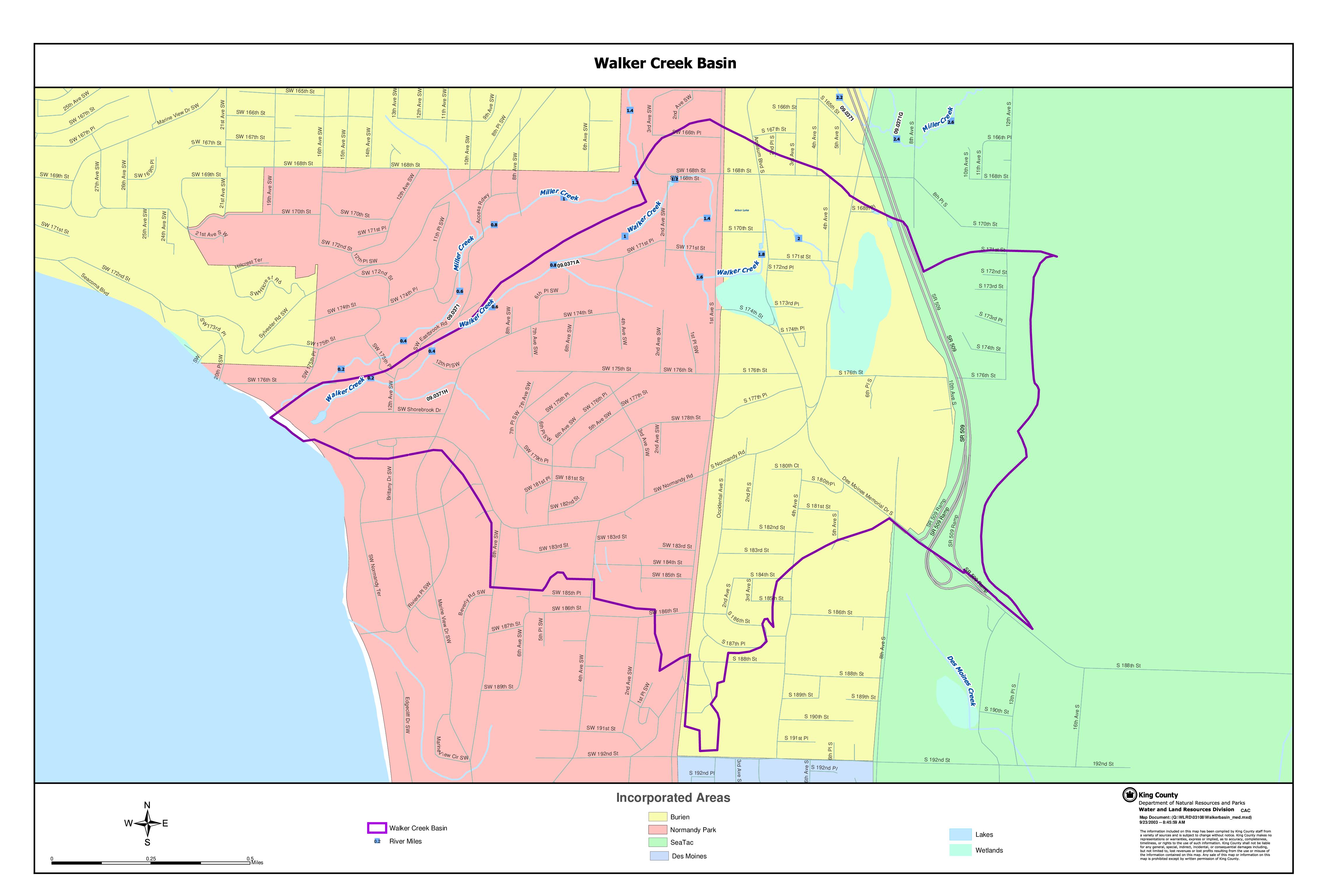
King County – Walker Basin Map, 2004
-
 2022-09-12 15:33
2005 State Plan Sum
In 2005, the Governor signed into law Engrossed Substitute Senate (ESSB) Bill 5121, which authorizes the state to conduct a statewide long-term air transportation study on general aviation and commercial airports. More specifically the project is as follows: Proposed Project. Statewide airport inventory assessment, demand, and market forecast analysis on commercial and general aviation air transportation. The project also includes formation of an aviation planning council to provide recommendations on how best to meet future aviation airport needs based on the study assessment, demand, market forecast, and evaluation of high-speed passenger transportation facilities and services. High-speed passenger transportation facilities and services would include rail or magnetic levitation transportation systems that connect airports to more efficiently utilize airport capacity, and connect major population and activity centers. Consultant Services Proposed. The statewide long-term air transportation planning study wourl require professional and technical specialists knowledgable about aviation capacity, airspace, demand, and market forcast assessment factors related to commercial and general aviation services. Knowledge in Federal Aviation Administration procedures and requirements is also needed. Draft Services and Deliverables. A. Develop a detailed scope of work, work delivery plan and work program schedule to conduct statewide airport capacity and facility assessment, demand needs and market forecast analysis, provide and facilitate the aviation planning council, evaluate high- speed rail, and communication strategies and public outreach program for the Statewide Long-term Air Transportation Assessment and Analysis project. More specifically the detailed scope of work, work deliver plan and work program schedule shall address the following: B. Statewide… -
 2022-09-12 15:33
Nrdc Foc
Clean Air & Energy: Transportation: In Depth: Report Flying Off Course Environmental Impacts of America's Airports This online report examines the noise, ground-level air quality, water pollution, global warming, and energy efficiency issues associated with America's airports. The information is excerpted from NRDC's print publication, Flying Off Course, published in October 1996. The specific data in the Airport Survey Results tables was collected in a 1995 National Airport Survey. OVERVIEW & QUICK REFERENCE FAQ TABLE OF CONTENTS Executive Summary 1995 National Airport Survey Results Report Credits and Acknowledgements Appendices Glossary of Terms and Acronymns Sample Survey Questionnaire List of Survey Recipients and Respondents For printed copies of this report, see our Publications List. http://www.nrdc.org/default.asp http://www.nrdc.org/joinGive/default.asp http://www.nrdc.org/about/default.asp http://www.nrdc.org/action/default.asp http://www.nrdc.org/search/default.asp http://www.nrdc.org/air/default.asp http://www.nrdc.org/air/pollution/default.asp http://www.nrdc.org/air/energy/default.asp http://www.nrdc.org/air/transportation/default.asp http://www.nrdc.org/air/transportation/brief.asp http://www.nrdc.org/air/transportation/depth.asp http://www.nrdc.org/reference/topics/air.asp http://www.nrdc.org/air/default.asp http://www.nrdc.org/globalWarming/default.asp http://www.nrdc.org/water/default.asp http://www.nrdc.org/wildlife/default.asp http://www.nrdc.org/land/default.asp http://www.nrdc.org/health/default.asp http://www.nrdc.org/nuclear/default.asp http://www.nrdc.org/cities/default.asp http://www.nrdc.org/legislation/default.asp http://www.nrdc.org/onearth/default.asp http://www.nrdc.org/reference/default.asp http://www.nrdc.org/publications/default.asp http://www.nrdc.org/features/default.asp http://www.nrdcaction.org/join/subscribe.asp http://www.nrdc.org/media/default.asp http://www.nrdc.org/espanol/default.asp http://www.nrdc.org/siteMap/default.asp http://www.nrdc.org/contactUs/default.asp http://www.nrdc.org/air/transportation/qairport.asp http://www.nrdc.org/publications/default.asp#air Clean Air & Energy: Transportation: In Depth: Report Flying Off Course Environmental Impacts of America's Airports Top of Report | Glossary Executive Summary In January 1995, the Natural Resources Defense Council (NRDC) undertook a study to determine: (1) the most important environmental issues connected with airports, and (2) the best management techniques airports were using to mitigate them. The bulk of our data came from a nationwide survey that we conducted in the spring and summer of 1995. We mailed a seven-page questionnaire to 125 of the nation's busiest airports, as defined by the Federal Aviation Administration (FAA) in terms of numbers of passengers, or… -
 2022-09-12 15:33
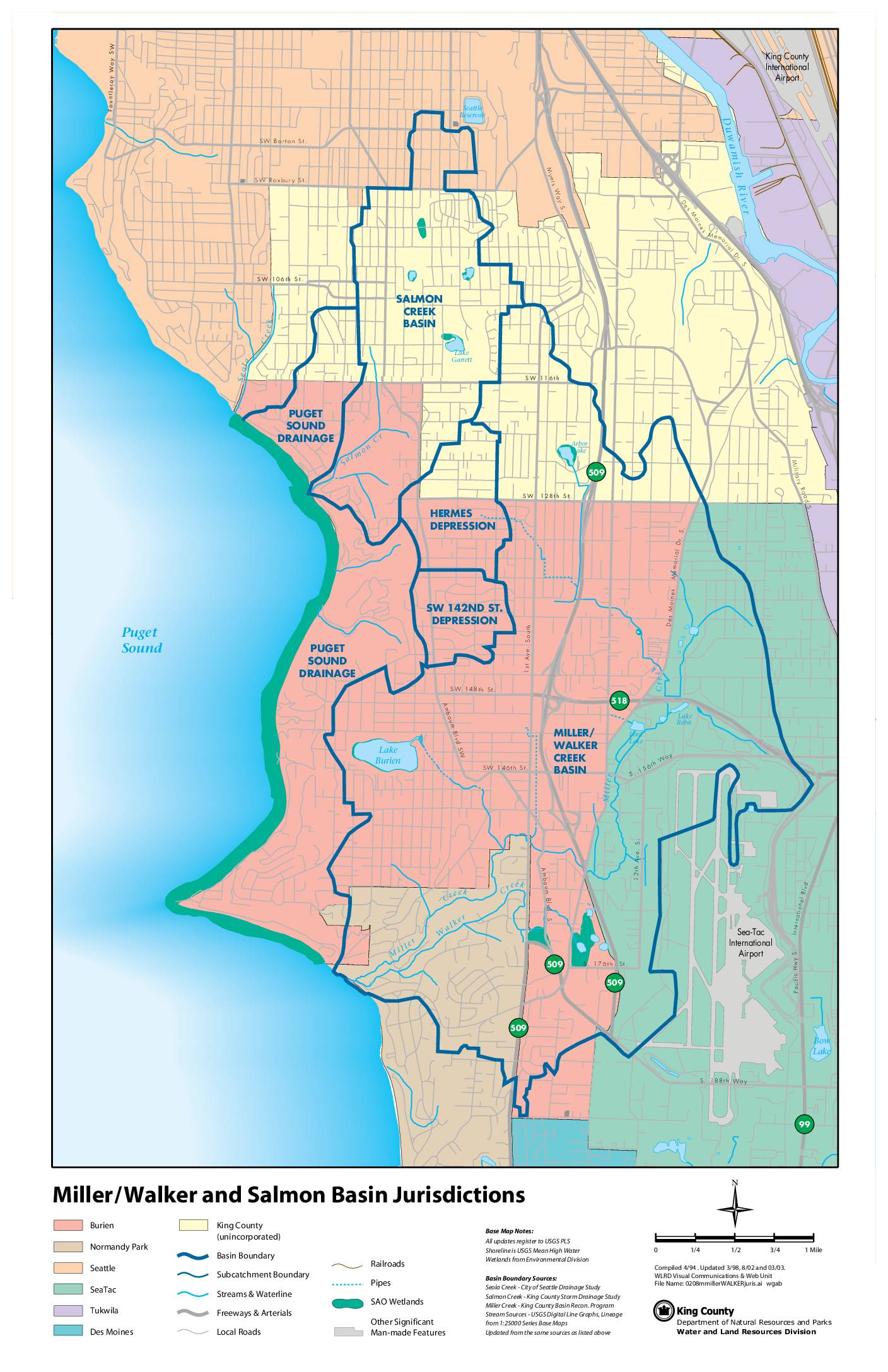
Miller-Walker – Jurisdictional Filing, September 2003
S . 1 8 8 t h W a y Pa ci fi c H w y S . n t e r n a t i n a l B l v d . M y e r s W a y S . D e s M o i n e s M e mor i a l D r. S . D e s M n e s M e m r i a l D r . S . S W 1 4 8 t h S t . M l i t a r y R o a d S . S W R o x b u r y S t . S W B a r t o n S t . A m b a u m B l v d . S S . 1 t h Wa y S . 1 7 6 t h S t . th A v e . S . S W 1 4 6 t h S t . S W 1 1 6 t h S W 1 2 8 t h S t . S W 1 0 6 t h S t . F a u n t l e r o y W a y S W PUGET SOUND DRAINAGE SALMON CREEK BASIN SW 142ND ST. DEPRESSION HERMES DEPRESSION MILLER/ WALKER CREEK BASIN PUGET SOUND DRAINAGE Miller/Walker and Salmon Basin Jurisdictions King County (unincorporated) Basin Boundary Subcatchment Boundary Streams &… -
 2022-09-12 15:32
ST 404b 1
5. Potential Impacts on Physical and Chemical Characteristics of the Aquatic Ecosystem...................................................................................32 (a) Substrate Impacts...........................................................................................32 (b) Suspended Particulates/Turbidity Impacts .....................................................33 (c) Water..............................................................................................................34 (d) Current Patterns and Water Circulation..........................................................35 (e) Normal Water Fluctuations .............................................................................36 (f) Salinity Gradients............................................................................................37 404(b)(1) ii 6. Potential Impacts on Biological Characteristics of the Aquatic Ecosystem .......................................................................................37 (a) Threatened/Endangered Species or Their Habitat .........................................37 (b) Fish and other Aquatic Organisms in the Food Web......................................38 (c) Wildlife............................................................................................................40 7. Potential Impacts on Special Aquatic Sites ......................................................41 (a) Sanctuaries and Refuges ...............................................................................41 (b) Wetlands ........................................................................................................41 (c) Mudflats ..........................................................................................................43 (d) Vegetated Shallows........................................................................................43 (e) Coral Reefs.....................................................................................................43 (f) Riffle and Pool Complexes .............................................................................44 8. Potential Effects on Human Use Characteristics .............................................44 (a) Municipal and Private Water Supplies............................................................44 (b) Recreational and Commercial Fisheries.........................................................47 (c) Water-Related Recreation ..............................................................................49 (d) Aesthetics .......................................................................................................49 (e) Parks, National and Historical Monuments, National Seashores Wilderness Areas, Research Sites, and Similar Preserves ............................50 9. Evaluation and Testing .......................................................................................50 (a) General Evaluation of Fill Materials ................................................................50 (b) Chemical, Biological, and Physical Evaluation and Testing............................51 10. Actions to Minimize Adverse Effects .................................................................51 (a) Actions to avoid or minimize impacts..............................................................51 (b) Actions to compensate for unavoidable impacts to the aquatic environment .................................................................................51 (c) Rationale for off-site mitigation .......................................................................52 (d) Determination of Adequacy of Compensatory Mitigation................................52 11. Compliance with Restrictions on Discharge ....................................................52 (a) Compliance with Pertinent Legislation............................................................52 (b) Potential for Degradation of Waters of the United States...............................53 (c) Measure to Minimize Potential Adverse Impacts on the Aquatic Ecosystems .................................................................................54 12. Factual Determinations.......................................................................................54 (a) Physical Substrate Determinations.................................................................54 (b) Water Circulation, Fluctuation, and Salinity Determinations...........................54 (c) Suspended… -
 2022-09-12 15:32
Tia V 6 4 Spring 2001
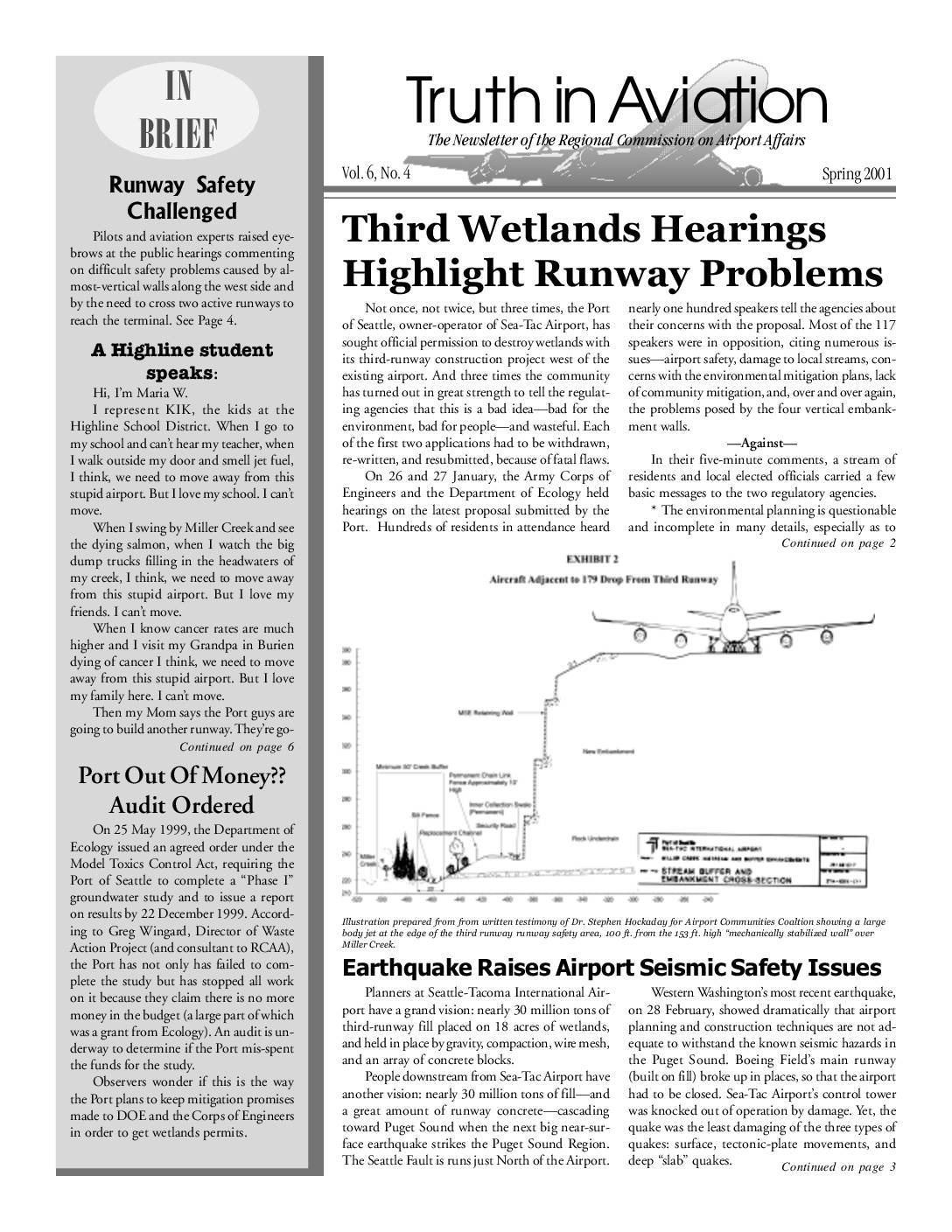
The Newsletter of the Regional Commission on Airport Affairs Vol. 6, No. 4 Spring 2001 IN BRIEF �������� ��� �������� ���� ��� ������������ �� Not once, not twice, but three times, the Port of Seattle, owner-operator of Sea-Tac Airport, has sought official permission to destroy wetlands with its third-runway construction project west of the existing airport. And three times the community has turned out in great strength to tell the regulat- ing agencies that this is a bad idea—bad for the environment, bad for people—and wasteful. Each of the first two applications had to be withdrawn, re-written, and resubmitted, because of fatal flaws. On 26 and 27 January, the Army Corps of Engineers and the Department of Ecology held hearings on the latest proposal submitted by the Port. Hundreds of residents in attendance heard nearly one hundred speakers tell the agencies about their concerns with the proposal. Most of the 117 speakers were in opposition, citing numerous is- sues—airport safety, damage to local streams, con- cerns with the environmental mitigation plans, lack of community mitigation, and, over and over again, the problems posed by the four vertical embank- ment walls. —Against— In their five-minute comments, a stream of residents and local elected officials carried a few basic messages to the two regulatory agencies. * The environmental planning is questionable and incomplete in many details, especially as to ���������� ��� ��� ���� ���� ������� �� ���� �� �������� �� �� �������� ������ ���� ��� ��� ��� ���� ��� �� �������� �…