TagPollution Control Hearings Board(1507)
-
EXH1227049825
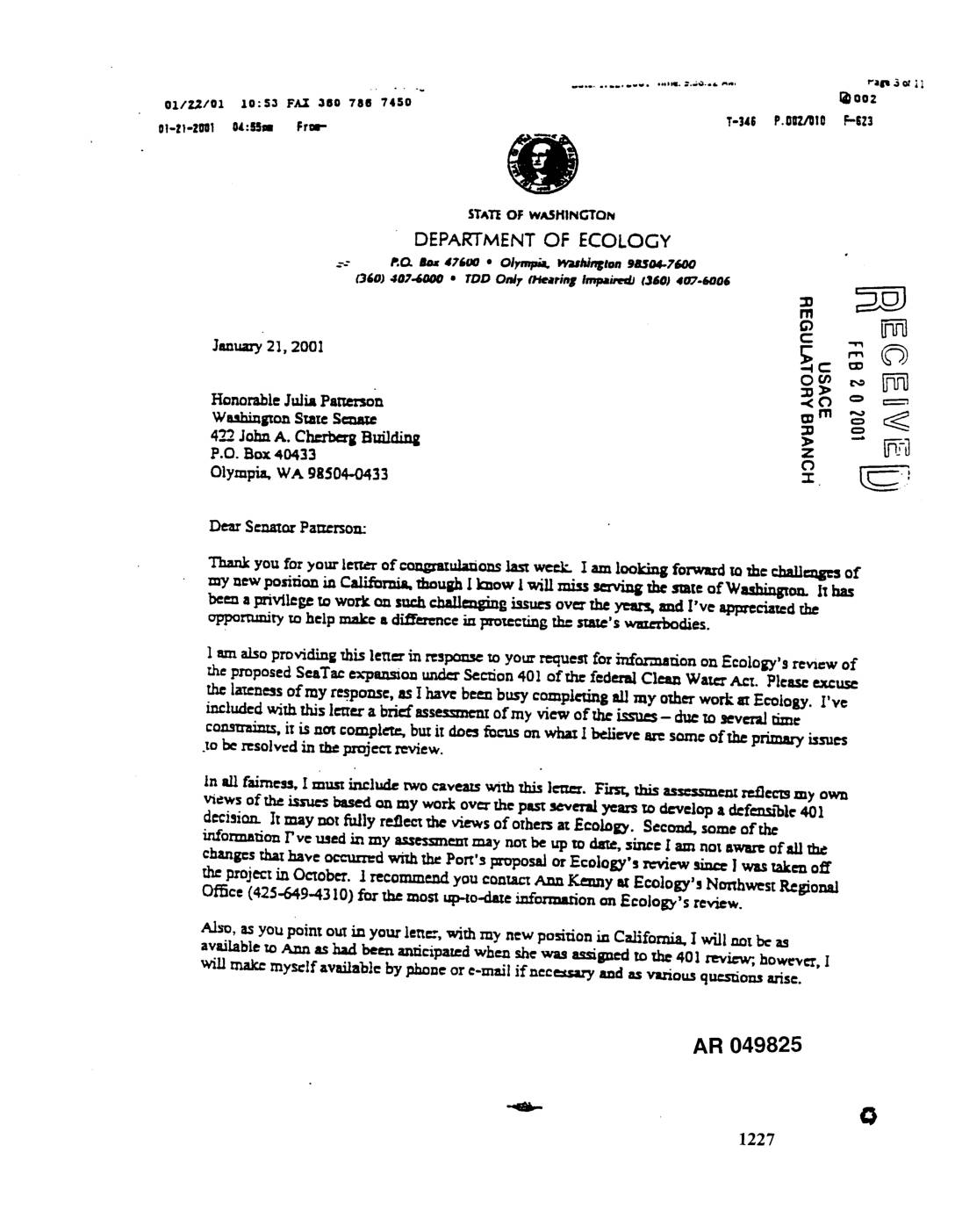
Thankyou for your |euer of cong_,,l:-ons last wec]c I am looking forw_l _ the:baUc:_-s of my _w positionm C_ dum_ I know t will _ servingThestateof W,-h;,,_on. h has beenaFnvll=getowoz_on suchctmUengingissuesoverTheyears,andI'veaRsn:c_d The opporumiry m help make a dLff.ex_ce in pro_ting tim=_,e's wmerbod_es. 1am also providing Thisletter in r=spon_ to your request for _=fmmadon on E¢ology'a rev_=wof the proposed SeaTa= expanmo_ under See'don401of the federalClean WaterAc_. Please excuse the laTenessof my response, as ] havebeen busy compledn$ all my other work e_ Ecolosy. I've included wi_ thislonera briff ass_ ofmy viewoflhcissues-ducm sevcr_time conscci==,i:isnm complete,butitdoesfocusanwhaxIbelievearesomeof_ primaryissues .m beresolvedintheprojectreview. Inallfairness,I mu._includetwocaveatswilhriffslem=.Fh_ ,h;,:us=ssmentre£1eclsmy own v_ews of the ismcs based on my work over the put _evend yearsto develop a defen._'ble401 d_ision, h may um fully reflect_ v'_"wsof othersat Ecok_gy. Second,someofabe infonn_uon rye used in my ardec_nem may nm be up to d_, since I am not awareofaJJt:b¢ changestha_haveocnur_dwithtttePort'spruposalorEcology'sx_viewsinceIwastakenoff l_ojectinOctober.IrecommendyoucontactAnn Kenny atEcology'sNorthwestRegional Office(425-649-43I0)fur_ mostup-m-d_ei_'m'mstiononEcology'sreview. Also, as you point ou_in your leu_, wid_my new position in California, I will not be u available u_ Ann as had been ax_i¢ipamdwhen shewas assiltnedto the401revi=w;,however, I willmake myselfavailableby phoneore-mailifnece=saryandasvariousqtw._onsarise. AR 049825 1227 , . .o 01122101 10:53 FA,,_ 380 788 7460 _003 OI-Z1-ZOOl 04:66m Freer- T-ii48 P.005/010 F-,il25 A4lsh_,th,,,; :youfar >,ourkind wishes.,,,,,__udc you for your mumm in EcoLogy'swork. Tom Lu._r Cc: Ecology: Tom FjT',_mmnne B/II Gordoa White HeU_S Ann K_my AR 049826 Pal_ _ ee,_2 ................................ "-" _ 004 01/22/01 10:S4 FAJ[ 380 786 T450 T-|4! P.064/_10 F-$23 Ot-Zl-ZOOl _:SSN Frof IS_ R.KLATED TO ECOLOGY'S SECTION 401WAT]UR QUA.LrrY CEgI'/FICATION… -
EXH1226049822
_'] Enclosedplease find the Costal Zone Management (CZM) Consistency Statements For Review andApproval Approved as Noted Approved /. Resubmit for Approval Not Approved Other: (see remarks) Very Truly yours, El_beth I_t, Environmental Manager 1226 AR 049822 CERTIFICATION OF CONSISTF_aNCYWITH THR. WASHINGTON STATE COASTAL ZONE MANAGEMENT PROGRAM FOR FEDERALLY LICENSED OR PERMITIT, D ACTIVITIES Federal Project Number: 96-4-02325 Appfieant: Port of Seattle Project Description: Construct ¢ Chirdrunwcw and other improvements ¢t ,,_eattle-Ta¢omalntcrn_at_ip__-l Ai _rvort.includin_ filline wetlands and relocatin_ a portion of a creek. See U.S. Army Corps of Eneineers" Public Notice of Apvl!ca_ffonfor Permit datea_ (attachsite plans, location (county�city), and proximity to waterbody (name)) This action under CZMA §307(c)0) is for a project that will take place within Washington's coastal zone or which will affect a landuse, water use, or naturalresource of the coastal zone. (The coastalzone includes all parts of Clallam, Grays Harbor, Island, Jefferson, King, Kitsap, Mason, Pac_ic, Pierce, San Juan, Skagit, Snohomish, Thurston, Wahklalcumand Whatcom counties.) The project complies with the following enforceable policies of the Coastal Zone Management Progrmn: 1. Shoreline Management Act (SMA): Is outside of SMA jurisdiction (x) (at airport) Applied for shoreline l_,..it ( )#. being reviewed by Has a valid shoreline per'wit ( )# issued by on Has received an SMA Exemption .(x)#Exenmtion letter issued by City of Auburnon 8/9/00 (at Auburn mitigation site) 2. State Water Quality Requirements: Does not require water qualitypermits ( ) Applied for water quality certification (x) Has received water quality certification ( )# issued on Applied for… -
EXH1219049771
TO: Ralph Wessels, Port of Seattle _o_to, FROM: Reese P. HasthnSsand Michael J.Bailey, P.E.,Hart Crowser, Inc. RE: Third Runway Project, Borrow Areas 1, 3, and 4 Projected Impacts to Wetlands (revised) c.,_o_ J-4978-62 CC: Marti Louther and JamesC. Kelley, Ph.D., Parametrix, Inc. J. Thomson, P.E., HNTB Derive, On-Site Borrow Activities f alrbanks This memorandum quantifies the potential impacts to wetland resources resulting from development of Borrow Areas 1, 3, and 4, and an on-sitehaul route for use in the construction of the Third Runway embankment. Completion of the Third Runway embankment will require about 17 million cubic yards of compacted earth fill Use of borrow sitesowned by the Port of Seattle (Port) to provide this material will significantly ....... c,_) reduce air quality and local traffic impacts associated with haulage from off-site sources. The Final Environmental Impact Statement (FEIS) (prepared for Sea-Tac International Airport's Proposed Master Plan update development actions) discussed development of Ju_ea_ construction fill material borrow areas from eight identified sourceswithin property controlled by the Port. Based on several factors (wetlands impacts, material types, operational costs) the FinalSupplemental Environmental Impact Statement (FSEIS)indicated that four of these eight on-site resource areas could likely be used to extract a maximum quantity of 15.45 million cubic yards of fill material. Further study by the Port has focused _,-,_-Be_ch on the Borrow Areas designated 1, 3, and 4, which are proposed to provide a combined total of 6.7 million cubic yards. Figure 1 - Site Location Map shows the location of Borrow… -
EXH1218049659
Analysis of Areas with Potential Foundation Instability 3 Recommended Subgrade Improvements 4 Other Construction Recommendations 5 Work in Progress 5 Organization of This Report 5 GEOTECHNICAL OVERVIEW OF SUBSURFACE CONDITIONS 6 Areas Addressed in this Report 6 Existing Information 6 Subgrade Improvement Needed for Specific Soil Conditions to Provide Stability 7 Occurrence of Problematic Subgrade Conditions Impacting Slope Stability 7 GEOTECHNICAL RECOMMENDATIONS FOR CONSTRUCTION 12 Embankment Site Preparation 12 Subgrade Improvement 15 Embankment Underdrain 16 Embankment Fill 17 Slope Face Treatment 17 USE OF THIS REPORT 18 REFERENCES 20 TABLES SoilGradationsfor EmbankmentFillMaterialGroups 22 Water Level Data 23 Hart Crowser -sDa'e iJ-4978-28 AR 049660 CONTENTS (Continued) PaRe FIGURES VicinityMap SiteandExplorationPlan,EmbankmentSlopeBetweenNSA and West MSEWalls SiteandExplorationPlan,EmbankmentSlopeBetweenWest and SouthMSEWalls Siteand ExplorationPlan,Phase4 Fill RecommendedPhase4 SubgradeImprovementArea APPENDIX A SLOPE STABILITY AND DEFORMATION ANALYSES A-1 Introduction A-1 Limit Equilibrium Slope Stability Analyses A-1 Additional Special Explorations A-6 Statistical Analysis of Liquefaction A-6 Deformation Analysis for Discontinuous Liquefaction Conditions A-9 FIGURE A-1 Illustrationof ProbabilisticBasedLiquefaction9% Probabilityof Liquefaction TABLES A-1 LimitEquilibriumAnalyses A-1 A-2 Summaryof Input Soil Parameters A-4 A-3 GeneralizedSummaryof LimitEquilibriumResults A-5 A-4 Resultsof LiquefactionAnalysisfor DifferentEarthquakeEvents A-7 A-5 SoilPropertiesUsedin the Displacement-Based(FLAC)Model at Station 193+19 A-IO A-6 DisplacementsCalculatedfor the 175-YearSeismicEvent(9% liquefaction) A-11 A-7 DisplacementsCalculatedfor the 475-YearSeismicEvent (33% liquefaction) A.11 A-8 DisplacementsCalculatedUsingthe CompositeStrengthMethod A-12 A-9 DisplacementsCalculatedUsingthe ProbabilisticStrengthMethod A-13 Hart Crowser rt_Oa-e iiJ-4978-28 AR 049661 CONTENTS (Continued) Paee APPENDIX B STABILITY ANALYSES CROSS SECTIONS FIGURES B-1 2H:IV EmbankmentSectionUsedfor StabilityAnalyses,Section 170+23 B-2 2H:1V EmbankmentSectionUsed for StabilityAnalyses,Section187+60 B-3 2H:IV EmbankmentSectionUsedfor StabilityAnalyses,Section193+19 13-4 2H:IV EmbankmentSectionUsedfor StabilityAnalyses,Section206+44 B-5 2H:1V EmbankmentSectionUsedfor StabilityAnalyses,Section210+00 B-6 2H:1V EmbankmentSectionUsedfor StabilityAnalyses,Section212+50 APPENDIX C… -
EXH1217049528
_ .... A Comparison of Pacific Groundwater and Hart Crowser Fill Modeling Approaches ii_.. B Estimates of Miller Creek Streamflow Effects as Predicted with Slice Model C Estimates of Historic Water Withdrawal in Miller Creek Buyout Area D HSPF Model Input and Results for Low Streamflow Conditions Port of Seanle i Seattle-Tacoma Airport Master Plan Update _' Low Streamflow Analys_ __" ,_42e 1601 _rREAMFLOW ANALYSIS.DOC AR 049530 LIST of TABLES Page Table ]: Recorded Average Flows August and September ............................................................ 1 Table2:HSPF Model StrcamflowinAugustandSeptemberfor1994LandUse Conditions......2 Table3:Seven-DayLow Flows(cfs)PerHSPF Model of1994Land UseConditions.................3 Table4:HSPF ModelStreamflowinAugustandSeptemberFor2006Land Use Conditions......3 Tablc5:Seven-DayLow Flows(cfs)PerHSPF Modelof2006LandUse Conditions.................3 Table6:EstimatesofMillerCreekStrcamflowEffectsfromFillInfiltrationDischarge_.............8 Table7:EstimatesofWalkerCreekStrcamflowEffectsfromFillInfiltrationDischargem...........9 Table8:Non-HydrologicChangesInSummer Streamflow(PGG Report)...................................9 Table9:MillerCreekReservedStormwaterReleaseRateDetermination...................................19 Tablel0:Des MoinesCreekReservedStormwaterReleaseRateDeterminationt......................19 Table11:Summary ofMillerCreekStreamflowEffects_............................................................26 Table12:Summary ofWalkerCreekStrearnflowEffectst..........................................................27 StrcamflowEffects...................................................28Table 13: Summary of Des Moines Creek LIST of FIGURES Page Figure 1: Annual Plow Duration Curves for A One-Foot-Wide Half Section of Runway and Adjoining Filter Strip ............................................................................................................ 12 Figure 2: Annual Flow Duration Curves for A One-Foot-Wide Section of Taxiway and Adjoining Filter Strip ............................................................................................................ 13 Figure 3: Annual Flow Duration Curves for A One-Foot-Wide Section of Connecting Taxiway and Adjoining Filter Strip ..................................................................................................... 14 Figure 4: Predicted Infiltration, PET and Total Recharge on Runway Filter Strip ...................... 16 Figure 5: Predicted Infiltration, PET and Total Recharge on Taxiway Filter Strip ...................... 17 Figure 6: Predicted Infiltration, PET and Total Recharge On Connecting Taxiway Filter Strip. 18 Figure 7: 7-Day Low Flow Occurrences in Miller Creek, 1949-1995 .......................................... 21 Figure 8: 7-Day Low Flow Occurrences in Des Moines Creek, 1949-1995 ................................ 23 Po_ ofSeattle i i Seattle-Tacoma Jirport… -
EXH1081040519
Volume I - Main Text and Appendices A through C-I r- This statement is submittedfor reviewpumuant to the requirementsof Section I02(2XC) of the National Environmental PolicyAct of 1969 (42 U.S.C. 4321 at seq); F_O. 11990, Protectionof Wetlands; E.O. 11998, FloodplainManagement; 49 USC Subtitle VII; 42 U.S.C. 7401 st mKl; Departmentof TransportationAct Section 4(f) - 49 USC 303 (c); 49 U.S.C. 47101 at seq;Washington State EnvironmentalPolicyAct (RCW 43.21C); and other applicablelaws. This Suppl_mmtol Environmental Impact Statement (SEIS) is a combined National Environmental Policy Act and Washington State Environmental Policy Act (SEPA) document. With regard to SEPA requirements,this SupplementalEIS _enfa the " third step of a phased environmental reWew which began with publicationof the 1992 Flight Plan Final EIS, which assessed altematives for addressingregional aviation needs, end the issuance of the Final EIS for the Master Plan Update. This Final Supplemental EIS also contains • final conformity analysis, as required by the Clean Air Act amendments. The Portof Seattle, operatorof SeatUe-Tacoma InternationalAirport, has prepareda Master Plan Update for the AirporL The Plan shows the need to addressthe poor weather operatingcapabilityof the Airport through the development of an 8,500 foot long third parallel runway (Runway 16X/34X), separated by 2,500 feet from e0dstingRunway 16L/34R, with associated_ys and navigationalaids. Other needs include:extensionof Runway 34R by 600 feet; establishmentof standard Runway SafetyAreas for Runways16R/L; developmentof • new air traffic co,,b-o;tower;,developmentof • new north unit terminal, Main Terminal improvements end terminal expansion; perking and access improvements and expansion; developmentof the Sou_ Aviation Support Area for cargo and/or… -
EXH1105041701
FROM: Jamie Beaver and Allen Jones,Hart Crowser, Inc. RE: BasePreparation Stability Analysis (PhaseII) J-4978-01 CC: Pete Douglass, Peter M. Douglass, Inc. This memo presents the results of our search for soil strength parameters we intend to use in our stability analyses.This memo is focusedtowards evaluating stability of the PhaseII embankment from a subgrade preparation standpoint. Stability analysesfor design of the Phase11and III embankments will be performed under separate scopes of work. Approach to Soil Strength Assignments Assessment We will be analyzing the stability of the Phase II embankment using the program UTEXAS3to provide base preparation recommendations. Our approach to assigning soil strengths will be to use relationships that have been established for soil strength in the geotechnical literature, while considering previous projects at similar sites in the Seattle area as a general guide (Attachment 1). The relationships presented on Figures1 and 2 are strength parameters that have been correlated with standard penetration resistance (SPT)N-values in the literature, and will be used to establish the baseline values for the stability analysis. In general, friction angleswill be assignedto cohesionless soils (sands,sandygravel, etc.). Both shearstrengths and cohesion/friction angle values will be used for both plastic and non-plastic silt/clays. We will use shear strength (undrained) based on SPTN.value to assignthe initial strengths to the fine-grained soil units or embankment fill zones. Friction angle and cohesion will also be used, primarily to test the sensitivity of the model to the strengths of the fine-grained soil units. Our _'L r_j_ Hart Crowser, Inc. J-4978-01 August 13,… -
EXH1019035118
This document is the Port's response to questions raised by agencies andthe public during the comment periods for the Public Notice. The document is organized into two main sections. The first addresses six general questions/concerns that were raised by several commenters. The following summarizes those concerns and the Port's responses. 1. Has the Port followed the required process regarding wetland impacts and mitigation? The sequencing outlined in the EPA/COE MOA has been followed. Impacts have been avoided and minimized wherepossible.Compensatorymitigationis proposedfor impactsthatcannotbeavoided. 2. Is there justification to replace some wetland functions in another watershed? The majority of wetland functions arebeing replaced in the impacted watersheds. The Port has proposed new in-basin mitigation in its Medified Mitigation Approach datedMay 1998. The off-site mitigation wetland in Auburn is proposed to compensate for impacts to wildlife habitat. FAA guidance and the Port's need to maintaina safe environment for aircraftoperations precludes it from being able to create and maintain wetland habitat near the Airport. 3. Is there a need for the proposed development in the area known m the South Aviation Support Area(SASA)? SASA is needed at Sea-Tac Airport to provide space for displaced line maintenance facilities and to accommodate an existing and growing need for cargo facilities. In response to agency concerns, the SASA preliminary design has been reevaluatedand it appears that impacts to 1.04 acres of wetlands can be avoided through the use of bridges and retaining walls. 4. Can the wetlands in the on-site borrow source areas be avoided? Impacts to… -
EXH2189034767
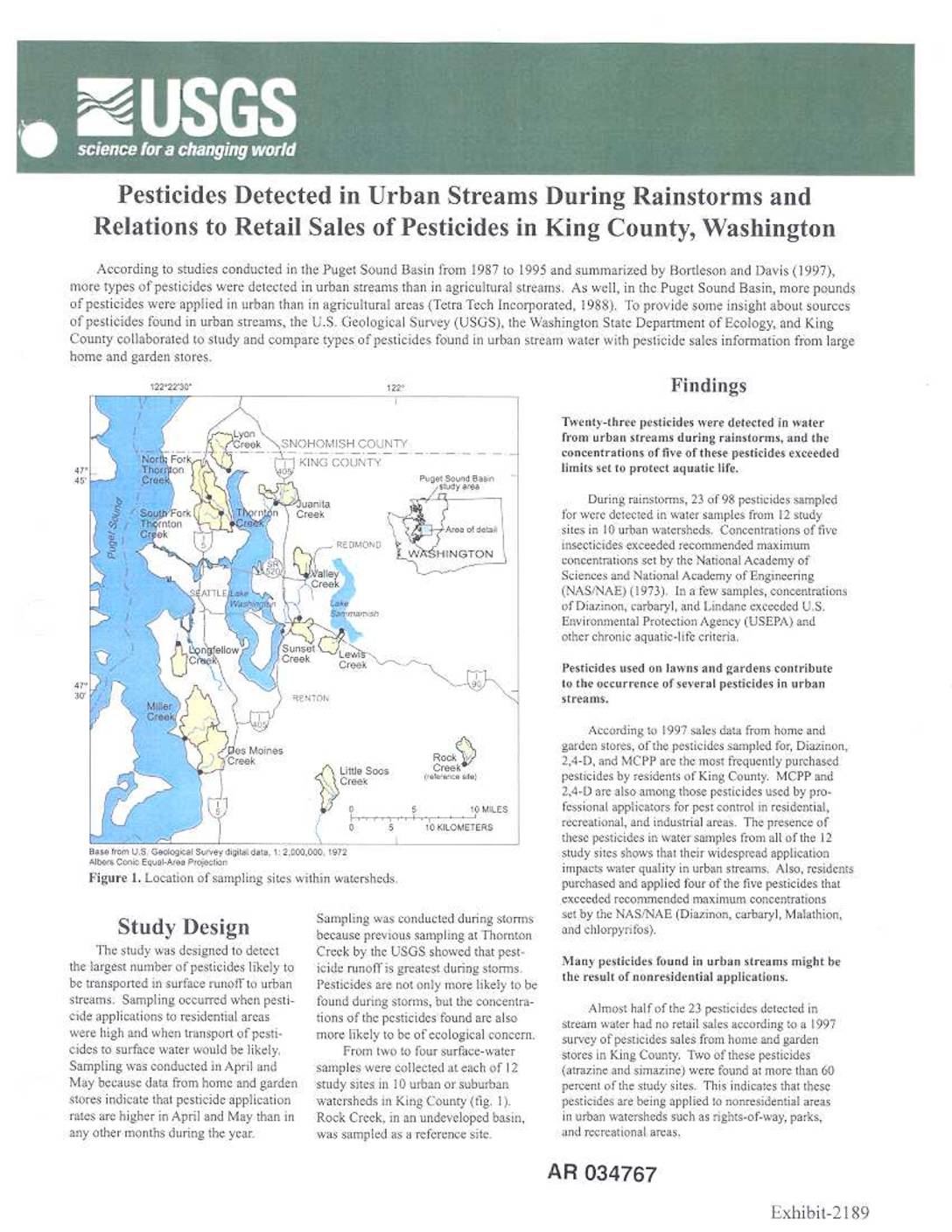
Data Availability and _on, S.J., Capel, P.D., and Majewski, Norris, L., and Dust, F., 1991, Proposed t--- - M.S., 1996, Pesticides in surface waters-- surface water quality criteria for selected Additional Analysis distribution, trends, and governing factors: pesticides used for forest management and Chelsea, Mich., Ann Arbor Press, Pesticides management of forest tree seedling and Data on the concentrations of pesticides in Hydrologic System series, v. 3,373 p. christmas tree plantations in Oregon and found in streams sampled during this study Washington (draft): Corvallis, Oregon, and a complete list of target pesticides can Market Trends Incorporated, 1996, 1996 Oregon State University, 39 p. be obtained from the Puget Sound Basin King County household hazardous waste NAWQA web site at survey report: Bellevue, Wash., prepared for State of Washington, 1992, Water quality http://wa.water.usgs.gov/ps.nawqa.html. King County Local Hazardous Waste standards for surface waters in the State of Additional analysis of the spatial distribution Management Program, 74 p. Washington: Olympia, Wash., chap. 173- of pesticides in urban watersheds and factors 201 WAC, 14 p. contributing to pesticide transport will be Menconi, M., and Cox, C., 1994, Hazard published in a future report by the Puget assessment of the insecticide diazinon to Tetra Tech Incorporated, 1988, Pesticides of Sound Basin NAWQA team. aquatic organisms in the Sacramento-San concern in the Puget Sound Basin-a review Joaquin River System: California Depart- of contemporary pesticide usage: Seattle, ment offish and Game, Environmental Wash., prepared for U.S. Environmental References Services Division, Administrative Report Protection Agency, Region 10, contract… -
EXH2131034044
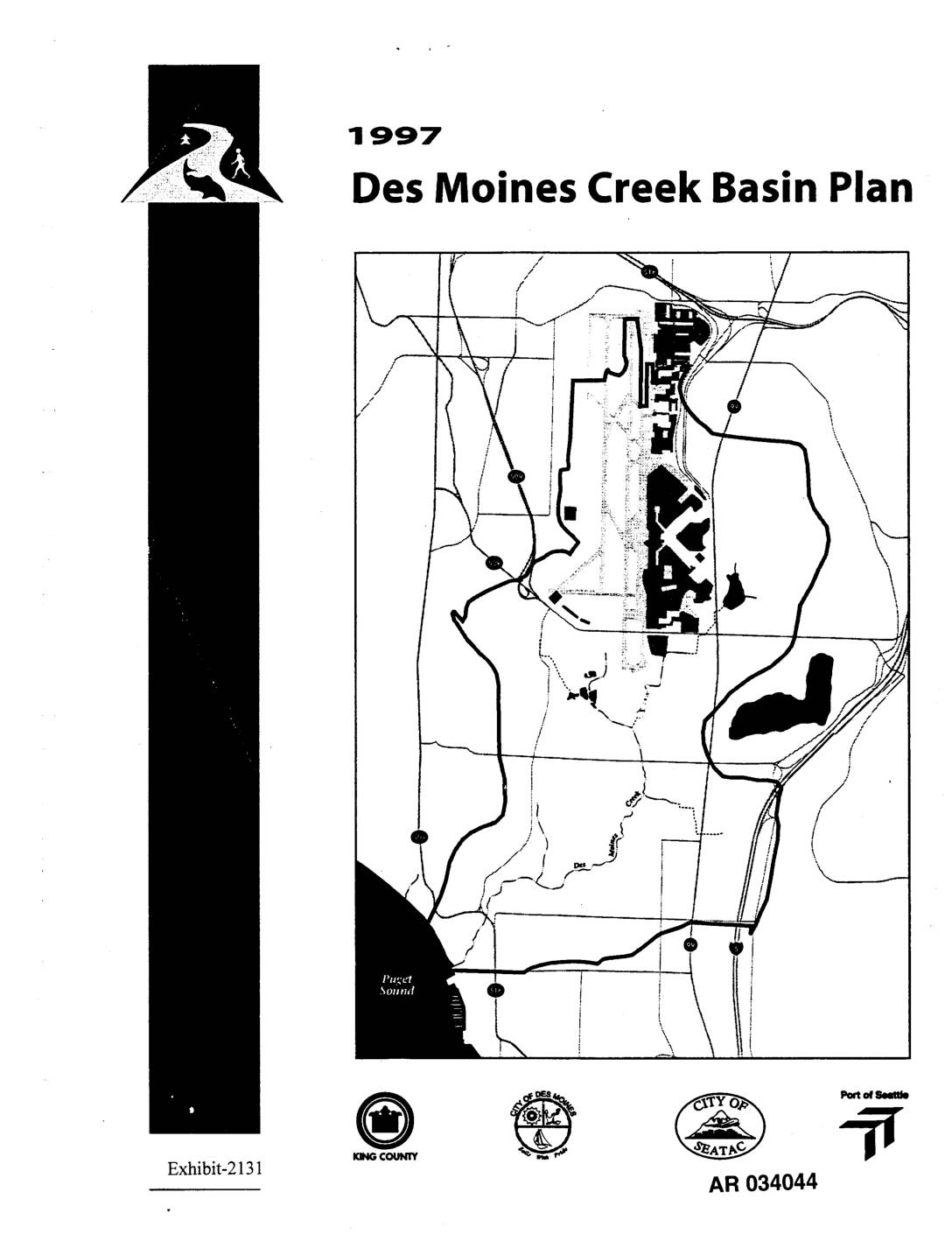
King County Department of Natural Resources, Water and Land Resources Division: David Masters, M.U.1LP. - Project Management, Land Use Planning David Hartley, Ph.D., P.E. - Hydrology, Modeling Alan Johnson, M.S. - Fisheries, Stream Ecology Aquatic Resources Consultants Clint Loper, P.E. - Engineering Derek Booth, Ph.D. - Geology Susan Kaufman-Una, M.S. - Water Quality Kenneth Ludwa, M.S. - Water Quality, Field Sampling Katie Morrill - Editing, Report Preparation Wendy Gable - Graphics PROJECT MANAGEMENT TEAM: Don Monaghan - City of SeaTac Tim Heydon - City of Des Moines Loren Reinhold - City of Des Moincs Tom Hubbard, - Port of Seattle Gary Minton - Port of Seattle COOPERATING AGENCIES: Ken Kase - Midway Sewer District Roy Moore - Tyee Golf Course ADDITIONAL SUPPORT: Phil Sehnieder - Washington Department of Fish and Wildlife Rod Maleom - Mucldeshoot Indian Tribe AR 034046 - Des Moines Creek Basin Plan EXECUTIVE SUMMARY Background: The Des Moines Creek Basin Plan is the result of a cooperative, consensus- building effort initially undertaken by the Cities of SeaTac and Des Moines, and the Port of Seattle. Early discussions among the parties generated agreement that a basin plan for Des Moines Creek would assist in guiding infrastructure investments and in addressing the growing number of cross-boundary stream-related issues. These parties also agreed that the cooperative efforts would be better for the stream, improveopportunitiesfor acquiring grants, and less expensive than if each of the jurisdictions performed stream work independently. The Cities and the Port then requested that the King County…