Seattle Times staff reporter
Seattle-Tacoma International Airport’s new security checkpoint opened Friday, but travelers can be forgiven for wondering where, exactly, it is.
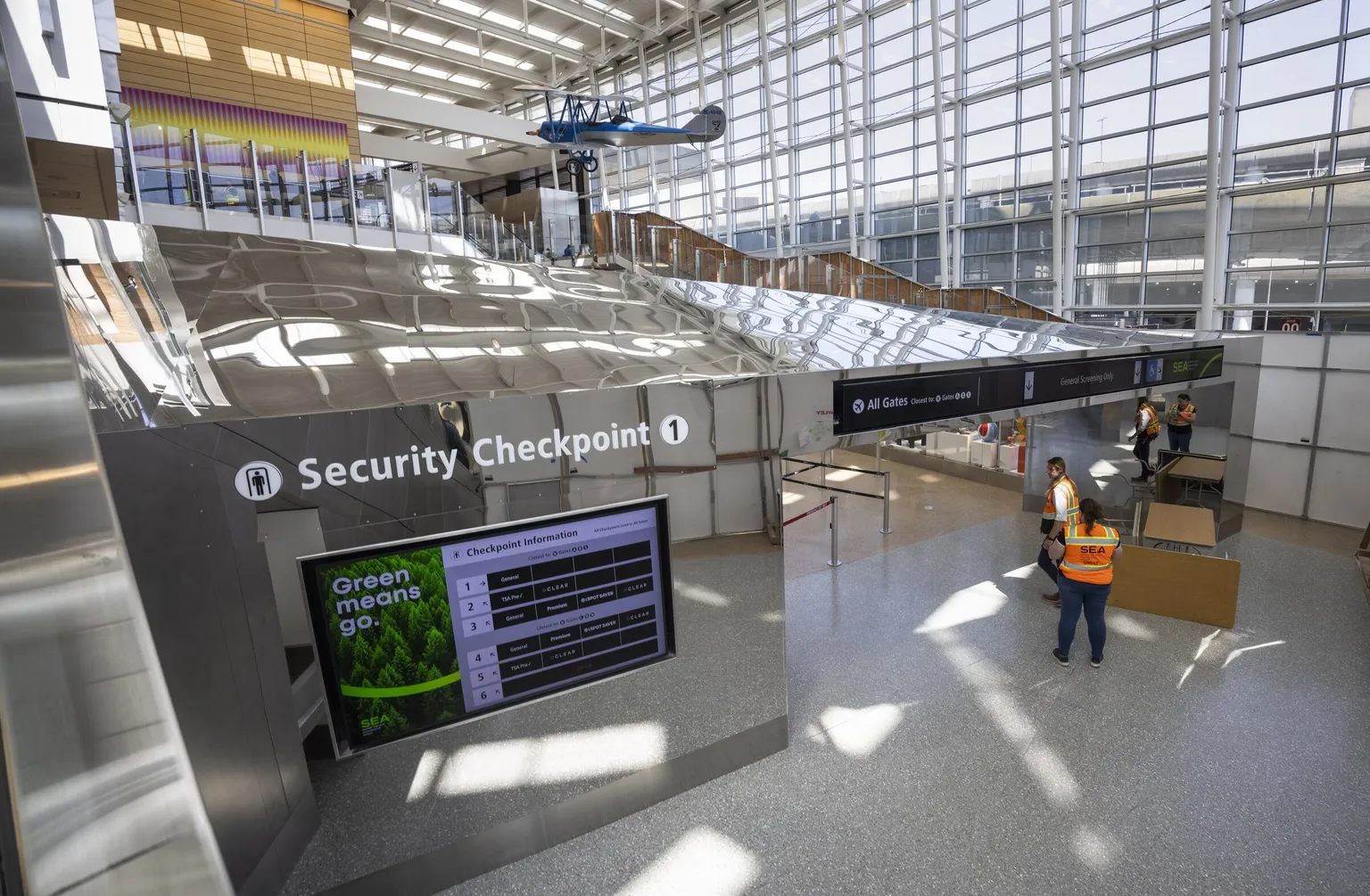
In short, the new Checkpoint 1 is downstairs on the baggage claim level, below a hanging replica of a historic aircraft, the Rutan Voyager, the first to fly around the world without stopping or refueling, and a 1920s-era biplane, the Alexander Eaglerock.
The old Checkpoint 1, directly upstairs with all the other checkpoints, is now the new Checkpoint 2, a renumbering that extends down the line to Checkpoint 6, the former Checkpoint 5.
Seattle-Tacoma International Airport opened a new security checkpoint, Checkpoint 1, at the south end of the airport Friday morning. (Ellen M. Banner / The Seattle Times)
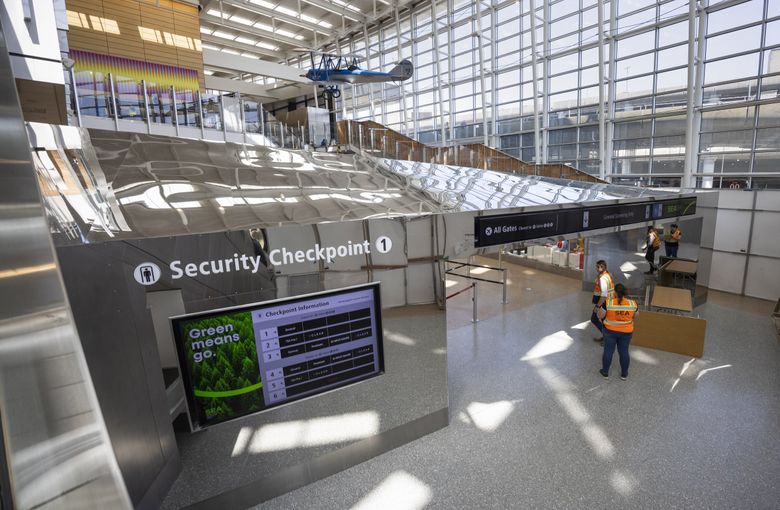
Seattle-Tacoma International Airport opened a new security checkpoint, Checkpoint 1, at the south end of the airport Friday morning. (Ellen M. Banner / The Seattle Times)
Port of Seattle officials say the expanded security capacity, with five new lanes, will help all travelers because — to echo the ancient Roman saying — all security checkpoints lead to all gates.
The new, unspoiled checkpoint is easy to find, but once you’re through, the airport can become a confusing warren for many wayfarers, thanks in part to the seemingly endless construction but also because of the airport’s relatively small footprint and growing number of passengers.
Security checkpoints at Seattle-Tacoma International Airport
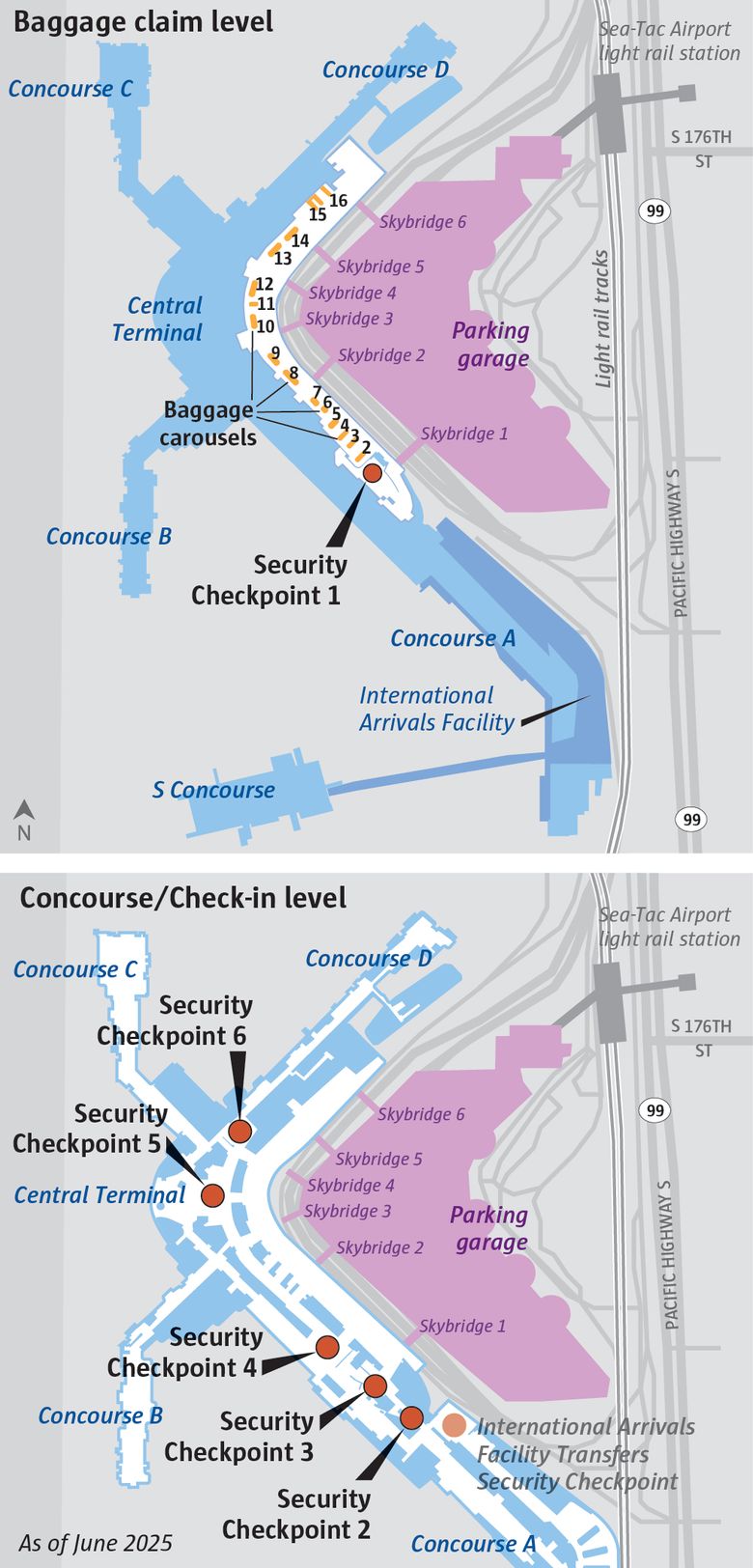
Sources: Esri, Port of Seattle (Mark Nowlin / The Seattle Times)
Cindy Maki, the airport’s manager of signage and wayfinding, used the most apt metaphor to describe work in recent years to update the airport, even while it sees record growth.
“We’ve been building a plane as we’ve been flying it,” Maki said.
For her, that means helping hordes of harried travelers find their way through a nearly 80-year-old airport with no space to grow, considering it’s surrounded by homes, highways and more.
Two lanes at the checkpoint at the north end of Seattle-Tacoma International Airport, which used to be Checkpoint 5 and now is renamed Checkpoint 6, will be open in August. The rest of the lanes will be opened by Thanksgiving of this year. (Ellen M. Banner / The Seattle Times)
Two lanes at the checkpoint at the north end of Seattle-Tacoma International Airport, which used to be Checkpoint 5 and now is renamed Checkpoint 6, will be open in August. The rest of the lanes will be… (Ellen M. Banner / The Seattle Times)More
Help comes in the form of new digital signs letting people know the wait time at each security checkpoint and arrows on the floor to help guide people through notorious pinch points. Maki has been thinking hard on what wordage is better: rideshare, ride app, or Uber/Lyft?
Maki characterized her work as a “process of breadcrumbs making sure you’re getting the right knowledge at the right time.”
Maki cut her teeth at Amazon, where she did similar work at the Seattle-based tech behemoth’s corporate campuses around the world. She came to the airport because she wanted something “I could wrap my arms around.”
She might’ve thought that, at 2,500 acres, the airport presented a simple problem. At that size, Sea-Tac is dwarfed by Denver International Airport’s 33,500 acres, the largest in the U.S.
As the nation’s third-busiest airport, Denver saw 82.4 million passengers in 2024. Seattle set its own record in 2024, with 52.6 million passengers. A better comparison is Florida’s Orlando International Airport, which last year saw a similar number of passengers flow through a space that is five times bigger.
“Having a smaller airport makes us really conscious on how we utilize space,” said Heather Karch, who works alongside Maki as the airport’s aviation facilities and infrastructure architecture manager.
The tight quarters have only been made tighter as construction has continued.
New signage at Seattle-Tacoma International Airport is in black and white because it is easier for passengers to see and read. The old, colorful signage will eventually be replaced. (Ellen M. Banner / The Seattle Times)
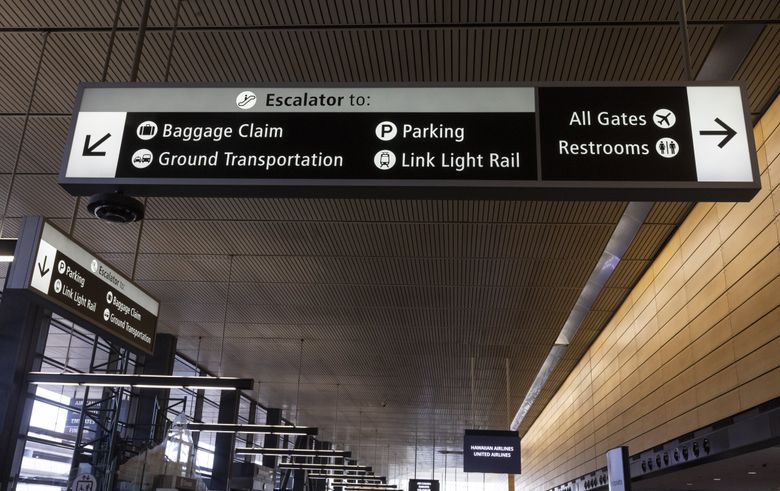
New signage at Seattle-Tacoma International Airport is in black and white because it is easier for passengers to see and read. The old, colorful signage will eventually be replaced. (Ellen M. Banner / The Seattle Times)
Over the past year and a half, travelers have been confronted with 120 projects at the airport, according to Perry Cooper, the Port’s spokesperson.
That includes a $1 billion International Arrivals Facility that opened in 2022; a $546 million reconfiguration of the north end ticketing area led by the airport’s biggest customer, Alaska Airlines; a $21.8 million renovation of the Central Terminal; and a $13.5 million cellphone parking lot, among others.
A recent five-year capital plan envisioned spending $1 billion a year more on airport projects, with a particular emphasis on finishing as much as possible before the world’s soccer fans descend on the region for next year’s FIFA World Cup.
Sabin Mudaliar, assistant director of terminal operations, said he meets each week with contractors to make sure he knows what’s happening, where it’s happening and how to help travelers navigate, and then gets those details to Maki.
With that information in hand, Maki and her crew of seven become something of a rapid response team. “We pump out temporary signs quickly during construction,” she said.
Not all of those temporary signs are created equally, at least in the eyes of Karch, who has been at the airport for eight years.
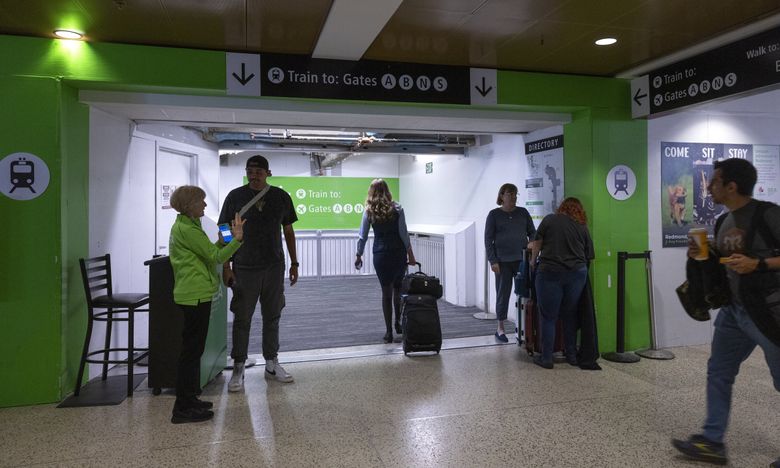
Standing at one of the stations for the SEA Underground — the intra-airport subway that shuttles people already past security between gates — Karch points to the arrows on the ground meant to tell people where to get on and off the train to avoid congestion.
Arrows at train station stops at Seattle-Tacoma International Airport have been taped to the floor so passengers know to stand to the side to give others departing the train a clear path. (Ellen M. Banner / The Seattle Times)
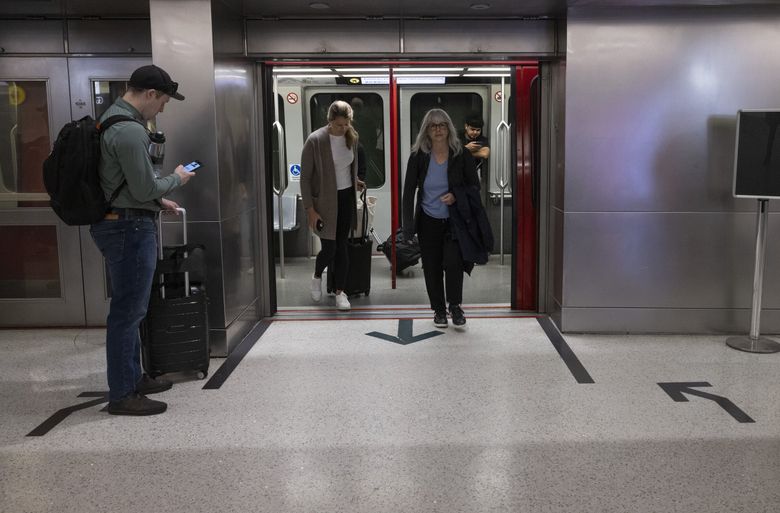
Arrows at train station stops at Seattle-Tacoma International Airport have been taped to the floor so passengers know to stand to the side to give others departing the train a clear path. (Ellen M. Banner / The Seattle Times)
It’s a bad idea to put signs on the floor in a part of the airport that easily gets crowded, she said. All those bodies block the floor signage.
But after noticing that people were literally running into each other getting on and off the trains, Karch agreed to put down some arrows. It led to a 40% reduction in people running into each other.
“We are very data-centric,” Karch said. “We’re not just pulling things out of the blue.”
Moments after a surprisingly deep dive on arrows on the ground, Maki had her own signage angst.
Near the trains, temporary signs alerted people that an elevator was closed — due to construction, of course. Maki looked perturbed. Four yellow signs were scattered slipshod around a big green one, all saying the same thing. She had put up the green one. The federal Transportation Security Agency came by later and put up the others.
Too many signs makes no one read them, Maki said, fighting the urge to tear the yellow signs down.
But also, people just don’t read signs at all sometimes. Despite all the signage and wayfinding, people still get lost. The top question?
“Where’s the bathroom?” Mudaliar said without missing a beat.
“Where’s the light rail?” Maki quickly followed. “Or the parking garage?”
Which, obviously, there are signs for.
Nicholas Deshais: 206-464-2932 or ndeshais@seattletimes.com. Nicholas Deshais covers transportation for The Seattle Times.