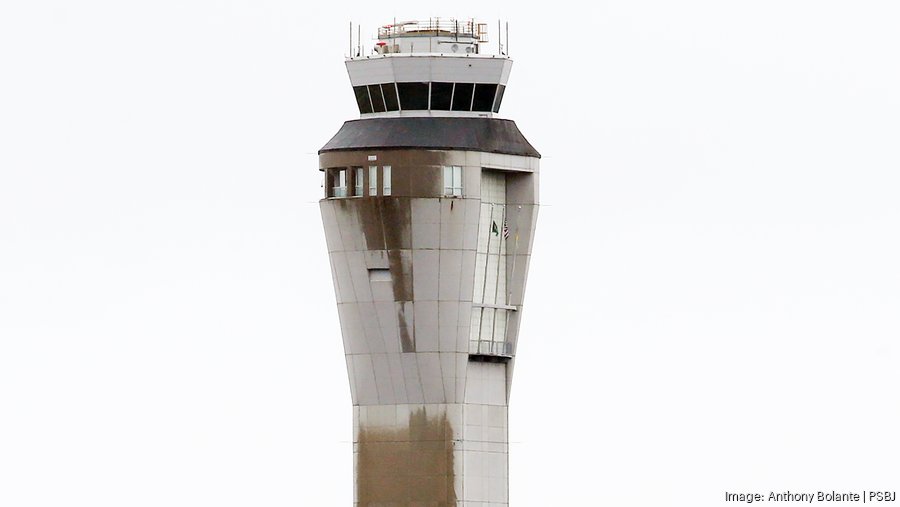
Sea-Tac Airport’s air traffic control tower, pictured in 2021. Air traffic controllers have gone weeks without pay amid the government shutdown. Anthony Bolante | PSBJ
By Nick Pasion and Lauren Ohnesorge – Puget Sound Business Journal
Story Highlights
- FAA begins cutting flights at 40 airports amid government shutdown.
- Seattle-Tacoma Airport faces 10% reduction affecting 267 daily flights.
- Air traffic controllers continue working without pay during shutdown.
The Federal Aviation Administration will begin cutting flights at Seattle-Tacoma International Airport on Friday if the government shutdown continues.
The move is part of the agency’s effort to reduce capacity at 40 of the nation’s “high traffic” airports. The FAA is seeking to alleviate pressure on the airports as the record-breaking shutdown enters its 36th day.
At Sea-Tac, a 10% reduction could result in 3,228 canceled flights in November and December, according to data compiled by the Business Journals. Approximately 267 flights would be affected daily.
It was not immediately clear which routes or services would be impacted at Sea-Tac, where there are about 1,030 to 1,400 aircraft operations per week, according to data from the Port of Seattle, which operates the airport.
A spokesperson for Alaska Airlines, the largest carrier at Sea-Tac, said Wednesday the airline is “staying close to the FAA and awaiting further guidance.”
“More information will be shared as it becomes available, and we continue to call for an end to the government shutdown,” the spokesperson wrote in an emailed statement.
On Thursday the FAA released a list of airports that would be impacted, including those in Seattle, Portland, Boston, New York, Los Angeles and Chicago. The New York Times reported the cuts would start at 4% of flights on Friday, ramping up to 10% by next week.
Chris Guizlo, a spokesperson for the Port of Seattle, said in a email Wednesday that “operations wise in general — we still continue to see little to no impact.” He did not immediately return a request for comment Thursday after new details about the planned reductions were reported.
The cuts would have significant effects across the industry — including at airports that aren’t on the final list of 40.
United Airlines Inc. CEO Scott Kirby said in a statement that its long-haul international flying and hub-to-hub flying won’t be affected.
He said the airline will focus on regional flying and domestic mainline flights that do not travel between hubs.
“That’s important to maintain the integrity of our network, give impacted customers as many options as possible to resume their trip, and sustain our crew pairing systems,” Kirby said.
He said the airline plans to make rolling updates to its schedule so it can give customers several advance days of notice.
A spokesperson for Southwest Airlines said in an email the airline is evaluating how the planned flight reductions will affect its schedule and that it will “communicate directly with customers as soon as possible.”
“Nothing is more important to Southwest than the safety of our customers and employees,” the spokesperson continued. “We continue to urge Congress to immediately resolve its impasse and restore the National Airspace System to its full capacity.”
American Airlines said it was also awaiting more information from the FAA. A spokesperson said “we expect the vast majority of our customers’ travel will be unaffected.”
“As schedule changes are made, we will proactively reach out to customers who are impacted,” the spokesperson said.
Other airlines did not immediately respond to requests for comment.
Amid the shutdown, air traffic controllers and Transportation Security Administration employees continue to work without pay.
Dan McCabe, Southern Regional vice president for the National Air Traffic Controllers Association, last week said that every controller has “a story.”
“You don’t know what somebody’s situation is, and that leads to the mystery of, where is someone’s breaking point?” he said.